
Slinkdsco Industrial-Grade 4×4 MIMO
4.7Editor score
Omnidirectional 4×4 MIMO
698-6000MHz frequency range
9dBi stated gain
Five-meter mounting cable
This guide compares the best 4x4 Mimo External Antenna for 4G and 5G products across MIMO support, gain, frequency bands, mounting options, and compatibility.
A 4×4 MIMO external antenna can improve cellular reception for compatible 4G and 5G routers, gateways, hotspots, and fixed wireless internet equipment. The right model depends on carrier bands, antenna gain, directional or omnidirectional coverage, connector type, cable quality, mounting location, and whether the device exposes four suitable antenna ports.
We compared all ten products by examining their stated MIMO configuration, supported frequency range, gain, radiation pattern, included cables and adapters, mounting hardware, weather resistance, and device compatibility. The guide covers both compact omnidirectional antennas and higher-gain directional panels, with options for homes, RVs, travel, and outdoor installations.
Each review identifies the antenna most suitable for a particular use case and explains practical limitations, including connector requirements, aiming needs, and installation considerations. Product ratings and availability can change over time, and prices fluctuate, so readers should verify current product details before making a purchase.
4.7Editor score
4.4Editor score
3.9Editor score
The table below compares the ten antennas by antenna type, supported frequency range, stated gain, and installation package. Pay particular attention to connector compatibility and whether your router needs a true four-port MIMO antenna.


The Slinkdsco Low-Profile Omni is a compact 4×4 MIMO antenna intended for cellular routers, gateways, mobile hotspots, RVs, and home internet setups. Its stated 3.2 rating is the second-lowest among the products reviewed, so the antenna should not be chosen on reputation alone. Its main appeal lies in the low-profile form, broad 698-6000MHz range, and straightforward omnidirectional operation.
We may earn a commission when you buy through this link, at no additional cost to you.
The antenna is described as supporting major carriers including Verizon, AT&T, and T-Mobile, which makes it a broadly relevant option for common 4G LTE and 5G networks. Four-element MIMO operation allows a compatible four-port router to work with multiple antenna paths rather than treating the antenna as a simple single-channel receiver. The stated 5dBi gain is modest, but the low-profile shape and omnidirectional pattern can make placement easier in apartments, vehicles, and other confined settings.
The main compromise is the included three-meter RG174 cable. RG174 is a relatively lightweight coaxial cable, and long runs can introduce more loss than heavier alternatives. The fixed wall-mount design also means the installer has less freedom than with a panel antenna supplied with a long, low-loss cable. The product description calls it rain resistant, but clear indoor placement is the simplest installation and is likely to provide the most consistent result.
This antenna makes sense for a buyer who values a small, unobtrusive unit, broad carrier support, and easy omnidirectional setup more than maximum gain. It is a sensible choice for a nearby cell tower, moderate signal, and short cable runs. Buyers in weak-signal locations should consider a lower-loss cable or a directional model with a proper installation kit.
The low-profile enclosure and wall-mount format are useful when the antenna must sit near a window, inside an RV, or on a discreet exterior surface. Because it receives signals in every direction, it does not need the repeated aiming process required by a directional panel.
The supplied RG174 lead is easy to route and keeps the installation compact, but it is not the preferred choice for long outdoor runs. A shorter route and an unobstructed position can preserve more of the antenna's available performance.
We may earn a commission when you buy through this link, at no additional cost to you.
The Waveform QuadMini is a complete 4×4 MIMO kit designed to improve cellular service for routers with four antenna ports. It carries a 4.1 rating and stands out for its installation package, low-profile omnidirectional housing, and support for several mounting methods. The product is particularly useful when a buyer wants one coordinated kit rather than assembling an antenna, cables, adapters, and mounting accessories separately.
We may earn a commission when you buy through this link, at no additional cost to you.
Waveform states that the QuadMini offers up to 5.2dBi gain and emphasizes MIMO isolation and polarization alongside conventional signal strength. That focus is technically relevant because a cellular router may not achieve its best performance if all four MIMO paths are not connected correctly. The kit includes a window entry cable, UltraFlex-Quad cables, weatherproofing boots, and mounting accessories. Suction cups, a pole adapter, a desktop stand, and direct wall mounting provide multiple ways to position the antenna.
The QuadMini is omnidirectional, so it does not need to be aimed directly at a tower. That makes it well suited to users who do not know where the nearest cell site is or who move between locations. Its tradeoff is that an omnidirectional antenna spreads energy across a broad area rather than concentrating it toward a specific tower. A directional panel may therefore outperform it in a location with weak but clearly identifiable cellular coverage.
Buyers should choose the QuadMini when straightforward placement, a full accessory kit, and professional installation guidance matter. It is particularly attractive for homes, temporary installations, and compatible routers with four external antenna connections. Users seeking the highest gain from a known tower direction should compare the higher-gain directional options in this guide.
The included window entry cable, Quad cables, weatherproofing boots, and mounting hardware reduce the need to source separate pieces. The instructions and support access can also help buyers avoid common installation mistakes involving cable routing or MIMO connections.
With no need to aim the antenna, users can compare locations by signal quality and retain broad horizontal reception. This makes the kit practical for renters, travelers, and anyone whose cellular tower direction is uncertain.
We may earn a commission when you buy through this link, at no additional cost to you.
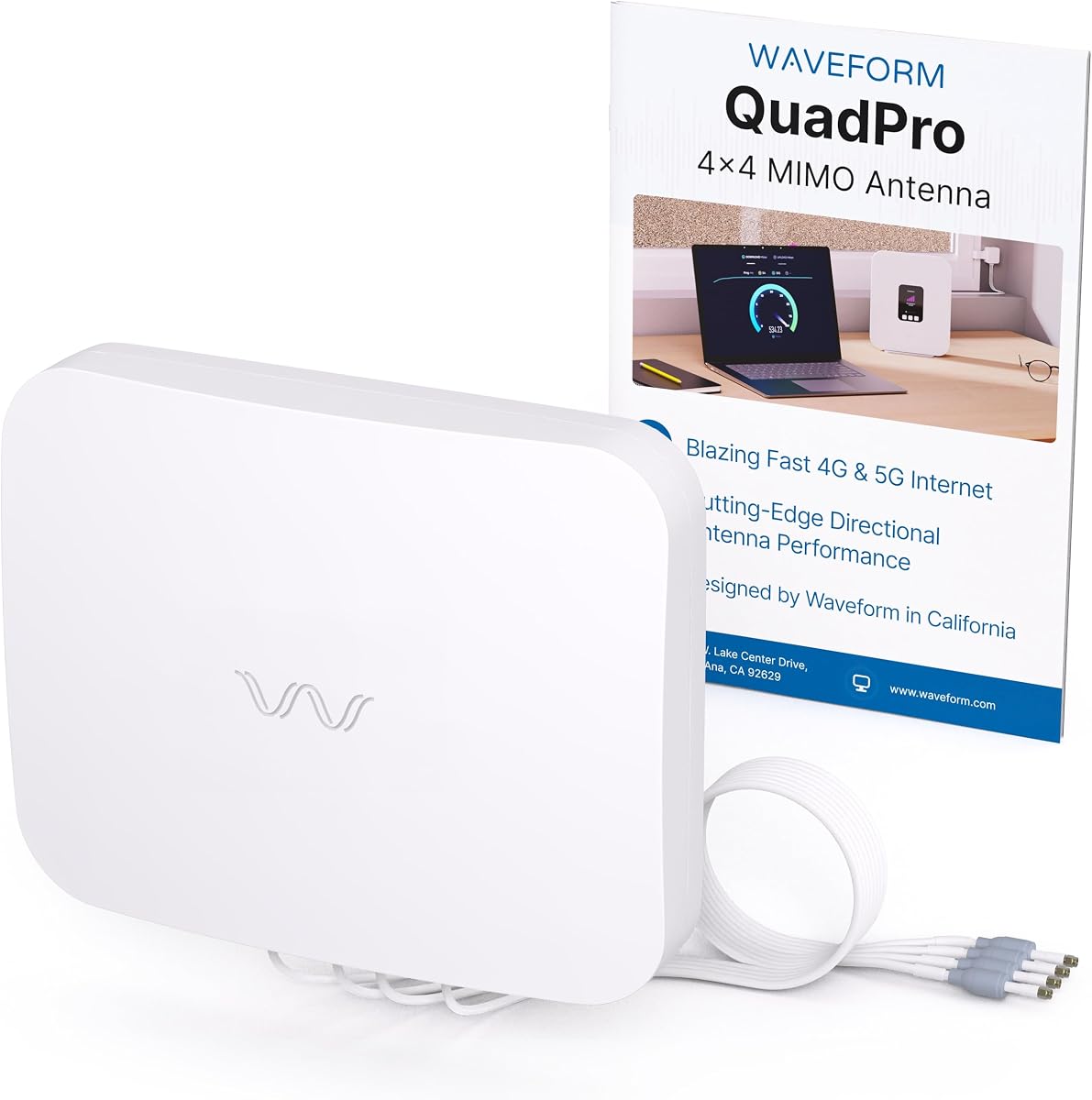
The Waveform QuadPro is a directional 4×4 MIMO panel antenna with a 4.4 rating, the highest-rated model in this ten-product guide. It supports up to 9.1dBi gain across 600-6000MHz and is designed for 4G and 5G routers, modems, and gateways. Its combination of substantial directional gain, broad band coverage, and a thoughtfully packaged installation system makes it the strongest all-around recommendation here.
We may earn a commission when you buy through this link, at no additional cost to you.
The supplied package includes a window entry cable, FlexMount, UltraFlex-Quad cable, weatherproofing boots, SMA and U.FL adapters, and a detailed installation guide. This approach can be especially valuable for fixed wireless internet users who want to place the panel near a better signal without drilling a permanent hole through a wall. The product description also provides specific guidance for T-Mobile Home Internet gateways, Verizon 5G Home Internet, and AT&T Internet Air.
Unlike the QuadMini, the QuadPro requires aiming toward the nearest tower. Directional antennas can concentrate signal and outperform compact omnidirectional units when mounted correctly, especially at the edge of coverage. However, pointing toward the wrong tower or placing the panel behind an obstruction can reduce the benefit. The included system and installation guide are important parts of the product rather than optional accessories.
The QuadPro is a strong recommendation for a fixed location where the user can identify a tower, use a window-mounted installation, and connect all four MIMO paths to a compatible router. It is less suitable for a moving vehicle or an installation where precise aiming is impossible. For those situations, an omnidirectional model is more forgiving.
Up to 9.1dBi of directional gain can provide a meaningful advantage over a compact omni when the panel faces the correct tower. The gain figure is a maximum, so real performance depends on tower direction, nearby obstructions, cable quality, and the router's supported antenna interface.
The window entry cable and FlexMount provide a practical route for renters and homeowners who want an exterior or near-window panel position. The user can test placement with less commitment than a permanently drilled installation would require.
We may earn a commission when you buy through this link, at no additional cost to you.
This Dual-Cable Omni Antenna has a 5.0 customer rating and provides 4×4 MIMO reception over a stated 600-6000MHz range. Its two dual ten-meter cables give users substantial freedom to place the antenna away from the router, while the omnidirectional pattern avoids the need to identify and aim toward a tower. It is designed for 4G and 5G routers, gateways, and compatible home internet equipment.
We may earn a commission when you buy through this link, at no additional cost to you.
The product supports major U.S. carriers, including AT&T, Verizon, T-Mobile, and US or Canadian cellular networks, and cites common bands such as n66, n41, n77, n2, n5, and n71. Its stated gain reaches 7dBi, placing it above the smaller low-profile models while remaining less directional than the premium panels. Because the antenna uses external ports, the router must expose compatible antenna connections for all four MIMO paths to operate as intended.
The connector arrangement deserves careful attention. The package includes a ten-meter cable with an SMA male interface, which can connect directly to an SMA female device port. Devices with a different interface will need a suitable adapter. Long runs also magnify the importance of cable quality, so installers should avoid unnecessary slack, sharp bends, and cable runs that pass through heavily obstructive materials.
This antenna is a compelling choice for users who want an outdoor or elevated omnidirectional position but do not want to aim a panel. It works especially well when the router is indoors and the antenna can be mounted near a window, on a wall, or in a suitable outdoor location. Buyers should confirm connector type and available router ports before ordering.
The extended cable runs allow the antenna to move away from a router's immediate surroundings, where walls and furniture may degrade cellular reception. A higher or more open position can be more valuable than a slightly higher gain figure in a poorly placed system.
A four-element antenna can only deliver its intended benefit when the connected equipment supports four cellular paths. Check the router documentation for external antenna mode, the required connector type, and the correct mapping of all four cables.
We may earn a commission when you buy through this link, at no additional cost to you.
The Wide-Band Omni 4×4 is a straightforward external antenna for compatible 4G LTE and 5G routers, gateways, and hotspots. Its stated 2.9 rating is the lowest in the group, which is an important consideration for a signal accessory whose performance can depend heavily on installation. The antenna's appeal comes from its broad 600-6000MHz range, 6dBi stated gain, and straightforward omnidirectional design.
We may earn a commission when you buy through this link, at no additional cost to you.
The product supports major carriers, including Verizon, AT&T, and T-Mobile, and its four-element MIMO configuration is intended to improve compatible 4G and 5G connections. A 6dBi gain figure offers more theoretical gain than the 5dBi Slinkdsco low-profile model, although gain alone does not determine the final result. Placement, cable loss, carrier congestion, and the router's antenna interface remain equally important.
The included three-meter KSR100 cable helps avoid the signal loss associated with very lightweight coaxial types, but it is still shorter than the ten-meter runs offered by some competitors. The listing emphasizes a cable-optimized design and a tidy installation. Detailed mounting hardware and weather-resistance claims are less prominent than in several complete-kit products, so buyers should consider their own bracket, adhesive, or wall-mounting solution.
This antenna is most appropriate for a user with moderate reception who needs a broad-band omni without directional adjustment. It may be less compelling when customer feedback consistency, a complete accessory bundle, or long placement flexibility are the top priorities. Confirming connector fit and using an open installation position will help maximize the available result.
The 600-6000MHz specification covers a wide collection of cellular frequencies used by 4G and 5G services. This makes the antenna a general-purpose option when the carrier and exact high-band allocations are not fully certain.
An omnidirectional antenna should be placed where it has a broad, unobstructed view of the surrounding sky. Even a good gain specification cannot compensate fully for a location blocked by thick walls, metal, or dense building materials.
We may earn a commission when you buy through this link, at no additional cost to you.
The High-Gain Outdoor Panel combines a 5.0 customer rating with up to 10dBi of stated gain, making it the highest-gain antenna listed. It is built for 4G and 5G routers, modems, hotspots, and gateways, including fixed wireless home internet equipment. Its directional panel design is intended for installations where the user can identify and point the antenna toward a cellular tower.
We may earn a commission when you buy through this link, at no additional cost to you.
The complete package contains one panel antenna, a mounting pole, four 32-foot low-loss cables with N male to SMA male connectors, and four TS9 adapters. Four separate paths support true 4×4 MIMO use, while the adapters broaden compatibility with different cellular equipment. The stated 600-6000MHz range covers 4G and 5G frequencies used by AT&T, Verizon, T-Mobile, US Cellular, and numerous international carriers.
The long cable set gives an installer considerable freedom to place the panel outdoors while keeping the router inside. However, it also makes cable management important. Long runs should be protected from sharp bends, abrasion, moisture, and unnecessary splices. As a directional antenna, the panel needs a clear view of the intended tower and may perform poorly if aimed into another coverage sector.
This product is best for a fixed home, business, or remote installation with weak outdoor signal and room to install a pole-mounted panel. It is less convenient for temporary setups, travel, or users who cannot determine tower direction. Its gain and complete hardware package make it a strong choice for maximizing a correctly positioned installation.
The panel's stated 10dBi maximum gain provides more potential directional concentration than the 6- or 7dBi omnidirectional alternatives. That difference can be useful at the edge of coverage when the antenna has the correct orientation and a mostly unobstructed path to the tower.
Four long cables allow the router to remain indoors while the panel is mounted outside. Labeling each cable, avoiding tight bends, and providing strain relief and weather protection at entry points will help preserve signal quality and installation reliability.
We may earn a commission when you buy through this link, at no additional cost to you.
The Maswell Cubic-4C is a rugged omnidirectional 4×4 MIMO antenna with a 5.0 customer rating. It supports 600-8000MHz, giving it one of the broadest frequency ranges in the guide, and provides up to 6dBi gain. Its IP67-rated, UV-stabilized ASA housing is designed for outdoor homes, RV use, and varied environmental conditions.
We may earn a commission when you buy through this link, at no additional cost to you.
The antenna uses cross-polarized dipole technology and is described as suitable for cellular, WiFi 6E, and WiFi 7 applications. The package includes a two-meter professional cable with four SMA male connections and TS9 adapters. Maswell provides specific guidance to enable external antenna mode after connection, warns against inferior RG58 or RG174 cable, and recommends LMR240-equivalent cable or better with a total length no greater than five meters.
The IP67 enclosure and included hardware make the Cubic-4C a compelling choice for an RV, exterior wall, pole, or exposed residential installation. Its compact form also allows several mounting options, including wall and pole arrangements. The two-meter lead is shorter than the ten- and 32-foot options in this guide, so it is more appropriate when the router is nearby or when a separate higher-quality cable run is planned.
The Cubic-4C suits buyers who want rugged construction and broad future-facing frequency support without directional aiming. Its 6dBi gain is moderate, so it is less suited to maximizing a very weak signal than a panel with a 9-10dBi maximum. It is a balanced, durable option for moderate-to-good coverage and outdoor travel applications.
The UV-resistant ASA housing and dual IP67 dust and water protection rating make the antenna better suited to long-term outdoor exposure than a basic indoor-style model. Screws, brackets, and multiple mounting choices support both temporary and more permanent arrangements.
Extending to 8000MHz provides useful headroom for high cellular bands and newer WiFi standards. Actual performance still depends on the connected equipment, the carrier's deployed frequencies, and whether the router supports the antenna's full multi-element configuration.
We may earn a commission when you buy through this link, at no additional cost to you.
The Slinkdsco Screw-Mount Omni combines a 4.7 customer rating with a stated 9dBi gain, making it the most compelling budget-oriented option in this guide. It provides 4×4 MIMO operation across 698-6000MHz and is marketed for cellular routers, gateways, hotspots, RV use, and home internet systems.
We may earn a commission when you buy through this link, at no additional cost to you.
Its key feature is the combination of a relatively compact omnidirectional housing and a five-meter, 16.4-foot mounting cable. This gives a user more freedom than the shorter three-meter models while avoiding the need to aim a directional panel. The screw-mount design is straightforward, the 50-ohm impedance matches conventional cellular equipment, and the stated carrier support includes Verizon, AT&T, and T-Mobile.
The product description identifies the housing as rain resistant but does not provide the same detailed IP certification found on the Maswell options. The fixed lead also means the mounting position must be chosen with router reach in mind. A four-port external antenna interface is still needed to take full advantage of the advertised 4×4 MIMO configuration, and the router may need external antenna mode enabled.
The product is a strong recommendation for a buyer who wants meaningful stated gain, simple omnidirectional reception, and straightforward installation without paying for a complete directional kit. It is particularly suitable for RV users, indoor window placements, and moderate-to-weak signal areas where a compact antenna can be mounted above or outside the router's immediate surroundings.
The stated 9dBi gain is unusually high for a compact omnidirectional model in this group. It gives the antenna more potential than the 5-6dBi alternatives while retaining the convenience of receiving signals in every horizontal direction.
The screw-mount format is useful for attaching the antenna to a suitable surface without a complex bracket system. Buyers should still allow enough clearance around the housing and avoid placing it directly against metal or conductive materials.
We may earn a commission when you buy through this link, at no additional cost to you.
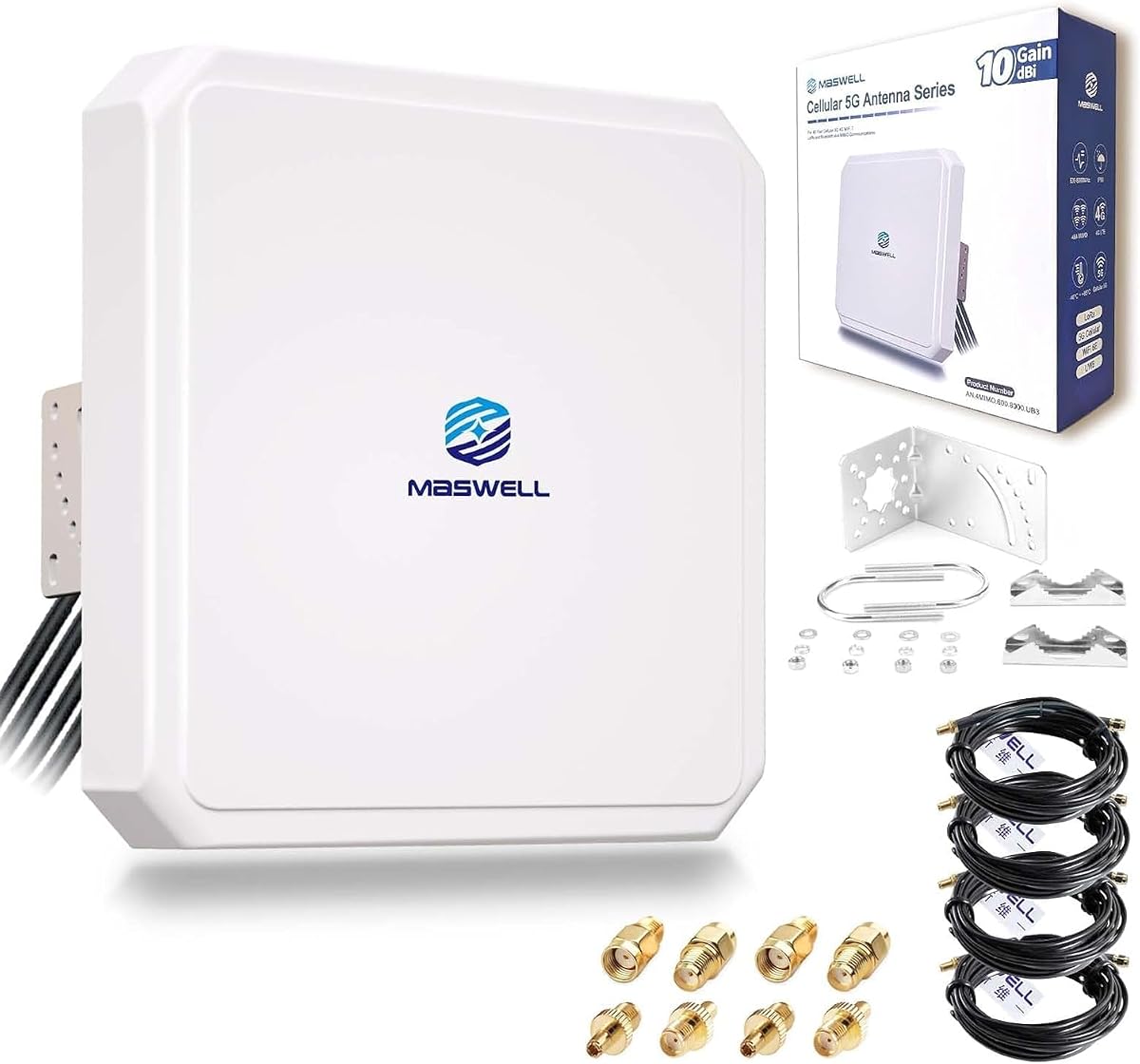
The Maswell 4MIMO_Ultra is a premium directional 4×4 MIMO panel kit with a 3.9 customer rating. It offers up to 10dBi maximum gain, a broad 600-8000MHz range, and a complete set of installation components. The package combines the antenna, mounting hardware, four low-loss cables, and several adapter formats for broad device compatibility.
We may earn a commission when you buy through this link, at no additional cost to you.
Four six-and-a-half-foot LMR240-equivalent cables connect the panel to a compatible four-port cellular device. SMA male, TS9, and RP-SMA adapters broaden the range of supported equipment. The stated frequency range covers cellular networks as well as WiFi 6E and WiFi 7, while the 60-80-degree directional beamwidth concentrates energy toward a general tower direction without requiring the extremely narrow focus of a small dish antenna.
The panel weighs 4.4 pounds and uses a UV-resistant ASA housing with a dual-certified IP66 dust and water protection rating. Maswell includes heavy-duty brackets and screws and provides professional technical support. These are meaningful benefits for an exposed installation, although the stated 3.9 rating is lower than that of several competing products and should be considered in the overall decision.
The 4MIMO_Ultra is a strong premium choice for a fixed home or business with a known tower direction and a compatible four-port router. Its broad bandwidth, professional cables, adapters, and durable mounting hardware create a well-rounded package. Users who need easy omnidirectional placement or who will not aim the panel should choose a smaller omni antenna instead.
The four low-loss cables, bracket set, screws, and three interface options reduce compatibility risk and make the kit more convenient than assembling a panel separately. Its complete-package approach is especially useful for a first serious outdoor MIMO installation.
The UV-resistant ASA housing and IP66 protection support outdoor use through heat, rain, and snow. The heavier construction adds stability, which can be valuable when a panel is mounted on a pole or exterior bracket in windy conditions.
We may earn a commission when you buy through this link, at no additional cost to you.
The Long-Cable Omni Antenna is a 4×4 MIMO exterior antenna designed for routers, gateways, and home internet equipment. It provides a stated 7dBi gain across 600-6000MHz and uses an omnidirectional pattern, allowing the antenna to receive cellular signals without directional adjustment. No customer rating is available for this listing, which makes the published specifications and installation details especially important when evaluating it.
We may earn a commission when you buy through this link, at no additional cost to you.
The kit includes one antenna, two dual ten-meter cables with SMA male connectors, and a mounting bracket. Two dual cable assemblies provide the four connections required for a 4×4 MIMO arrangement. The extended leads allow the antenna to be installed outdoors or in a better position while the router remains inside, which is valuable for users dealing with walls, floors, or other obstructions.
The listing specifically advises that the device should have an SMA female connector for direct connection. Other equipment may require a suitable adapter. As with all long cable runs, the actual benefit depends on cable quality and routing. Avoid tight bends, pinching, and lengthy sections through metal or dense building materials. The bracket also needs a stable attachment point and enough clearance around the antenna.
This antenna is most appropriate for users who know their device uses SMA female ports and need more installation distance than a short-lead omni provides. Its 7dBi gain and long cables make it a capable general-purpose option, but the lack of customer feedback means buyers should confirm fit, connector orientation, and router support before ordering.
The ten-meter leads make it possible to position the antenna outside a problematic room while leaving cellular equipment in a convenient location. This separation can be especially helpful in homes where one wall or floor heavily attenuates the cellular signal.
A long cable introduces loss, so a shorter route is preferable when it provides an equally clear signal. Confirm that the router's SMA female ports accept the supplied connectors and that external antenna mode is available in its settings.
We may earn a commission when you buy through this link, at no additional cost to you.
Choosing a 4×4 MIMO antenna involves balancing antenna pattern, gain, frequency support, cable loss, connector compatibility, and installation constraints. Use the following factors to narrow the list before comparing the final products.
A 4×4 MIMO antenna uses four distinct signal paths, and the connected router must support four external cellular antenna connections. Connecting only one or two leads may allow basic reception, but it will not provide the full MIMO capability described by the product. Review the router manual for external antenna mode, the supported connector type, and the recommended way to map the four cables.
Choose only when your modem, gateway, or hotspot has a genuine four-port 4×4 MIMO interface.
Omnidirectional antennas receive signals from all horizontal directions and are convenient for travel, RVs, and locations where tower direction is unknown. Directional panels concentrate energy toward one area and usually offer greater potential gain, making them better for fixed installations where the tower can be located. A directional model pointed incorrectly can perform worse than a well-positioned omni.
Choose omni for easy placement; choose directional for maximum fixed-installation reach.
The antenna should cover the frequencies used by your carrier and router. Most products in this guide span 600-6000MHz, while the Maswell models extend as high as 8000MHz. Wider ranges can provide more flexibility, but the antenna must still support the exact bands and polarization of the connected equipment. Major carrier compatibility is useful, though it should not replace checking the device specifications.
Prioritize overlap with your carrier's active 4G and 5G bands.
Gain is measured in decibels and indicates how strongly an antenna concentrates energy. A compact omni may offer 5-7dBi, while directional panels in this guide reach 9-10dBi maximum. The gain figure is a maximum under specified conditions, not a guaranteed improvement in download speed. Carrier congestion, tower distance, terrain, obstructions, and router limitations can all remain the limiting factors.
Treat gain as one factor; placement and signal quality remain decisive.
Longer and lighter coaxial cables can reduce the signal reaching the router. The Maswell guidance recommends LMR240-equivalent cable or better and warns against RG58 and RG174. Use the shortest practical run, avoid sharp bends, and do not pass the cable through metal walls or doors unless a suitable pass-through is used. Higher-quality cable can be especially important with a ten- or 32-foot installation.
Use low-loss cable, minimize length, and protect every connector.
The products use variations of SMA and TS9 connections, and some listings include RP-SMA adapters. SMA male does not automatically fit every SMA female device because reverse-polarized connectors can look similar while using different signal contacts. Check the equipment manual rather than relying on thread shape alone. If an adapter is necessary, include that step in the installation plan.
Confirm connector gender, polarity, and equipment support before ordering.
The best-performing antenna is usually the one with the clearest view toward the relevant tower. Indoors, a window or upper wall location may work better than a position beside the router. Outdoors, avoid metal obstructions and keep the antenna away from conductors. Directional models require deliberate aiming, while omni models benefit from a broad, open horizon. A bracket or window-entry system is useful for testing before permanent installation.
Prioritize an open position over convenience or concealment.
Weatherproofing, UV resistance, and included mounting hardware matter for exterior or travel use. The Maswell models provide the most detailed IP ratings, while other products describe rain resistance without a specific certification. A complete kit can include cables, adapters, entry hardware, and brackets, reducing compatibility problems. Compare the full package rather than focusing only on the antenna housing.
For outdoor use, favor documented weather resistance and complete mounting hardware.
Begin by identifying your carrier, router or gateway model, external antenna ports, connector type, and required four-port MIMO configuration. Read the device manual and enable external antenna mode before connecting the antenna. Compare the router's signal readings with the antenna disconnected and connected, and make sure the four cables are securely attached without introducing sharp bends.
For an omnidirectional model, try several positions and keep the antenna in the location with the strongest and most stable readings. For a directional panel, use a cellular tower map or the router's signal information to find the likely tower direction, then rotate and adjust the panel in small increments. Mount the unit securely, protect the connectors from moisture, and keep the cable run as short and straight as practical.
Inspect the installation periodically, especially after storms or seasonal weather changes. Check for loose brackets, damaged cables, water intrusion, corrosion, and connector contamination. Clean the housing with a damp cloth without allowing moisture to enter the antenna, and avoid abrasive cleaners. If performance changes, test each cable connection, confirm external antenna mode remains enabled, and compare the signal readings with a different position before assuming the antenna has failed.
A 4×4 MIMO external antenna is designed to support four simultaneous cellular signal paths on a compatible 4G or 5G device. It can improve reception by moving the antenna away from obstructions and, when a directional model is aimed correctly, concentrating gain toward a cell tower. The router must support four external antenna ports and external antenna mode for the full benefit.
No. The antenna must support the relevant cellular bands, use compatible connectors, and provide the correct number and configuration of MIMO paths. Check the router documentation for its antenna specifications, supported frequency ranges, connector type, and whether external antenna mode is required.
A directional panel is usually better when a fixed installation can be aimed accurately toward a known tower, because it concentrates energy and can offer higher gain. An omnidirectional model is more convenient for travel, RVs, and uncertain tower directions. Incorrect aiming, obstructions, or a poorly located directional panel can negate its theoretical advantage.
Install it in the highest practical location with the clearest view toward the cell tower. An upper wall, window, exterior eave, or pole-mounted position often works better than placing the antenna directly beside the router. Avoid metal obstructions, tight cable bends, and positions enclosed by thick walls or dense roofing materials.
Cable length can introduce signal loss, especially with lighter coax such as RG174. Longer runs also make it harder to achieve the same gain shown on an antenna specification. Use the shortest practical route, favor LMR240-equivalent or better cable, and protect connectors and entry points from moisture.
Many cellular routers require external antenna mode to be enabled after connecting an outside antenna. The manual should identify the correct setting, and some devices may need a restart afterward. If the menu does not offer that option, check the manufacturer's documentation or support resources for guidance specific to the model.
Yes, if the hotspot has compatible external cellular antenna ports and supports the required MIMO configuration. An omnidirectional model is generally more convenient in a moving vehicle because it does not need constant aiming. The unit should be mounted securely with unobstructed clearance, and the vehicle's roof and body should be considered when selecting the position.
A higher-gain antenna can improve the available cellular signal and help the router maintain higher throughput in weak or marginal coverage. It cannot overcome network congestion, tower distance, or a carrier-side speed limitation. Placement, carrier conditions, and equipment compatibility determine the real-world result, so comparing signal readings before and after installation is the most useful approach.
The Slinkdsco Screw-Mount Omni stands out as the best value because it combines a 4.7 rating, stated 9dBi gain, omnidirectional operation, and a useful five-meter lead. The Waveform QuadPro is the editor's choice for fixed installations because its directional design, 9.1dBi maximum gain, and complete window-entry package provide a strong balance of performance and installation flexibility.
The Maswell 4MIMO_Ultra is the premium selection for users who want broad 600-8000MHz coverage, professional low-loss cables, multiple adapter formats, and a durable IP66-rated panel. For travel or uncertain tower direction, the Waveform QuadMini, Maswell Cubic-4C, or one of the long-cable omni models will be easier to position. Prioritize four-port support, frequency overlap, connector fit, and low-loss cable routing before focusing on maximum gain.
Customer ratings, product specifications, availability, and prices can change, so check the current listing before purchasing. Compare the router's antenna requirements with the complete package, and plan the mounting location before ordering. That preparation helps ensure the selected 4×4 MIMO antenna is used in the conditions where it can deliver its greatest practical value.