
SANDISK 256GB High Endurance
4.7Editor score
High-endurance surveillance design
Up to 20,000-hour claim
256GB recording capacity
Harsh-environment resistance
This guide compares the best SD cards for Tapo cameras, covering capacity, endurance, speed ratings, compatibility, and recording needs.
A Tapo camera depends on its microSD card for continuous recording, event clips, and dependable access to stored footage. The right card should combine suitable capacity with steady write performance, a compatibility-focused format, and durability suited to security-camera workloads rather than ordinary file storage.
We compared ten options using the supplied specifications, including capacity, speed classes, endurance claims, environmental resistance, included adapters, and stated support for surveillance devices. The guide highlights purpose-built high-endurance cards, Tapo-specific cards, general-purpose alternatives, and lower-capacity choices for selected cameras.
Each pick reveals what it is best positioned to handle, along with important limitations around capacity, formatting, and device support. Product ratings and availability can change, and prices fluctuate, so readers should confirm the current camera requirements and listing details before ordering a card.
4.7Editor score

4.3Editor score

4.6Editor score
The table below compares all ten cards by capacity, speed positioning, intended use, and practical compatibility considerations for Tapo security cameras.




This 128GB card is the most purpose-specific option in the guide because its listing is built specifically around Tapo Wi-Fi security cameras. It holds a 4.3 rating, lower than the ratings attached to most conventional high-endurance or general-purpose cards in this comparison. Even so, its targeted compatibility list and strong Class 10, UHS-1, U3, and V30 specifications make it the most straightforward choice when supported Tapo model names appear on the packaging.
We may earn a commission when you buy through this link, at no additional cost to you.
The key strength is the combination of useful capacity and video-oriented speed classes. Its listing says the U3 and V30 chips are suitable for video storage, while 128GB provides meaningful room for continuous recording and event clips. It explicitly names Tapo C100, C200, C210, C220, C310, C325, C420, C500, C510W, TC60, TC65, TC70, D230S1, and C420S1 cameras. A full-size SD adapter is also included, making it easier to move footage to a computer for viewing or backup.
The trade-off is that its 4.3 rating trails the 4.5 to 4.7 ratings earned by the other products here, and the listing provides fewer details about endurance testing than the SanDisk High Endurance cards. Its support list is extensive, but it is still a model-based claim rather than proof that every camera, firmware version, and recording mode will behave identically. Owners should also confirm maximum supported capacity in the manual for their exact camera.
This is the strongest recommendation for a buyer who wants an explicitly Tapo-oriented card and has one of the listed models. It balances dedicated compatibility with 128GB of space and V30 video performance. For a broader device ecosystem or more demanding endurance scenario, the 256GB SanDisk High Endurance option offers a higher capacity and a stronger rating, but this card remains the most direct match to the keyword.
The explicit list of supported Tapo cameras reduces guesswork. Buyers can compare their model with the listing before ordering, although it is still wise to verify firmware and capacity requirements in the camera manual.
U3 and V30 ratings make this card better aligned with sustained video than a basic U1 option. The 128GB capacity balances recording room with broad suitability for supported indoor and outdoor cameras.
We may earn a commission when you buy through this link, at no additional cost to you.
The SANDISK 256GB High Endurance is the premium choice in this roundup, combining a 4.7 rating with a surveillance-oriented design and generous 256GB capacity. It is positioned for dash cams and home monitoring systems, making its feature set closely aligned with a Tapo camera that writes video continuously. The card supports Full HD and 4K recording when the host device and file conditions permit.
We may earn a commission when you buy through this link, at no additional cost to you.
Its standout specification is the claim of recording for up to 20,000 hours. The listing appropriately clarifies that this figure is based on Full HD recording and that actual saved time will be lower at 4K because those files consume more space. The physical card is described as temperature, water, shock, humidity, and magnet proof, with limitations applying to the card rather than every included accessory. C10, U3, and V30 ratings also indicate that it is better structured for video than a basic Class 10 card.
Its main drawback is that this card is more than many Tapo users need. A 64GB or 128GB option may be sufficient for motion-activated recording, especially when older clips are rotated automatically. The 20,000-hour figure should also not be treated as a guaranteed result for every Tapo model, bit rate, resolution, or recording schedule. Exact compatibility is not spelled out in the supplied product data, so camera-specific capacity limits still apply.
This card is ideal for owners who want generous storage, a high-endurance design, and fewer rewrites of a smaller card. It is also a sensible premium option for multiple cameras if they support the capacity and format required. Buyers with lighter recording needs can get the same high-endurance product family at 128GB, while the Tapo-specific card remains the more explicit compatibility choice.
High-endurance construction makes more sense than general-purpose speed alone when a camera writes footage continuously. The stated 20,000-hour claim is valuable context, though actual retention depends on resolution, bit rate, and scene activity.
At 256GB, this card reduces how frequently a camera must overwrite or rotate files. That is particularly useful for continuous-recording configurations and installations where retrieving footage locally is inconvenient.
We may earn a commission when you buy through this link, at no additional cost to you.
This 64GB microSDXC card delivers a practical budget-oriented option with a 4.6 rating. It advertises up to 90MB/s read speed, U1 and A1 performance classes, and stable 1080p recording for phones, dashcams, and security cameras. Those characteristics make it a sensible consideration for Tapo users who primarily need Full HD footage and do not require a high-endurance specialist card.
We may earn a commission when you buy through this link, at no additional cost to you.
The major benefit is the balance between useful capacity and everyday performance. The listing identifies the card as suitable for security cameras, and an included adapter makes it easier to transfer files to a computer. It is also described as resistant to temperature, shock, water, and X-rays. Because read speed can vary with the host device, interface, and usage conditions, the headline figure should be understood as a laboratory result rather than a guaranteed camera-side transfer rate.
The limitation is that a 64GB card stores less footage than the 128GB and 256GB alternatives, so continuous recording will overwrite older footage sooner. Its U1 classification is also below the U3 and V30 ratings offered by several stronger alternatives. Although the listing mentions Full HD readiness and security-camera use, it does not provide a detailed endurance-hour claim or specific Tapo model list.
This is the best budget-oriented selection for a compatible Tapo camera with lighter storage needs, particularly one that records short clips or uses motion-based events rather than uninterrupted capture. Buyers should first confirm that their camera accepts 64GB microSDXC cards and supports the required file format. Those needing longer retention, 4K recording, or a card explicitly engineered for surveillance should move up to a U3 V30 or high-endurance model.
The listing expressly supports stable 1080p recording without frame drops in suitable devices. That focus makes this card appropriate for Tapo installations operating at Full HD rather than requiring maximum sustained throughput.
64GB can be sufficient for event-driven recordings and moderate use, but it rotates sooner than larger cards. Check whether frequent overwrite behavior matches the user's retention needs.
We may earn a commission when you buy through this link, at no additional cost to you.
The SANDISK 128GB High Endurance earns a 4.7 rating and is designed around continuous video capture for home monitoring and dash cameras. Its C10, U3, and V30 specifications align closely with the demands of security footage, while 128GB provides more room than a basic capacity card without reaching the storage level of the 256GB version.
We may earn a commission when you buy through this link, at no additional cost to you.
The card's endurance claim of up to 10,000 hours is particularly relevant to a Tapo camera running on a recurring recording schedule. SanDisk notes that the estimate applies to Full HD video, with fewer hours available at 4K UHD. The physical card is described as temperature, water, shock, humidity, and magnet proof, giving it a rugged profile appropriate for indoor and outdoor placements.
As with any endurance estimate, the number is not universal. Recording resolution, bit rate, motion, write cycles, and the host camera all affect results. The product data also does not explicitly list supported Tapo models, so users must verify their camera's capacity and format requirements. Actual user-visible storage will also be lower than the labeled 128GB after formatting and measurement differences.
This is a compelling choice for continuous recording because it combines high-endurance positioning with ample capacity and strong video classes. It is more purpose-built for surveillance than the Ultra and Amazon Basics alternatives. Choose it when the Tapo camera records frequently and the installation may be exposed to heat, moisture, or shock, but verify compatibility before replacing an existing card.
Unlike cards optimized mainly for phone storage or app performance, this model is explicitly intended for home monitoring. That focus makes it a strong candidate for cameras that overwrite footage continuously.
The 128GB capacity offers a practical retention balance, while U3 and V30 ratings support stable video writing. It is well suited to Full HD and compatible 4K camera setups.
We may earn a commission when you buy through this link, at no additional cost to you.
The Amazon Basics 128GB microSDXC combines a 4.7 rating with a strong set of speed and application classes. Its A2, U3, and V30 credentials make it more suitable for sustained video than many general-purpose cards, while the advertised read speed of up to 100MB/s supports quick file transfers when the camera and reader allow them.
We may earn a commission when you buy through this link, at no additional cost to you.
The product is described as optimized for high-bitrate video, burst photography, RAW files, time-lapse sequences, and smooth 4K UHD playback. For a Tapo camera, the most relevant attributes are reliable sequential writing, a 128GB capacity, and broad device support. The included full-size adapter is convenient for transferring recordings to a computer, while claimed resistance to shock, X-rays, and magnetic fields adds everyday durability.
This is not explicitly marketed as a high-endurance surveillance card, so it lacks the long recording-hour claims associated with the High Endurance models. The 100MB/s figure is a laboratory read result and does not describe sustained write speed. IPX6 water resistance also should not be confused with protection against every form of immersion or exposure. Exact Tapo support is also not listed in the supplied details.
This card is a good all-rounder for a Tapo camera that records Full HD or compatible 4K video and also serves other devices. It provides stronger video classes than the basic U1 choices while remaining straightforward to use across phones, laptops, tablets, and cameras. Buyers prioritizing explicit monitoring endurance should choose a High Endurance card instead.
The A2 and U3 ratings signal stronger application and sequential-performance characteristics than U1 cards. The V30 rating is particularly relevant to uninterrupted video recording in a security camera.
The adapter and broad device support make the card convenient beyond a single camera. It can also serve compatible phones, tablets, and laptops when additional storage is useful.
We may earn a commission when you buy through this link, at no additional cost to you.
The SANDISK 128GB Ultra is optimized more toward general content storage and fast transfers than surveillance endurance. Its 4.7 rating and advertised read speed of up to 195MB/s make it attractive for users who regularly move large photo and video files, provided the reader and host device can take advantage of that speed.
We may earn a commission when you buy through this link, at no additional cost to you.
For a Tapo camera, the card's V10, U1, and C10 ratings support Full HD video, while A1 performance benefits application use in compatible Android devices. The listing also mentions storage for cameras and laptops and easy backup or transfer through the SANDISK Memory Zone desktop or Android app. Its main advantage for camera users may therefore be the ease of retrieving footage rather than specialized endurance.
The important limitation is that a very fast read rating does not guarantee equivalent sustained write performance. U1 is below U3 and V30, which are stronger indicators for high-bitrate continuous recording. There is also no stated endurance-hour target or explicit Tapo model support. The highest read speed depends on the 128GB-capable reader specified in the listing, so users should not expect the headline figure from every camera or adapter.
This card is suitable for a Tapo camera that records Full HD and is paired with users who want fast card-to-computer transfers. It is less compelling for 24-hour continuous capture or higher-resolution recording than the U3 V30 and high-endurance options. The best buyers should still verify maximum card capacity and supported formats for their exact camera.
The advertised 195MB/s read rate is useful when moving large files with a compatible USB-A reader. It improves backup workflow but does not by itself guarantee strong sustained writing inside a camera.
The listed Memory Zone options can simplify backup and organization on compatible systems. This makes the card appealing to users who regularly review and archive camera footage.
We may earn a commission when you buy through this link, at no additional cost to you.
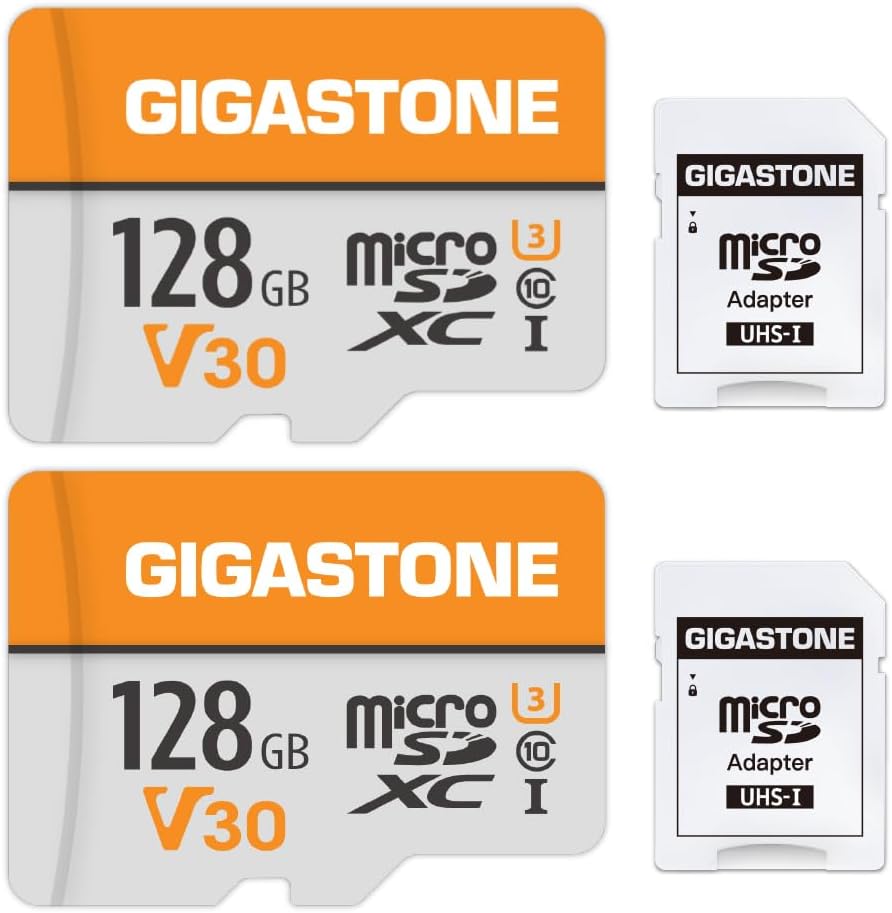
The GIGASTONE 128GB two-pack is a distinctive option for homes with more than one camera or for users who want a spare card ready for swapping. It carries a 4.6 rating, and each card has an A1 and V30 specification. The stated read and write speeds reach up to 95MB/s and 40MB/s, respectively, making its write performance more clearly described than that of many general-purpose alternatives.
We may earn a commission when you buy through this link, at no additional cost to you.
Both cards are positioned for security cameras, action cameras, laptops, tablets, PCs, and smartphones. Their 4K Ultra HD recording support can suit a Tapo model that records at higher resolution, subject to the camera's own capabilities. Two adapters are included, allowing either card to fit a standard SD slot for file transfer, and the cards are described as waterproof, shockproof, temperature-proof, and X-ray proof.
The most important caveat is formatting. These cards arrive natively formatted as exFAT, and older security cameras, dash cams, or Android phones may require FAT32. That means some users will need to format the card through compatible device settings before insertion. The card also lacks a dedicated endurance-hour claim, and V30 alone does not guarantee suitability for every camera model or recording bit rate.
This two-pack is an attractive pick for multi-camera households because it offers two 128GB cards and useful video classes without relying on a single Tapo-specific compatibility claim. It is especially practical if one card can remain installed while another is being transferred or formatted. Confirm the camera's supported capacity and file system before use, and keep the second card as a rotation spare.
A second card allows footage transfer without interrupting recording. It can also serve another compatible camera, reducing the need to purchase separate storage for every installation.
The exFAT default can cause problems with older devices. Formatting through the camera or a compatible computer may be necessary, but users should follow the camera manual rather than assuming every file system is accepted.
We may earn a commission when you buy through this link, at no additional cost to you.
The SANDISK 256GB Ultra provides substantial storage and a strong 4.7 rating. It is primarily marketed for expanding compatible phones, tablets, Chromebooks, and Windows laptops, but its capacity and stated read speed make it worth considering for a Tapo camera when the camera supports 256GB cards.
We may earn a commission when you buy through this link, at no additional cost to you.
The listing advertises read speeds up to 150MB/s when used with a compatible SanDisk MobileMate USB 3.0 microSD reader. A1-rated performance helps app responsiveness on compatible Android devices, while the included adapter makes the card easy to use in standard slots. The product is backed by a stated ten-year limited warranty, adding an additional point in its favor beyond raw capacity.
For surveillance use, the key weakness is the absence of a high-endurance designation or a detailed recording-hour claim. The supplied data also does not identify a V30 or U3 video class for this exact product. Its excellent read speed can help users move existing clips, but the camera must recognize the card and sustain its writes reliably. Some Tapo models impose capacity restrictions regardless of the card's capabilities.
This is a good high-capacity general-purpose option for someone who wants one card to serve several compatible devices. It may be especially useful for archiving local camera footage because of its storage volume and transfer speed. For continuous recording, however, the SANDISK High Endurance 256GB card offers a more directly aligned feature set and should be prioritized.
At 256GB, the card can hold substantially more local recordings than 64GB or 128GB options. This reduces overwrite frequency and can simplify archiving when the camera supports the capacity.
Up to 150MB/s reads can shorten card-to-computer transfers with compatible hardware. The card remains more broadly useful than a surveillance-only product, although that positioning may matter more for some buyers.
We may earn a commission when you buy through this link, at no additional cost to you.
The TF162 128GB two-pack earns a 4.5 rating and offers two microSD cards with a general-purpose UHS-I, Class 10, and A1 specification. It is not marketed around one particular Tapo model, but the stated compatibility includes cameras and surveillance equipment, making it a possible fit for compatible indoor or outdoor Tapo devices.
We may earn a commission when you buy through this link, at no additional cost to you.
Each card has a stated transfer speed of up to 80MB/s, with the listing appropriately noting that results vary by capacity, hardware, software, and operating system. A1 performance is useful in compatible Android environments, while the included adapter allows access from standard SD slots. Two cards provide flexibility for multiple cameras, a rotation workflow, or keeping one card available for general storage.
The shortcomings are mostly about specificity. The card has a lower 4.5 rating than the strongest products in the guide, and there is no endurance-hour claim, no detailed sustained-video class, and no explicit Tapo model list. The broad device claim also does not guarantee that every Tapo camera will recognize the card or accept its native formatting. Capacity support must be checked in the exact camera's documentation.
This two-pack is best for users who want two flexible 128GB cards and use a Tapo camera mainly for Full HD recording. It can also prevent interruption during footage transfers if the cameras are configured suitably. Buyers who need guaranteed explicit Tapo compatibility, stronger V30 video specifications, or monitoring endurance should choose a more purpose-built card.
Two cards make the package useful for more than one camera. They also allow a rotation approach, though recording behavior should not be interrupted if continuity is critical.
The card lists cameras, surveillance equipment, phones, computers, and consoles. That flexibility is convenient, but exact Tapo camera and file-system support should be verified beforehand.
We may earn a commission when you buy through this link, at no additional cost to you.
The TOPESEL 32GB two-pack is the most compact option in this guide, with a 4.5 rating and two microSDHC cards. Its target use is basic compatibility across phones, tablets, cameras, game consoles, and dashcams. A Tapo camera that accepts 32GB microSDHC cards and primarily captures short event clips may be able to use it, although it is not the strongest choice for sustained recording.
We may earn a commission when you buy through this link, at no additional cost to you.
Each card provides up to 80MB/s read speed and 20MB/s write speed under stated conditions. The package includes two microSD cards and one shared adapter. FAT32 is the default format, which can improve compatibility with some cameras and phones, while the UHS-I Class 10 designation identifies a basic performance level suitable for ordinary Full HD workflows.
Capacity is the most significant limitation. The product explicitly states approximately 28.8GB of usable space, meaning a continuous-recording camera will overwrite footage quickly. The listing also warns that the U1 card may not suit high-speed write scenarios. Some older cameras may fail to recognize it, and potential symptoms include formatting errors, recording interruptions, or an inability to perform continuous shooting.
This two-pack makes sense for inexpensive, light-duty use or a spare card that will be swapped occasionally. It is less appropriate for a user who wants meaningful local retention, high-resolution continuous recording, or the strongest sustained-write characteristics. Confirm microSDHC support, FAT32 acceptance, and maximum capacity in the camera manual before purchase.
The small capacity is most practical for motion events and short clips. Buyers should consider how quickly the camera overwrites files and how frequently footage must be exported.
Although FAT32 is convenient, the supplied data warns that some cameras may not recognize the card. Testing in the intended camera and checking the model requirements can prevent recording interruptions.
We may earn a commission when you buy through this link, at no additional cost to you.
The right card depends on camera support, recording mode, resolution, retention needs, and write reliability. These factors help narrow a broad range of microSD options to a card that can work safely inside a Tapo installation.
A microSD card cannot exceed the maximum capacity supported by the camera. The 128GB Tapo-specific card lists compatible models including C100, C200, C210, C220, C310, C325, C420, C500, C510W, TC60, TC65, TC70, D230S1, and C420S1, but every exact model and firmware should still be checked. The 256GB products provide more room for continuous recording, yet their larger capacity may place them outside the supported range of some cameras. Conversely, a camera designed only for up to 32GB may reject every larger card in this guide.
Choose a capacity that appears in the camera manual and fits your retention goal. Start with the largest officially supported size only when the camera's format and recording specifications also align.
A card's headline read speed describes transferring files away from it, not necessarily writing footage inside a camera. For continuous recording, U3 and V30 are stronger indicators than basic U1 or Class 10 labels. The Tapo-specific card, both SanDisk High Endurance cards, the Amazon Basics card, and the GIGASTONE cards carry V30-oriented specifications. Their suitability still depends on the Tapo camera's output bit rate and the card's real-world behavior.
Prioritize sustained video classes over an impressive read-speed figure. The listed cards with V30 are better aligned with uninterrupted recording than the Ultra, TF162, and TOPESEL selections.
Security cameras repeatedly overwrite files, making endurance more relevant than the speed of an occasional app launch. The SANDISK High Endurance cards are expressly designed for dash cams and home monitoring, with claims of up to 10,000 hours for the 128GB model and 20,000 hours for the 256GB model. Those figures are qualified as Full HD claims and produce fewer hours at 4K. General-purpose cards may work, but their behavior under constant writing is not described as thoroughly.
For 24-hour recording, a card marketed for monitoring offers the clearest evidence of intended use. For event-only recording, a mainstream U3 or U1 card may be sufficient.
Continuous recording consumes storage much faster than motion-triggered clips, while high-resolution footage consumes more space than Full HD. A 32GB card can be reasonable for infrequent events but will rotate quickly during continuous use. A 64GB card offers more room without requiring the largest capacity. The 128GB choices are the practical middle ground, and 256GB cards are preferable when long retention or multiple high-resolution streams matter.
Estimate retention using the camera's actual bit rate and recording schedule rather than relying only on labeled capacity. A larger card cannot compensate for a camera that writes unstable files.
A card may be technically compatible yet fail because its default file system is unsupported. The GIGASTONE cards arrive formatted as exFAT, and the listing says older security cameras may need FAT32. The TOPESEL 32GB cards are formatted as FAT32 by default but still may require reformatting or may not be recognized by certain cameras. The Tapo-specific card avoids a stated formatting caveat in the supplied data, though camera procedures should still be followed.
Check whether the camera formats the card itself, whether it accepts exFAT, and whether a computer-based format is appropriate. Never move critical footage to a card without keeping a separate backup.
The Tapo-specific card, Amazon Basics card, and GIGASTONE cards mention 4K-oriented capabilities, while the High Endurance and Ultra products state Full HD or conditional 4K support. A V10 or V30 class can describe different write requirements, so the camera's documented resolution and bit rate are more important than a generic 4K label. A faster card does not force a camera to record in 4K, and a card that handles 4K cannot compensate for an unsupported camera setting.
Match the card to the camera's actual output mode. For a Full HD Tapo model, a reliable V30 or high-endurance card is generally more relevant than maximum transfer speed.
Outdoor Tapo installations may encounter heat, moisture, dust, vibration, and occasional impact. The SANDISK High Endurance cards claim temperature, water, shock, humidity, and magnet proof characteristics. The Amazon Basics card lists shock resistance, IPX6 water resistance, extreme-temperature tolerance, X-ray resistance, and magnetic-field resistance. GIGASTONE describes waterproof, shockproof, temperature-proof, and X-ray-proof properties, while the 64GB budget card also lists several environmental protections.
Physical protection claims concern the card and may have limitations for adapters or other accessories. Install the card where it is not exposed to unnecessary water or heat, even when the card itself is rugged.
A full-size SD adapter makes footage easier to transfer to a computer, and every product in the guide includes some form of adapter. The GIGASTONE two-pack supplies two adapters, the TOPESEL pack includes one shared adapter, and the Tapo-specific card includes a full-size adapter. Multiple cards can support camera rotation, multi-camera installations, or a spare for formatting. They should not be assumed to support simultaneous hot swapping unless the camera specifically allows it.
Choose a multi-pack when separate cameras or continuity during transfers matter. Choose a single card when simplicity and straightforward management are the priority.
Before insertion, confirm that the card's capacity, physical size, speed class, and file format are supported by the exact Tapo camera model. Back up any existing recordings, format the new card in the camera when that is the recommended procedure, and avoid interrupting the camera while it recognizes or configures the card. Let the camera complete its setup before changing recording resolution or storage settings.
Treat the microSD card as active storage rather than permanent archive media. Review footage regularly, export important clips, and avoid assuming that files remain on the card indefinitely. A card in continuous recording mode may overwrite older material without warning. Use the included adapter to transfer files to a computer when needed, but handle the card by its edges and keep it away from static discharge, moisture, and strong magnets.
If the camera reports a read error, refuses to recognize the card, or produces interrupted recordings, stop repeated write attempts and inspect the camera's format requirements. Reformat the card through the camera or another confirmed-compatible device, test it with a short recording, and verify that capacity remains supported. Replace the card if errors continue, and consider a dedicated high-endurance model for continuous operation.
Use the largest capacity officially supported by the camera model. The 128GB Tapo-specific card is a practical middle ground, while 64GB can suit lighter event recording. A 256GB card is preferable for continuous recording only when the camera explicitly supports that capacity.
A high-endurance card is strongly preferable for continuous or near-continuous recording. The SanDisk High Endurance models are explicitly designed for home monitoring and dash cameras. For motion-based recording on a compatible camera, a mainstream U3 or V30 card may be sufficient.
It is often enough for typical security-camera use and provides a good balance of capacity and compatibility. Retention still depends on resolution, bit rate, and whether the camera records continuously. Confirm that the camera supports 128GB before installation.
V30 is generally the safer choice for continuous video because it communicates a minimum sustained write capability. U1 cards can work for lower-demand or event-driven recording, but they offer less margin for demanding video streams. Always prioritize the camera's stated requirements.
The cause may be excessive capacity, an unsupported file system, or an incompatibility with the specific camera model. Check the maximum supported capacity in the manual, format the card as directed, and test it in the camera. Some older devices also reject newer or unusually formatted cards.
Only if each camera supports the card and the recording setup allows it. Moving one card between cameras can interrupt recordings and may cause files to be split or overwritten. Two-pack options are more convenient for installations that need separate storage for separate cameras.
An adapter is convenient because it lets a microSD card fit a computer's full-size SD slot. It is not required by the camera itself. Some readers may also provide different transfer speeds, so use a compatible reader when moving large files.
Actual retention varies with capacity, resolution, bit rate, motion, and recording mode. The manufacturer or camera documentation provides the best estimates for supported cards. Continuous Full HD recording consumes space faster than motion-triggered clips, while 4K consumes more than Full HD.
The 128GB Tapo-specific microSD card is the most direct overall recommendation because it explicitly names supported Tapo cameras and combines U3 and V30 video classes with useful capacity. For buyers seeking stronger endurance evidence, the 256GB SANDISK High Endurance is the premium option, while the 64GB card provides a focused budget choice for lighter Full HD workloads.
Prioritize official camera compatibility, sustained video performance, and the appropriate format before considering headline read speed. Dedicated high-endurance cards are best for continuous recording, while U3 V30 options provide a strong general balance. Low-capacity U1 cards should be reserved for compatible cameras with limited recording demands and short retention cycles.
Ratings, product availability, and prices change over time, so check the current listing and the camera's support documentation before purchasing. Confirm maximum capacity, format requirements, and recording resolution, then maintain a separate backup of important footage rather than relying on the card as permanent storage.
