
ASRock Intel Arc A580 Challenger OC
4.6Editor score
8GB GDDR6 on 256-bit
Dual-fan 0dB cooling
Four modern display outputs
Factory-overclocked 2000 MHz
Our Intel Arc GPU guide compares 10 models for gaming, AI inference, professional visualization, compact builds, media work, multi-display setups, and buyers.
Intel Arc GPUs span a wide range of needs, from efficient gaming cards and multi-display solutions to professional accelerators designed for AI, rendering, and visualization. The right model depends on memory capacity, graphics architecture, cooling approach, power requirements, display configuration, and the applications you expect to run.
This guide compares 10 Intel Arc models using the supplied specifications, including GPU architecture, memory capacity and bandwidth, cooling design, connectivity, power needs, and intended workloads. It covers gaming-focused cards, workstation models, dual-GPU configurations, and a low-profile option for compact systems.
The selections show why there is no single Intel Arc GPU for every builder: some focus on 1440p gaming, others prioritize large AI workloads, and several target specialized professional or multi-monitor use cases. Product availability and prices can change, so confirm current listings and system compatibility before ordering.
Intel Arc graphics products cover an unusually broad set of use cases, from compact multi-monitor cards to high-capacity professional accelerators. A good choice should fit your case, meet your power supply requirements, provide enough graphics memory for your applications, and connect cleanly to the displays you use.
The 10 products in this guide were compared using their published specifications and supplied product information. The lineup includes conventional gaming cards, workstation-oriented models, dual-GPU systems, a power-supply bundle, a low-profile professional card, and a four-HDMI display solution.
Each review explains the strongest reasons to choose a particular card while making its limitations clear. The guide also identifies three standout picks for different priorities, but individual requirements should determine the final choice. Prices, ratings, bundle contents, and availability may change after publication.
4.6Editor score

4.7Editor score

This side-by-side comparison highlights each Intel Arc GPU's memory, architecture, cooling, connectivity, and strongest use case, making it easier to identify the model that matches your gaming, professional, or compact-system requirements.



The ASRock Intel Arc Pro B60 Creator is a workstation-oriented graphics card built around 24GB of GDDR6 memory, 20 Xe cores, and Intel's Xe2-HPG architecture. Its supplied rating is 3.9, but the specifications make it particularly compelling for local AI inference, 3D rendering, generative design, and other workloads that benefit from more memory than a conventional gaming card offers.
We may earn a commission when you buy through this link, at no additional cost to you.
Memory is the defining attraction. A 192-bit bus and stated bandwidth of 456 GB/s give the card considerably more headroom for large models, complex scenes, and professional datasets than the 4GB, 8GB, and 10GB alternatives in this guide. The 20 Xe cores and 160 XMX engines provide up to 197 INT8 TOPS, while the listed 2400 MHz clock supports general compute and graphics tasks.
Connectivity and media capabilities are also professional-minded. Four DisplayPort 2.1 outputs can drive up to four high-resolution 8K displays, and twin media transcoders support AV1, H.264, and HEVC encoding. PCIe 5.0 x16 bandwidth suits modern workstation platforms, while a blower-style cooler, nickel-plated copper base, heatpipe, and 0dB low-load behavior suit systems where consistent cooling matters more than a decorative RGB design.
The trade-offs are practical rather than fundamental. It is a 200W card requiring one 8-pin power connector, occupies two slots, and measures 271 by 112 by 39 mm, so case and power-supply clearance must be checked. The 3.9 rating also suggests the customer experience is not as uniformly positive as that of the B570 and A580. Even so, buyers prioritizing memory capacity, workstation validation, and compact multi-display connectivity will find this an unusually capable Intel Arc Pro model.
The 24GB pool is more consequential than raw gaming clock speed for many professional tasks. It can hold larger AI models, textures, and rendering datasets without forcing the same compromises associated with much smaller consumer cards.
A single blower can move heat directly out of a workstation chassis more consistently than a large open-air cooler in a cramped enclosure. The 0dB stop behavior also keeps the card quiet during lighter professional sessions.
Four DisplayPort 2.1 connections make the card suitable for dense editing, monitoring, or visualization desks. Dedicated AV1, H.264, and HEVC encoding hardware can shorten export workflows when the relevant application supports the media engine.
We may earn a commission when you buy through this link, at no additional cost to you.
The ASRock Intel Arc B570 Challenger is a well-rounded gaming card for 1440p-oriented systems, combining 10GB of GDDR6 memory with a 2600 MHz GPU clock and a 4.7 supplied rating. Its Xe2-HPG architecture also brings XMX and XeSS 2 support, giving it useful capabilities beyond straightforward raster gaming.
We may earn a commission when you buy through this link, at no additional cost to you.
The card's 10GB allocation provides a comfortable buffer for modern textures and many 1440p gaming scenarios, while 19 Gbps memory speed and a 160-bit bus form the basis of its performance. The factory clock of 2600 MHz is clearly communicated, making it easier to compare with other factory-overclocked models. Xe Matrix Extensions support AI-assisted workloads, and Xe Super Sampling 2 can improve output in games that implement the technology.
Thermal and physical design are also well suited to mainstream gaming builds. Two striped axial fans provide active cooling, while 0dB Silent Cooling stops both fans at low load. A metal backplate adds rigidity and helps prevent GPU sag, and a single 8-pin connector keeps the power requirement straightforward. Display connectivity includes three DisplayPort 2.1 ports and one HDMI 2.1a output for modern high-refresh-rate and high-resolution monitors.
This is not the most memory-heavy card in the guide, and its 160-bit bus is narrower than the 256-bit bus used by the A580. The included media engine supports AV1 encoding, although actual acceleration depends on application support. For a builder seeking a current-architecture gaming card without moving into professional AI hardware, the B570 Challenger offers an attractive balance of capacity, features, and everyday usability.
Ten gigabytes of memory and a 2600 MHz clock create a configuration aimed at the popular 1440p gaming class. The card also provides enough capacity to avoid memory limitations that can affect some settings in demanding modern releases.
Stopping the dual fans at low temperatures makes the card less noticeable during browsing, desktop work, and lighter games. Under sustained graphics loads, the same dual-fan arrangement provides the active cooling required by the Xe2-HPG GPU.
XeSS 2, XMX acceleration, DirectX 12 Ultimate support, and modern display connectors create a flexible feature set. AV1 encoding is another bonus for creators, provided their editing or streaming application is configured to use the hardware encoder.
We may earn a commission when you buy through this link, at no additional cost to you.
The ASRock Intel Arc A580 Challenger is a value-oriented 1440p graphics card with 8GB of GDDR6 memory, a 256-bit interface, and a 4.6 supplied rating. Its factory-overclocked engine runs at 2000 MHz, while 384 XMX engines provide a meaningful foundation for AI-assisted gaming and content-creation features.
We may earn a commission when you buy through this link, at no additional cost to you.
One of the most important strengths is its wide 256-bit memory bus. That configuration gives the A580 a different memory profile from the 10GB B570, whose bus is 160 bits wide. The card also supports Intel Xe Super Sampling, OpenGL 4.6, and DirectX 12 Ultimate, helping it remain relevant for modern games and applications that support Intel's graphics technologies.
Cooling and construction are handled by two striped axial fans, an ultra-fit heatpipe, and 0dB Silent Cooling. A metal backplate improves rigidity, while Super Alloy components are intended to support long-term reliability. Three DisplayPort 2.0 outputs and one HDMI 2.0b port support up to four displays, with listed resolution support reaching 7680 by 4320.
Compatibility deserves close attention. The card is 271 by 132 by 48 mm, uses a 2.4-slot design, requires two 8-pin PCIe power connectors, and calls for a recommended 650W power supply. It also uses the older Xe HPG rather than Xe2-HPG architecture. Even with those constraints, the A580 Challenger is a strong pick for a builder who values a wide memory bus, 1440p capability, and a mature dual-fan design over newer architectural features.
A 256-bit bus can move data more efficiently across wider memory channels than a narrower design. That distinction is particularly useful in graphics workloads that repeatedly exchange large textures, frame buffers, and geometry data with the GPU.
The three DisplayPort and one HDMI arrangement provides flexibility for a productivity-focused multi-screen desk. It also makes the card relevant to users who want more screen real estate for timelines, dashboards, or general productivity alongside gaming.
Two 8-pin connectors and a 2.4-slot body make this model less flexible in compact builds. Checking case width, connector clearance, and power-supply headroom before ordering can prevent an otherwise straightforward installation from becoming a constraint.
We may earn a commission when you buy through this link, at no additional cost to you.
The Sparkle Intel Arc B580 Titan OC stands out with 12GB of GDDR6 memory and a listed 2760 MHz boost clock, making it a higher-capacity alternative to the 10GB B570 models in this guide. Its supplied rating is 4.5, and the card's defining extras include TORN Cooling 2.0, a metal backplate, blue breathing light, and a sag bracket.
We may earn a commission when you buy through this link, at no additional cost to you.
The 12GB allocation is especially notable because memory capacity can influence the settings and texture combinations available in modern games. The 2760 MHz boost clock is also the highest explicitly listed clock among the B580 options here, giving this card a clear appeal for buyers who want a higher factory ceiling and a distinctive enthusiast-style design.
Thermal management centers on the TORN Cooling 2.0 system and an axial fan. The metal backplate contributes structural rigidity, while the included graphics-card sag bracket can help support the weight of a larger card. The breathing light adds a visible element for systems with side panels, though it is not a substitute for evaluating the underlying cooling design in a tightly packed chassis.
The supplied information is less detailed than for several other entries, so confirming the exact power connector, overall dimensions, and display outputs before purchase is especially important. With that caveat, the Titan OC offers a persuasive combination of 12GB memory, a high boost clock, and enthusiast-oriented physical features for users interested in the B580 generation.
The larger memory pool provides extra headroom for demanding textures and high-detail settings. It also gives the card a distinct identity within the B570 and B580 range rather than duplicating the more common 10GB configuration.
A listed 2760 MHz boost clock is a useful headline specification for a gaming card. Actual performance still depends on the rest of the system, application support, cooling, and sustained thermal behavior.
The metal backplate and included sag bracket improve the board's support and rigidity. They also make the Titan OC a visually distinctive option for builders who want their internal components to complement the rest of the system.
We may earn a commission when you buy through this link, at no additional cost to you.
The WEELIAO MAXSUN Intel Arc Pro B60 48G Turbo is a specialized workstation card that combines two Arc Pro B60 GPUs into one 48GB GDDR6 configuration. It is aimed at local AI inference and high-concurrency workloads, and its supplied information describes support for large quantized models without requiring a separate multi-card arrangement.
We may earn a commission when you buy through this link, at no additional cost to you.
Each GPU contributes 24GB of memory, operates at 2400 MHz, and provides 20 Xe cores with 197 INT8 TOPS. The combined figures are 48GB of memory and 394 INT8 TOPS. Separate recognition of each chip allows the system to assign work flexibly, which can benefit parallel inference, multi-turn dialogue systems, and applications that recognize both accelerators.
The cooling system is designed for long, uninterrupted loads. A blower fan, large vapor chamber, and metal backplate provide a more workstation-oriented thermal approach. Software support includes PyTorch, IPEX-LLM, vLLM, standard professional applications, Qwen3-32B, Qwen3-VL, DeepSeek models, and SR-IOV virtualization, although users should still confirm that their exact framework and model combination are supported.
Its PCIe 5.0 x8 plus PCIe 5.0 x8 interface is the main installation consideration. A motherboard supporting x16 lane bifurcation is needed to provide full bandwidth through standard consumer-platform lanes. No customer rating is supplied, so the extensive stated specifications carry more weight in this evaluation. For an organization or technically experienced user building a dedicated local AI node, this card is a specialized and potentially transformative choice rather than a general-purpose gaming upgrade.
Combining two 24GB accelerators creates a much larger memory ceiling than any single GPU in the guide. That capacity is the central reason to consider this product for large quantized models, professional rendering, and other tasks where working sets exceed the limits of ordinary gaming cards.
The stated 394 combined INT8 TOPS offers considerably more compute capacity than the single-GPU workstation models. Recognizing both chips separately gives compatible software an opportunity to distribute workloads, provided the application and operating system support that arrangement correctly.
The blower and vapor-chamber combination is aimed at moving heat out of the chassis during sustained inference or rendering. This is more relevant for long server-like sessions than for short gaming bursts, where power efficiency and acoustics may deserve greater attention.
We may earn a commission when you buy through this link, at no additional cost to you.
The MAXSUN Intel Arc Pro B60 Dual 48G Turbo combines two Intel Arc Pro B60 graphics processors in a dual-slot workstation card. Its 48GB of dedicated graphics memory and parallel-processing design target AI inference, machine learning, large-scale rendering, and other demanding visual-computing workloads that benefit from more than one GPU.
We may earn a commission when you buy through this link, at no additional cost to you.
The dual-GPU arrangement is the central advantage. Rather than requiring two separate physical cards and two sets of installation space, the product consolidates two professional GPUs into one board. That can simplify deployment in workstations designed around a single large accelerator slot, provided the card's physical dimensions, power requirements, and motherboard interface are compatible.
Its compact dual-slot format is another practical strength. A single large-diameter turbo fan expels heat from the chassis, which is a common strategy in workstation and server-style designs where several boards may operate close together. The card prioritizes high-bandwidth memory and parallel compute capacity rather than gaming aesthetics or a quiet, decorative cooler.
The available product data is concise and does not include a customer rating, memory bus detail, exact power figure, or full display-output list. Those omissions make compatibility verification essential. The MAXSUN B60 Dual is best considered by professional buyers who need substantial memory and multi-GPU capability in one workstation card and can confirm that their platform supports the required interface and software stack.
Integrating two professional GPUs into a single card can reduce motherboard occupancy compared with installing two full-size boards. It also simplifies cabling in some workstation layouts, although the card's own power and airflow requirements still need to be checked.
Forty-eight gigabytes gives rendering, simulation, and inference workflows considerably more working memory than a standard gaming card. The benefit is strongest when the software can recognize and use both GPUs rather than treating them as separate adapters.
The large turbo fan is designed to move heat away from the card itself. That approach can be effective in dense workstation cases, but the chassis must provide enough intake and exhaust airflow to support sustained operation.
We may earn a commission when you buy through this link, at no additional cost to you.
The ASRock Arc B570 Gaming Bundle pairs the Intel Arc B570 Challenger 10GB OC with the PRO-650G 650W 80 Plus Gold power supply. It offers a convenient route to a 1440p-oriented gaming configuration, and the bundle has a 5.0 supplied rating. The graphics card's 2600 MHz clock and 10GB of GDDR6 memory form the core of the package.
We may earn a commission when you buy through this link, at no additional cost to you.
For someone assembling or upgrading a gaming PC, bundling the GPU and PSU can simplify procurement. The included 650W power supply is 80 Plus Gold certified and ATX3.1 ready, while the B570 uses the Xe2-HPG architecture and supports Xe Matrix Extensions, Xe Super Sampling 2, and AI-powered frame generation in supported games.
The dual striped axial fans and 0dB Silent Cooling give the graphics card suitable thermal behavior for a gaming system. Its 10GB memory buffer is useful for high-detail textures, and the architecture provides a more modern feature set than older Arc A-series models. The power supply is intended to provide stable, efficient delivery to the combined system while reducing the need to select a separate compatible unit.
A bundle is only convenient if every included part works with the intended case and the rest of the system. Buyers should check PSU dimensions, modular-cable requirements, case clearance, and the graphics card's power requirements. Existing owners with an adequate power supply may gain little from the bundle, but new builders who want a matched core upgrade may find it a streamlined and well-rated package.
Matching a graphics card with a power supply can reduce compatibility guesswork for new builders. The bundle provides a 650W Gold-rated unit alongside a card designed for mainstream 1440p gaming, covering two important components of a capable gaming platform.
XeSS 2 and XMX support add AI-assisted rendering features to the B570's underlying Xe2-HPG design. Their real-world effect depends on game support, and frame generation should be evaluated alongside the game's own upscaling and latency options.
The included power supply does not automatically make every other component compatible. Confirm case dimensions, cable style, motherboard support, processor requirements, and graphics-card clearance before treating the bundle as a complete system.
We may earn a commission when you buy through this link, at no additional cost to you.
The GUNNIR Intel Arc Pro B50 LP is a compact professional card designed for small-form-factor PCs, mini-towers, and edge workstations. Its defining feature is a single-slot, low-profile body measuring 167 by 69 by 18.4 mm, combined with a 70W power draw that requires no external PCIe power connector.
We may earn a commission when you buy through this link, at no additional cost to you.
Despite its small size, the card provides 16GB of GDDR6 memory on a 128-bit bus with 224 GB/s of bandwidth. The Intel Xe2 architecture includes 16 Xe cores and 128 XMX engines, delivering up to 170 INT8 TOPS. Those specifications make it suitable for AI inference, deep learning, 3D rendering, and data-heavy visual computing where a small card is normally a significant compromise.
A single turbo fan and robust metal shroud manage heat in the constrained format. The absence of external power simplifies installation because the card draws its power through the PCIe slot. It also reduces cable-management demands in compact enclosures, where every saved millimeter and connector can matter.
No customer rating is supplied, so there is no direct customer-feedback score to assess. The small 128-bit memory bus and single-fan design may also limit sustained performance compared with larger professional models with wider buses and more elaborate cooling. Even so, this is one of the most distinctive products in the guide: a 16GB professional Intel Arc option for systems that cannot accommodate a full-size, externally powered accelerator.
Sixteen gigabytes is unusually useful in a low-profile card because many smaller form factors limit graphics-card selection. The capacity gives compact workstations access to larger models, scenes, and datasets without requiring a full-length board.
Drawing 70W through the PCIe slot removes the need for an external auxiliary power cable. That makes installation cleaner and reduces the chance of cable conflict in tightly packed enclosures.
The 167 mm length and 18.4 mm thickness suit compact workstation formats where full-size dual-slot cards are difficult to cool or install. Buyers should still verify the case's slot clearance, bracket shape, and airflow.
We may earn a commission when you buy through this link, at no additional cost to you.
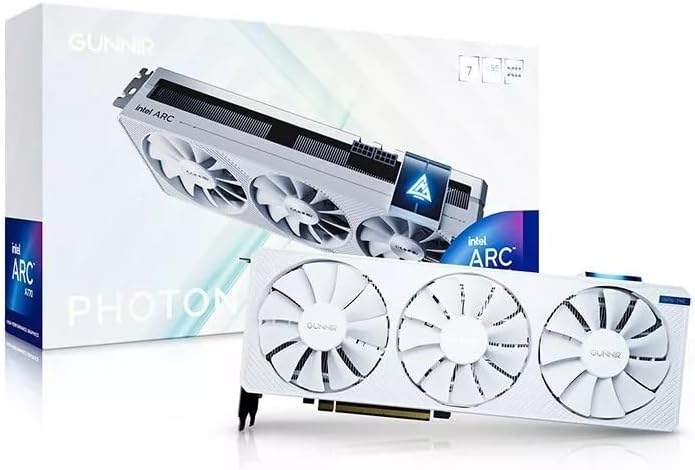
The GUNNIR Intel Arc A770 Photon is an 8GB OC graphics card built around the A770 platform and a 256-bit memory interface. It combines a listed 2400 MHz clock, GDDR6 memory, a triple-fan cooler, and a white exterior, giving it a distinctive look for gaming systems where appearance matters as much as core specifications.
We may earn a commission when you buy through this link, at no additional cost to you.
The card's triple-fan configuration is designed to spread cooling across a larger heatsink and maintain performance during intense gaming and content-creation workloads. Its 8GB of GDDR6 provides a useful amount of graphics memory, while the wide 256-bit bus gives the A770 a familiar high-bandwidth profile. The supplied 4.5 rating reflects a generally positive customer response.
PCIe 4.0, HDMI, and DisplayPort connectivity provide compatibility with current display hardware, including 4K monitors. The white design can pair well with similarly themed cases and components. The product data is relatively general, however, and does not list exact output counts, connector requirements, dimensions, or power consumption.
The A770 platform itself is not the newest generation represented in this guide, and newer B-series options offer more explicitly documented architecture and media features. Even so, the Photon is a visually appealing alternative for builders who prioritize a substantial cooler, 8GB memory, and a wide bus over the latest platform. Confirming power and physical dimensions before purchase is especially important for this listing.
Three fans give the Photon a large cooling surface and a recognizable appearance. The white finish also makes it easier to coordinate with a themed system than a conventional dark graphics card.
Eight gigabytes of GDDR6 across a 256-bit interface gives the card a conventional gaming profile. It can support high-detail games and creative applications, though newer high-memory alternatives provide more room for unusually demanding projects.
The supplied summary leaves out power and size details. Prospective buyers should check the manufacturer's specifications and their case and power-supply requirements rather than assuming it matches the dimensions of other A770 designs.
We may earn a commission when you buy through this link, at no additional cost to you.
The Sparkle Intel Arc A310 Omni View is built around a different goal from most gaming-focused Arc cards: compact operation and multiple displays. It combines 4GB of GDDR6 memory, four HDMI outputs, a 50W total board power target, and a single-slot, single-fan chassis, earning a 4.6 supplied rating.
We may earn a commission when you buy through this link, at no additional cost to you.
Four HDMI connections make the card immediately useful for a productivity desk, digital-signage array, kiosk system, or multi-window control environment. Because the outputs are integrated, users can drive several displays without needing to rely on motherboard video outputs, add-in adapters, or a separate display-management product. The exact maximum resolutions and refresh rates should be confirmed for the displays in use.
A 50W power target and single-slot format make installation straightforward. The card needs no elaborate multi-connector power arrangement, and its narrow shape leaves more room for other expansion cards. A single fan provides basic cooling while keeping the overall design compact and potentially quiet during lighter workloads.
The major limitation is memory. Four gigabytes is modest for modern high-detail gaming, intensive 3D work, and large AI models, so this is primarily a display and compact-system solution rather than a high-performance graphics upgrade. For a four-screen office, control room, or embedded-style application, however, the specialized connectivity can outweigh capacity that a gaming card would value.
Native HDMI connectivity is the Omni View's main advantage. It provides a straightforward path to a four-display arrangement in systems where convenient video output and tidy cabling are more important than heavy graphics workloads.
A 50W board-power target and single-slot body reduce the demands placed on the case and power supply. This makes the card suitable for compact builds where space, power, and easy installation outweigh maximum gaming performance.
Four gigabytes of memory can become a bottleneck in demanding games or creative software. The Omni View is best matched to display-heavy productivity and visualization tasks where its outputs and low-power design are the deciding features.
We may earn a commission when you buy through this link, at no additional cost to you.
The most important Intel Arc GPU decision is the match between the card's memory, architecture, power design, and intended workload. Start with your applications and display needs, then confirm that the physical and platform requirements fit the rest of your system.
In short: buy for the workload you will actually run, not for a headline feature that your applications may never use.
Prioritize capacity for large models and complex scenes, and pay attention to both capacity and bus width for memory-intensive gaming.
Check application support and driver maturity alongside architecture; an attractive specification is not useful if your required application does not support it.
Verify connector type, recommended power-supply capacity, case clearance, and overall system load before purchasing.
Measure the available case space, account for the power connector, and ensure the chassis can supply enough cool air around the card.
Match connector types and display capabilities to your monitors, including resolution, refresh rate, HDR, and the number of screens you plan to operate.
For multi-GPU cards, validate lane bifurcation, thermal clearance, power delivery, and software recognition before ordering.
Use ratings as one signal, then prioritize workload fit, verified specifications, and dependable support for the system you are building.
Before installation, identify the correct operating system version, install the latest available Intel graphics driver, and confirm that the power supply, case, and motherboard meet the card's requirements. Connect all required auxiliary power cables before powering on, and verify that the display cables are attached to the graphics card rather than the motherboard. The system's integrated graphics may need to be disabled in firmware for proper operation.
After the first boot, install the graphics driver and any application-specific Intel software required by your games or professional workloads. Check the card's temperature, fan behavior, and power draw during a realistic workload. Update drivers when stability or compatibility improves, but avoid changing multiple software components at once, since that makes it harder to identify the source of a problem.
To maintain performance, keep intake and exhaust paths unobstructed, clean dust from the case and cooler periodically, and avoid operating the card in a severely restricted enclosure. For dual-GPU systems, confirm that both devices appear in the operating system and that the intended application can assign work across them. Always follow the manufacturer's installation and safety instructions for the specific model.
The ASRock Arc B570 Challenger is the clearest all-around 1440p recommendation because it combines 10GB of GDDR6 memory, a 2600 MHz factory clock, and a modern Xe2-HPG feature set. The A580 Challenger is a credible value-oriented alternative with 8GB of memory and a wider 256-bit bus. Actual game performance also depends on your processor, resolution, settings, and whether the game supports Intel's upscaling features.
You do not necessarily need one, but Arc Pro models are built specifically around substantial graphics memory and compute capacity. The 24GB B60 Creator is suitable for a broader range of professional workloads, while the dual-GPU 48GB products offer much more memory for large quantized models. Before buying, confirm that your model, framework, inference engine, and drivers support the exact configuration.
The 24GB B60 Creator contains one professional GPU with 24GB of GDDR6 and a PCIe 5.0 x16 interface. The 48GB products combine two B60-class processors, providing 48GB of total memory and parallel compute capacity, but require attention to lane configuration, thermals, and software support. The single-GPU card is generally the more conventional workstation choice, while the dual designs target large shared memory pools.
It depends on the specific model and case. The GUNNIR Arc Pro B50 LP is explicitly designed as a low-profile, single-slot card measuring 167 by 69 by 18.4 mm and requiring no external PCIe power connector. The A310 is also single-slot, but other gaming and workstation cards in the guide may be much longer, thicker, and more demanding. Measure the enclosure and check airflow before buying.
The required capacity depends on the graphics card and the rest of the PC. The A310 targets 50W, the B50 LP targets 70W, and the B570 Challenger uses one 8-pin connector, while the A580 requires two. The B60 Creator lists a 200W TDP. Use the manufacturer's guidance and allow adequate headroom for the CPU, memory, storage, and transient power demands.
They can be valuable, but only when the application supports them. XeSS 2 provides AI-assisted upscaling, while XMX exposes additional matrix capabilities that can accelerate supported AI and graphics workloads. You should not treat these features as a substitute for sufficient raw performance or memory. Check the current application and driver situation before choosing a card primarily for an AI feature.
Yes, particularly in productivity, control-room, signage, and kiosk environments. The Sparkle A310 Omni View provides four HDMI outputs in a single-slot, low-power design, making it convenient for several displays without extra video-output adapters. Its 4GB memory and low-power GPU position it as a display solution rather than a high-end gaming or rendering card.
A bundle can be convenient for a new build because it reduces the number of components to select. The ASRock B570 bundle includes a 650W 80 Plus Gold PRO-650G unit and a 10GB B570 card. Before purchasing, check the case dimensions, connector style, motherboard, processor, and remaining components to ensure the included power supply is appropriate for the entire system.
The ASRock Arc B570 Challenger is the strongest all-around gaming selection in this guide, offering 10GB of memory, a modern 2600 MHz clock, XeSS 2 support, and modern display connectivity. The A580 Challenger stands out as the budget-focused alternative for buyers who prefer a 256-bit memory bus, while the MAXSUN Arc Pro B60 48G Turbo takes the premium slot for specialized local AI and professional workloads.
Prioritize the requirement that cannot be compromised: memory for large models, a 256-bit bus for gaming memory throughput, native display outputs for multi-screen desks, low-profile dimensions for compact systems, or lane bifurcation and cooling for dual-GPU deployments. The 24GB B60 Creator is the most conventional professional workstation option, while the B50 LP covers compact professional systems and the A310 serves efficient four-display configurations.
Finally, check current product details, user ratings, prices, and availability before purchasing because the market can change. Confirm the card's dimensions, power connectors, recommended power supply, display support, and software compatibility with your specific system. That final compatibility check is essential for turning any of these Intel Arc recommendations into the right upgrade.