
Home Cell Booster with Two Indoor Antennas
4.8Editor score
Two indoor panel antennas
Up to 7000 square feet
Automatic gain control
70 dB maximum gain
Carrier-compatible cellular bands
A panel antenna for cell signal boost can make a major difference when cellular service is weak indoors, at the edge of carrier coverage, or inside a vehicle. The right model combines suitable directional or omnidirectional reception, compatible frequency-band support, a weather-resistant connector, and a mounting approach that fits the available space.
We compared all 10 products by examining their antenna type, supported carriers and cellular bands, signal gain, intended installation environment, included components, and ease of setup. The list includes complete home booster systems, directional MIMO panel antennas, an overland exterior antenna, and vehicle-mounted options for different needs.
Each pick reveals a different route to stronger reception, from broad home coverage to targeted 4G and 5G connections. Product listings, package contents, compatibility details, and current listing terms can change, so readers should verify the latest specifications and carrier requirements before purchasing.
4.8Editor score
4.4Editor score

4.4Editor score
As an Amazon Associate we earn from qualifying purchases.
The comparison below separates complete home booster systems from standalone antennas and vehicle-specific options. Pay close attention to antenna pattern, supported bands, gain, package contents, and whether a separate booster or router is required.


This is the most complete starting point in the guide for anyone who wants to improve cellular reception throughout a home or office. It combines a booster unit, an exterior receiving arrangement, and two indoor panel antennas in one package. Its 4.8 rating is the highest among the listed products, reflecting a generally favorable customer reception, while the stated 70 dB gain and coverage of up to 7000 square feet make it suitable for multi-room environments.
We may earn a commission when you buy through this link, at no additional cost to you.
The two indoor panel antennas are especially useful when a single indoor antenna leaves part of a building with weak service. Panels can distribute amplified signal more evenly across several rooms than a highly directional indoor emitter. The system also includes automatic gain control, self-oscillation elimination, a low-noise design, and an LED display, so it is built for straightforward operation rather than the kind of manual tuning associated with some advanced radio installations.
There is an important technical qualification concerning 5G. The listing notes that the FCC has not yet permitted new millimeter-wave cellular enhancers, so the system can improve 5G only where the carrier offers 5G through existing 4G spectrum using Dynamic Spectrum Sharing. It cannot create a usable signal where the location has no cellular service, and actual indoor coverage will depend on exterior signal quality, building materials, antenna placement, and the available carrier bands.
This is a strong recommendation for households and small offices that want a ready-made indoor distribution system without selecting every component separately. It is particularly attractive when weak service affects several rooms and an exterior signal is available. Buyers should confirm compatible phone bands, plan the outdoor antenna position, and follow the manufacturer’s installation guidance rather than assuming the stated square-foot coverage applies equally to every property.
The two included indoor panel antennas make this kit more versatile than a single-antenna arrangement. Positioning them in separate rooms or on opposite sides of a larger floor plan can help improve service where walls, floors, or metal fixtures weaken a cellular connection.
Automatic gain control adjusts amplification according to incoming signal conditions, while the listed self-oscillation elimination helps prevent feedback. The LED screen provides a visible status indicator, which is useful when positioning components and checking basic operation.
We may earn a commission when you buy through this link, at no additional cost to you.
The weBoost Overland Antenna is designed as an exterior receiving antenna for compatible Drive Reach mobile signal booster kits. It is not a panel antenna in the conventional indoor distribution sense, but it fills an important gap in this comparison by providing a rugged option for travel, overlanding, and remote outdoor connectivity. Its 4.4 rating indicates generally positive customer feedback.
We may earn a commission when you buy through this link, at no additional cost to you.
The antenna supports 5G and 4G LTE and is advertised as compatible with major U.S. carrier networks, including Verizon, AT&T, and T-Mobile. Its construction is rated to U.S. military and NEMA durability standards, making it more appropriate for exposed installations than a lightweight indoor panel. The seller also highlights a two-year warranty and access to U.S.-based support through an app, chat, phone, or email.
The main limitation is dependency. This is an outside antenna for Drive Reach systems rather than a complete cellular booster or a universal standalone panel. Users need a compatible booster, appropriate cabling, and a vehicle or portable mounting arrangement. A strong exterior antenna cannot compensate for an incompatible system or the absence of carrier service at the selected location.
Choose this product when your primary need is improving cellular reception in a moving vehicle, campsite, remote work area, or temporary outdoor setup using a Drive Reach ecosystem. It is less relevant to someone seeking to distribute signal through a fixed home. Confirm the connector, booster compatibility, power supply, and mounting requirements before ordering.
NEMA and U.S. military durability standards make the Overland Antenna better suited to weather-exposed mobile use than an ordinary indoor panel. A secure roof or window-area installation can give the receiver a clearer view of available carrier signals.
The listing states support for major U.S. networks and 4G LTE plus 5G operation. As with every cellular antenna, real performance depends on the frequencies deployed by the local carrier and the capabilities of the paired booster.
We may earn a commission when you buy through this link, at no additional cost to you.
This home booster is built around two indoor panel antennas, multiple cellular bands, and a claimed indoor area of up to 8000 square feet. It earns a 4.7 rating, placing it among the most favorably reviewed options here. Its strongest appeal is the combination of broad stated band support and a maximum gain of 70 dB for users who need service in several rooms.
We may earn a commission when you buy through this link, at no additional cost to you.
The listing names bands 66, 2, 4, 5, 12, 17, 13, and 25, with a maximum output of 17 dBm. It is intended to support voice, text, data, and streaming across major North American networks, including Verizon’s 5G Nationwide signals. The two indoor panels can be placed in different areas to distribute coverage more evenly through a home or workplace.
Coverage is not guaranteed solely by square footage. The listing provides a useful reality check: approximately 800 square feet may be possible with one or two exterior bars, around 3000 square feet with three or four bars, and up to 7000 square feet with five bars. It also notes that the system cannot operate without an available signal at the external antenna location.
This kit is a practical choice for larger homes, offices, and rural properties where outdoor service exists but indoor walls weaken it. Installation requires turning power off while adjusting antennas, placing the outdoor log-periodic antenna, and maintaining roughly 32 feet between the outdoor and indoor antennas. Buyers should follow the manual closely to minimize feedback and obtain the best usable result.
The product’s own guidance emphasizes that interior results depend on signal at the outdoor antenna. Locating the exterior antenna where the phone receives the strongest reliable signal can be more important than the nominal maximum square-foot figure.
Two panel antennas offer placement flexibility in larger buildings. Keeping the indoor antennas appropriately separated from the outdoor unit and one another can help reduce interference while improving reception in separate rooms.
We may earn a commission when you buy through this link, at no additional cost to you.
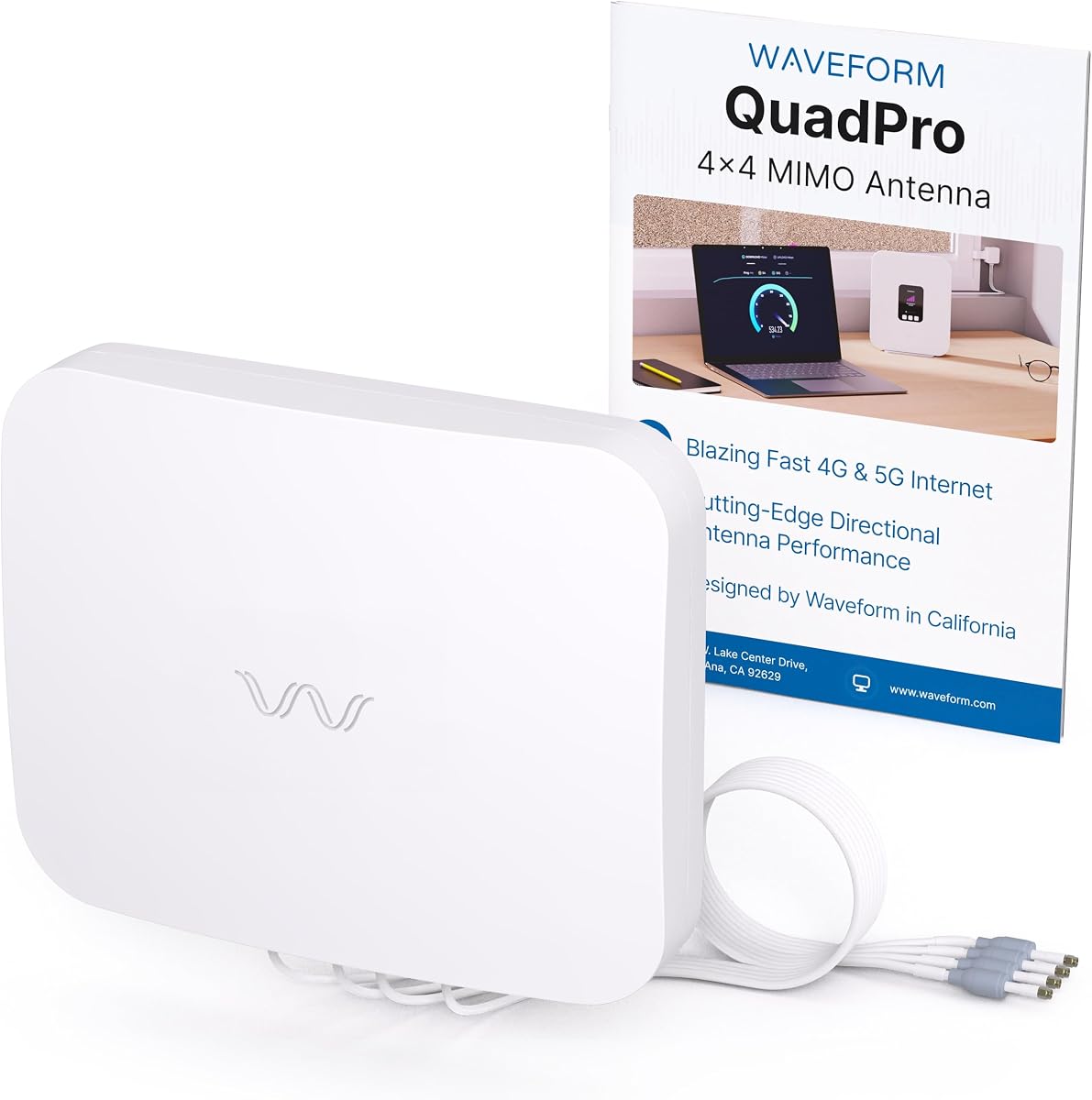
The Waveform QuadPro antenna-only package is the most directly targeted panel antenna in the guide. It is a directional 4×4 MIMO panel designed to improve cellular data reception for compatible 5G routers, modems, and gateways. Its 4.4 rating reflects solid overall feedback, and its use of four-input, four-output MIMO makes it a compelling option for modern high-speed cellular connections.
We may earn a commission when you buy through this link, at no additional cost to you.
The panel supports up to 9.1 dBi gain across 600 to 6000 MHz, covering a wide range of 4G and 5G bands used by AT&T, Verizon, T-Mobile, and US Cellular. Unlike an omnidirectional antenna, it concentrates reception toward a specific tower. That focus can deliver stronger results at the edge of coverage, but the user must identify the relevant tower and aim the panel accurately.
Although this is the antenna-only version, the package includes a FlexMount, UltraFlex-Quad cable, Window Entry Cable, weatherproofing boots, an SMA adapter, a U.FL adapter, and an installation guide. The window-entry arrangement is designed to reduce the need to drill holes. Despite those included accessories, the listing specifically supports antenna-only, so buyers should verify that their own router, modem, or gateway supplies the necessary processing and cellular connection.
This is the best fit for a technically capable user who wants a modern MIMO panel for fixed 5G internet at home or in a small office. It also supports documented T-Mobile Home Internet gateways, Verizon 5G Home Internet, and AT&T Internet Air. It is not the simplest choice for a typical smartphone user seeking whole-home voice coverage, but it is especially attractive for high-bandwidth data service.
A directional panel can concentrate energy toward a specific tower, making it useful beyond the edge of service coverage. The trade-off is sensitivity to alignment, so users may need to test several orientations and record which position produces the strongest stable connection.
The included Window Entry Cable and FlexMount are designed to help create a cleaner installation without drilling through walls. A properly sealed cable route also helps preserve the home’s exterior and reduce the likelihood of air or moisture intrusion.
We may earn a commission when you buy through this link, at no additional cost to you.
The HiBoost home booster is designed for homes, offices, rural properties, and basements where a few rooms need better cellular service. Its 4.3 rating is respectable, and the combination of a main-unit display, automatic gain control, and SignalSupervisor app support makes it especially approachable for users who want visual and mobile-assisted setup guidance.
We may earn a commission when you buy through this link, at no additional cost to you.
Maximum gain is listed at 62 dB, with coverage for 2–3 rooms and a stated area of up to 2500 square feet. The supported bands are 700–750 MHz, 800–850 MHz, 1900 MHz, and 1700–2100 MHz, corresponding to low and mid-band cellular frequencies. The system supports 5G, 4G, and 3G devices and is compatible with major U.S. carriers, including Verizon, AT&T, T-Mobile, Sprint, US Cellular, and Straight Talk.
The app can help users check signal strength, find a better outdoor antenna location, view installation guidance, and contact support. The system also includes a three-year manufacturer warranty and lifetime technical support. Its smaller stated footprint and 62 dB gain make it less ambitious than the larger two-panel kits, and users should understand that carrier labels alone do not guarantee performance on every local band or frequency.
Choose this system when you want guided installation, remote troubleshooting, and a compact installation for a home office or several rooms. It is a sensible alternative for users who value app-based support more than maximum stated square footage. Before installation, confirm the outdoor signal and the exact band plan, then use the app to compare antenna positions rather than guessing.
The SignalSupervisor app turns antenna placement into a more measurable process. Users can compare signal readings at different exterior locations and follow the provided installation resources without relying entirely on visual guesses.
A 62 dB maximum and claimed 2500-square-foot capacity are suited to small offices and compact homes. In a larger property, users may need to reposition the indoor antenna or consider a multi-antenna system designed to distribute service over a greater area.
We may earn a commission when you buy through this link, at no additional cost to you.
The P50 is a home and office booster marketed for challenging spaces such as houses, shops, basements, and metal buildings. It has a 4.6 rating, making it one of the stronger-reviewed items in the list. Its most notable specification is 72 dB maximum gain, accompanied by a stated 32-times amplification factor and coverage of up to 3000 square feet.
We may earn a commission when you buy through this link, at no additional cost to you.
Compatibility is based on cellular bands rather than carrier names alone. The product information says the phone must support band 2, 4, 5, 12, 13, or 17 and receive at least two bars of service outdoors. It can work with AT&T, Verizon, T-Mobile, Straight Talk, and other services when the device and local network use those bands. Its 5G benefit also depends on the phone’s current 5G signal using one of the supported bands.
The explicit outdoor-signal requirement is a strength because it helps set realistic expectations. A booster amplifies an existing carrier transmission; it cannot generate service where the tower signal is completely absent. That makes the P50 appropriate for buildings where service reaches the exterior but is blocked internally, particularly structures with metal walls, concrete, or multiple levels.
This is a good choice for a workshop, warehouse-like office, metal building, or basement where ordinary indoor coverage struggles. Buyers should check their phone’s supported bands, compare outdoor signal at multiple locations, and place the exterior antenna where reception is strongest. The listed 72 dB gain is substantial, but proper placement and compatible hardware remain more important than the headline figure.
Metal and masonry can sharply attenuate cellular signals. The P50’s high stated gain and indoor distribution equipment are intended to overcome that loss by capturing a usable signal outside and redistributing it within the structure.
The listed requirement of at least two exterior bars and supported phone bands prevents misleading expectations. A carrier’s service area does not guarantee that the local network uses the exact frequencies the booster can amplify.
We may earn a commission when you buy through this link, at no additional cost to you.
The complete-kit version of the Waveform QuadPro packages a directional 4×4 MIMO panel with the accessories needed for a more complete installation. It shares the QuadPro’s 4.4 rating and stands out as the most advanced panel-oriented option in this guide. It is designed primarily for cellular routers, modems, and gateways rather than for broadcasting a voice signal throughout an entire home.
We may earn a commission when you buy through this link, at no additional cost to you.
The antenna supports full 4×4 MIMO operation and up to 9.1 dBi gain from 600 to 6000 MHz. The listing states compatibility with 4G and 5G bands used by every major U.S. carrier, including AT&T, Verizon, T-Mobile, and US Cellular. Because the panel is directional, the installer must aim it toward the nearest relevant tower to maximize gain and maintain a stable data connection.
The complete kit includes the FlexMount, Window Entry Cable, UltraFlex-Quad cable, weatherproofing boots, SMA and U.FL adapters, and an installation guide. Detailed instructions are listed for T-Mobile Home Internet gateways such as the G4AR, G4SE, Nokia 5G21, Arcadyan KVD21, and Sercomm Fast 56WW, with additional compatibility stated for Verizon 5G Home Internet and AT&T Internet Air.
This is the best premium choice for a homeowner or remote worker building a dedicated fixed 5G internet connection. It offers a more focused and technically mature alternative to a conventional phone booster, but it is less suitable for improving ordinary cellular calls throughout a family home. Confirm the gateway, connector, and MIMO requirements before installation.
Including the mounting and cabling components makes this a more cohesive setup than an antenna-only purchase. Users can follow the guide, select an appropriate cable route, and connect the panel to a compatible cellular gateway.
Full 4×4 MIMO support is the central benefit for high-speed cellular internet. It allows the panel to work with advanced gateways capable of using multiple spatial streams, unlike a simpler single-chain antenna.
We may earn a commission when you buy through this link, at no additional cost to you.
The SureCall Fusion Professional is a high-capacity system intended for large homes and commercial buildings. Its 3.6 rating is the lowest among the ten products, so buyers should examine both the listed capabilities and customer feedback carefully. Even so, it offers an ambitious stated coverage area of up to 8000 square feet and is designed for multiple cellular users.
We may earn a commission when you buy through this link, at no additional cost to you.
The system uses SureCall’s patented 2XP technology to double uplink power, a feature intended to improve service where the phone-to-tower direction is the limiting factor. Its exterior and indoor antenna arrangement includes Yagi and panel components, allowing the system to capture cellular signals outside and distribute them throughout a large building. The listing states support for voice, text, and data on 4G and 5G devices, including hotspots and cellular data hubs.
Compatibility is stated across major North American carriers, including Verizon, AT&T, Sprint, and T-Mobile. The product is FCC approved, designed and assembled in the United States, and made with components intended for longevity. These are meaningful benefits for commercial users who value multi-device capacity and stronger uplink performance rather than a simple consumer installation.
This system is best suited to a large property, small commercial building, or other location where many people need cellular service and the exterior signal is usable. Installation is more involved than with a compact kit because multiple antennas must be positioned and separated. The lower rating is the principal reason it does not rank above the better-reviewed options, so professional planning and careful placement are especially important.
The 2XP technology focuses on uplink performance, which is crucial when many phones must send calls, messages, and data simultaneously. This makes the system more relevant to busy offices than a basic system designed mainly to improve inbound reception.
Yagi and panel antennas work together to serve a large interior. The exterior unit receives distant carrier signals, while the indoor panels distribute them through occupied rooms and work areas.
We may earn a commission when you buy through this link, at no additional cost to you.
The weBoost Drive Magnetic Outside Antenna is designed for use with compatible weBoost in-vehicle boosters. Its 4.4 rating matches several other strong performers in the guide, and its practical advantage is installation speed: a strong magnetic base lets the user attach or remove the antenna without permanent tools.
We may earn a commission when you buy through this link, at no additional cost to you.
The shark-fin enclosure is intended to complement a vehicle’s exterior while resisting rain, snow, and heat. It includes a 10-foot low-loss cable and four cable-exit points, giving installers several routing paths around a window or trim. The SMA connector fits the listed Drive X and Drive 4G-X systems, making compatibility checks especially important before purchase.
The listing states compatibility with all U.S. carrier networks, including Verizon, AT&T, Sprint, T-Mobile, Straight Talk, and US Cellular, and describes the product as 5G ready. Actual results still depend on the paired booster, the local network, the phone’s supported bands, and the availability of a usable signal outside. A high-performing antenna cannot compensate for a complete lack of tower coverage.
Choose this antenna for drivers, delivery fleets, or travelers who need a removable and quick-install exterior antenna. It is less appropriate for a permanent home or office because its magnetic mounting and short included cable are optimized for vehicles. Confirm that the booster uses the correct connector, route the cable away from sharp edges, and test several exterior positions before settling on a final location.
The magnetic base is the defining convenience feature. A driver can reposition the antenna when a different part of the vehicle has a clearer view of the carrier tower without making a permanent mounting change.
Four exit points make it easier to lead the 10-foot cable through a window or trim without pressing against a sharp edge. A careful route protects the cable and can prevent avoidable damage during normal use.
We may earn a commission when you buy through this link, at no additional cost to you.
The weBoost Trucker Edition antenna is a high-gain omnidirectional roof antenna intended for semi-trucks, fleet vehicles, and overlanders. Its 4.5 rating is among the better results in this comparison. Unlike a directional panel, it can receive signals from multiple tower directions, which is useful when a long-haul driver does not know exactly which carrier tower will be available along the route.
We may earn a commission when you buy through this link, at no additional cost to you.
The antenna telescopes from 7.5 inches to 40 inches, allowing users to select a height that fits the vehicle and available mounting points. Its package includes mast extensions, a spring base, threadlocker, a three-way mount, and a 16-foot low-loss cable. The spring base helps absorb movement and road vibration, while the adjustable height can place the antenna above obstructions that interfere with nearby cellular signals.
Construction is rated to U.S. military 810H and NEMA IP66 standards, supporting use in rain, snow, and other outdoor conditions. The listing states universal compatibility with U.S. carriers when paired with compatible weBoost boosters, which are sold separately. Because the antenna is omnidirectional, it provides broader horizontal coverage than a panel but does not concentrate reception toward a specific tower.
This is the strongest option for professional drivers and overlanders who value a durable, flexible-height roof antenna with broad tower visibility. It is less useful for ordinary smartphone users or fixed installations. Confirm the antenna-to-booster connector, plan the cable route through the cab, and securely tighten all mounting hardware before entering highway speeds.
An omnidirectional pattern is valuable on roads because the closest usable tower can change quickly. The antenna can maintain horizontal awareness in several directions without requiring the driver to rotate or re-aim it.
The 7.5-to-40-inch adjustment range helps users clear cargo, sleeper-cab structures, and other obstructions. The included spring base, extension hardware, and three-way mount support a more resilient long-term installation.
We may earn a commission when you buy through this link, at no additional cost to you.
The best choice depends on whether you need whole-building phone coverage, a focused 5G data connection, or an exterior antenna for a vehicle. Use the following factors to match antenna pattern, frequency support, gain, and installation requirements to your environment.
Choose the antenna system that matches the device, location, and desired outcome rather than selecting solely by stated gain.
Use directional panels for fixed, known tower locations and omnidirectional antennas for mobile or changing tower conditions.
Check both the local carrier bands and the device bands before buying; carrier name alone is not enough.
More gain cannot overcome a completely missing tower signal, so locate a usable outdoor signal before installation.
Buy a complete kit for a turnkey phone-coverage project and an antenna-only model for compatible advanced equipment.
Optimize the exterior location first, then position indoor panels where users need service and keep cables protected.
Confirm connectors, cable length, mounting parts, and weatherproofing before ordering separate accessories.
Choose advanced 4×4 MIMO for high-speed cellular data and multiple indoor panels for broad voice coverage.
Begin by measuring the outdoor cellular signal at several locations around the property or vehicle. For fixed systems, place the exterior antenna where the phone consistently receives the strongest available signal, and point a directional panel toward the relevant tower. Turn booster power off while connecting or repositioning antennas, then follow the manufacturer’s separation and grounding requirements to reduce feedback.
After the exterior unit is positioned, connect the appropriate cable and place each indoor panel where service is weakest. Keep indoor antennas away from the exterior antenna and from one another as specified by the manual. Power the system on, allow it to settle, and compare signal readings and data performance in the rooms you intend to cover. For a vehicle, secure the magnetic base or mast and route the low-loss cable through a protected opening without sharp bends.
For care, inspect mounts, connectors, seals, and cables periodically, especially after severe weather or a long trip. Clean the antenna housing with a damp cloth and mild soap, avoiding harsh chemicals and spraying water into connectors. Recheck alignment if a carrier changes network behavior or the building layout changes. Never attempt to open a powered booster unit, and follow local regulations and the product’s FCC-approved instructions.
No. A panel antenna and booster can capture and redistribute an existing carrier signal, but they cannot generate a connection to a cell tower. The outdoor installation location must receive usable service. The P50 listing, for example, recommends at least two outdoor bars, and other systems provide smaller coverage estimates when the exterior signal is weak.
A directional panel is usually better when the tower location is known and the antenna can be aimed accurately. It concentrates reception into a narrower path and can provide a stronger result. An omnidirectional antenna is more convenient for a moving vehicle or a site where the nearest tower is uncertain, because it receives from a broader horizontal area without repositioning.
No. The device, booster, and antenna must all support relevant cellular bands. Some products amplify 5G carried over existing 4G spectrum through Dynamic Spectrum Sharing, while others support specific low, mid, or high bands. Check the phone’s band information, the local carrier deployment, and the product’s stated compatibility before installation.
Not always. Consumer kits with LED displays, apps, and simple indoor panels can often be installed by following the manual. A directional MIMO panel or a large commercial system benefits from more careful surveying, aiming, cable management, and signal testing. Users who are uncomfortable with roof mounting, exterior wiring, or connector handling should seek qualified assistance.
The manufacturer’s instructions take priority because separation depends on the system’s design and gain. One included system recommends approximately 32 feet between its outdoor log-periodic antenna and indoor antennas. Separation helps prevent the amplified outdoor signal from being received directly by an indoor antenna, which can create feedback and unstable performance.
Yes, if the antenna’s frequency range, connector, and MIMO configuration match the gateway. The Waveform QuadPro specifically lists guidance for several T-Mobile Home Internet gateways and states support for Verizon 5G Home Internet and AT&T Internet Air. Check the gateway guide, antenna connectors, and MIMO requirements before installation.
It can, provided the system includes suitable indoor distribution antennas and the exterior signal is strong enough. Two-panel kits are designed to place coverage across multiple rooms, but large homes, concrete basements, and metal buildings may need several strategically positioned panels. A single highly directional antenna may improve data near one router without delivering uniform call coverage throughout the property.
No. Stated area is an estimate based on favorable signal conditions and a particular installation. Exterior signal strength, carrier bands, building materials, antenna separation, and indoor antenna placement all affect actual results. Treat the published figure as a guide and verify performance in the rooms and areas that matter most.
The Home Booster with Two Panels is the strongest all-around choice for improving phone service across multiple rooms, while the Waveform QuadPro Antenna is the leading choice for a focused modern MIMO data connection. The Complete Kit version is ideal for installers who want the panel, mounting system, cables, and adapters together, and the P50 stands out for challenging homes, basements, shops, and metal buildings.
Prioritize the requirement that matches your situation: broad indoor distribution, high-gain 4×4 MIMO, vehicle mobility, or long-haul truck reception. Verify local band support, exterior signal availability, connector type, and the need for a separate booster before purchasing. A correctly matched system and careful placement will be more useful than a larger specification applied to the wrong application.
Finally, review the current listing details before ordering, because package contents, carrier support, installation guidance, and listing terms can change. Check the ASIN, included accessories, warranty information, and compatibility notes for the exact version you intend to buy, and preserve the included instructions for setup and maintenance.