
Interstate 12V 100Ah Marine AGM
4.1Editor score
Group 31 AGM format
925 cold-cranking amps
Dual-purpose marine design
Thick-plate construction
Our best battery for trolling motor guide compares capacity, chemistry, app monitoring, safety protection, runtime, expansion, and practical marine features
A reliable trolling motor battery can determine how long you stay on the water, but the right choice depends on more than nominal capacity. Amp-hour ratings, discharge limits, weight, cold-weather safeguards, charging needs, and the electrical demands of your boat all influence the result.
This guide compares ten trolling motor power solutions, including 100Ah and 320Ah lithium batteries, dual-purpose AGM batteries, and powered marine battery boxes. We evaluated the supplied specifications for capacity, monitoring, protection, compatibility, expansion potential, and intended marine applications.
Each review identifies the strongest use case and relevant trade-offs, while the comparison table makes major differences easier to scan. Battery boxes require a separate compatible battery, and specifications can evolve, so readers should confirm current details and prices before purchasing.
4.1Editor score

4.2Editor score

4.4Editor score
The table below compares all ten options by their core power format, monitoring features, electrical protection, and trolling motor suitability. It also distinguishes complete batteries from battery boxes that require a separately purchased battery.




This 12V 100Ah marine battery combines a 12.8V lithium iron phosphate design with 1280Wh of nominal energy, making it one of the most purpose-built picks in the group. Its 4.2 rating reflects a generally positive reception, while the combination of Bluetooth monitoring, a 100A BMS, and a claimed 4,000-plus deep cycles gives it a balanced feature set for trolling motor users.
We may earn a commission when you buy through this link, at no additional cost to you.
The strongest feature is its smartphone connectivity. Bluetooth 5.0 provides real-time visibility into battery level, voltage, current, and temperature, allowing anglers to check the pack without moving from the helm or opening a battery compartment. Its integrated BMS adds overcharge, over-discharge, short-circuit, over-current, and overheating protection, while a low-temperature discharge cutoff below -20°C helps guard the cells in cold conditions.
The battery is also advertised as lighter and smaller than a comparable AGM unit, with a claimed weight of roughly one-third and 15 percent less space than a same-capacity AGM battery. That comparison is particularly relevant in small boats where every pound and cubic inch matters. Its 4P4S expansion support adds flexibility, although the actual runtime still depends on motor draw, starting load, temperature, and charger performance.
This is a strong all-around recommendation for anglers who want more useful information than a conventional battery provides and who prefer lithium chemistry. It is especially suitable for a trolling motor, fish finder, livewell, and other onboard electronics operating from one coordinated system. Buyers should use a charger appropriate for LiFePO4 chemistry and confirm that their boat's wiring, fusing, and mounting arrangement meet the battery's requirements.
Real-time battery and temperature information makes it easier to recognize a draining pack or an abnormal operating condition. The app also gives the owner a clearer view of remaining capacity than a basic voltmeter alone.
The 100A BMS combines several layers of electronic protection with a cold-weather discharge cutoff. That balance makes the battery suitable for sustained marine electronics and a trolling motor without overlooking basic cell safety.
We may earn a commission when you buy through this link, at no additional cost to you.
This Group24 lithium iron phosphate battery delivers 100Ah at 12V and carries a 4.1 rating. Its most attractive features for a trolling motor installation are the Bluetooth 5.0 connection, app-based remote controls, and 20-plus intelligent safeguards. It is a practical alternative to the first model for owners who prefer the physical dimensions associated with a Group24 battery.
We may earn a commission when you buy through this link, at no additional cost to you.
The app displays state of charge, voltage, and temperature while also providing remote charge and discharge controls and immediate fault alerts. On the electrical side, the BMS includes low-temperature charging and discharging cut-offs. The enclosure is described as durable ABS that resists splashes, dust, and corrosion, which suits a marine environment where ordinary household battery boxes may be inadequate.
Expansion is another major advantage. A 4S4P configuration can scale the listed system to 51.2V and 400Ah, or 20,480Wh. That makes the battery useful as the foundation of a larger trolling motor, RV, solar, or backup system. The trade-off is that more ambitious configurations require correct wiring, compatible charge controllers, appropriate fusing, and attention to battery balancing.
Choose this model when a Group24 footprint, app controls, and expandability matter more than having the exact feature wording of the first battery. It should work well for mid-size trolling motors and mixed electronics, but owners should confirm physical clearance, terminal position, and electrical compatibility before buying. It includes the battery, two M8 terminal bolts, access to the manual by QR code, and manufacturer customer support.
Remote monitoring and charge controls reduce the need to access a difficult-to-reach battery. Fault alerts may also help an owner identify charging or temperature issues before a trip is interrupted.
The 4S4P arrangement creates a path toward higher-voltage and higher-capacity installations. It is especially relevant to boaters who may later add solar, an inverter, or additional deep-cycle loads.
We may earn a commission when you buy through this link, at no additional cost to you.
The Interstate 12V 100Ah AGM is a conventional marine battery for anglers who value established sealed lead-acid architecture and straightforward operation. It carries a 4.1 rating and combines 925 CCA, 1110 CA, and 100Ah deep-cycle capacity. Its Group 31 format also makes it more immediately recognizable to many boat owners.
We may earn a commission when you buy through this link, at no additional cost to you.
This is a two-in-1 battery designed to provide both cranking power and sustained output. The thick plates support repeated deep discharge, while the AGM construction reduces the maintenance associated with flooded batteries. It can support a trolling motor along with accessories such as appliances, audio equipment, depth finders, fish locators, and a windlass, provided the boat's electrical system and charger are correctly configured.
The main advantage over lithium alternatives is familiarity. Lead-acid chemistry does not require a dedicated LiFePO4 charger, and there is no app to pair or firmware to update. On the other hand, the battery is likely to weigh more than a comparable lithium pack, and it lacks real-time remote monitoring. The stated expected service life is three times that of conventional flooded batteries and twice that of an alloyed lead AGM battery, though actual results depend on use and maintenance.
This Interstate battery is a sensible selection for boaters who want one battery to support both engine starting and marine electronics, or who prefer a conventional system with abundant charger compatibility. It is not intended to replace automotive or mobility-device batteries. Confirm the physical dimensions, terminal configuration, and required charge voltage before installation, and use a charger matched to AGM chemistry.
Combining starting and deep-cycle functions can simplify a boat's battery arrangement. The high cranking figure adds useful starting headroom while the thick plates support sustained accessory loads.
The AGM format avoids the need for smartphone setup and lithium-specific charging equipment. That simplicity can be valuable for owners who want dependable electrical behavior without adding another connected device to the boat.
We may earn a commission when you buy through this link, at no additional cost to you.
This 320Ah lithium iron phosphate battery is the premium long-runtime choice in the lineup. Its 4.4 rating is the highest among the complete batteries, and its specifications focus on sustained trolling motor use. With substantially more nominal capacity than a 100Ah model, it is intended for anglers who run larger motors, operate for extended periods, or want room for additional electronics.
We may earn a commission when you buy through this link, at no additional cost to you.
The companion app reports voltage, capacity, temperature, and cycle information, allowing the owner to monitor the system remotely and recognize abnormal conditions. A reinforced casing helps resist light moisture and environmental exposure, while the integrated smart BMS guards against overcharge, over-discharge, overheating, and short circuits. The stated stable-voltage delivery is a meaningful benefit for electronics that perform consistently as the battery's state of charge changes.
The product is described as matching most 30–55 lb trolling motors, although actual performance depends on the motor's current draw, boat weight, water conditions, and speed. Its size and weight are the central trade-offs. A large 320Ah lithium battery can demand more space and handling effort than a 100Ah unit, so owners should assess their battery compartment and whether two-person installation is possible.
This is the premium pick for anglers who prioritize runtime and monitoring above minimum footprint or conventional battery pricing. The 4P4S expansion support can scale the battery into larger 24V or 48V solar and off-grid systems, making it relevant for RV and backup configurations too. Confirm the motor's voltage, recommended battery configuration, terminal layout, and charger compatibility before committing to the installation.
The 320Ah rating provides a large energy reserve for sustained motor use and mixed electronics. It is particularly relevant to anglers who travel farther, run at higher speeds for longer periods, or dislike planning around a limited runtime.
Reporting voltage, capacity, temperature, and cycle information gives owners a more complete picture of battery condition. That visibility is useful when deciding whether a battery is nearing the end of its usable charge or operating outside its preferred conditions.
We may earn a commission when you buy through this link, at no additional cost to you.
This 12V 320Ah battery is designed for RV, trolling motor, solar, and backup-power use, with a claimed 4,096Wh capacity and over 8,000 deep cycles. Its 4.1 rating places it among the stronger-rated complete batteries. Compared with the previous 320Ah model, its specifications emphasize charging flexibility, inverter use, and cycle longevity.
We may earn a commission when you buy through this link, at no additional cost to you.
A 200A BMS protects against overcharge, over-discharge, short circuits, and overheating, while low-temperature protection supports operation in cold mornings and harsh conditions. Bluetooth connectivity reports voltage, current, capacity, temperature, and cycle count through an app. The information can be particularly helpful in an RV installation where the battery supports several loads at once.
Charging can be handled through a 12V 20A LiFePO4 charger, a 600W solar panel, or a 20A DC generator, with stated charging times of approximately 16, 13, and 16 hours respectively. The battery also supports up to 48V and 1,280Ah through a 4P4S configuration, and the stated compatibility with a 3,000W inverter makes it useful for more demanding RV systems.
This battery makes sense for owners whose trolling motor battery must also support an RV or stationary solar installation. The substantial capacity and expansion capability come with considerable size and weight, while charging time varies significantly by method. Owners should size the charger, inverter, cables, and fusing system around the intended load rather than relying on nominal capacity alone.
The battery can support a refrigerator, trolling motor, solar system, and backup loads without forcing the owner into unrelated products. That versatility is particularly attractive for mobile or off-grid setups.
Compatibility with a LiFePO4 charger, a 600W solar panel, and a DC generator gives owners several replenishment routes. This flexibility is valuable when shoreline charging is unavailable.
We may earn a commission when you buy through this link, at no additional cost to you.
This two-pack includes two 12V 100Ah Group24 LiFePO4 batteries, providing a matched foundation for trolling motor and RV installations. Its 3.0 rating is the lowest among the complete batteries in this list, so prospective buyers should weigh the bundle convenience carefully against the volume of customer feedback. The supplied information does not establish why individual reviews were less favorable.
We may earn a commission when you buy through this link, at no additional cost to you.
The batteries share the same core features as the single Group24 model: Bluetooth 5.0 app monitoring, remote charge and discharge controls, fault alerts, more than 20 BMS safeguards, and low-temperature charging and discharging cut-offs. The durable ABS casing is described as resistant to splashes, dust, and corrosion. The bundle includes four M8 terminal bolts rather than two.
A two-battery package can be useful for redundancy, longer runtime, balanced parallel operation, or a split installation across different circuits. However, two batteries do not automatically double a boat's range if the motor and charger remain unchanged. Owners must understand series and parallel configurations, ensure compatible chargers and wiring, and follow the battery instructions regarding matching and balancing.
The 4S4P expansion claim makes this bundle appealing to owners who may grow from a 12V system into a larger 24V, 48V, or off-grid installation. Before buying, check the lower 3.0 rating, review current customer feedback, verify the physical space required for two Group24 batteries, and plan how the batteries will be secured, fused, charged, and ventilated.
Receiving two batteries from the same bundle can make it easier to build a balanced parallel bank. That convenience is useful when the goal is redundancy or a planned increase in usable capacity.
The stated 4S4P capability gives the bundle a path toward much larger systems. Realizing that potential still requires correctly sized cables, fusing, charge controllers, and an installation that follows the manufacturer's guidance.
We may earn a commission when you buy through this link, at no additional cost to you.
The SUNAPEX Smart Battery Box PRO is not a battery but a marine power center designed to hold and distribute power from a Group 24, 27, or 31 AGM or lithium battery. It carries a 4.6 rating and is especially relevant to anglers who want convenient connections for a trolling motor, fish finder, livewell, refrigerator, or other 12V equipment.
We may earn a commission when you buy through this link, at no additional cost to you.
Its interface is notably extensive: two 30A Anderson-style plugs, a 12V cigarette lighter socket, QC3.0 and USB Type-C charging, high-current terminals, a digital voltmeter, and lighting. Each Anderson plug includes a 30A fuse, while the combined maximum is stated as 50A. A 16A overload switch protects the 12V, QC3.0, and USB Type-C ports.
This distinction matters when comparing it with complete batteries. Buyers must purchase a compatible battery separately, and the box's 4.6 rating reflects the power center rather than the energy capacity of a battery. Its external dimensions are 14 by 12.6 by 8.5 inches, with internal dimensions of 13.1 by 8.2 by 7.8 inches. The base is described as sturdy, slightly flexible plastic.
Choose the PRO when connector variety and rapid device charging are the priorities. It can be particularly useful on fishing boats, kayaks, and small boats where keeping connections organized reduces setup time. Verify the total load against the protected branch limits, confirm that the connector rating meets your trolling motor's current draw, and use appropriate fusing for the entire electrical system.
Having high-current and low-current outputs in one enclosure can simplify cable routing on a crowded boat. The digital voltmeter adds a quick way to inspect system status without opening the battery compartment.
Individual fuse protection for the Anderson connections and a shared overload switch for smaller ports help limit damage from excessive current. These safeguards still need to be matched to the battery and installed wiring.
We may earn a commission when you buy through this link, at no additional cost to you.
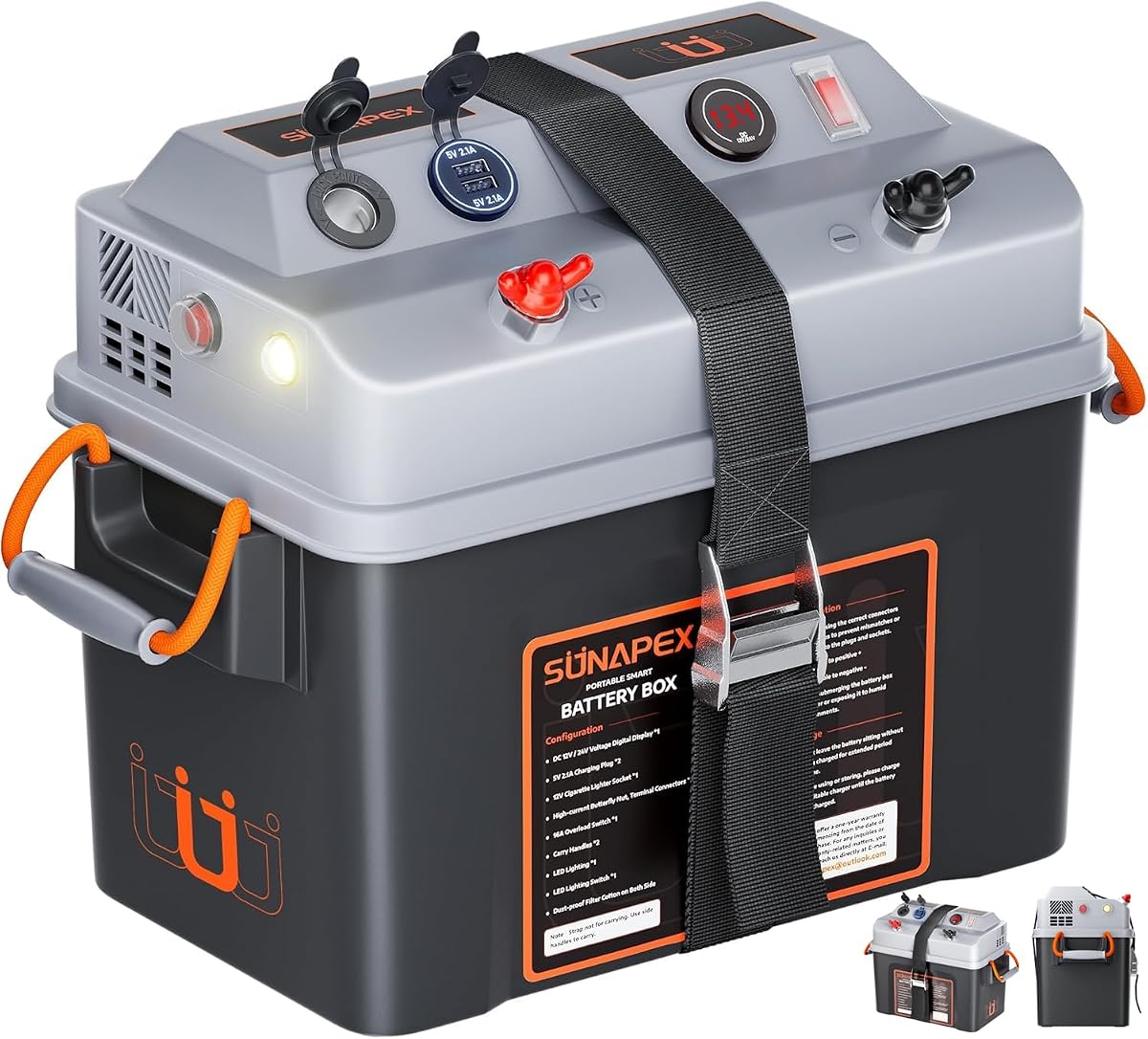
This SUNAPEX marine battery box is a more streamlined version of the PRO power center. It supports Group 24, 27, and 31 AGM or lithium batteries, works with 12V and 24V systems, and has a 4.5 rating. As with the PRO, the battery is not included, so this is an accessory for an existing trolling motor setup rather than a complete energy source.
We may earn a commission when you buy through this link, at no additional cost to you.
The box provides a digital voltmeter, a 12V cigarette lighter socket, two 5V 2.1A USB ports, high-current terminals, and integrated lighting. A 16A overload switch protects the ports against excessive current and short circuits. The illumination is useful during dawn, dusk, or nighttime preparation, while the ergonomic side handles make the enclosure easier to carry between a storage area and the boat.
Its principal advantage over the PRO is simplicity. Owners who do not need Anderson plugs, high-wattage USB-C, or QC3.0 can use a less complex distribution box. The tradeoff is fewer connection options and a lower aggregate output for modern devices. The external measurements are 14 by 12.6 by 8.5 inches, and the internal measurements are 13.1 by 8.2 by 7.8 inches.
This model is a good fit for anglers who want an organized battery location, quick voltage checks, basic USB charging, and a light without carrying the additional connections found on the PRO. Make sure the separately purchased battery fits the internal dimensions and that the trolling motor's current requirements fall within the protected output paths. Secure the box against movement in the boat.
The digital voltmeter provides a fast indication of system voltage. It is a simple monitoring feature that can help with routine checks before launching or after returning from a trip.
The side-mounted light improves visibility around a battery area at night, while the ergonomic handles make the enclosure easier to transport. These details can matter in small boats where space and mobility are limited.
We may earn a commission when you buy through this link, at no additional cost to you.
The OPTIMA D34M BLUETOP is a 12V sealed AGM battery designed for both deep-cycle and starting applications. Its 4.3 rating is strong, and its listed specifications make it a credible option for smaller boats or as a starting battery that also supports electronics. It weighs 43.5 pounds and measures 10.06 by 6.88 by 7.94 inches.
We may earn a commission when you buy through this link, at no additional cost to you.
Its 750 cold-cranking amps and 870 MCA provide starting headroom, while a C20 capacity of 55Ah and a stated reserve capacity of 120 minutes support selected onboard loads. The Spiralcell construction uses 99.99 percent pure lead, and the battery is advertised as 15 times more resistant to vibration than standard flooded batteries and up to three times longer-lived than conventional flooded designs.
Compared with the 100Ah AGM batteries in this guide, the D34M has less nominal deep-cycle capacity. That makes it most appropriate when starting, electronics, and moderate accessory loads are the priority rather than maximum trolling motor runtime. It also lacks a smartphone monitoring system, although its sealed, maintenance-free design means there is no app to configure.
This battery fits buyers who want a dual-purpose marine unit in a familiar sealed AGM format. It may serve as a dedicated engine-start battery, support a smaller trolling motor system, or provide dependable power for a boat's electronics. Check the available space, terminal orientation, and charging system before purchase, and evaluate the motor's current draw against the available capacity.
The dual-purpose design makes the battery useful for engine starting as well as moderate accessory loads. That versatility can simplify a boat with limited battery space or a need for one battery to perform both roles.
The high vibration-resistance claim is important on a boat where constant motion and shock can fatigue conventional battery construction. The sealed AGM format also eliminates routine electrolyte servicing.
We may earn a commission when you buy through this link, at no additional cost to you.
This smart marine battery box combines battery storage, distribution, and charging in a portable center. It carries a 4.6 rating and accepts 12V or 24V deep-cycle batteries, making it relevant to trolling motor boats, kayaks, RVs, and camping equipment. The battery is not included, and two adhesive pads help keep it from shifting during travel.
We may earn a commission when you buy through this link, at no additional cost to you.
Its charging selection is the defining feature: USB-C Power Delivery up to 30W, QC3.0 USB-A up to 18W, a 12V socket, and an LCD voltmeter. A 50A Anderson-style quick connector provides a direct connection route for a trolling motor or other marine equipment. The connector rating is separate from the 10A resettable circuit breaker that protects the smaller accessory and charging outputs.
Safety and portability are handled with secure terminals, fuse protection, a master switch, a rugged polypropylene housing, and a carrying strap. The stated maximum battery weight is 35kg. These details make the box more suitable for mobile power than a permanently installed battery tray, while the monitor helps users check voltage in different locations.
Choose this option for anglers who want one movable center for trolling motor power, device charging, and basic 12V accessories. Verify the battery fit and weight, determine whether the 50A quick connector is sufficient for the motor, and keep accessory loads within the 10A breaker's limits. Because the battery is separate, compare the combined cost and capacity of the complete setup rather than the box alone.
USB-C Power Delivery and QC3.0 provide convenient charging for phones, navigation equipment, and other compatible devices. The LCD voltmeter adds status information without requiring a separate meter.
The rugged housing, carrying strap, secure terminals, and anti-shift adhesive pads make the center well suited to mobile use. The master switch provides a clear way to isolate connected equipment when the boat is not active.
We may earn a commission when you buy through this link, at no additional cost to you.
The most useful trolling motor battery is one whose chemistry, capacity, physical design, and electrical limits fit your boat. Compare the motor's draw, available space, charging method, and accessory loads before focusing on any single specification.
Choose capacity and discharge capability that comfortably cover the motor's rated current and the electronics operating at the same time.
Starting with the motor specification prevents an underpowered or electrically mismatched installation.
Compare usable energy rather than amp-hours alone, and leave some capacity margin for aging, cold weather, and electronics.
More capacity can extend runtime, but only when the charger, wiring, and installation are designed to handle the system.
Choose lithium for weight, usable capacity, and cycle longevity; choose AGM for simplicity and conventional charger compatibility.
Both chemistries can serve a trolling motor when their electrical ratings and charging setup match.
Verify charging cut-offs if you fish in freezing weather and allow the battery to reach a suitable temperature before charging.
Cold protection improves safety but does not eliminate the normal reduction in winter performance.
Look for a BMS with the protections required by your motor and electronics, then confirm that the surrounding wiring is equally well protected.
Battery safety is a system property, not an excuse for undersized wiring or missing circuit protection.
Prefer connected monitoring if you routinely operate far from shore or run several electrical loads at once.
Remote data can improve awareness, but reliable charging and correct battery selection remain more important than app features.
Measure the compartment and account for wiring, ventilation, restraint, and handling before buying a large pack.
The right capacity is only useful if the battery fits safely and can be secured against movement.
Plan a complete electrical architecture if expansion is likely, rather than treating additional capacity as a plug-and-play upgrade.
Expansion potential is useful only when the rest of the system is designed to support the intended voltage and load.
Before installation, identify the battery's chemistry, nominal voltage, capacity, terminal arrangement, and required charging profile. Mount the battery securely in a stable, ventilated location away from direct water exposure and moving parts. Use cables and marine-grade connections appropriate for the motor's current draw, and install correctly rated fuses close to the battery positive terminal.
For lithium batteries, use a charger designed for LiFePO4 chemistry and observe any low-temperature charging restrictions. For AGM batteries, use a charger compatible with sealed lead-acid batteries and the manufacturer's voltage settings. Keep terminals clean and tight, inspect connections periodically, and avoid repeatedly running the pack deeply discharged. The app or voltmeter can help confirm voltage and state of charge during use.
After each trip, disconnect loads as appropriate and return the battery to a proper charging setup. Check for swelling, corrosion, damaged cables, loose hardware, or unusual heat, and keep the compartment clean and ventilated. If a fault alert appears or performance changes materially, stop using the affected battery until the issue is investigated. Recycle or return spent batteries through an appropriate battery-recycling program.
The appropriate capacity depends on the motor's rated current, expected runtime, battery age, and the other electronics drawing power. A 100Ah lithium battery is a common starting point for many 12V systems, while a 320Ah pack offers a much larger reserve. Divide the battery's usable watt-hours by the approximate average system draw to estimate runtime, then allow extra margin for cold weather and aging.
A properly sized LiFePO4 marine battery with a functional BMS is designed to support demanding deep-cycle applications. Protection circuits address overcharge, over-discharge, short circuits, over-current, and overheating. Safe performance still depends on correct mounting, ventilation, compatible charging, appropriate fusing, and avoiding charging under the manufacturer's low-temperature restrictions.
It is best to use a charger specifically configured for LiFePO4 chemistry. A lead-acid charger may use different absorption or equalization stages that are inappropriate for lithium chemistry. The battery manual or manufacturer should define the appropriate charger voltage, current, and temperature limits before the battery is connected.
A battery box is optional, but it can make wiring neater and keep the battery stable while protecting connections. The SUNAPEX and smart marine power centers in this guide also provide fused outlets, voltmeters, switches, or charging ports. Remember that these boxes do not include batteries, so a compatible AGM or lithium pack must be purchased separately.
Two 12V batteries can be connected in parallel for more capacity at the same voltage or in series for a higher-voltage system. The correct arrangement depends on the motor and controller, while series and parallel configurations require compatible batteries, balanced wiring, suitable fusing, and an appropriate charger. Follow the battery manufacturer's instructions rather than assuming any two packs can be combined safely.
Calculate the system's average current draw in amps and divide the battery's usable amp-hour capacity by that figure for a rough runtime estimate. Motor speed, wind, waves, boat weight, and electronics loads can change actual consumption considerably. Treat the calculation as a planning guide, not a guarantee, and use the battery monitoring features to track real conditions when available.
A 100Ah battery can support many 55 lb trolling motor installations, especially when paired with suitable wiring and a charger that can replenish it between trips. Runtime depends on motor current, boat conditions, and simultaneous electronics loads. A larger 320Ah battery provides more reserve, but the motor's manufacturer recommendations and the boat's available space should guide the final choice.
Store the battery in a cool, dry, ventilated location away from combustible materials and direct heat. Keep it at an appropriate state of charge, use a compatible charger for its chemistry, and avoid leaving a lithium battery below its permitted charging temperature. Periodically inspect the case, terminals, and cables for corrosion, swelling, or damage.
The 12V 100Ah Marine LiFePO4 Bluetooth Battery is the strongest all-around choice because it combines trolling motor-focused capacity, real-time monitoring, a 100A BMS, cold-weather discharge protection, and expansion support. The Interstate 12V 100Ah AGM remains a compelling conventional option for owners who prefer simple charging and a familiar marine format, while the 12V 320Ah Bluetooth Battery offers the premium package for maximum runtime.
Prioritize the factors your boating setup actually demands: match the motor voltage and current, choose usable capacity for realistic runtime, verify charging compatibility, and make sure the battery fits and can be secured. App monitoring is useful but secondary to sound wiring, correct fusing, compatible connectors, and a dependable charging plan. Battery boxes can improve cable organization and device charging, although they require a separate battery.
Finally, confirm the latest specifications, current customer feedback, dimensional details, and price before making a purchase. Ratings and product configurations can change over time, and a battery's value depends as much on the surrounding electrical system as on the individual unit.