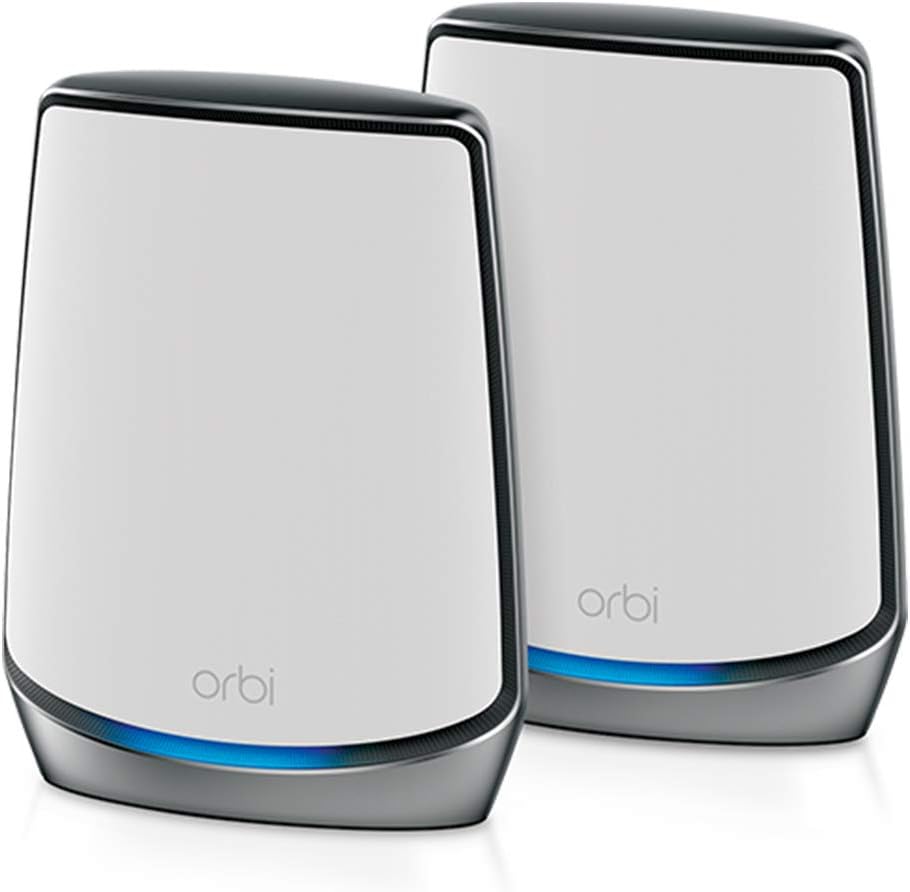
NETGEAR Orbi RBK852
4.3Editor score
Covers up to 5,000 square feet
Router with one WiFi 6 satellite
AX6000 tri-band wireless networking
Supports up to 100 devices
Our Netgear Orbi WiFi System guide compares coverage, speed, backhaul, ports, security, and expansion options to help you choose the right model for your home.
A Netgear Orbi WiFi System is designed to eliminate weak coverage and inconsistent connections by combining a router with one or more mesh satellites. The right configuration depends on home size, construction, device count, internet speed, wired-backhaul options, and whether you want room to expand later.
This guide compares ten systems and mesh products using the specifications and feature details supplied by their manufacturers and retailers. It considers wireless generation, advertised aggregate speed, coverage area, backhaul architecture, Ethernet connectivity, security features, compatibility, and practical expansion paths.
Each review explains who the product is best suited for, along with its strongest benefits and practical limitations. The featured selections include complete Orbi systems, standalone satellites, a cable modem combination, and two Deco alternatives for shoppers comparing mesh ecosystems.
4.3Editor score
4.2Editor score

3.7Editor score
The comparison below highlights the major differences among complete mesh systems, add-on satellites, a cable modem combination, and two competing Deco systems, with special attention to coverage, wireless generation, backhaul, and wired connectivity.

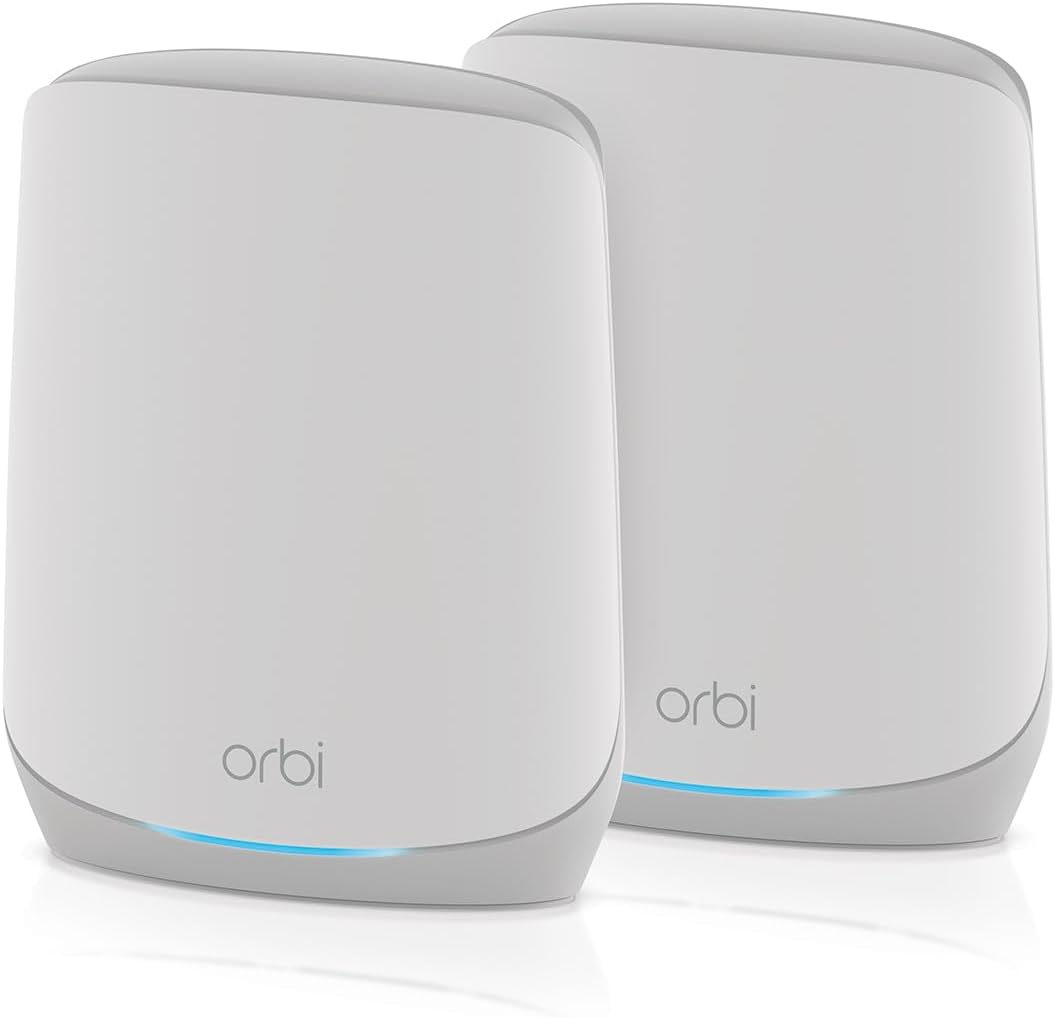


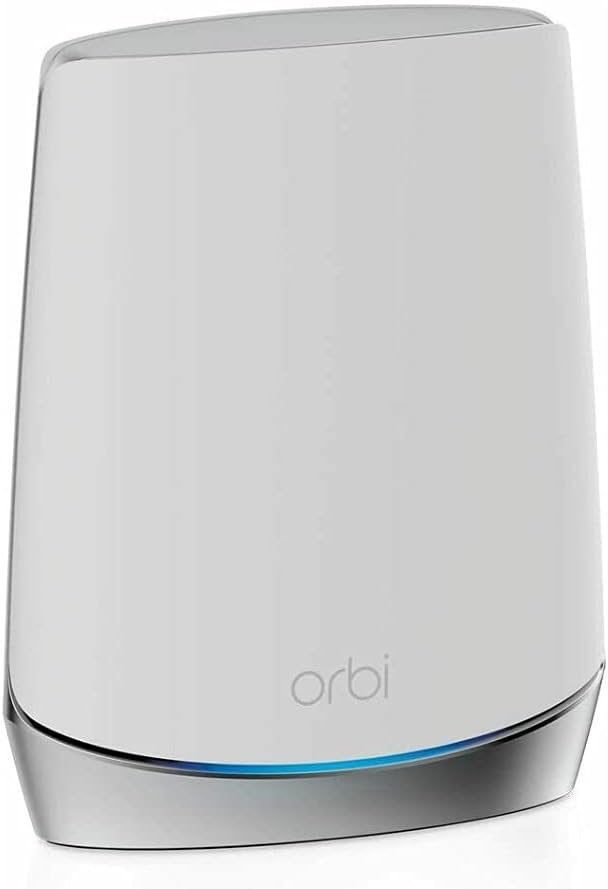

The NETGEAR Orbi 970 Series WiFi 7 Mesh System Add-on Satellite is a purpose-built expansion unit rather than a complete networking system. It carries a 3.3 rating and is designed to work exclusively with Orbi 970 Series models RBE971, RBE972, and RBE973. Its primary appeal is the combination of WiFi 7 performance, dedicated backhaul, and an advertised additional coverage area of up to 3,300 square feet.
We may earn a commission when you buy through this link, at no additional cost to you.
The satellite uses patented Quad-Band technology with Enhanced Dedicated Backhaul to reserve wireless capacity for communication between mesh nodes. That architecture is intended to keep client traffic moving even when several devices are active throughout the home. It also supports WiFi 6, WiFi 5, and older devices, while the supplied specifications identify use cases including 8K streaming, gaming, virtual reality, and video calls.
The most important limitation is compatibility. This hardware does not create a mesh by itself and cannot serve as a general-purpose router or extender for an unrelated network. It is also a satellite rather than a full kit, so buyers without an existing 970 Series system should choose one of the complete RBE972S or RBE973S bundles instead. The 3.3 rating also makes it difficult to recommend for buyers who place greater weight on customer feedback.
This satellite is best for an existing 970 Series owner who has discovered a weak area beyond the current mesh layout. It is particularly suitable when a wired backhaul route is unavailable but the household still wants the multi-band benefits of the 970 Series. For everyone else, the lack of stand-alone functionality and exclusive ecosystem requirement outweigh the strong coverage and speed claims.
Enhanced Dedicated Backhaul reserves a wireless lane for mesh traffic, helping client devices retain capacity when several nodes communicate. This makes the satellite useful in larger homes where every radio band is likely to carry regular traffic.
The unit is designed to fill a remaining coverage gap in an existing 970 Series network. Its single-network roaming experience lets connected devices move between the router and satellite without requiring separate network credentials.
We may earn a commission when you buy through this link, at no additional cost to you.
The NETGEAR Orbi 970 Series RBE973S is the most complete premium option in this guide. It combines a router and two satellite extenders, carries a 3.7 rating, and is built around Quad-Band WiFi 7. The supplied specifications advertise speeds up to 27 Gbps, coverage up to 10,000 square feet, support for as many as 200 devices, and a 10 Gig Internet port.
We may earn a commission when you buy through this link, at no additional cost to you.
Its defining technical feature is patented Quad-Band technology with Enhanced Dedicated Backhaul. The dedicated backhaul arrangement is designed to preserve client-facing performance while the mesh nodes communicate, making the package more compelling for large homes with many simultaneous users. WiFi 7 remains backward compatible with older WiFi devices, so a household does not need to replace every phone, television, or smart-home product at once.
NETGEAR includes security measures and automatic firmware updates, with Advanced Router Protection described as offering enhanced safety features and updates. The product is made for use in the United States. Buyers should not interpret the 27 Gbps figure as guaranteed internet speed; it represents a theoretical wireless aggregate, and actual service remains constrained by the internet plan, client hardware, distance, walls, interference, and the placement of nodes.
The RBE973S is the right recommendation for large homes seeking a current-generation mesh, high device capacity, and room for demanding streaming, gaming, virtual reality, and conferencing. It may be excessive for a small apartment, but the complete three-node package and 10 Gig Internet port provide a strong foundation for demanding networks. The lower 3.7 rating is the main reason to compare it carefully with well-reviewed alternatives.
With a router and two extenders, this package is structured for broad floor coverage and high device counts. The claimed 10,000-square-foot reach makes it more relevant to large homes than to compact spaces where a smaller two-node kit may be sufficient.
The 10 Gig Internet port prepares the system for suitably fast service and local network transfers. It does not make every satellite port faster, so buyers should also consider whether Ethernet wiring can support a wired-backhaul arrangement.
We may earn a commission when you buy through this link, at no additional cost to you.
The NETGEAR Orbi RBK852 balances coverage, features, and customer feedback better than most complete systems in the guide. Its 4.3 rating is among the highest listed, while the bundle combines an Orbi router with one satellite extender. The system uses tri-band WiFi 6, advertises aggregate performance up to 6 Gbps, covers up to 5,000 square feet, and targets as many as 100 connected devices.
We may earn a commission when you buy through this link, at no additional cost to you.
The router and satellite each provide four Gigabit Ethernet ports, giving owners multiple options for computers, game consoles, streaming devices, and other wired equipment. It connects to an existing cable modem and is compatible with internet providers offering service up to 2.5 Gbps. Additional Orbi satellites can extend coverage by up to 2,500 square feet each, making the initial setup a practical starting point for a medium or large home.
NETGEAR Armor is included with a 30-day trial and provides tools intended to help protect against hackers, malware, and identity theft. Continued use beyond the trial requires a separate subscription, a detail worth recognizing when comparing the package with systems offering longer included security terms. Setup and management are handled through the Orbi app, and the product is made for use in the United States.
This is a compelling recommendation for buyers who want proven tri-band WiFi 6 mesh performance without moving to the newest WiFi 7 platform. It is a good fit for medium homes, many-device households, and users who want a router with a satellite but still retain an expansion path. Those with newer WiFi 7 clients, very fast service, or unusually complex coverage needs should compare the 970 Series instead.
One included satellite is enough for many moderate homes, while the ability to add further units makes the architecture adaptable. Expansion is most effective when each new node has a clear line of communication with the rest of the mesh.
Four Gigabit Ethernet ports on each node make it easier to connect desktop computers, consoles, streaming boxes, and network storage. Users can also use Ethernet where available to reduce reliance on wireless backhaul.
We may earn a commission when you buy through this link, at no additional cost to you.
The NETGEAR Orbi RBK762S is a streamlined WiFi 6 mesh bundle with a 4.1 rating. It includes a router and one satellite extender, provides up to 5,000 square feet of advertised coverage, and is designed for up to 75 devices. Its AX5400 tri-band platform targets everyday streaming, HD gaming, and web conferencing without moving into the higher aggregate speed class of the RBK852.
We may earn a commission when you buy through this link, at no additional cost to you.
This package includes a one-year NETGEAR Armor subscription, which is a meaningful advantage over the RBK852's 30-day trial. It connects to an existing cable modem and supports internet service providers with speeds up to 2.5 Gbps. The router includes three Gigabit Ethernet ports, while the satellite includes two, providing enough wired connectivity for essential devices without matching the four-port layout of the RBK852.
Expansion uses the Orbi 760 satellite sold separately, and the product data describes this process as straightforward through a button-based approach. That narrower expansion path means buyers should not assume it works with every Orbi satellite from another series. Compatibility should therefore be checked before planning a larger deployment or mixing generations of equipment.
The RBK762S is a strong fit for buyers prioritizing included security service, straightforward expansion, and a two-node system for a medium home. It may be a better fit than the RBK852 for households that value a longer ARMOR term more than extra Ethernet ports and a higher stated device target. It is less appropriate for buyers who want the newest wireless generation or a large three-node package from the start.
The supplied information distinguishes this model by including a one-year ARMOR subscription. Buyers can use that year to evaluate the protection suite and parental features before deciding how they want to continue.
The RBK762S is designed to add coverage with an Orbi 760 satellite. This dedicated path keeps the initial installation approachable while allowing another room or floor to be served later.
We may earn a commission when you buy through this link, at no additional cost to you.
The NETGEAR Orbi 970 Series RBE972S brings WiFi 7 to a two-node configuration and carries a 3.3 rating. The supplied specifications advertise aggregate speeds up to 27 Gbps, coverage up to 6,600 square feet, support for up to 200 devices, and a 10 Gig Internet port. The bundle includes one router and one satellite extender.
We may earn a commission when you buy through this link, at no additional cost to you.
Quad-Band technology with Enhanced Dedicated Backhaul is the system's strongest technical feature. It reserves capacity for communication between mesh nodes while clients use the other available bands. The system is backward compatible with older WiFi devices and is positioned for 8K streaming, conferencing, gaming, and virtual reality use, although actual performance depends on the client, service, and environment.
The package includes built-in security measures, automatic firmware updates, and industry-leading safety features. It is made for use in the United States. Despite the high theoretical performance and generous device target, the 3.3 customer rating is notably weaker than the RBK852, RBK853, and the two Deco products in this comparison.
The RBE972S makes sense for a buyer who wants a WiFi 7 Orbi system but does not need the RBE973S's second satellite. It can suit a large home where one router and one extender provide sufficient physical reach, particularly when newer devices can benefit from WiFi 7. Buyers with more demanding coverage requirements or greater interest in established customer satisfaction should carefully compare the alternatives.
WiFi 7 can offer meaningful benefits to compatible clients, while older devices remain supported. The benefit is most relevant when several modern phones, computers, televisions, and smart-home products compete for network capacity.
The stated support for 200 devices suits busy homes with many connected products. That figure describes intended capacity, not a guarantee of uniform speed in every room or under every interference condition.
We may earn a commission when you buy through this link, at no additional cost to you.
The TP-Link Deco 7 Pro BE10000 is a credible alternative for shoppers willing to consider another mesh ecosystem. Its 4.2 rating, three-node package, and WiFi 7 hardware position it strongly against the complete Orbi bundles. The three units cover up to 7,600 square feet, support more than 200 devices, and use a tri-band BE10000 architecture with combined advertised speeds of 5,188 Mbps on 6 GHz, 4,324 Mbps on 5 GHz, and 574 Mbps on 2.4 GHz.
We may earn a commission when you buy through this link, at no additional cost to you.
Each unit includes four 2.5G WAN/LAN ports and a USB 3.0 port. WiFi 7 and 2.5G Ethernet can work together to balance traffic between Deco nodes, although backhaul still requires at least two units. The network presents one network name and uses AI-Roaming technology to support movement between locations. Because this is a Deco system, it cannot join an existing Orbi mesh or function as an Orbi satellite.
Security and utility features are extensive. The supplied details describe network protection, parental controls, real-time IoT security, VPN support, and simultaneous VPN plus regular internet connections. The Deco app handles setup, management, and firmware updates, while a separate modem is required. The system is backward compatible with earlier WiFi generations and works with most internet providers.
This product is worth serious consideration for a buyer prioritizing 2.5G port availability, extensive management tools, and strong customer feedback. It is particularly attractive when every node benefits from multiple 2.5G connections, since a typical Orbi WiFi 6 kit offers only Gigabit ports. The trade-off is ecosystem separation: choosing Deco means all mesh nodes must come from the Deco range, so the decision should be made before installation.
Four 2.5G ports per node are a significant advantage for local networks, modern connections, and homes with multiple wired endpoints. The port density makes this package relevant to buyers who do more than use the system as basic wireless access.
AI-Roaming adapts to movement and network conditions to help maintain a stable connection. Users can move among rooms while retaining one network name, reducing the need to switch manually between separate access points.
We may earn a commission when you buy through this link, at no additional cost to you.
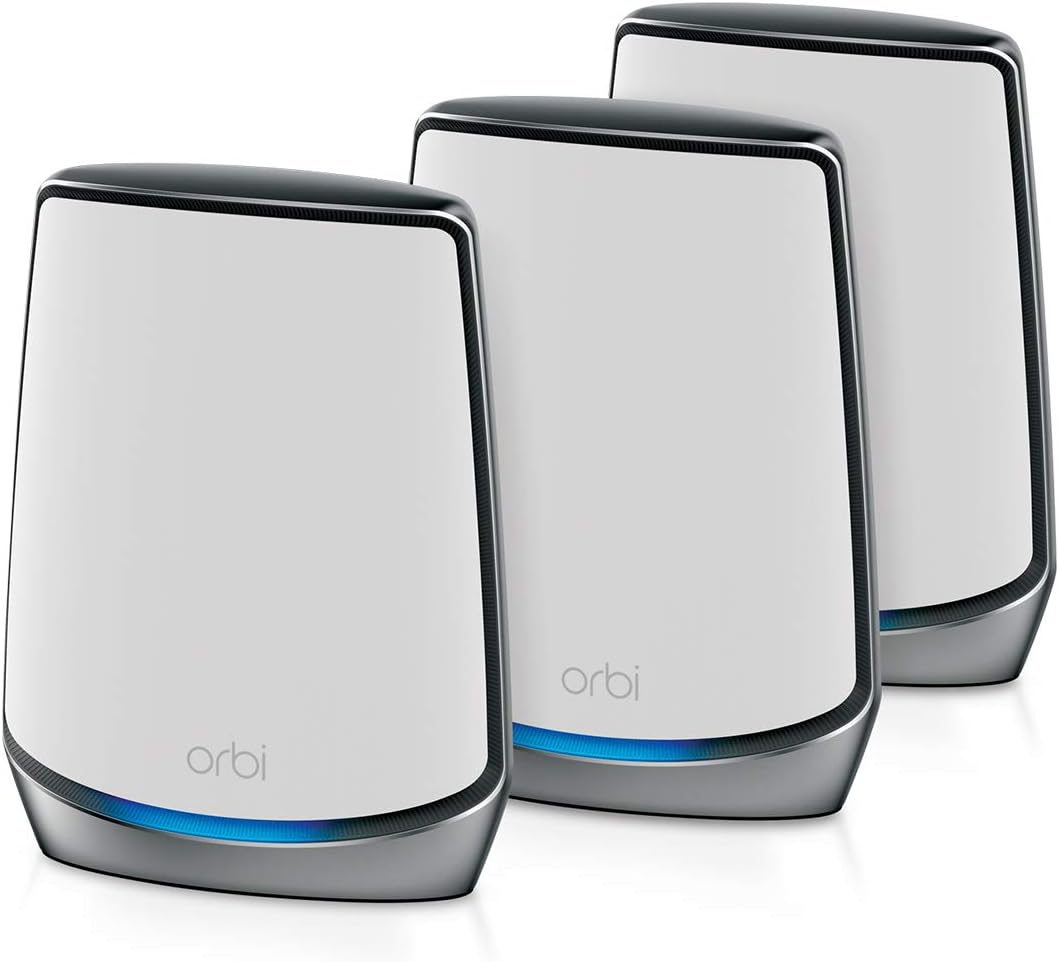
The NETGEAR Orbi RBK853 is the best overall recommendation because it combines a complete three-node configuration, broad coverage, useful wired connectivity, and a favorable 4.2 rating. It supports up to 7,500 square feet and as many as 100 devices, while its AX6000 tri-band WiFi 6 architecture advertises aggregate performance up to 6 Gbps.
We may earn a commission when you buy through this link, at no additional cost to you.
The package includes one router and two satellite extenders, reducing the need to purchase add-on nodes after installation. Each unit provides four Gigabit Ethernet ports, allowing computers, game consoles, streaming players, storage, and other equipment to use stable wired connections. The system connects to an existing cable modem and supports internet service up to 2.5 Gbps across cable, satellite, fiber, and DSL providers.
Its main trade-off is that it remains a WiFi 6 platform. Newer clients and the 970 Series offer WiFi 7, while the 760 Series has different port counts and expansion compatibility. NETGEAR Armor includes a 30-day trial, meaning a longer-term subscription is needed to retain access to that paid protection after the trial. The product is also made for use in the United States.
This is the most balanced choice for a large home that needs comprehensive wireless coverage now and may add a node later. It suits families that value a proven Orbi setup, a 4.2 rating, and abundant Gigabit ports without requiring the newest standard. Choose the RBE973S instead for WiFi 7 and a 10 Gig Internet port, or the RBK852 for a smaller home and a lower-tier starting point.
Including two satellites allows the installer to serve several floors or widely separated rooms without immediately buying another unit. Coverage still depends on sensible placement, but the larger package reduces the amount of extra hardware required.
Four Gigabit Ethernet ports are available on the router and both satellites. This consistency is useful for a home office, entertainment area, or another location where several wired devices need access to the mesh.
We may earn a commission when you buy through this link, at no additional cost to you.
The NETGEAR Orbi CBK752 is a DOCSIS 3.1 cable modem router combined with a mesh satellite. It carries a 4.0 rating and uses AX4200 tri-band WiFi 6 with advertised aggregate performance of 4.2 Gbps. The supplied specifications list coverage up to 5,000 square feet in open layouts and support for 40 or more devices.
We may earn a commission when you buy through this link, at no additional cost to you.
Its defining advantage is consolidation. Instead of operating a separate cable modem and standalone WiFi router, compatible cable customers can use one integrated system. The modem router has four Gigabit Ethernet LAN ports and the satellite has two, providing useful wired options for game consoles, streaming players, computers, and storage drives. An optional RBS750 satellite can add up to 2,500 more square feet.
Provider compatibility requires careful attention. The system is certified with Xfinity for service up to 900 Mbps, Spectrum up to 1 Gbps, and Cox up to 1 Gbps. It is not compatible with fiber, DSL, or satellite internet. Customers should contact their provider for activation and confirm current service and equipment requirements. A physical coax connection is required.
The Orbi app supports setup and management on iOS or Android or through a web browser. NETGEAR includes automatic firmware updates, WiFi encryption, a separate guest network, and a 30-day NETGEAR Armor trial. This is a practical choice for a compatible cable household that wants fewer boxes and an integrated mesh, but it is a poor fit for non-cable services or buyers wanting a provider-independent router.
The integrated cable modem router can simplify a compatible cable installation by combining two roles in the primary unit. The included satellite then handles wireless coverage without requiring a separate conventional router.
Certification and service limits vary by cable provider. The stated Xfinity, Spectrum, and Cox limits make advance verification important, while the lack of fiber, DSL, and satellite support narrows the product's audience.
We may earn a commission when you buy through this link, at no additional cost to you.
The NETGEAR Orbi RBS750 is an add-on satellite with a 4.4 rating, the highest customer rating among the products compared. It is designed to add up to 2,500 square feet of coverage to an Orbi WiFi 6 system, specifically identifying compatibility with the RBK752. Its AX4200 tri-band architecture advertises aggregate performance up to 4.2 Gbps.
We may earn a commission when you buy through this link, at no additional cost to you.
The satellite extends an existing mesh rather than creating a standalone network. Devices can move throughout the home on one WiFi network name, reducing the need to manually select a different extender. Installation and management are handled through the Orbi app, and the product follows the same general mesh experience as the compatible RBK752 system.
Compatibility is the decisive limitation. This is not a general-purpose range extender and it should not be assumed to work with the 970 Series, the 760 Series, or every other Orbi generation. Buyers should verify the exact system model before ordering. It also cannot act as the primary router, provide internet service, or solve an incompatible-network problem.
The RBS750 is an excellent choice for an RBK752 owner who needs to cover a basement, garage, upstairs room, or another poorly served area. Its strong rating supports the satellite approach, and tri-band wireless backhaul helps maintain performance as the network expands. For a new installation, however, the RBK853 or RBK852 is generally more straightforward than assembling a compatible system separately.
The 2,500-square-foot addition is focused on a specific weak area rather than an entire home. Positioning the satellite near the main router and near the target room usually produces better results than placing it at the far edge of the property.
A shared network name lets compatible devices move between the router and satellite more seamlessly. This is especially helpful for calls, streaming, and other sessions that could be interrupted by manually changing networks.
We may earn a commission when you buy through this link, at no additional cost to you.
The TP-Link Deco 7 BE5000 is a dual-band WiFi 7 mesh system with a 4.3 rating. It is included to show how a competing mesh platform compares with Orbi rather than because it can extend an Orbi installation. The system covers up to 6,600 square feet, supports more than 150 devices, and advertises speeds of up to 4,324 Mbps on 5 GHz and 688 Mbps on 2.4 GHz.
We may earn a commission when you buy through this link, at no additional cost to you.
Its four-stream design and 240 MHz specification target 4K and 8K streaming, augmented reality, and virtual reality applications, although performance changes with distance, interference, walls, and client capabilities. WiFi 7 and 2.5G Ethernet work together to balance traffic between Deco units, but at least two units are required for backhaul. The separate modem requirement also applies.
TP-Link includes a unified network with one name, AI-Roaming, VPN support, and simultaneous VPN plus standard internet connections. The security information identifies a one-year subscription to TP-Link HomeShield, with basic network security, parental controls, quality of service, and reports available without the paid service. The Deco app handles setup, management, and firmware updates.
This system is a good value-oriented alternative for a buyer who wants WiFi 7, 2.5G connectivity, and strong customer feedback without moving to a premium quad-band Orbi model. It is less suitable for shoppers already invested in Orbi, because Deco units work with other Deco products and cannot become part of an Orbi mesh. It also offers a lower wireless aggregate class than the tri-band Deco 7 Pro.
The dual-band layout focuses capacity on 5 GHz and 2.4 GHz rather than adding a third band. That can provide a simpler system for homes that need modern wireless generation without the complexity of a quad-band platform.
VPN support, basic parental controls, quality of service, and device identification add value for everyday administration. The Deco app keeps configuration and firmware updates in one place, although account and service details should be reviewed before setup.
We may earn a commission when you buy through this link, at no additional cost to you.
The best Orbi system depends less on the largest advertised speed and more on a careful match among home size, building materials, node placement, internet service, wired-backhaul opportunities, device requirements, and expansion plans.
Start with the floor plan rather than relying on a square-foot estimate alone. A two-node system may be adequate for a compact, open home, while a three-node package is more useful when rooms span several floors or the router cannot be placed centrally. Advertised coverage assumes favorable conditions, and thick walls, concrete, appliances, metal, and long corridors can reduce practical range. Measure the dimensions of every usable floor and identify where dead zones currently occur.
Choose a package with enough nodes to place one in a central location and another near each problematic area. Avoid stacking satellites beside the router, because that does not create meaningful additional coverage. For very large properties, a three-node system may be the minimum, while extra Orbi-compatible satellites can extend coverage further.
WiFi 7 systems are appropriate for buyers with compatible devices and interest in future-facing capacity, while WiFi 6 remains fully backward compatible and can provide a more established platform. The 970 Series, Deco 7 Pro, and Deco 7 BE5000 offer WiFi 7, whereas the RBK852, RBK762S, RBK853, CBK752, and RBS750 use WiFi 6. An old smartphone does not prevent a WiFi 7 router from working, but it cannot take advantage of every newer capability.
Prioritize the number and type of clients that will use high-speed wireless. Recent computers, televisions, phones, and consoles may benefit from newer standards, while basic browsing, printing, and many smart-home products work effectively on WiFi 6. Avoid paying for a premium generation if the household's demanding clients remain limited to older equipment.
Backhaul is the connection between mesh nodes, and its capacity affects how quickly local data can travel throughout the home. The 970 Series uses Quad-Band technology with Enhanced Dedicated Backhaul, while the other complete Orbi systems use tri-band arrangements. Dedicated backhaul is designed to preserve bandwidth for client traffic, but it cannot overcome poor placement or severe interference.
For the best results, place the router near the internet entry point and first service area, then position satellites where they can communicate clearly with another node. Wired Ethernet backhaul is generally preferable where available because it removes wireless communication from the link between nodes. Keep nodes elevated, open, and away from enclosed cabinets, microwaves, metal objects, and other sources of interference.
A faster mesh cannot create internet speed that the provider does not deliver. The RBK852, RBK762S, RBK853, and CBK752 support providers with service up to 2.5 Gbps, while the 970 Series includes a 10 Gig Internet port. Choose a port class that leaves room for the current plan and potential upgrades, but do not confuse a 10 Gbps port with a 10 Gbps internet connection.
Consider local traffic separately. Large file transfers, network storage, cloud backups, and media servers can move data between devices without using the internet. In those cases, multiple 2.5G or Gigabit Ethernet ports on each node can be more valuable than a higher aggregate wireless figure. The Deco 7 Pro's four 2.5G ports per node stand out in this respect.
Count more than phones and laptops. Televisions, speakers, cameras, appliances, consoles, work devices, and smart-home products all create background traffic and contribute to the number of associations the system must support. The RBK852 and RBK853 target up to 100 devices, the RBK762S targets 75, the 970 Series bundles target 200, and the Deco systems advertise support for 150 or more.
The larger number is not automatically the better experience. Households that stream in 4K or 8K, participate in high-resolution gaming, conduct frequent video calls, or transfer large files need sufficient per-client capacity as well as device capacity. Match the system to peak simultaneous use rather than the total number of devices present in the home.
Inspect the port count and speed on every included unit. The RBK852, RBK853, and CBK752 provide four Gigabit Ethernet ports on the router or relevant primary unit, while the RBK762S has three on the router and two on its satellite. The Deco 7 Pro provides four 2.5G ports on each node, and the Deco 7 BE5000 combines WiFi 7 with 2.5G Ethernet connectivity.
Decide where wired devices will operate before choosing a mesh. A gaming console, desktop, streaming box, or storage device can benefit from a stable Ethernet connection. If the layout allows, wiring satellites to the router creates a more dependable backhaul path. Otherwise, a dedicated wireless backhaul system is essential to maintaining performance throughout the home.
Security is more than a checkbox on the specification sheet. Compare automatic firmware updates, WiFi encryption, guest networking, parental controls, IoT protection, and the terms of any paid security subscription. The RBK762S includes a one-year NETGEAR Armor term, while the RBK852 and RBK853 include 30-day trials. The Deco 7 BE5000 provides basic features without its paid service and a one-year HomeShield subscription.
Look for controls that are understandable and useful to everyone managing the network. A subscription that provides protection your household will actually configure may be more valuable than a longer trial for features that remain unused. Also verify whether advanced functions continue without payment, particularly if family members rely on parental filtering or threat protection.
Mesh systems work best when all nodes belong to the same supported family. The RBS750 is specifically identified as compatible with the RBK752, while the RBK762S expands with an Orbi 760 satellite. The 970 Series add-on works with the RBE971, RBE972, and RBE973. These details matter because similar-looking satellites from different generations may not be interchangeable.
Deco units also form a separate ecosystem. They can work together with other Deco products and remain backward compatible with older WiFi generations, but they cannot extend an Orbi mesh. Plan the full system before buying the first component, and favor an architecture that can grow without forcing a complete replacement when another room needs coverage.
Begin by positioning the router near the modem or internet source, but choose an elevated and open location rather than hiding it inside a cabinet. Connect the appropriate Ethernet or coax cable, power the equipment, and use the Orbi or Deco app to complete setup. For a cable-modem combination, connect coax to the CBK752 and follow the provider's activation process. For a separate modem, connect the modem to the router's internet port before configuring the mesh.
Place each satellite in the area it will serve, keeping it within reliable communication range of another node. Run the app's speed and signal tests after installation, then move a node if a room remains weak. Avoid placing satellites in dead zones, near large metal objects, or behind televisions and entertainment cabinets. If Ethernet is available, test wired backhaul because it can provide a more stable connection between nodes than wireless backhaul.
Keep the app and firmware current, review connected devices periodically, and update administrator credentials before giving visitors access to the guest network. Preserve the original modem, router, and satellite for possible troubleshooting. If the connection fails, power-cycle the equipment and wait two minutes, as recommended for the CBK752, before removing or replacing any unit. Changes to placement and firmware usually resolve more mesh issues than replacing equipment immediately.
The RBK853 is a strong all-around answer because it includes a router and two satellites, supports up to 7,500 square feet, and provides four Gigabit Ethernet ports on every node. The RBE973S is the premium option for a house that needs WiFi 7, a 10 Gig Internet port, and even more advertised capacity. In either case, the package still needs careful placement because construction and interference can reduce real-world coverage.
Compatibility must be checked for each specific series. The RBS750 is listed as compatible with the RBK752, the RBK762S expands with an Orbi 760 satellite, and the 970 Series satellite works with the RBE971, RBE972, and RBE973. Similar product names and shared Orbi branding do not guarantee that every satellite can join every mesh.
WiFi 7 is most worthwhile when several recent devices perform demanding tasks at the same time and the home has a suitably fast internet plan. It is also a better long-term platform for users who expect frequent device upgrades. A WiFi 6 Orbi system remains backward compatible and can provide an effective mesh for ordinary browsing, streaming, gaming, and smart-home use.
No. Advertised mesh speed represents a theoretical or aggregate capability under ideal conditions, not the speed delivered by every client. The internet plan, WiFi generation of the client, distance, walls, interference, node placement, and backhaul method all influence the result. Wired devices and local transfers may also behave very differently from internet downloads.
No. The CBK752 is designed for compatible cable internet service and is not compatible with fiber, DSL, or satellite service. Its listed certifications include Xfinity, Spectrum, and Cox within specified service limits. Customers should contact their provider before buying to verify service availability, activation requirements, and current equipment policies.
A small or moderately sized open home may be well served by one router and one satellite, while a home spanning several floors may benefit from the three-node RBK853 package. Add nodes only where a real coverage problem remains and position them where they can communicate with the rest of the mesh. The number needed depends more on layout and building materials than on the total floor area alone.
Most standalone Orbi routers require a compatible modem or gateway to provide internet access. The CBK752 is the exception because it includes a DOCSIS 3.1 cable modem, though it only suits compatible cable providers. The Deco alternatives also require a separate modem for most internet services.
Wired backhaul is generally preferable when practical because it removes the inter-node connection from the wireless radio environment. If running Ethernet is inconvenient, a system with dedicated wireless backhaul, such as the 970 Series, is designed to preserve more client capacity. Either approach depends on proper placement and clean cable or power infrastructure where appropriate.
The NETGEAR Orbi RBK853 is the best overall option for most large homes because its router-and-two-satellite package combines broad advertised coverage, abundant Gigabit ports, and a 4.2 customer rating. The RBK852 is the more restrained choice for a medium home, while the RBE973S leads buyers seeking a premium WiFi 7 system with a 10 Gig Internet port and a large three-node configuration.
Prioritize the requirements that affect everyday performance: a suitable number of nodes, a central router position, short or wired backhaul links, enough Ethernet ports, and a wireless generation that matches the household's devices. Existing Orbi owners should also confirm satellite compatibility before expanding, while shoppers considering Deco should understand that it is a separate mesh ecosystem rather than an Orbi accessory.
Finally, check current prices, provider compatibility, subscription terms, and the latest product details before ordering. Mesh system prices and configurations can change, and promotional pricing may shift the value of a package. Comparing the current bundle with the permanent features it includes is the most reliable way to choose a system that fits the home and remains useful as connected devices grow.