
ROVE R2-4K
4.3Editor score
4K UHD front recording
Eight-megapixel Sony sensor
WiFi 6 and GPS
Compare 10 dash cams for semi truck use, including front, rear, cabin, and side coverage, night vision, GPS, parking mode, and ease of installation.
A dash cam for a semi truck must do more than record the road ahead. It should capture blind spots, support long installation runs, withstand demanding commercial-vehicle environments, and make important footage easy to retrieve. Resolution, low-light performance, storage support, parking protection, and accurate route data all influence which system is most useful.
This guide compares ten dash cam and camera-system options suited to semi trucks, trailers, vans, and other large vehicles. We evaluated the number of recording channels, front, rear, cabin, and side coverage, image sensors, night capabilities, GPS and WiFi functions, power compatibility, and the availability of mobile viewing and event protection.
Each review identifies the strongest reason to consider a particular system while also explaining its limitations. The list ranges from compact two-camera designs to multi-camera commercial setups and truck-focused navigators with integrated recording. Product availability and prices can change, so compare current listings and verify fit before purchasing.
4.3Editor score

4.5Editor score

4.2Editor score
The table below compares all ten systems by camera coverage, resolution, navigation or tracking features, and night or parking support, making it easier to identify the right format for a tractor, trailer, van, or mixed fleet.




The ROVE R2-4K Dual combines a front camera, rear camera, large sensor, GPS, and fast dual-band WiFi in a coordinated package. It earns a 4.5 rating and stands out as the most balanced option in this guide for drivers who want useful roadside evidence without moving through a complicated multi-screen DVR interface.
We may earn a commission when you buy through this link, at no additional cost to you.
Its front camera records at 2.5K and upscales to 4K, while the rear records at 1080P. That distinction matters because the front output is not native 4K, but the Sony STARVIS 2 IMX675 sensor, wide apertures, HDR, and upscaling can still produce sharper everyday playback than a basic 1080P system. Dual-band WiFi supports downloads of up to 20MB/s through the ROVE app, while built-in GPS stamps routes, locations, and speed onto recordings.
The main trade-offs are the need to purchase a hardwire kit for parking mode and the fact that the advertised 4K is upscaled rather than native. It also gives you only front and rear angles, so it does not provide the dedicated side or cabin coverage available from the VSYSTO and REDTIGER three-channel systems. Those limitations are reasonable for a driver whose priority is a clean, capable front-and-rear setup.
This is the strongest general recommendation for a semi truck owner seeking straightforward installation, quick phone access, and dependable road coverage. It is particularly attractive when a rear camera and memory card are desired in one package. Choose a multi-camera DVR instead if side blind spots, interior monitoring, or split-screen operation is more important than compactness and app simplicity.
The paired cameras cover the road ahead and the space behind the vehicle, which is useful when reviewing lane position, following vehicles, or a rearward incident. The front image benefits from the STARVIS 2 IMX675 sensor and HDR, while the 1080P rear camera provides a practical second perspective.
Dual-band WiFi and transfers advertised at up to 20MB/s make phone-based review more convenient than pulling files from the card. Built-in GPS adds route, location, and speed context without requiring a separate tracker, and the included 128GB card gets the system ready for use.
We may earn a commission when you buy through this link, at no additional cost to you.
The VSYSTO 3CH WiFi is purpose-built for large vehicles and provides simultaneous front, side, or rear recording on a 4.5-inch display. Its 4.0 rating reflects a capable package, and the three-camera layout offers more awareness around a long tractor or trailer than a conventional two-channel dash cam.
We may earn a commission when you buy through this link, at no additional cost to you.
The front camera captures 1080P, while the two separate cameras record 720P and include infrared night vision with waterproof camera construction. The display can show all three feeds simultaneously, while a yellow trigger wire can switch automatically to the appropriate side view when a turn signal is activated. The screen also presents vehicle voltage and speed, and the GPS module records coordinates, altitude, atmospheric pressure, and route information.
Its limitations are visible in the lower resolution of the secondary cameras and the absence of a stated hardwire kit. The configurable movie-off period is useful, but it should be paired with the stated low-voltage protection, which disables continued recording when vehicle voltage falls below the selected threshold. The system is more complex to install and configure than a compact front-and-rear system.
For a semi truck driver who routinely needs side visibility, this is a practical value choice. It is especially useful when trailer or blind-spot evidence matters more than maximum image resolution. Buyers should confirm the available power connection, mount each external camera where it will not be exposed to impact, and check the app with their phone before relying on it for daily evidence review.
The separate left and right cameras create a useful three-point record of the tractor and trailer. Their adjustable mounts and long connection cables allow installation around a larger vehicle, while the split display lets the driver monitor all available angles rather than relying on a single forward view.
GPS tracking captures speed, longitude, latitude, altitude, and atmospheric pressure, with route playback available through the app or computer software. The G-sensor locks collision-related recordings, and configurable loop lengths of one, two, three, or five minutes provide a reasonable balance between event detail and storage use.
We may earn a commission when you buy through this link, at no additional cost to you.
The REDTIGER F7NP is a front-and-rear system that emphasizes image detail, wide-angle context, and quick phone transfers. It holds a 4.1 rating, and its 4K front recording makes it a strong alternative for drivers who prioritize road footage over multi-camera or integrated navigation features.
We may earn a commission when you buy through this link, at no additional cost to you.
The STARVIS 2 sensor, F1.5 aperture, six-layer optical lens, WDR, and HDR work together to balance shadows and highlights. A 170-degree front lens and 140-degree rear lens capture broad surroundings, while 5.8GHz WiFi supports transfers advertised at up to 20MB/s. GPS data includes route, speed, and location, and the package includes a memory card for immediate setup.
The trade-off is coverage limited to two cameras, making it less useful for documenting both sides of a long combination vehicle or the cab interior. Parking surveillance also requires an additional hardwire kit. While the supercapacitor is preferable to a lithium battery for heat resistance and parking endurance, the system still demands thoughtful cable routing through a large cab.
This is a good fit for a semi truck operator who wants a high-resolution forward record and rear context with uncomplicated app-based review. It may be particularly useful for highway drivers who want the wider front perspective and detailed low-light images. Drivers needing side or cabin evidence should compare it with the three-channel REDTIGER F17 and VSYSTO systems.
Native 4K front recording gives the F7NP an advantage when distant vehicles, road signs, or license plates need to be reviewed. The broad 170-degree field of view expands situational awareness, while the rear camera preserves a second view at 1080P.
Seamless loop recording maintains ongoing coverage, while the G-sensor secures important event clips. The included card reduces setup friction, and the 5.8GHz WiFi connection speeds up preview, download, replay, and sharing through the Redtiger Cam app.
We may earn a commission when you buy through this link, at no additional cost to you.
The REDTIGER F17 4K 3CH combines a high-resolution front camera with 1080P inside and rear cameras, giving a semi truck driver a broad view of the cab and vehicle perimeter. Its 4.4 rating is among the strongest in this list, and the system is one of the more versatile three-channel options considered.
We may earn a commission when you buy through this link, at no additional cost to you.
A STARVIS 2 IMX675 sensor powers the front camera, with WDR and HDR improving dynamic range and low-light performance. The viewing angles are 150 degrees at the front, 160 degrees inside the cab, and 155 degrees at the rear. Users can record all three channels simultaneously or select a dual mode that preserves the front and rear. The app supports simultaneous three-channel replay, GPS metrics, and faster transfers over the 5GHz network.
Its principal trade-offs are the 1080P resolution of the cabin and rear cameras and the additional hardwire kit required for parking monitoring. As with any three-camera arrangement, cable management around a large truck takes planning, and the driver must choose mounting positions that do not obstruct safe operation or create vibration-prone images.
The F17 is a strong choice for long-haul drivers who want evidence of what happened ahead, behind, and inside the cab. It offers more comprehensive protection than a two-camera system without adopting the larger monitor and complex wiring of a dedicated commercial DVR. It is best for buyers who value a smartphone-centered system and flexible recording modes.
Three separate views let the driver document traffic ahead, activity behind the vehicle, and conditions inside the cab. This is especially useful for professional operators who need a wider account of an incident than a conventional front-and-rear arrangement can provide.
The system can retain all three channels in 2.5K dual-channel mode or prioritize 4K front and 1080P rear detail. That flexibility helps balance clarity with storage demands, while the 64GB card and fast WiFi reduce the friction of reviewing longer routes.
We may earn a commission when you buy through this link, at no additional cost to you.
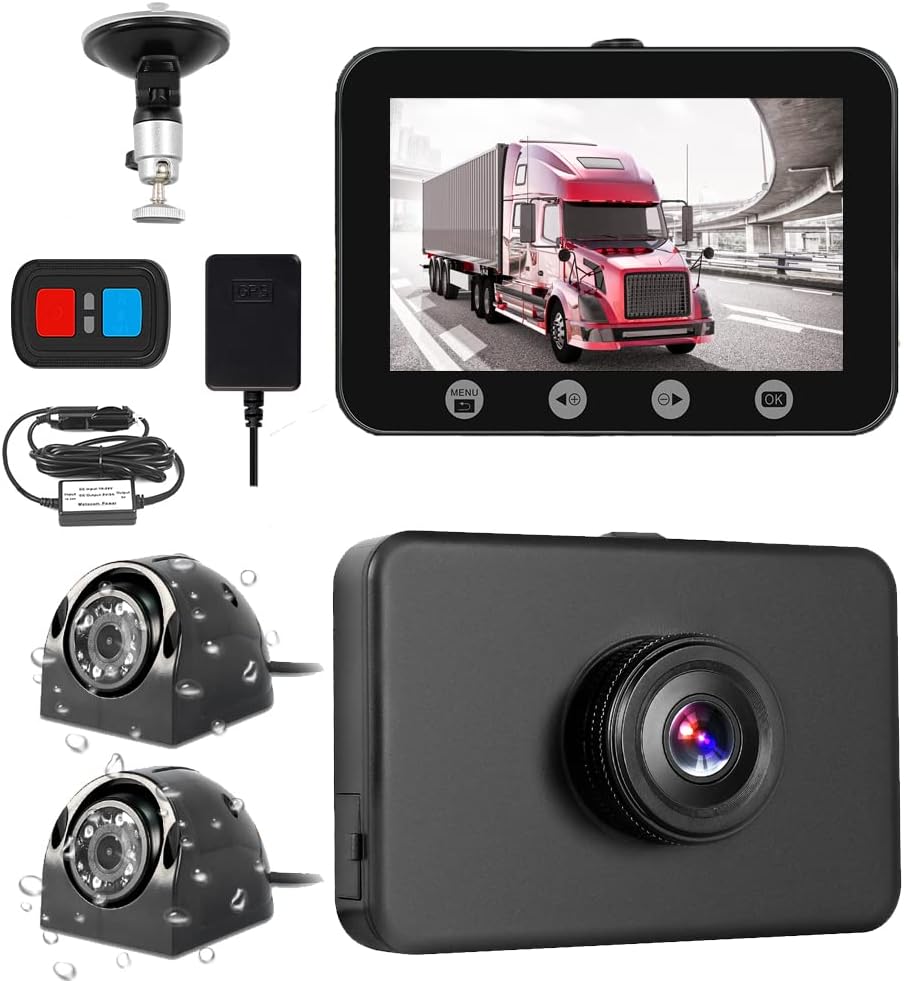
The VSYSTO T4.5M is designed to reduce blind spots with a front camera and two adjustable side cameras. Its 3.4 rating places it lower in the comparison, but its dedicated 12–30V compatibility, long cables, waterproof exterior cameras, and front-plus-side layout are directly relevant to semi truck installations.
We may earn a commission when you buy through this link, at no additional cost to you.
The front camera uses a 1080P CMOS sensor, while both side cameras record at 720P with infrared night vision. Their IPX7 waterproof rating supports operation in dark and adverse conditions. A 4.5-inch monitor displays a single or split view, and an included 2.4G remote provides manual control. Connecting the trigger wire to the turn-signal circuit automatically brings up the relevant side camera.
The main weakness is the 720P resolution of the side feeds, which may limit distant detail compared with higher-resolution multi-camera systems. Its 3.4 rating also suggests a less consistently satisfying experience than the best-rated choices. The large screen and long cable runs require careful planning, and users must route wiring away from moving and hot vehicle components.
This system makes the most sense for a driver who needs both sides of a large vehicle covered and values weather-resistant cameras over maximum resolution. It is also a logical choice for vans, trailers, RVs, and commercial trucks operating across a broad voltage range. Buyers should inspect the final camera placement and confirm that the trigger wiring behaves correctly before relying on automatic switching.
The 6.6-foot and 19.7-foot cables provide more installation reach than a compact two-camera kit. Adjustable mounts make it possible to aim the side cameras along the trailer or toward vulnerable areas, while the broad 12–30V power range supports numerous truck configurations.
IPX7 waterproof external cameras and infrared illumination improve the system's suitability for night operation and wet weather. The 1080P front channel supplies a clear primary record, while the side channels cover otherwise difficult-to-see zones.
We may earn a commission when you buy through this link, at no additional cost to you.
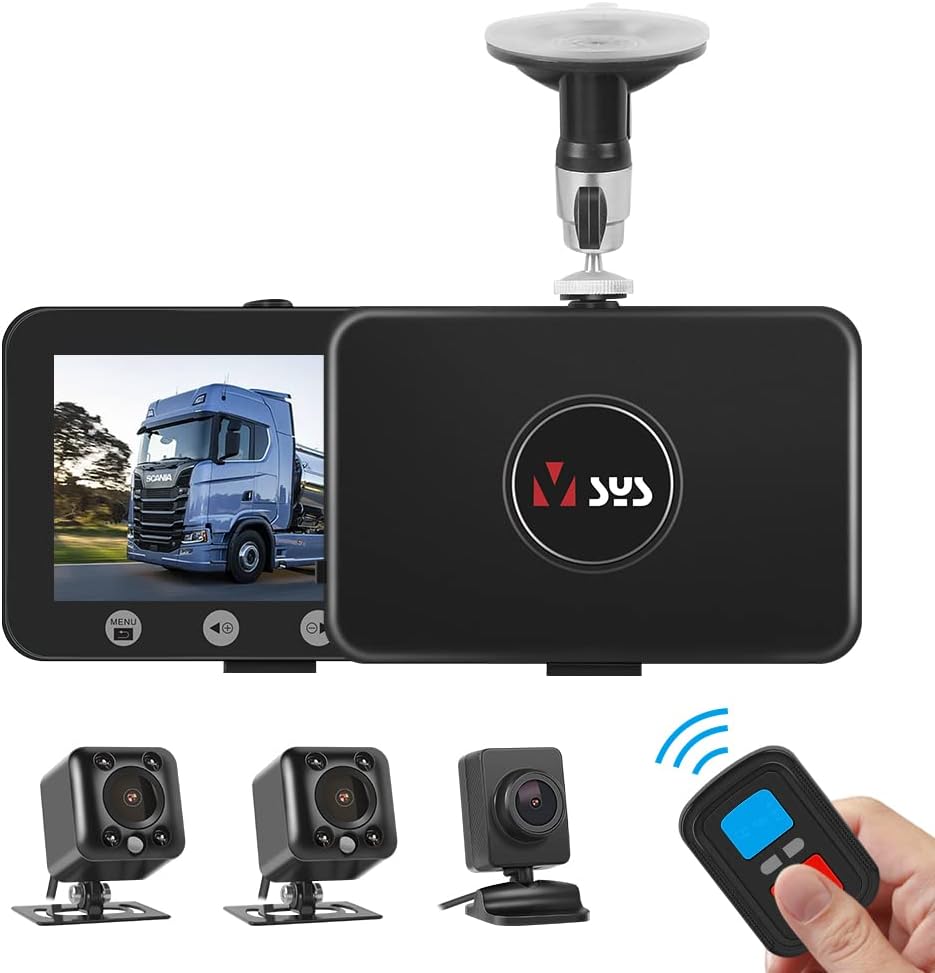
The VSYSTO T3 3CH is a straightforward commercial-vehicle recording system with a 3-inch monitor, 1080P front camera, and two 720P auxiliary cameras. Its 3.7 rating reflects a functional design with fewer high-end extras, but its weather resistance, automatic trigger switching, and flexible display modes are useful for semi truck use.
We may earn a commission when you buy through this link, at no additional cost to you.
Its external cameras carry IP67 waterproof resistance and use four infrared LEDs for low-light capture. The monitor can show one full view or a split screen with up to three feeds. Connecting the yellow wire to a turn or reverse trigger automatically changes the displayed camera, while the included 2.4G remote allows manual selection. Loop recording supports one-, three-, or five-minute files, and the G-sensor protects emergency footage.
The 3-inch screen is smaller than those on the more spacious VSYSTO systems, which may make multi-camera monitoring less comfortable. The described power arrangement uses the vehicle's cigarette-lighter socket through a 9–24V-to-5V converter, which should be checked against the power arrangement of the intended truck. The side cameras also remain at 720P.
The T3 is most appropriate for operators who want three-camera coverage and dependable triggering without a larger navigation display. Its automatic turn and reverse views can reduce blind spots during maneuvering, and its card capacity supports extended continuous recording. For in-cab navigation, a dedicated truck navigator may be the better choice.
Triggering the display with turn or reverse signals is a practical feature for a large vehicle. Instead of manually changing channels, the driver can see the relevant exterior camera as maneuvering begins, which is especially helpful around loading docks and tight trailer areas.
Infrared illumination and IP67 camera construction support recording in darkness and wet conditions. The system accepts memory cards up to 256GB, while loop recording and G-sensor locking preserve recent road context and collision-related evidence.
We may earn a commission when you buy through this link, at no additional cost to you.
The ROVE R2-4K is a straightforward 4K front camera with an eight-megapixel Sony sensor, WiFi 6, and GPS. Its 4.3 rating and clean feature set make it an attractive budget-oriented option for a semi truck driver who wants a dependable forward record without a larger multi-camera screen.
We may earn a commission when you buy through this link, at no additional cost to you.
It records at up to 2160P and uses a six-glass lens, F1.5 aperture, and Sony IMX415 sensor for low-light performance. A 150-degree wide-angle lens broadens the forward view, while the ROVE app provides live viewing, management, route review, and downloads at up to 6MB/s. The supercapacitor, emergency lock, time-lapse mode, motion detection, and G-sensor cover the essentials.
Two limitations are important for truck owners. First, it is a single-camera system, so all footage comes from the forward position. Second, the memory card is not included and must support up to 512GB at Class 10 or U3 speed. Even with those caveats, the product is less complex to operate than a multi-channel DVR.
This is a compelling choice for a driver focused on road evidence, low-light detail, and uncomplicated app access. It can serve as the primary forward camera in a larger commercial vehicle, although it does not independently document side or rear blind spots. A memory card should be selected for endurance and compatible capacity before installation.
The 4K UHD recording and broad 150-degree lens give the driver a detailed view of traffic and roadway conditions. Sony IMX415 hardware, a six-glass lens, and an F1.5 aperture support the system's low-light and night-recording capabilities.
WiFi 6 and the ROVE app make it straightforward to preview, download, and manage recordings from a compatible phone. Built-in GPS captures route and speed information, while over-the-air firmware updates help keep the device current without a complicated wired workflow.
We may earn a commission when you buy through this link, at no additional cost to you.
The renewed Garmin dēzlCam OTR725 combines a seven-inch truck navigator with a built-in 1080P dash cam. Its 3.4 rating is modest compared with the dedicated camera systems, but this product serves a distinct purpose: combining route planning for commercial vehicles with automatic forward incident recording.
We may earn a commission when you buy through this link, at no additional cost to you.
The built-in camera records at 1080P through a 140-degree lens and saves incident video automatically to the pre-installed memory card. Navigation is tailored to truck size and weight, with alerts for bridge heights, sharp curves, truck entrances, and loading docks. BirdsEye Direct satellite imagery offers overhead views, while the community features can help locate truck parking, gates, and loading docks shared by other drivers.
As a renewed product, its physical and accessory condition may differ from a new unit, so buyers should inspect the listing carefully. It is also a front-camera and navigator rather than a multi-camera blind-spot system. Custom routing is not available in every area, and drivers must always defer to posted signs and real road conditions.
This is a good match for an owner-driver who wants a large truck-specific navigation screen and basic forward evidence in one device. It is less suitable for a fleet requiring side, rear, or cabin cameras, and the renew status deserves additional scrutiny. For those who need comprehensive recording, one of the dedicated three-channel systems will be more useful.
Custom routes based on vehicle size and weight can help avoid unsuitable roads, low clearances, and sharp turns. The seven-inch display makes these tools more practical in a tractor cab, while satellite imagery and community-shared loading locations support arrival planning.
The integrated 1080P camera records through a wide 140-degree lens and automatically preserves incident footage. This adds valuable evidence without requiring a separate screen or another set of cables, although it does not replace dedicated side and rear cameras.
We may earn a commission when you buy through this link, at no additional cost to you.
The Garmin dēzlCam OTR725 is the more complete version of the combined truck navigator and built-in dash cam. Its 4.2 rating reflects a well-rounded feature set, while the large display, commercial routing, and 1080P incident camera make it especially relevant to professional drivers.
We may earn a commission when you buy through this link, at no additional cost to you.
The seven-inch touchscreen provides truck-specific routes based on vehicle dimensions and weight, along with bridge-height and sharp-curve alerts. BirdsEye Direct imagery supports loading-dock planning, and the Garmin community can provide truck parking, loading dock, security gate, and entrance information. CAT Scale searches help drivers locate suitable weighing locations in the United States and Canada.
The built-in 1080P camera and 140-degree field of view record the road ahead and automatically save incident video. However, this remains a single-camera design with no side or rear channels. Some connected services also depend on an active PrePass account, Bluetooth-enabled phone, and the Garmin app, which means the navigation experience extends beyond the device itself.
This is a strong all-in-one option for a long-haul owner-operator who values route guidance as much as forward evidence. It reduces the need to mount a separate truck navigator and camera, leaving more room in the cab for the integrated unit. Drivers who need side and rear coverage should choose a multi-camera system and can retain a dedicated navigation device for route planning.
Weight-aware routing, clearance alerts, loading-dock imagery, and truck parking information support commercial trips from planning through arrival. PrePass and CAT Scale features can improve efficiency, although their availability depends on the associated accounts, services, and phone compatibility.
Combining a 1080P camera with a bright seven-inch navigation screen keeps both route context and road evidence in one unit. Automatic incident saving reduces the need to manually protect important clips, while the wide lens captures more of the surrounding traffic.
We may earn a commission when you buy through this link, at no additional cost to you.
The VIOFO A229 Pro is a premium front-and-rear system built around two STARVIS 2 sensors. Its 4.2 rating reflects strong image quality and advanced control features, while 4K front and 2K rear recording provide more resolution than most conventional two-channel alternatives in this guide.
We may earn a commission when you buy through this link, at no additional cost to you.
The front IMX678 sensor records at 4K 2160P, while the rear IMX675 records at 2K 1440P. HDR Night Vision 2.0 is applied to both channels to balance highlights and shadows, improving the chance that license plates and nearby vehicles remain recognizable. The included circular polarizing filter helps reduce windshield reflections, and the six-meter rear cable suits installation in larger vehicles.
The trade-offs are cost and the absence of an included memory card or hardwire kit. The three parking modes—auto event detection, low bitrate, and time-lapse—require appropriate hardwiring, and the buffering function records 15 seconds before and 30 seconds after a detected event. A high-endurance card is also advisable for continuous operation.
The A229 Pro is the premium recommendation for drivers who put a premium on front-and-rear image quality, refined night recording, and hands-free operation. It has no side cameras, so it does not solve every blind spot, but the long rear cable and advanced sensors make it a compelling choice for a well-installed tractor. It is best for owners who want greater detail and control than a basic front camera provides.
Using the IMX678 at the front and IMX675 at the rear raises the detail ceiling in both directions. HDR Night Vision 2.0 preserves information in difficult lighting, and the included polarizing filter helps control glare that can otherwise obscure vehicles and signage.
Twelve voice commands allow the driver to photograph, lock clips, manage WiFi and audio, or switch camera views without handling the device. The feature supports safer operation, and the app provides previews, configuration, sharing, and access to location, speed, and timestamp data.
We may earn a commission when you buy through this link, at no additional cost to you.
The right system depends on vehicle size, blind-spot risk, power layout, retention needs, and whether in-cab navigation matters. These factors help narrow the options before you compare sensors, screens, and storage.
Match the camera count to the evidence you need. Two channels are often enough for highway evidence, while three channels add valuable context during parking, loading, and reversing.
Choose a proven low-light sensor and balanced exposure features. Verify that infrared night vision applies to the exterior cameras when darkness coverage is the priority.
Check whether 4K is native or upscaled and which resolution applies in every multi-channel mode. Favor the setup that maintains the clearest image in the direction that matters most.
Confirm the voltage range, cable length, mounting locations, and hardwiring requirement before purchase. Route all permanent wiring away from heat, movement, and sharp edges.
Prioritize adequate capacity, loop recording, G-sensor locking, and compatible high-endurance storage. Check the maximum supported card size and any restrictions on included cards.
Choose fast WiFi and GPS when incident review and route context are priorities. Add truck navigation only when route planning, clearances, and commercial destinations are recurring needs.
Choose a supercapacitor-based system with flexible parking modes and protected event clips. Budget for the correct hardwire kit and check heat-management guidance before leaving the camera active for long periods.
Plan every cable path and mounting angle before installation. Secure connectors, avoid driver-obstructing placements, and test the app, display, triggers, and recording channels before relying on the system.
Start by identifying the correct power source, mounting location, and camera angle for every channel. Inspect the truck's cab, exterior panels, trailer spaces, and available accessory circuits before drilling or attaching anything. Keep the lens area clean, place cameras where vibration and airflow are minimized, and route cables away from sharp metal edges, hot exhaust components, and moving steering or suspension parts.
Format a compatible high-endurance memory card when required, set the time zone and date, choose the recording and loop lengths, and confirm GPS data before beginning a trip. Test the front, rear, side, or cabin feeds as appropriate. On systems with turn-signal or reverse triggers, activate those signals to verify that the display changes to the intended camera and that the recordings are synchronized correctly.
Review important footage promptly through the app, computer software, or display, and back up incident clips before the loop recorder overwrites them. Inspect mounts, connectors, and cables regularly, especially after poor weather or heavy road vibration. Keep the lens clean, use the supplied or approved charging accessories, and follow the manual's heat and storage guidance. Never handle a memory card or connect the app while the vehicle is moving unless the operation is safe and permitted.
A front-and-rear system can provide useful evidence of traffic ahead and vehicles behind, making it adequate for many highway-driving needs. Semi truck operators should consider side or cabin cameras when blind spots, loading activity, parking, or interior context are important. The best choice depends on the vehicle, routes, and evidence requirements rather than camera count alone.
Night performance depends on the sensor, aperture, lens, HDR processing, and the camera's position. STARVIS 2 models such as the ROVE R2-4K Dual, REDTIGER F7NP, REDTIGER F17, and VIOFO A229 Pro are strong options for low-light detail, while VSYSTO systems add infrared illumination to exterior cameras. Clean lenses and correct exposure settings also affect the result.
A passenger-car unit can record the forward road, but it may not provide suitable cable length, mounting security, power handling, or multi-angle coverage for a large vehicle. Commercial systems with adjustable mounts, longer leads, wider voltage support, and side cameras are generally more practical for a tractor or trailer installation.
Several products require a separate hardwire kit for continuous or event-triggered parking surveillance. The kit supplies a permanent connection and may also be necessary for a more stable low-voltage cutoff. Follow the manufacturer's instructions, select a suitable fused circuit, and avoid connections that could interfere with vehicle systems or drain the battery unexpectedly.
Required capacity depends on resolution, channel count, loop length, and how often recordings are reviewed. The systems in this guide support capacities ranging from 512GB in some single-camera models to 256GB in several commercial DVRs, while others include storage. Use a compatible high-endurance card and allow additional capacity for parked time-lapse or event recording.
GPS can add route, speed, location, and timestamp context to recordings, which helps reconstruct a trip or support an incident claim. It is especially valuable for professional drivers covering changing routes. GPS does not replace collision or motion detection, so systems with both metadata and G-sensor event locking provide more complete evidence.
Only systems with dedicated side channels can continuously record both sides, and even then the mounting positions determine what is visible. The VSYSTO T4.5M and T3 3CH, along with the REDTIGER F17, provide multi-camera options. Drivers should use the split display to check for obstructions and confirm coverage after installation.
A dash cam is centered on recording and event evidence, while a truck navigator emphasizes commercial routing, vehicle restrictions, clearances, and arrival tools. The Garmin dēzlCam OTR725 combines both in one device. Other products in this guide provide GPS metadata and app-based route review but are not substitutes for every specialized truck-navigation feature.
The ROVE R2-4K Dual is the most balanced overall choice, combining a detailed front camera, 1080P rear camera, fast dual-band WiFi, GPS, and included storage. The ROVE R2-4K provides a simpler budget-focused 4K forward option, while the VIOFO A229 Pro is the premium choice for high-resolution dual cameras, advanced HDR, and refined parking controls.
Coverage should be the first priority. Choose the VSYSTO or REDTIGER multi-camera systems when side or cabin angles are essential, and consider the Garmin dēzlCam when truck-specific navigation is as important as incident recording. Then confirm night performance, available recording modes, power requirements, card capacity, and the physical space needed for the monitor and wiring.
Before ordering, verify that the product fits your exact truck or trailer, compare the current listing, and confirm which accessories are included. Prices and bundle contents can change, and a hardwire kit or memory card may be needed. A careful installation and early test of every channel will produce a more dependable system than the headline resolution alone can guarantee.