
Vantrue N4 Pro S
4.4Editor score
Triple STARVIS 2 sensors
Flexible 360-degree rear camera
Buffered parking surveillance
Voice control and GPS
This Dash CAM guide compares 10 leading models for resolution, night vision, parking coverage, storage, GPS, WiFi, and ease of use.
A dash cam can provide valuable visual evidence when traffic incidents happen, while also recording the road during ordinary commutes and longer journeys. The best model balances front, rear, or cabin coverage with usable night footage, dependable parking surveillance, simple app controls, and a form factor that does not obstruct the driver.
This guide compares ten dash cams across resolution, sensor technology, viewing angles, low-light performance, storage support, parking modes, GPS, wireless connectivity, displays, voice control, and installation considerations. The list includes front-only, dual-channel, three-channel, and four-camera systems for commuters, families, rideshare drivers, and owners seeking broader vehicle coverage.
Each review explains the strongest features, practical trade-offs, and the driver most likely to benefit from the particular design. Ratings and specifications reflect the supplied product information, while availability and pricing can change, so readers should verify current listings and confirm important compatibility details before purchasing.
4.4Editor score

4.5Editor score

4.4Editor score
The following comparison highlights the most important differences among the ten dash cams, including recording channels, resolution, sensor technology, wireless connectivity, storage, and parking surveillance.




The ROVE R2-4K Dual is a two-camera dash cam rated 4.5 out of 5, combining a front camera with a rear camera and a generous bundle of accessories. Its standout combination is a Sony STARVIS 2 IMX675 sensor, wide apertures, HDR processing, built-in GPS, dual-band WiFi, and an included 128GB microSD card. That makes it a particularly well-rounded choice for drivers who want more than basic incident recording.
We may earn a commission when you buy through this link, at no additional cost to you.
The front camera records at 2.5K and intelligently upscales to 4K, while the rear records at 1080p. The supplied information specifically notes that the 4K front image is upscaled rather than native, an important distinction for buyers comparing specifications. At the same time, the STARVIS 2 sensor, F1.5 front aperture, HDR, and wide viewing angle support clearer low-light details, including license plates, signs, and nearby vehicles. A three-inch IPS screen displays live speed and compass information, while GPS records routes, locations, and speed stamps into the footage.
Connectivity is another strength. Dual-band 5.8GHz and 2.4GHz WiFi permits app-based viewing and downloads at speeds stated as high as 20MB/s. Firmware updates, camera management, and video transfers are handled through the ROVE app. The supplied 128GB card allows immediate use, and the system supports cards up to 1TB. Parking coverage is also unusually flexible, with one-frame-per-second time-lapse, motion detection, and collision detection modes. Each detected event produces a locked one-minute clip, although a hardwire kit must be purchased separately.
The main compromise is the distinction between upscaled 4K and native 4K. Buyers who place the highest value on maximum native detail may prefer one of the true 4K front-and-rear systems in this list. Even so, the R2-4K Dual's sensor, GPS, app performance, storage support, and three parking choices make it easy to recommend for everyday drivers, road travelers, and anyone seeking a feature-rich front-and-rear system without a complicated initial setup.
The Sony STARVIS 2 IMX675 is the centerpiece of the ROVE's low-light proposition. Its F1.5 front aperture and HDR processing should be especially valuable at night, around tunnels, and during the low-light transitions common at dawn and dusk.
Three parking modes, a 128GB card, and expandable storage give the camera flexibility for long journeys. Built-in GPS adds route and speed context that can make saved footage more useful when reviewing a trip or incident.
We may earn a commission when you buy through this link, at no additional cost to you.
The REDTIGER F7N TOUCH is a dual-channel dash cam with a 4.3 rating, pairing a 4K UHD front camera with a 1080p rear camera. It is designed for drivers who want straightforward physical controls alongside modern wireless functions. The touch display, voice commands, retained hardware buttons, GPS, and 5.8GHz WiFi create an accessible control package for daily use.
We may earn a commission when you buy through this link, at no additional cost to you.
The front camera uses STARVIS 2 technology and a stated 170-degree wide-angle view, while the rear camera records at 1080p through a 140-degree lens. WDR and HDR are listed as supporting clearer low-light and more balanced imagery. Rather than relying on a touchscreen alone, REDTIGER includes conventional buttons, giving users multiple ways to lock emergency footage, activate WiFi, or capture still scenery. Voice commands add another hands-free method for operating the camera.
The built-in GPS records routes, location, and speed information, and dual-band WiFi works with the REDTIGER Cam app on Android and iOS. Stated transfer speeds reach as high as 20MB/s, making it practical to review and save footage without removing the card. Seamless loop recording overwrites the oldest material, while the G-sensor protects clips associated with sudden movement or impact. The included 128GB card is useful for immediate setup, although its real-world recording duration depends on resolution and file bitrate.
Parking surveillance is available through time-lapse and G-sensor collision modes, but a separate hardwire kit is required. That added expense and installation step are the main drawbacks for someone seeking a completely self-contained parked-car solution. Overall, the F7N TOUCH suits drivers who prioritize an easy-to-reach display, flexible controls, good front resolution, and fast wireless access over the highest possible rear resolution.
The combination of a touchscreen, physical buttons, and voice commands is one of the F7N TOUCH's defining features. It offers several ways to manage recordings without depending exclusively on a phone, which can be useful for drivers who prefer immediate physical access to key functions.
The 4K front camera, STARVIS 2 sensor, and 170-degree lens prioritize road detail and broad forward coverage. The 1080p rear channel still captures vehicles and traffic behind the car, making the system a practical two-camera compromise for routine driving.
We may earn a commission when you buy through this link, at no additional cost to you.
The AProX HD Night Vision 3-Channel Dash Cam carries a 4.8 rating and stands out for recording 4K footage at both the front and rear, plus 1080p coverage inside the cabin. That combination makes it a compelling choice for rideshare drivers, families monitoring rear-seat activity, and anyone who wants broad situational awareness rather than only a conventional front-and-rear pair.
We may earn a commission when you buy through this link, at no additional cost to you.
The three cameras use viewing angles of 170 degrees at the front, 150 degrees at the rear, and 150 degrees inside the cabin. Four infrared lights on the cabin camera improve visibility in complete darkness, while WDR and the listed AProX HD night vision technology target difficult lighting. A laminated 3.18-inch display is designed to reduce reflections, and a screen saver helps keep the windshield area less distracting while the vehicle is parked.
WiFi 6 on both 5.8GHz and 2.4GHz bands provides a strong app-based workflow, with stated transfer rates of up to 20MB/s. The TERUNSOUL app handles live viewing, downloads, sharing, settings, and over-the-air firmware updates. A free 128GB card is included, and the camera supports storage up to 512GB. Loop recording manages capacity, while the G-sensor locks footage associated with an impact. Integrated GPS stores route, speed, and location information directly with recordings.
Parking protection includes low-bitrate time-lapse and collision detection, but a hardwire kit is required. The three-camera arrangement also demands more careful routing and placement than a simple two-camera system. Those considerations are acceptable for buyers who value the uncommon combination of true 4K front and rear cameras, infrared cabin coverage, modern WiFi, and a three-year guarantee. It is a particularly strong recommendation for vehicles that need interior monitoring.
Four infrared lights distinguish this system from many conventional three-channel models. They give the cabin camera a useful advantage for nighttime rideshare work, family travel, and monitoring the passenger compartment when ambient light is minimal.
Recording true 4K at the front and rear preserves more detail than mixing a 4K front camera with a 1080p rear. The cabin channel completes the picture, while the laminated display and WiFi 6 support convenient setup and review.
We may earn a commission when you buy through this link, at no additional cost to you.
The REDTIGER F7NP is a front-and-rear dash cam rated 4.1 out of 5, offering 4K recording at the front and 1080p at the rear. It uses a STARVIS 2 sensor, an F1.5 aperture, and a six-layer optical lens, giving it a specification set aimed particularly at balanced exposure and stronger low-light output. A free memory card is included for immediate use.
We may earn a commission when you buy through this link, at no additional cost to you.
The front camera covers a stated 170 degrees, while the rear uses a 140-degree lens. WDR and HDR are listed for maintaining detail in bright and dark areas, and the supplied feature information describes the system as suitable for commuting, road trips, rideshare use, and newer drivers. Built-in 5.8GHz WiFi supports real-time preview, playback, downloads, and settings through the Redtiger Cam app, with transfer speeds stated as high as 20MB/s.
GPS records route, speed, and location. Loop recording automatically overwrites older files, while the G-sensor protects event clips. For parked operation, the system offers time-lapse monitoring and collision-triggered recording, provided the user installs a hardwire kit. Instead of a lithium battery, the F7NP uses a supercapacitor, which the manufacturer describes as improving heat resistance and supporting a longer operational life in hot climates.
This is a conventional two-camera system with no cabin channel, so buyers wanting interior evidence will need to look at a three-channel model. Its 4.1 rating is also lower than several alternatives, although the included card, established sensor specification, and strong fast-transfer features remain meaningful. The F7NP is best suited to daily drivers who want front-and-rear coverage, a capable low-light sensor, and straightforward app-based management.
The STARVIS 2 sensor, wide F1.5 aperture, and six-layer lens form a strong nighttime foundation. The supercapacitor is also relevant because dash cams operate inside vehicles that can become very hot, making heat-conscious design a practical concern.
Drivers who mainly need evidence ahead and behind can keep the system simple with a 4K front and 1080p rear arrangement. GPS, fast WiFi, loop recording, and G-sensor protection add useful context without adding another interior camera to install.
We may earn a commission when you buy through this link, at no additional cost to you.
The 4-Channel 360 Degree Dash Cam has a 5.0 rating and records four synchronized views: one 4K front lens and three adjustable 1080p lenses covering the rear, left, and right sides. It is the broadest physical coverage in this guide, making it appealing to drivers who prioritize blind-spot awareness and want evidence from several directions at the same time.
We may earn a commission when you buy through this link, at no additional cost to you.
A three-inch IPS screen provides control and status visibility, while the pre-installed 64GB card allows immediate recording. Dual-band 5GHz WiFi works through the Viidure app on iOS and Android, and built-in GPS traces the vehicle's path for incident context. The G-sensor detects sudden movement and locks relevant footage against being overwritten, complementing continuous loop recording.
Low-light handling is addressed through an F1.6 aperture, WDR, automatic exposure balancing, and eight LED infrared lights. These features are intended to preserve detail under headlights and in dark conditions while preventing highlights from dominating the image. The camera also includes a described 24-hour parking mode, with a front sensor detecting objects approximately three to four meters away and triggering a one-minute recording after a five-second quick start.
The parking function requires a separate hardwire kit, and only the front view is 4K; the three other channels remain 1080p. Installation also takes more planning because each camera must be positioned and routed. Even so, the synchronized four-angle design is unmatched in this group. It is best for drivers who want complete visual coverage around the vehicle, including both side-facing views that conventional front-and-rear dash cams cannot provide.
The front, rear, left, and right cameras record together, reducing the blind zones created by a conventional two-camera arrangement. This is especially useful for wide intersections, parking maneuvers, rideshare work, and drivers who want footage from side-facing traffic.
The front detection sensor monitors a stated three-to-four-meter area and can trigger a one-minute clip when a parked vehicle is approached. A hardwire connection is necessary for this function, and drivers should verify the kit is compatible with their vehicle.
We may earn a commission when you buy through this link, at no additional cost to you.
The galphi 4K Dash Cam is a compact, front-only model rated 4.4 out of 5. Its core appeal is straightforward 4K recording, a 160-degree wide-angle lens, 5GHz WiFi, and a small body without a built-in screen. It is a practical choice for drivers seeking unobtrusive everyday evidence without the wiring and installation demands of a multi-camera system.
We may earn a commission when you buy through this link, at no additional cost to you.
The front camera records at 4K UHD, and an F1.6 aperture combined with WDR is intended to balance exposure in darkness, rain, snow, and other challenging conditions. The screen-free design reduces visual distraction and keeps the overall footprint compact. Setup is described as straightforward, with detailed instructions and a simple mounting arrangement suitable for first-time users.
The free app connects over 5GHz WiFi, and stated download speeds reach as high as 8MB/s. That is lower than the 20MB/s figures associated with several dual- and triple-channel competitors, but it remains faster than a typical 2.4GHz connection. A 32GB card comes pre-installed, allowing immediate use. For extended capacity, the manufacturer recommends a Class 10, U3, V30 or higher card, and the camera supports cards up to 256GB.
Loop recording overwrites the oldest material, while the G-sensor locks footage when it detects a sudden shake or collision. Parking mode can record low-frame-rate time-lapse clips, but it requires a separately purchased Type-C hardwire kit. The lack of rear and cabin cameras is the decisive limitation. This model makes the most sense for commuters who want a small 4K front camera, straightforward app transfers, and minimal windshield obstruction.
Removing the display keeps the camera compact and leaves more attention on the road. It also simplifies the visual profile, which can appeal to drivers who dislike large screens or devices that appear to compete with the vehicle's own instruments.
The pre-installed 32GB card removes the need to buy storage before first use. For longer recordings, the camera supports larger cards, including suitable high-speed U3 and V30 models, allowing buyers to tailor capacity to their usual driving time.
We may earn a commission when you buy through this link, at no additional cost to you.
The Vantrue N4 Pro S is a premium three-channel dash cam rated 4.4 out of 5, built around three STARVIS 2 sensors and HDR imaging. It records 4K, 2.5K, and 1080p footage across the front, cabin, and rear, with wide viewing angles of 155 degrees, 160 degrees, and 165 degrees. The hardware is aimed at drivers who want high-end sensors, flexible camera placement, and extensive parking features.
We may earn a commission when you buy through this link, at no additional cost to you.
The supplied information highlights PlatePix technology and triple HDR, with the manufacturer claiming improved license-plate accuracy in dim nighttime conditions and strong backlight. The rear camera can rotate through 360 degrees, allowing it to monitor traffic or the trunk area. Drivers can also select front-and-rear mode, which records at 4K plus 2.5K, reduces heat by a stated 30 percent compared with triple recording, and lowers power use for hotter operating environments.
Buffered parking mode is the standout surveillance feature. Motion and impact detection can preserve ten seconds of footage preceding an event, and all three cameras remain active while the vehicle is parked. Permanent parking operation requires a separately sold hardwire kit. The system also offers 5GHz WiFi, built-in high-precision GPS, and voice commands such as taking a photo, allowing drivers to access core functions with less visual interaction.
Loop recording can be configured in one-, two-, or three-minute segments, and the supercapacitor is designed to tolerate extreme temperatures. Storage support extends to 1TB, with the manufacturer estimating more than 37 hours of continuous 4K triple-camera recording. A memory card is not included, and VANTRUE recommends its own industrial-grade U3 cards. The N4 Pro S is best for demanding owners who value sensor quality, flexible placement, and buffered evidence above a simple installation.
A rotating rear camera expands the possibilities beyond a fixed rear view. It can be aimed toward following traffic, the trunk, or another direction, providing installation flexibility that is especially useful across different vehicle types.
Buffered recording can retain the seconds before a detected event, making the footage more useful for understanding how an incident developed. The tradeoff is the need for a compatible hardwire kit and deliberate configuration of all three channels.
We may earn a commission when you buy through this link, at no additional cost to you.
The 4K+4K Starlight Dual Dash Cam has a 4.9 rating and records 3840 by 2160 pixels from both the front and rear. It is a strong option for drivers who want equal high-resolution coverage in both directions. The 170-degree front lens, 150-degree rear lens, F1.5 aperture, and five-element optical lens are designed to preserve detail while balancing difficult lighting.
We may earn a commission when you buy through this link, at no additional cost to you.
Wide Dynamic Range is included to balance highlights and shadows, and the stated starlight-level sensor is intended to improve low-light clarity and color. A dual-band 5.8GHz and 2.4GHz WiFi system works through a dash cam app on iPhone and Android. Stated download speeds reach as high as 20MB/s, while the app supports preview, playback, downloads, GPS viewing, settings, and photo capture.
The included 128GB card allows immediate operation. Loop recording overwrites older files, while an emergency lock and collision sensor protect event footage. GPS positioning adds route and location context, and voice guidance helps with operation. The system is described as using materials designed to withstand both cold and heat, which is relevant for cars parked outdoors through seasonal changes.
Parking mode provides continuous time-lapse monitoring, and a collision event can generate a locked one-minute clip in the event folder. A compatible hardwire kit is required, and the product listing identifies a separate kit by ASIN. This model does not add an interior camera, so it sits between conventional two-camera systems and more complex three-channel designs. It is a compelling recommendation for anyone prioritizing true 4K resolution in both the forward and rear views.
Recording 4K at the rear is a meaningful advantage over systems that pair a 4K front camera with 1080p behind. It can make nearby vehicles, road surfaces, and signage easier to inspect when footage is reviewed after a sudden event.
Dual-band WiFi and stated 20MB/s downloads speed up the process of moving clips to a phone. GPS, emergency locking, and a full 128GB card support both convenient review and more complete documentation of a trip.
We may earn a commission when you buy through this link, at no additional cost to you.
The REDTIGER F17 is a three-channel dash cam rated 4.4 out of 5, with a 4K front camera and 1080p interior and rear cameras. Its STARVIS 2 IMX675 sensor, HDR, and WDR are designed to improve brightness, dynamic range, and detail in dim streets and nighttime highways. A 64GB card is included, and the three-channel layout offers broad coverage for daily and family driving.
We may earn a commission when you buy through this link, at no additional cost to you.
The front camera offers a 150-degree view, the cabin camera 160 degrees, and the rear camera 155 degrees. This creates broad coverage of the road, passenger compartment, and area behind the vehicle. The F17 also supports 2.5K dual-channel recording and a 4K front plus 1080p rear mode, allowing owners to prioritize resolution and reduce the number of active channels when desired.
Both 5GHz and 2.4GHz WiFi are supported, with the REDTIGER app used for film access, route review, video replay, and transfer. Built-in GPS provides real-time location and route data. For parked use, time-lapse and collision-detection modes can preserve footage across the front, rear, and cabin cameras, although a separate hardwire kit is required. A supercapacitor supports more reliable operation in extreme temperatures.
The included 64GB card is smaller than the 128GB bundles offered by several rivals, so owners seeking long recording periods may need additional storage. The F17's three cameras also require more setup than a front-and-rear pair. Despite those points, its flexible recording modes, strong front sensor, and broad three-angle capture make it a well-rounded recommendation for families, rideshare drivers, and anyone who wants interior evidence without moving to a four-camera system.
The ability to use 2.5K dual-channel recording or 4K front with a 1080p rear gives drivers control over the detail-versus-heat balance. Running fewer channels may also reduce storage consumption and power demand during extended journeys.
The cabin camera expands the system beyond traffic documentation, providing a view of the passenger compartment. Combined with parking surveillance and a supercapacitor, it supports use as a broader vehicle-monitoring setup.
We may earn a commission when you buy through this link, at no additional cost to you.
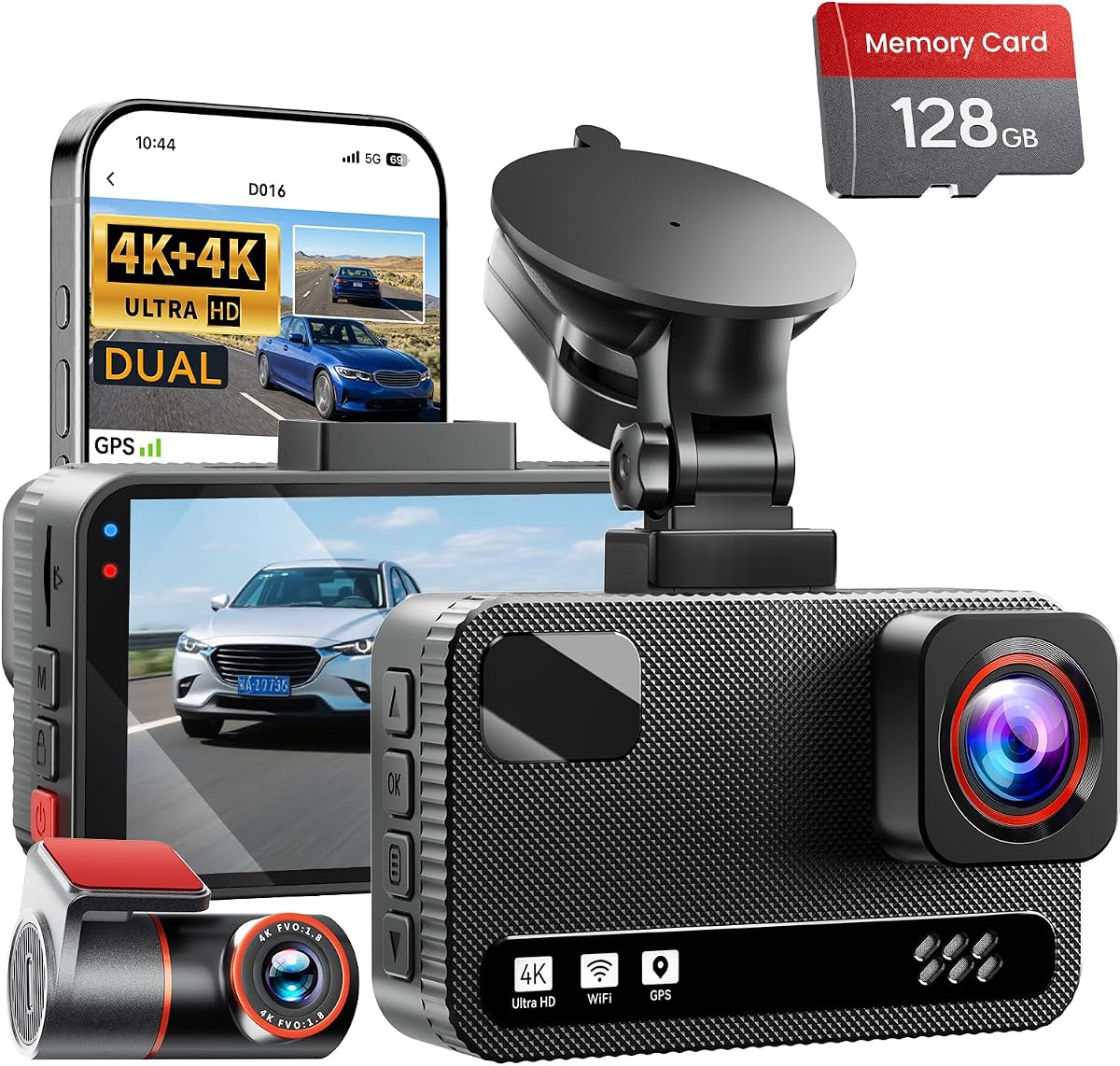
The 4K+4K Front and Rear Dash Cam has a 4.9 rating and offers a clean two-camera configuration built around high-resolution video. Both the front and rear cameras record in 4K, while 5.8GHz WiFi, built-in GPS, and a 3.39-inch IPS screen provide a straightforward way to configure, view, and review recordings.
We may earn a commission when you buy through this link, at no additional cost to you.
The IPS display assists with setup, live viewing, playback, and camera-angle adjustment. Its F1.8 lens is intended to preserve clarity in ordinary road scenes, while simultaneous front-and-rear capture documents lane changes, traffic lights, road signs, vehicles, and potential rear impacts. The system avoids the complexity of interior or side cameras, making it easier to install and maintain.
The included 128GB card supports immediate recording. Loop recording overwrites older unlocked files, and the G-sensor helps lock footage associated with an impact so it is less likely to be erased during normal cycling. GPS records route, speed, and location data directly into the driving footage, adding context when the clip is reviewed later. The 5.8GHz connection supports live preview, playback, fast downloads, saving, and sharing through a phone app without removing the card.
Parking Monitor and Time-Lapse modes are available for owners seeking surveillance after shutdown, but a compatible hardwire kit must be purchased separately. There is also no interior camera, limiting its usefulness for rideshare or family monitoring compared with three-channel systems. Even so, the combination of true 4K front and rear capture, generous included storage, physical controls, and GPS makes this a practical recommendation for drivers who want a capable two-camera system without a complex feature set.
The system concentrates on the two views most drivers consider most important: the road ahead and the area behind the vehicle. A physical IPS screen makes direct setup and angle adjustment easier without requiring a phone for every adjustment.
The included 128GB card removes a common extra purchase, while GPS adds route and speed context to recordings. Together, these features make the camera convenient for ordinary continuous use and more informative when reviewing an incident.
We may earn a commission when you buy through this link, at no additional cost to you.
The right dash cam depends on how you drive, what you need to document, and how much installation complexity you accept. These are the most important factors to compare before choosing a model.
A front-only camera is the simplest option and records what the driver sees ahead. Dual-channel systems add a rear camera for evidence of vehicles or impacts behind the car, while three-channel systems also include an interior view. Four-channel products can add side-facing coverage, which may reduce blind spots but requires more mounting and cable routing. Buyers should consider not only image resolution but also whether a cabin or side camera meets their actual monitoring needs.
Resolution specifications can be misleading because some cameras upscale a lower-resolution image to a 4K output. Native 4K generally preserves more source detail, while upscaled 4K can still look sharp and may be sufficient for ordinary evidence. Reviewers should note the distinction carefully, along with frame rate, lens quality, and sensor capability, because the final image depends on the entire imaging chain rather than one resolution label.
Night footage depends on more than nominal resolution. STARVIS 2 sensors, wide apertures, optical lenses, WDR, HDR, and infrared illumination can materially change how a vehicle, plate, or road sign appears under difficult lighting. The best system for night driving should combine a sensitive sensor with balanced exposure, because high resolution alone cannot recover information that the sensor failed to capture.
Most parking surveillance features require a hardwire kit connected to the vehicle's electrical system, and none of the listed kits are included with the relevant products. A suitable kit provides continuous power after the engine is off, but installation should follow the vehicle-specific instructions and avoid routing that interferes with safety systems. Buyers should compare time-lapse, motion-detection, and collision-detection modes, along with how long clips are retained after an event.
A dash cam writes large files continuously, making storage speed, endurance, and capacity essential. Some models include 32GB, 64GB, or 128GB cards, while the Vantrue N4 Pro S does not include one. Suitable high-speed cards matter, particularly for 4K or multi-channel recording, and supported maximum capacities range from 256GB to 1TB across this list. Check the card format, speed class, and manufacturer recommendations before buying additional storage.
Fast WiFi makes it far easier to preview, download, lock, and share important clips without repeatedly removing the memory card. Dual-band connections can provide a useful balance between speed and reliability, while GPS adds route, speed, and location context. App quality and control options also matter, so buyers should review whether live view, multi-channel playback, settings, firmware updates, and emergency locking are available in the companion software.
Some dash cams include a bright screen, while compact models such as the galphi 4K Front omit one to reduce visual obstruction. Touchscreens, physical buttons, and voice commands offer different ways to manage recordings. Large displays help with setup and angle adjustment, but drivers should choose a size and mounting position that does not cover meaningful portions of the windshield or compete with the driver's attention.
A dash cam operates in temperatures that can climb quickly inside a closed vehicle. Models using supercapacitors are presented as more heat-conscious than conventional lithium-battery designs, while the ROVE includes thermal protection. Consider parking duration, climate, and whether continuous hardwired operation will increase heat. Proper cable quality, secure mounting, ventilation, and compliance with the manufacturer's power guidance are all important for stable operation.
Before installing the unit, read the included instructions and confirm that the memory card, charger, and power cable are undamaged. Clean the mounting area, choose a position that does not obstruct the driver, and route rear or interior cables away from airbags, sharp trim edges, pedals, and moving window mechanisms. Test the front and rear angles while the vehicle is parked, then confirm that recorded images show the intended road areas rather than excessive glare or car bodywork.
Format a compatible memory card in the dash cam when the manufacturer recommends it, insert it in the proper orientation, and perform a short test recording before relying on the camera. Connect to the app over the appropriate WiFi band, review the preview, enable the settings you want, and verify that GPS, date, time, loop recording, and G-sensor protection are working. If parking mode is required, install a compatible hardwire kit according to both the camera and vehicle instructions, then confirm that the system transitions into parking mode after shutdown.
For ongoing care, review important clips periodically, back up needed evidence, and check that emergency or impact files remain locked rather than being overwritten. Clean the lens gently with a dry microfiber cloth and avoid leaving the camera exposed to extreme heat beyond its rated operating conditions. Inspect the mount, cables, and card for looseness or damage at regular intervals, and update firmware through the official app when an update is available.
Not always. A 4K camera can preserve more detail when its sensor, lens, and processing are capable, but a strong 1080p system may still produce clearer usable footage than a poorly tuned 4K model. Check whether 4K is native or upscaled and prioritize low-light performance, dynamic range, and stable mounting in addition to the resolution label.
A rear camera is valuable for documenting following vehicles, lane changes, and impacts from behind. An interior camera is useful for rideshare drivers, families, and anyone who needs a record of passenger activity. A front-only design remains adequate for simple road recording, but broader coverage requires additional cameras, mounts, and cable routing.
Parking mode needs continuous electrical power after the vehicle is switched off, and a hardwire kit connects the camera safely to the vehicle's power system. Every parking-capable model in this guide requires a separate compatible kit. Installation varies by vehicle, so follow the instructions carefully and confirm compatibility before connecting the system.
The amount depends on resolution, number of channels, recording mode, and bitrate. A 32GB card may fill quickly in a three-camera 4K setup, while 128GB or 256GB provides more room for extended use. Use a card that meets the manufacturer's speed and endurance requirements, and format it in the camera when advised.
Usually, yes. The 5GHz band listed on many of these cameras is designed for faster transfers and can reduce the time needed to download clips to a phone. Dual-band systems also retain the 2.4GHz option, which may be useful in some environments. Actual performance depends on the phone, signal conditions, file size, and the camera's app.
Yes, when the system is connected to a compatible hardwire kit and parking mode is configured. Depending on the model, it can use continuous time-lapse, motion detection, collision detection, or a buffered event system. The available storage and hardwired power determine how much footage can be retained during a long parking period.
Modern dash cams are designed for vehicle environments, but heat still affects electronics, card performance, and battery-based designs. Models with supercapacitors can be a sensible choice in hot climates, and thermal protection adds another layer of resilience. Avoid leaving a card or accessory in a hot vehicle, and follow the manufacturer's temperature and power guidelines.
It depends on the model. Several products here include a 32GB, 64GB, or 128GB card, while the Vantrue N4 Pro S does not. If you need more capacity, select a card with the speed, endurance, format, and maximum capacity supported by your chosen camera. Using an unsuitable or low-quality card may lead to recording failures.
The ROVE R2-4K Dual is the strongest all-around choice for most drivers because it combines a sensitive STARVIS 2 front sensor, front-and-rear recording, GPS, fast dual-band WiFi, substantial included storage, and three parking options. The AProX 3-Channel system stands out for true 4K front and rear footage plus infrared cabin coverage, while the galphi 4K Front offers a compact, screen-free, budget-friendly way to begin recording.
Prioritize the coverage and image characteristics that match your driving rather than choosing on resolution alone. Night drivers should examine sensor and aperture specifications, families and rideshare workers may need an interior camera, and vehicles parked for long periods require a compatible hardwire kit. Reviewing the supplied footage after installation is also important because lens glare, mounting angle, and exposure can affect real-world results.
Ratings, feature availability, and pricing can change over time, so check the current product listing and included accessories before purchasing. Verify memory-card compatibility, hardwire-kit requirements, app support for your phone, and the length of the rear cable. Those final checks will help ensure that the chosen dash cam is practical for your vehicle and recording priorities.