
2 Pack Brass Compression Fitting Connector
4.9Editor score
3/8-inch copper tube compatibility
1/2-inch NPT male connection
Single-ferrule sealing design
Heavy-duty brass construction
Compression fittings create secure mechanical connections in copper tubing without soldering, flaring, or permanent welding. A quality fitting depends on compatible dimensions, robust construction, reliable sealing, and a design suited to the intended water, air, fuel, oil, or inert-gas application.
We compared all ten products by examining their connection types, included components, material, stated pressure and temperature limits, installation requirements, and intended uses. The list includes complete assortments, individual adapters, a compression tee, a ball valve, press-style copper fittings, and kits centered on sleeves, inserts, and nuts.
Each review explains the product's most useful qualities, limitations, and best-fit projects, while the comparison and buying guide clarify the differences among the options. Product ratings and availability can change, and current prices should be checked at the linked listings before purchasing.
4.9Editor score
4.7Editor score
4.7Editor score
As an Amazon Associate we earn from qualifying purchases.
The comparison highlights the products' connection formats, materials, included components, and stated operating limits, helping readers distinguish finished fittings from rebuildable component kits and conventional compression parts from press-style copper connectors.


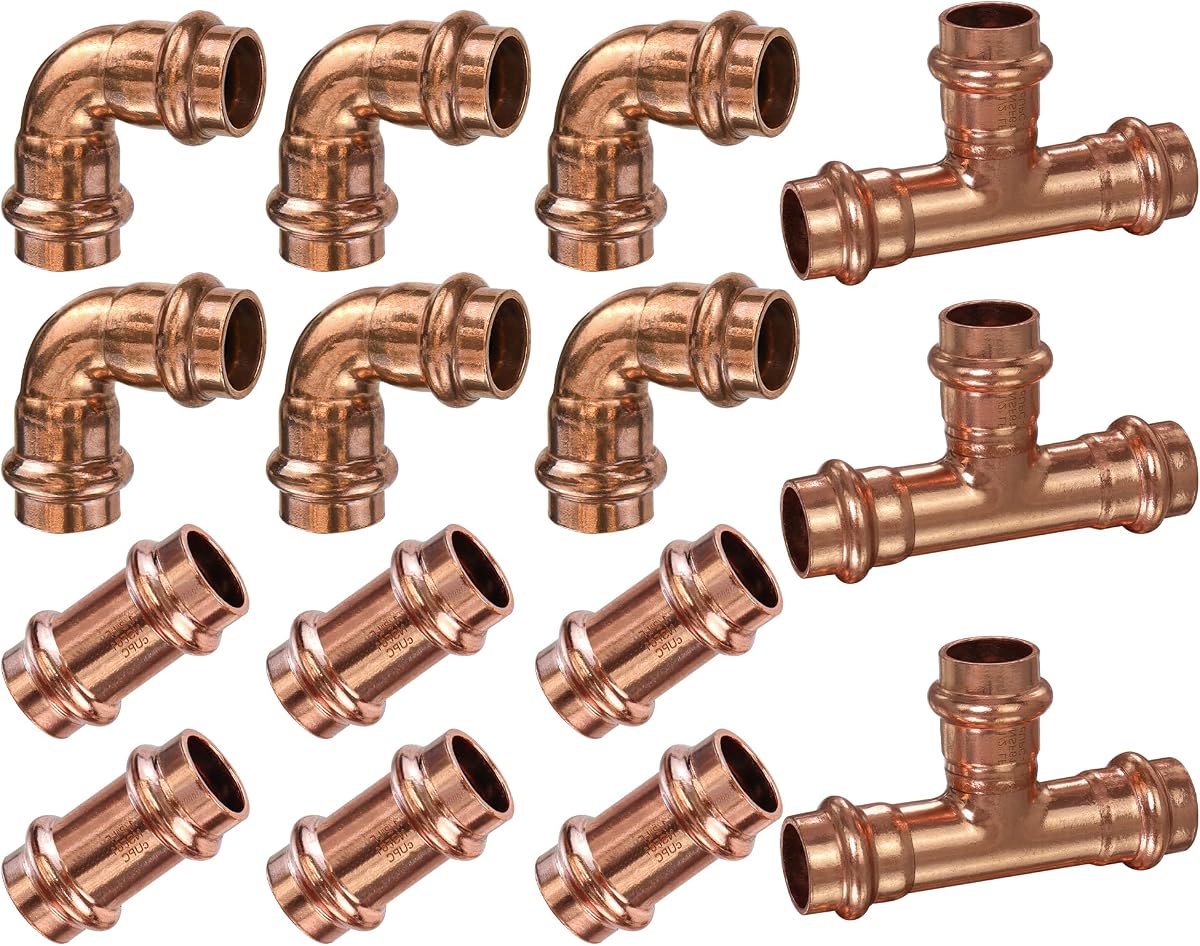
This kit is the most directly oriented option for connecting nominal 1/2-inch copper pipe because it provides finished copper press couplings, 90-degree elbows, and tees in one coordinated set. Its 4.7 rating reflects a favorable buyer consensus, while the zero-lead copper construction and CUPC and IAPMO certifications make it especially relevant to potable-water applications.
We may earn a commission when you buy through this link, at no additional cost to you.
The assortment is practical for repairs involving multiple fitting types rather than a single isolated connection. It includes six couplings with stops, six press-by-press 90-degree elbows, and three tees, giving a homeowner or installer several ways to extend, redirect, or branch a copper line. Stated compatibility includes hot and cold water, HVAC, compressed air, and hydronic heating systems, with a working-pressure figure of 300 PSI and a temperature range from 0°F to 250°F.
The principal trade-off is that these are press fittings rather than conventional nut-and-ferrule compression fittings. Installation requires a compatible hydraulic press tool, so this kit is less attractive to someone who wants to complete a job with only hand tools. Buyers should also note that the product description identifies the nominal configuration as 1/2 inch but lists the actual outer diameter as 5/8 inches, making a tape-measure check before ordering essential.
This is the strongest overall choice for a copper-pipe repair that calls for several common fitting shapes and for users who already own or can obtain a press tool. It is especially useful around shower valves, water heaters, hot-water tanks, and bath-tube connections. For a single standard compression union, however, one of the dedicated adapters or valves may be a more focused purchase.
Combining couplings, elbows, and tees reduces the need to source separate components during a repair. That variety is valuable when extending a line and adding a branch or direction change, especially for installers working from a prepared parts list.
The mechanical press process eliminates solder, flux, open flame, and surface preparation at the joint. It can also reduce disruption around occupied rooms, although users still need the correct press jaws and a tool capable of handling the pipe and fitting sizes.
We may earn a commission when you buy through this link, at no additional cost to you.
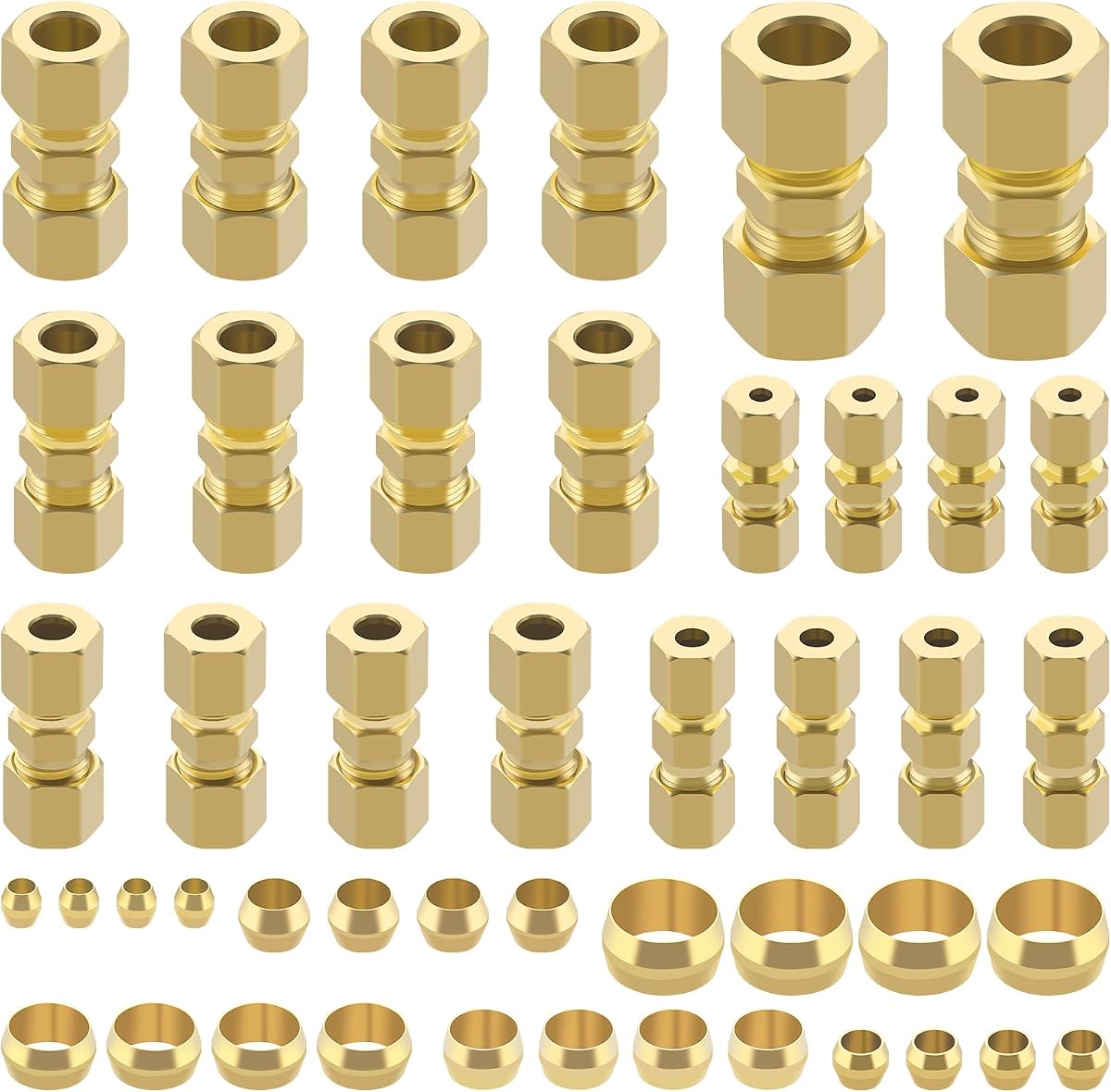
This 46-piece brass assortment focuses on straight compression couplings and matching sleeves across six tube sizes. Its 4.3 rating reflects a generally favorable but less emphatic buyer response, and the 2000 PSI maximum working-pressure claim gives it a high stated capacity for mechanical tube connections.
We may earn a commission when you buy through this link, at no additional cost to you.
The kit is useful when a project requires joining lengths of copper, brass, aluminum, or other compatible tubing without welding, soldering, or flaring. It includes four couplings each in 1/8-inch, 3/16-inch, 1/4-inch, 5/16-inch, and 3/8-inch sizes, plus two in 1/2-inch size. Matching sleeves are included for each size, making the assortment particularly relevant to straight-line tubing extensions.
A significant restriction appears in the supplied product information: these fittings contain lead and are not permitted for potable-water installation in the United States and its territories. That limitation rules out an otherwise attractive choice for household drinking-water work. The product is better aligned with suitable non-potable oil, gas, water, and other pipeline systems where local rules and application requirements permit the stated material.
Buyers should choose this kit when they need several straight couplings in mixed tube diameters and can confirm that the lead-containing construction is appropriate for the intended line. It is less suitable for drinking-water installations, directional changes, branching, or shutoff control, none of which are addressed by the included assortment.
Having couplings and sleeves for several small tube sizes can prevent a minor dimension mismatch from interrupting a repair. The organized quantities also make the set useful for installers who repeatedly service narrow pneumatic or fluid-transfer lines.
Compression hardware can generally be disassembled when a section of tubing must be replaced or a joint inspected. The brass construction is described as corrosion resistant, durable, and suitable for demanding pressure and temperature conditions.
We may earn a commission when you buy through this link, at no additional cost to you.
This two-pack is designed for buyers who need a specific 3/4-inch compression connection rather than a broad assortment. It carries a 4.4 rating and uses a brass body, nut, and tapered ferrule arrangement intended to create a tight seal by compressing the ferrule around the tube.
We may earn a commission when you buy through this link, at no additional cost to you.
The fitting is listed for oil, gas, water, and other non-corrosive pipeline systems, with no requirement for welding or flaring tools. Its stated working pressure reaches 1200 PSI and its listed temperature range extends from -65°F to 250°F. Those specifications make it relevant to compact, high-pressure pneumatic or fluid-handling installations when dimensions and application rules align.
There is an important detail to verify before purchase. The product title identifies a 3/4-inch OD to 3/4-inch NPT male compression union, while the supplied feature description describes 3/4-inch tube OD at both ends. Because those statements differ, a buyer should inspect the listing photographs and confirm the actual port arrangement and thread configuration for the planned connection.
This focused union is a good option for replacing a known 3/4-inch compression joint or connecting two compatible lines. It is less appropriate when the installer needs elbows, tees, valves, or multiple sizes, and it is not ideal for a project where the exact NPT and OD arrangement cannot be verified before ordering.
A union is intended to join two tube ends and can be useful where a straight run needs to be connected without changing direction. Its limited geometry makes it straightforward to pair with another union when a removable section of line is needed.
Threading the nut draws the tapered body against the ferrule, causing it to grip the tube radially. The result is a mechanical seal that does not depend on solder, cement, or a permanent adhesive, provided dimensions and assembly torque are correct.
We may earn a commission when you buy through this link, at no additional cost to you.
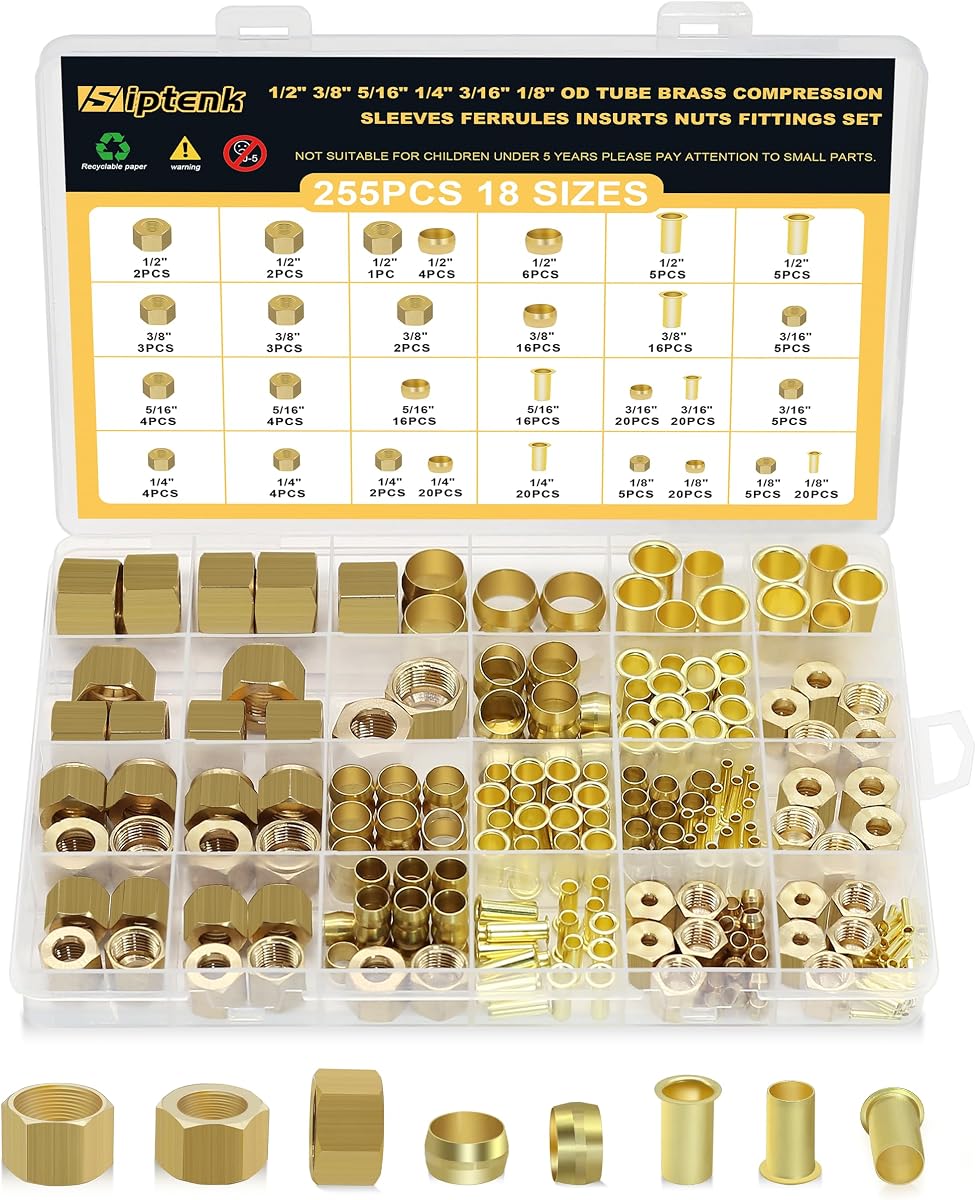
This 255-piece kit is best understood as an inventory of brass compression components rather than a collection of fully assembled copper-pipe fittings. Its 4.7 rating indicates strong buyer approval, and the range of sleeves, inserts, and nuts makes it particularly valuable for technicians who rebuild or replace components frequently.
We may earn a commission when you buy through this link, at no additional cost to you.
Six tubing sizes are represented: 1/2 inch, 3/8 inch, 5/16 inch, 1/4 inch, 3/16 inch, and 1/8 inch. The kit contains matching quantities of brass sleeves, inserts, and nuts for each size, along with a lightweight plastic storage container. Its listed compatibility with copper, brass, aluminum, and plastic tubing broadens its potential use in air, water, fuel, oil, hydraulic, pneumatic, and inert-gas systems.
The main limitation is that buyers do not receive a full assortment of elbow, tee, union, and adapter bodies in the quantities suggested by the headline piece count. Inserts and sleeves are useful for hose or fitting assembly, but the correct body must already be present or purchased separately. Anyone seeking a plug-and-assemble copper connector should look for a product whose description explicitly includes finished fitting bodies.
This kit is an economical way to build a service inventory of small compression hardware, especially when repeated repairs involve different tube diameters. It is a strong choice for experienced installers and maintenance teams, but less convenient for a first-time homeowner trying to make one copper-pipe connection from scratch.
Having sleeves, inserts, and nuts available in several sizes reduces the chance that a repair must be delayed because one small piece is missing. The included case also helps keep unlike sizes organized and less exposed to dirt or corrosion.
The six size combinations are especially relevant to narrower tubing used in pneumatic, hydraulic, fuel, oil, and inert-gas assemblies. Users should still verify the material and diameter of the tubing before selecting inserts and ferrules.
We may earn a commission when you buy through this link, at no additional cost to you.
The Eastman 20096LF is a functional inline valve rather than a general connector, making it the right choice when the project needs to isolate, open, or close a 1/2-inch copper line. Its 4.5 rating reflects a solid buyer reception, and the full-port design is intended to minimize flow restriction and pressure loss.
We may earn a commission when you buy through this link, at no additional cost to you.
Both ends use 1/2-inch compression connections, allowing the valve to connect two compatible copper runs without traditional threaded plumbing joins on the tubing side. Heavy-duty solid brass provides the primary body strength, while a Teflon seal supports the stated temperature and pressure performance. A vinyl-coated steel lever provides a practical grip for changing flow direction.
The listed specifications include 600 WOG working pressure, 125 PSIG steam working pressure, UPC approval, CSA certification, and compliance with NSF and lead-free guidelines for potable-water applications. Those approvals give this product a more defined role in household plumbing than a general-purpose brass adapter, although users should follow all local plumbing requirements and the manufacturer's installation instructions.
Choose this valve for a water-heater branch, appliance supply, or other inline location where a shutoff is useful and both copper lines measure 1/2 inch. It does not replace a coupling, elbow, or tee, so it works best as one component within a broader repair rather than as the sole connection needed.
A full-port opening closely matches the nominal bore of the connected line, helping reduce unnecessary restriction. That matters when a valve is installed in a supply or circulation path where pressure loss should be minimized.
Compression connections can make it easier to create a serviceable union between two copper sections. The tube must be clean and square, and the manufacturer's specified tightening method should be followed to achieve a reliable seal.
We may earn a commission when you buy through this link, at no additional cost to you.
This focused 1/4-inch component kit contains 20 sleeve rings, 20 inserts, and 10 nuts for a total of 50 pieces. Its 4.6 rating reflects a favorable response, while the single-size organization makes it easier for users to understand than a large mixed assortment.
We may earn a commission when you buy through this link, at no additional cost to you.
All components are described as solid brass, offering corrosion and wear resistance with high-temperature ductility. The listed applications include air, fuel, water, oil, and inert-gas lines, and the product data specifically identifies copper tubing among the compatible materials. Installation does not require welding, flaring, or deburring according to the supplied description.
As with the larger Siptenk assortment, the total piece count should not be mistaken for 50 complete connectors. The kit provides the hardware used to assemble compatible compression systems, but it does not clearly include matching elbow, tee, coupling, or adapter bodies. It is therefore most valuable to a technician with existing bodies or as backup stock for replacement components.
This is a practical choice for maintaining 1/4-inch air, fluid, or inert-gas lines where the installer already knows the required fitting style. A homeowner making a single household copper repair may prefer a finished 1/4-inch coupling or adapter because it provides more of the required connection in one package.
Keeping every component at 1/4 inch can make it easier to sort and select parts without handling multiple sizes. This is useful in controlled workshop environments where 1/4-inch assemblies are routine.
Brass combines strength with corrosion resistance and remains ductile across a broad temperature range. Those characteristics suit repeat assembly and disassembly in properly selected air, water, fuel, oil, and inert-gas applications.
We may earn a commission when you buy through this link, at no additional cost to you.
This five-piece adapter set solves a common transition problem: connecting 1/4-inch OD compression tubing to a 1/4-inch NPT male threaded port. It holds a 4.6 rating and offers a straightforward geometry for joining copper, aluminum, or plastic straight tubing to a conventional threaded connection.
We may earn a commission when you buy through this link, at no additional cost to you.
The compression side grips the tube mechanically, eliminating the need to flare the tubing or apply solder. On the opposite side, the NPT male threads allow the adapter to enter a female-threaded fitting or equipment port. Heavy-duty brass is used for corrosion resistance, rust resistance, high-temperature ductility, and low magnetic permeability.
The limitation is that this is only a straight transition adapter. It cannot turn the line, create a branch, or provide isolation, so additional components may be needed for a complete installation. The threaded connection must also be sealed appropriately, and thread compatibility should be checked because NPT descriptions alone do not guarantee that every downstream port has the same sealing method or exact dimensions.
This is the appropriate focused choice for linking a small copper tube to a threaded device or pipe system. It is especially useful when the user wants to avoid a solder joint near equipment, while recognizing that the surrounding system must still support the application's pressure, temperature, and fluid compatibility requirements.
The adapter allows copper tubing to meet equipment designed around NPT threads without forcing the installer to flare the copper. That makes it useful for isolated appliances, sensors, regulators, and other threaded ports.
Multiple identical adapters provide useful spares when one fitting becomes damaged or several points need the same transition. The simple straight design also keeps installation and inspection straightforward.
We may earn a commission when you buy through this link, at no additional cost to you.
This 135-piece assortment is the broadest conventional fitting collection in the list, combining unions, tees, elbows, straight male connectors, bushings, sleeves, inserts, and nuts. Its 4.4 rating indicates a generally positive reception, while the variety makes it attractive to maintenance professionals who want one source for many small-tube connection tasks.
We may earn a commission when you buy through this link, at no additional cost to you.
The kit covers nominal 1/8-inch, 3/16-inch, 1/4-inch, 3/8-inch, and 1/2-inch tubing. Included hardware totals 24 union connectors, three tube tees, twelve 90-degree NPT-thread elbows, ten straight NPT male connectors, six hex bushings, 40 sleeve ferrules, 20 sleeve inserts, and 20 sleeve nuts. A tube cutter and a piece of Teflon tape are also included.
The stated maximum working pressure is 200 PSI, considerably lower than the 2000 PSI figure listed for the 46-piece kit and the 1200 PSI figure listed for the ChillWaves union. The product is also described as intended for low- and medium-pressure work where excessive vibration or tube movement is not involved. Those conditions should be checked carefully against the demands of the installation.
This assortment is most sensible for a technician, contractor, or serious hobbyist who performs varied repairs and values having elbows, tees, unions, and adapters close at hand. For one known copper-pipe connection, a dedicated fitting would usually be easier to use and less likely to leave unnecessary parts unused.
The mix of straight and directional components lets a technician plan a route without ordering every piece separately. It is particularly helpful for service kits intended to handle unpredictable small-tubing failures.
The included cutter and Teflon tape reduce the need for separate preparation supplies. They also encourage correct tube cutting and appropriate preparation of the kit's NPT-threaded components.
We may earn a commission when you buy through this link, at no additional cost to you.
This compact adapter has the highest listed rating in the group at 4.9, reflecting especially strong buyer satisfaction. It joins 3/8-inch OD tubing to a 1/2-inch NPT male connection, making it useful when a copper line must transition to a larger threaded port.
We may earn a commission when you buy through this link, at no additional cost to you.
The fitting is made from heavy-duty brass and is described as durable, corrosion resistant, and capable of high-temperature ductility. Its single-ferrule compression arrangement has fewer possible leak paths than a twin-ferrule design, which can be an advantage in water, gasoline, oil, and vacuum lines when the joint is assembled correctly.
The package information presents a minor ambiguity. The product title calls this a two-pack, while the supplied bullet describing the package contents states that three connectors are included. Buyers should therefore check the seller's current package imagery and quantity before ordering if the exact count affects the purchase. The fitting also offers only a straight transition and does not include isolation or directional control.
This is a focused choice for installers dealing with 3/8-inch copper or compatible tubing and a 1/2-inch NPT equipment port. Its strong rating, straightforward design, and compact brass construction make it appealing for a targeted repair, while the quantity discrepancy is easy to resolve by checking the current listing.
A single ferrule concentrates the seal at one principal compression point, which the manufacturer describes as having fewer potential leak paths than twin-ferrule arrangements. Simplicity can also make inspection and assembly more consistent.
The 3/8-inch tube-to-1/2-inch NPT arrangement handles a size and connection-type change in one part. This makes it useful for connecting tubing to equipment whose port differs from the copper line's outside diameter.
We may earn a commission when you buy through this link, at no additional cost to you.
The HIGHCRAFT D64-12-OM is a single-purpose but essential fitting: a three-way compression tee for 1/2-inch OD tubing. Its 4.4 rating shows a favorable buyer response, and the product's stated use in instrumentation, hydraulic, and pneumatic systems makes it relevant wherever a line must split or combine.
We may earn a commission when you buy through this link, at no additional cost to you.
All three connections use 1/2-inch OD compression, allowing copper, aluminum, or plastic tubing to join at a common point. The brass body is described as durable, rust resistant, corrosion resistant, and vibration resistant. The product is also presented as easy to install, reusable, and capable of producing a secure, leak-free seal in compression applications.
The design is limited by geometry and size. A tee cannot serve as an elbow, and the fact that all three branches are 1/2 inch means the installer cannot mix 1/4-inch, 3/8-inch, or other pipe sizes without additional reducers. The listed temperature range is -65°F to 250°F at maximum pressures, although the exact pressure allowance should be confirmed for the application.
Choose this tee when a 1/2-inch copper line must branch into two additional 1/2-inch runs, such as in an instrumentation, air, or hydraulic arrangement. It is less suitable for a standard household repair that requires differing branch sizes, but it is a direct and reusable solution for matching compression lines.
A compression tee provides a clean way to divide or combine a run without soldering multiple joints. The result can be visually organized and mechanically serviceable when the tubing is clean, prepared, and tightened correctly.
Brass's resistance to rust and corrosion makes it well suited to the environments commonly encountered in air, hydraulic, and pneumatic work. Its reusability is valuable when equipment must be modified repeatedly, provided the sealing surfaces remain undamaged.
We may earn a commission when you buy through this link, at no additional cost to you.
Choosing a suitable fitting requires matching the connection geometry, tubing dimensions, application limits, and installation method. The most important distinction is whether the project needs a finished connector, a component for rebuilding a joint, or a press-style fitting that requires a dedicated tool.
Compression fittings are selected by the actual outside diameter of the copper tube rather than by the nominal pipe size used in some plumbing contexts. Measure the tube's outer wall with a caliper or confirm the manufacturer's marked size before ordering. A fitting that is correct for nominal 1/2-inch copper may need to match a specific actual OD, so confusing nominal dimensions with measured tube dimensions can prevent a proper seal.
Copper tubing may need to connect to another length of tube, a threaded NPT port, a valve, or an equipment inlet. Straight couplings join matching runs, unions permit disassembly, tees create branches, elbows redirect flow, and adapters bridge compression tubing to threaded components. A tee that is ideal for a branching arrangement will not solve a straight-line transition, so determine the geometry before considering quantity or size assortment.
Some kits contain complete fitting bodies, while others contain only sleeves, ferrules, inserts, and nuts. Component kits are valuable for rebuilding existing joints or maintaining an inventory, but they are not necessarily ready to connect two tubes on their own. A first-time buyer should look for explicit language stating that coupling, tee, elbow, union, or adapter bodies are included.
Conventional compression fittings use a nut, body, and ferrule to create a mechanical seal around copper tubing. Press-style copper fittings instead use a hydraulic press tool to form a permanent mechanical connection. Press systems can reduce heat, solder, and open-flame requirements, but they are not interchangeable with conventional compression fittings and require compatible jaws and a correctly sized press tool.
The products in this guide carry widely different stated maximum pressures, from 200 PSI in one broad kit to 2000 PSI in the 46-piece assortment, while other products state 300, 600, 1,200, or 1,500 PSI figures. A product's capacity should exceed the line's working conditions with suitable margin, but ratings also need to reflect the fluid, temperature, tubing, installation quality, and applicable code. Always follow the manufacturer's documentation rather than assuming every brass fitting shares the same limit.
Brass is common because it is strong, corrosion resistant, and mechanically durable, while zero-lead copper is frequently specified for potable-water systems. Material safety can vary within a kit and even among its components. The 46-piece kit expressly contains lead and is not permitted for potable-water installation in the United States and its territories, whereas the Eastman valve is listed as lead-free and compliant with NSF guidelines for potable use.
The listed uses range from water and HVAC systems to oil, gasoline, fuel, compressed air, hydraulic lines, and inert gases. A fitting that performs well in one medium may not be approved for another because seal materials, thread compounds, corrosion behavior, or regulatory rules can differ. Match the fitting's documented compatibility to the transported fluid, including any temperature and pressure conditions.
A compression joint depends on a clean, square tube and a properly assembled ferrule or insert. Tube damage, ovality, contamination, and incompatible wall dimensions can prevent a reliable seal even when the fitting is correctly sized. If the connection may need to be opened later, a union is more serviceable than a fixed coupling. Keep the manufacturer's assembly instructions available and avoid reusing a fitting if its sealing surfaces or threads are damaged.
Begin by shutting off and depressurizing the relevant line, then confirm that the tube's material, outside diameter, wall condition, and intended service match the fitting. Measure the tubing rather than relying on its nominal label, and inspect the cut end for flatness, burrs, dents, and ovality. A clean, square tube is essential because the ferrule grips a limited band of copper and cannot compensate for a seriously damaged end.
For a conventional compression fitting, place the nut and any required ferrule or insert in the correct order on the tube, thread the body onto the prepared end, and tighten the nut with the appropriate tool according to the manufacturer's instructions. The ferrule should seat evenly rather than deform the tube. For a press-style system, use a compatible press tool and correctly sized jaw, position the fitting at the required insertion depth, and complete the prescribed press cycle.
After assembly, inspect each joint for correct tube seating, even ferrule compression, exposed threads, and signs of damage. Open the system slowly and watch the connection closely before restoring normal flow. Keep compression parts clean and dry, avoid forcing a seized fitting, and replace a fitting that has damaged threads, distorted sealing surfaces, or a ferrule that no longer seats correctly.
Choose the fitting by the copper tube's actual outside diameter, not merely by the nominal size printed on the pipe. Measure the tube and compare that measurement with the fitting's listed tube-OD specification. If the listing uses a nominal size, confirm the actual OD shown in the product photographs or manufacturer documentation before purchasing.
Only fittings specifically approved and lead-free for the potable-water application should be used on drinking-water systems. The 46-piece brass assortment in this guide contains lead and is expressly restricted from potable-water installation in the United States and its territories. The zero-lead copper press kit and the lead-compliant Eastman valve have more suitable stated certifications, but local code and the manufacturer's documentation still govern.
Conventional compression fittings generally do not require soldering, flaring, welding, or a specialized press tool. A correctly sized wrench is usually used to tighten the nut. Copper press fittings are different: they require a compatible hydraulic press tool and matching jaws to form the permanent connection.
Many compression components can be disassembled and reused if they remain free of damage, but the ferrule or insert should be inspected carefully because it may become distorted after compression. Threads must remain clean and undamaged, and sealing surfaces must not be gouged or deformed. Follow the manufacturer's reuse and replacement instructions, particularly after a joint has been disassembled.
Common causes include an incorrect tube diameter, a crooked or burred tube end, damaged ferrule, dry or contaminated sealing surface, loose nut, or an incompatible tubing material. Check that the ferrule seated evenly and that the tube did not collapse, then disassemble the joint for inspection rather than simply tightening it repeatedly. Replace any distorted component rather than relying on additional sealant.
A coupling joins two straight tube ends, while a union also provides a convenient serviceable connection that can be opened. A tee creates or combines a branch between three runs, and an adapter transitions from compression tubing to a different connection type such as NPT threads. Select the shape that matches the route and function of the line.
No. Press fittings and conventional compression fittings use different installation methods and are not designed as drop-in replacements for each other. A press connection requires a compatible press tool, jaw, and fitting system, whereas a conventional compression connection uses a nut, body, and ferrule tightened with a wrench.
The stated limit depends on the specific product and design, and the figures in this guide range considerably. Actual capacity also depends on the tubing, installation, temperature, medium, and service conditions. Use the manufacturer's listed rating for the exact fitting and retain an appropriate safety margin for the installation rather than comparing isolated headline figures.
The Copper Press Fittings 1/2inch Kit stands out as the most versatile choice for copper-pipe work because it includes couplings, elbows, and tees made from zero-lead copper and intended for water, HVAC, compressed-air, and hydronic applications. The compact 3/8-inch-to-1/2-inch NPT adapter earns attention for its strong rating and straightforward single-ferrule design, while the Siptenk assortment serves technicians who need a broad inventory of rebuildable small-tube components.
For a single connection, prioritize exact tube OD, endpoint type, and the required fitting shape before considering a multi-piece kit. A dedicated valve, adapter, union, or tee may be more appropriate than carrying many unused components, and press-style products should be selected only when the necessary press equipment is available. Potable-water work additionally requires attention to lead content, certification, and local approval.
Ratings, package configurations, and prices can change, so verify the current listing and product documentation before ordering. Compare the physical dimensions with the actual tubing, confirm the application's pressure and temperature requirements, and review lead-related restrictions. Those checks are essential for choosing a connector that fits correctly, performs as intended, and provides a durable connection.