
30 Pack NTAG Ultralight EV1 NFC Cards
4.1Editor score
48-byte rewritable user memory
Advanced security configuration
Broad NFC project applications
Our Blank Rewritable Rfid Cards guide compares ten options across frequency, chip type, compatibility, capacity, printability, and ease of programming for
Blank rewritable RFID cards offer a flexible way to create credentials, visitor passes, inventory labels, and personalized access records. A useful card depends on matching its frequency and chip format to your reader, then providing the durability, memory, and printability needed for its intended role.
This guide compares ten blank and programmable cards across 125kHz and 13.56MHz systems. It considers chip type, supported formats, read range, memory, rewrite capability, card construction, printing options, programming requirements, and important exclusions so buyers can narrow the field before purchasing.
Each entry identifies the product's strongest use and the trade-offs that matter in practice. The selections include writable proximity cards, MIFARE-compatible cards, and an NTAG Ultralight EV1 option; ratings and availability can change, so confirm current product details and compatibility before ordering.
4.1Editor score

4.6Editor score

5.0Editor score
This side-by-side comparison covers the ten products' operating frequencies, chip formats, capacities, construction, and key compatibility limitations, making it easier to identify the card that fits your existing reader and intended application.




The LEXI 20pcs Rewritable UID Smart Card is a 13.56MHz PVC card built for access-control and RFID programming projects. Its 4.2 rating reflects a generally positive market response, while its standout feature is the ability to reprogram each card's unique encrypted identifier. The advertised compatibility with MIFARE Classic 1K makes it a practical choice for users working with the widely recognized 1K format.
We may earn a commission when you buy through this link, at no additional cost to you.
The card supports reading, writing, and copying, with the manufacturer stating that it can be rewritten more than 100,000 times. Its memory is organized into 16 sectors of four blocks, and the listed reading range is approximately 0–10 centimeters with compatible readers. These features suit administrators who want reusable records rather than disposable credentials, particularly where new identifiers are needed without replacing the physical card each time.
There are important limitations. This is a 13.56MHz card, not a 125kHz proximity card, and it will not work with every lock or reader. The card must also be programmed or copied before it can serve its intended function. Buyers should verify the reader's chip support, desired identifier format, and access-control protocol rather than assuming all MIFARE-compatible systems accept changeable UIDs.
This is a sensible selection for access-control technicians, system integrators, and technically experienced users who need reusable 13.56MHz credentials. It is less suitable for someone seeking a phone-programmable NFC tag or a card that works immediately in a 125kHz system. Overall, the combination of changeable IDs, high rewrite capacity, and MIFARE Classic 1K support makes it a versatile specialist option.
Reprogramming the UID allows one physical card to represent changing credentials, user groups, or access periods. That flexibility is especially useful for controlled testing, temporary assignments, and environments where issued IDs must be revised frequently.
The card's 13.56MHz operation and MIFARE Classic 1K compatibility make it appropriate for compatible door controllers and general RFID workflows. Confirm protocol support and programming requirements before deploying a full batch.
We may earn a commission when you buy through this link, at no additional cost to you.
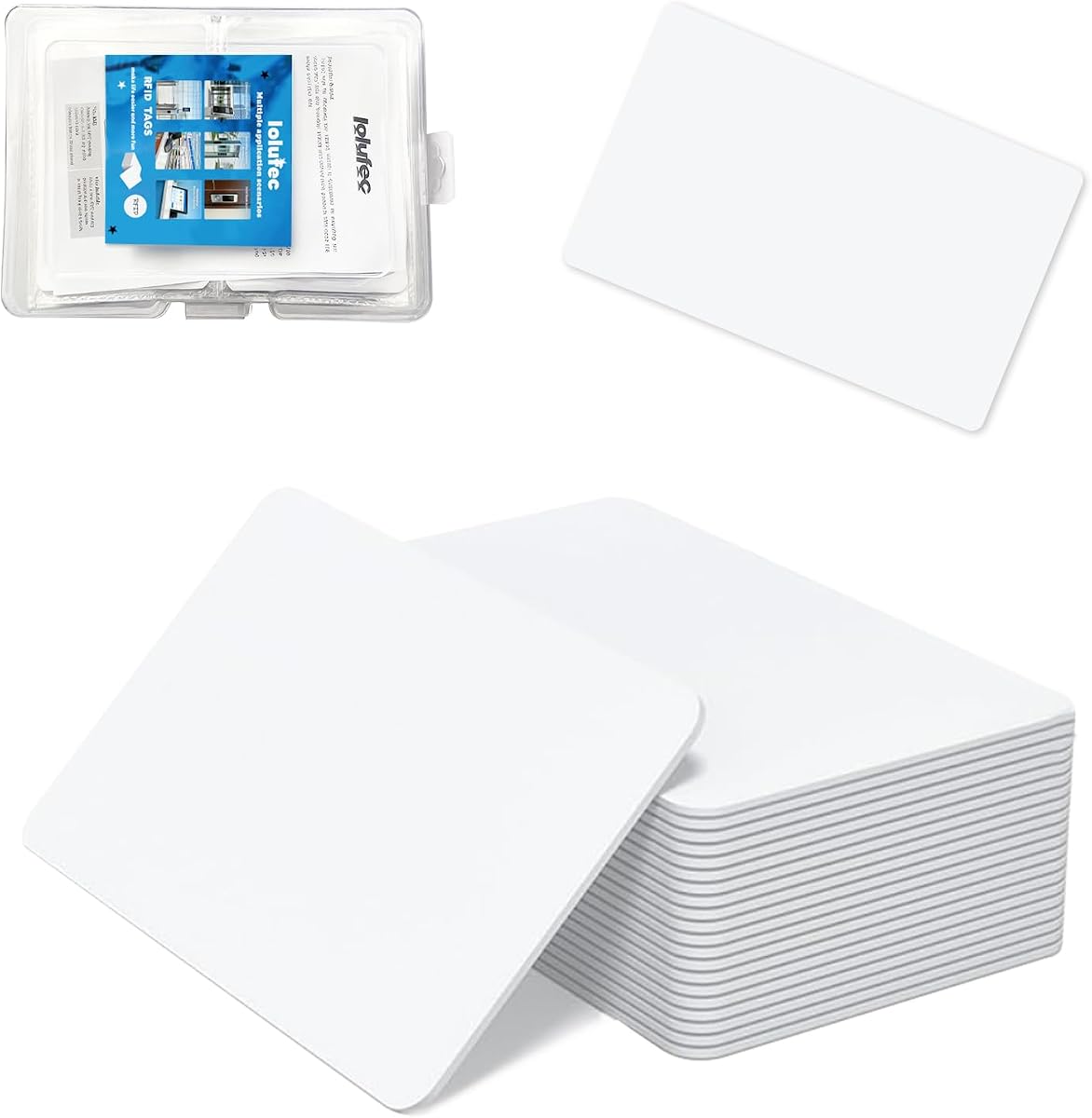
The 30 Pack NTAG Ultralight EV1 NFC Cards is the most feature-oriented selection in this guide. It uses an original NTAG Ultralight EV1 chip operating at 13.56MHz, provides 48 bytes of user-rewritable memory, and carries a 4.1 rating. Its major attraction is the advanced security configuration, including password protection, lock bytes, anti-tamper counters, a one-time-programmable area, and an originality signature.
We may earn a commission when you buy through this link, at no additional cost to you.
The cards can support admission tickets, temporary visitor authorization, loyalty programs, event passes, membership use, campus access, and personal NFC projects. A maximum read distance of 100 millimeters is listed when paired with suitable readers, while anti-collision support helps identify multiple cards in the same field. The solid PVC cards are described as waterproof, bend-resistant, scratch-resistant, and suitable for thermal sublimation or compatible specialized card printers.
The trade-off is complexity. NTAG Ultralight EV1 cards arrive factory-locked, and the seller provides specific setup commands for unlocking them through NFC Tools. A phone and compatible app may therefore be needed before ordinary programming begins. The uncoated surface also cannot be printed directly by a standard household inkjet printer, and the relatively limited user memory is not intended for large records.
This option best suits NFC experimenters, event organizers, and developers building personalized shortcuts, links, or limited visitor records. Buyers who need simple phone-based data writing will appreciate it, but those wanting large MIFARE memory should choose a 1K card instead. For a security-conscious and highly programmable NFC workflow, it is the premium pick.
Password limits, lock settings, anti-tamper counters, and a one-time-programmable area make the EV1 chip useful when basic rewritable tags do not offer enough control. These features also make setup more involved.
After the specified unlocking process, users can write valid content and links to the cards through NFC Tools. This supports temporary passes, event admission, campus access, and personal automation projects.
We may earn a commission when you buy through this link, at no additional cost to you.
YARONGTECH's 20-pack of T5577 cards is a practical choice for 125kHz access, attendance, and identification projects. It has a 4.5 rating and uses an original T5577 chip that supports both 125kHz ID and H-ID WG formats. Because the identifier is blank, the cards must be written with a compatible 125kHz RFID writer or copier before a reader can use them.
We may earn a commission when you buy through this link, at no additional cost to you.
The white plastic surface is printable by Zebra, Fargo, and Evolis card printers, giving it an advantage over basic untagged cards when organizations want branded credentials. It can also serve hotel key cards, time-and-attendance systems, access control, ticketing, and packing cards. The ability to rewrite the chip makes it useful for replacing issued credentials or rotating IDs without changing the physical card format.
The product does not arrive with a pre-programmed ID, which is central to its blank-card function but can surprise first-time buyers. It also cannot be read before programming and does not work with ordinary NFC systems. A compatible writer and familiarity with the desired ID format are therefore essential rather than optional.
This pack is best for administrators, installers, and hobbyists who already use 125kHz T5577-compatible systems. It is a strong middle ground between small sample packs and larger bulk orders. The combination of printing support, recognized rating, and multiple writable formats makes it a dependable choice for established low-frequency workflows.
Starting with unprogrammed IDs lets administrators issue credentials according to their own numbering system. This control is valuable for integrations that already depend on a particular writable-card format.
Support for Zebra, Fargo, and Evolis printers makes it easier to add names, branding, and visual identifiers. The blank white finish also supports more polished credential designs than a visibly generic tag.
We may earn a commission when you buy through this link, at no additional cost to you.
The 12 Pack T5577 Proximity Cards is a well-balanced option for users who need a moderate quantity of standard-size writable RFID credentials. Its 4.5 rating reflects a favorable reception, and the product includes 12 cards with T5577 chips. These are blank 125kHz cards, so the identifier must be written before they can be read or used.
We may earn a commission when you buy through this link, at no additional cost to you.
Each card follows CR80 30-mil sizing and is approximately 0.8 millimeters thick. That familiar profile fits wallets, badge sleeves, and many standard badge systems. The cards can be programmed in common 125kHz formats, including EM4100 or TK4100, H-ID WG, and a customizable 26-bit Prox format. Applications include hotel keys, access control, attendance, ticketing, and packing identification.
The main drawback is that the product description contains a confusing range of pack-count language even though the selected listing identifies the offer as 12 cards. Buyers should verify the package quantity shown for their particular listing. More importantly, the cards cannot function merely by handing them to a reader; compatible writer hardware and the correct target format are necessary.
This pack is a good fit for small offices, installers completing a manageable deployment, or hobbyists comparing formats. It is easier to stock than a 100-card order while still providing enough cards for a practical pilot. Its thin standard profile and broad format support make it a versatile choice for traditional 125kHz access environments.
CR80 sizing and a 0.8-millimeter thickness make the cards straightforward to use with conventional badge holders. The design is less substantial than thicker clamshell cards but fits systems built around ordinary plastic cards.
Support for EM4100, TK4100, H-ID WG, and 26-bit Prox formats gives integrators options when working with different reader populations. The selected reader and writer must support the chosen format.
We may earn a commission when you buy through this link, at no additional cost to you.
The 10Pcs T5577 Writable RFID Cards offer an approachable entry point for testing a 125kHz workflow. The product has a 5.0 rating, although it also carries the practical caveat that blank cards are not useful until a compatible writer has assigned an identifier. Its ten-card quantity is small enough for a pilot project or replacement stock without creating a large unused inventory.
We may earn a commission when you buy through this link, at no additional cost to you.
The cards use writable T5577 chips and are intended for readers, writers, and access-control systems that support T5577 and common low-frequency proximity formats. Compatibility is specifically highlighted with 1386, 1326, and H10301 format readers. Each card is close to credit-card size, approximately 1.8 millimeters thick, and made from white PVC described as waterproof and wear-resistant.
Its repeated erase-and-write operation makes the cards suitable for reusable access, employee IDs, membership cards, school cards, parking systems, hotel keys, and other low-frequency assignments. However, the product is not recommended for direct use on metal surfaces, and it is not a substitute for a 13.56MHz NFC card. The buyer still needs appropriate programming equipment and must confirm that the existing controller supports the desired format.
This is our budget recommendation for users building a small 125kHz system, testing card compatibility, or keeping a modest replacement supply. Its excellent rating and low-risk pack size are appealing, but the 5.0 score should not be interpreted as evidence of universal reader compatibility. Technical verification remains the most important purchasing step.
Ten cards are enough to test a writer, reader, access-control workflow, and badge design before committing to a larger batch. This makes the pack useful for installers, developers, and careful first-time buyers.
The white PVC body and repeated erase-and-write capability suit environments where issued credentials need updating. Users should still keep the cards away from direct metal contact for reliable reading.
We may earn a commission when you buy through this link, at no additional cost to you.
The 100 Pack T5577 Proximity Cards is intended for organizations that need a larger inventory of standard-size low-frequency credentials. It carries a 4.5 rating and uses the same basic T5577 platform seen in several smaller packs. The cards are blank, meaning a compatible 125kHz writer must assign an ID before the cards are read or deployed.
We may earn a commission when you buy through this link, at no additional cost to you.
The large quantity is the defining advantage. Hotels, schools, membership organizations, attendance operators, and access-control installers can standardize on one card type without repeatedly purchasing small packs. Cards are credit-card sized, 0.8 millimeters thick, and made from PVC. The T5577 chip supports 125kHz ID and H-ID WG formats, with compatibility also listed for EM4100, TK4100, and customizable 26-bit Prox credentials.
A hundred blank cards is excessive for casual experimentation, and every card must be programmed before use. The listing's general description references several possible pack quantities, so shoppers should confirm that the selected variation includes 100 cards. There is also no support for high-frequency NFC workflows or phones acting as readers for these low-frequency cards.
This bulk option is a strong fit for established deployments with predictable card consumption. Its thin, standardized format is convenient for existing badge systems, while writable IDs provide flexibility after issuance. For a smaller pilot, one of the 5-, 10-, 12-, or 20-card options is more efficient; for a full rollout, this pack reduces repeated ordering and stock-management work.
A hundred-card inventory supports schools, hotels, and businesses that issue credentials routinely. The quantity helps standardize replacement cards and reduces the need for frequent small orders.
The chip can be written to several established low-frequency ID formats, making it adaptable to a range of compatible readers. Program the cards in the exact format expected by the destination system.
We may earn a commission when you buy through this link, at no additional cost to you.
The JASAG 100pcs Premium Rewritable UID Smart Card is our editor's choice because it combines a strong 4.6 rating with substantial memory, changeable identifiers, and a large deployment quantity. It operates at 13.56MHz and is compatible with MIFARE Classic 1K, ISO/IEC 14443A, and four-byte UID systems. Its 1,024 bytes are divided into 16 sectors of four blocks.
We may earn a commission when you buy through this link, at no additional cost to you.
Read, write, and reprogramming operations are supported, and the listing states that the cards can be rewritten more than 100,000 times. Each card has a unique encrypted identifier that can be reprogrammed. The stated reading range is 0–10 centimeters with compatible readers, making the product appropriate for door access control and other 13.56MHz RFID workflows.
The crucial limitation is that this is not a 125kHz card and cannot copy lower-frequency credentials. Users also need compatible 13.56MHz readers and writing equipment, and individual access platforms may impose additional rules. As with any changeable-UID product, the intended use should be limited to systems the user owns or is authorized to administer.
This selection is ideal for installers, integrators, and organizations needing many reusable 13.56MHz credentials. It combines 1K memory with a reprogrammable identifier and strong rewrite endurance, while the 100-card pack suits full deployments. For anyone prioritizing comprehensive features rather than a small test quantity, it offers the most balanced specification set in the guide.
The reprogrammable encrypted UID allows the physical credential to be reassigned without replacing it. That is useful for rotations, temporary access, controlled testing, and frequent internal changes.
The 1,024-byte capacity exceeds the small user-memory area offered by the NTAG selection. It provides more room for structured data within compatible MIFARE Classic workflows.
We may earn a commission when you buy through this link, at no additional cost to you.
The 80 Pcs MIFARE Classic 1K RFID Cards have a 4.7 rating, the highest numerical rating in this roundup. They use an original Fudan FM11RF08 chip configured for MIFARE Classic 1K and ISO/IEC 14443A, providing 1,024 bytes across 16 sectors. Their blank appearance makes them look like ordinary printable cards, but their key distinction is that they store rewritable data while retaining a factory-locked UID.
We may earn a commission when you buy through this link, at no additional cost to you.
The card supports sector-level A and B access keys, allowing permission management at a granular level. It is listed as compatible with devices such as ACR122U, PN532, and RC522, and the product information names several professional door-lock systems. Printing support includes UV, retransfer, direct-to-card thermal, and all-in-one lamination printers. The surface cannot be printed directly by an ordinary household inkjet printer.
This is important to the keyword: these cards are not rewritable at the UID level. Sector 0 Block 0 and the four-byte UID are hardware-locked, so users cannot turn them into a new identity by changing the UID. Data can still be written after successful authentication, and the default factory key is listed as six FF bytes. The product explicitly excludes cloning use and compatibility with several proprietary or encrypted systems.
The cards are a strong choice for organizations seeking a conventional, secure MIFARE data credential rather than a changeable-UID card. They fit access control, attendance, hotel, membership, and stored-value workflows that use compatible readers. Buyers who require a physically different identifier each time should choose the JASAG or LEXI selections instead.
Independent A and B keys for each sector allow different readers or applications to enforce different access rules. Proper authentication is required before data can be written.
A unique UID and locked manufacturer block protect the card's identity while leaving its data sectors usable. This design avoids the risks and limitations associated with freely changing identifiers.
We may earn a commission when you buy through this link, at no additional cost to you.
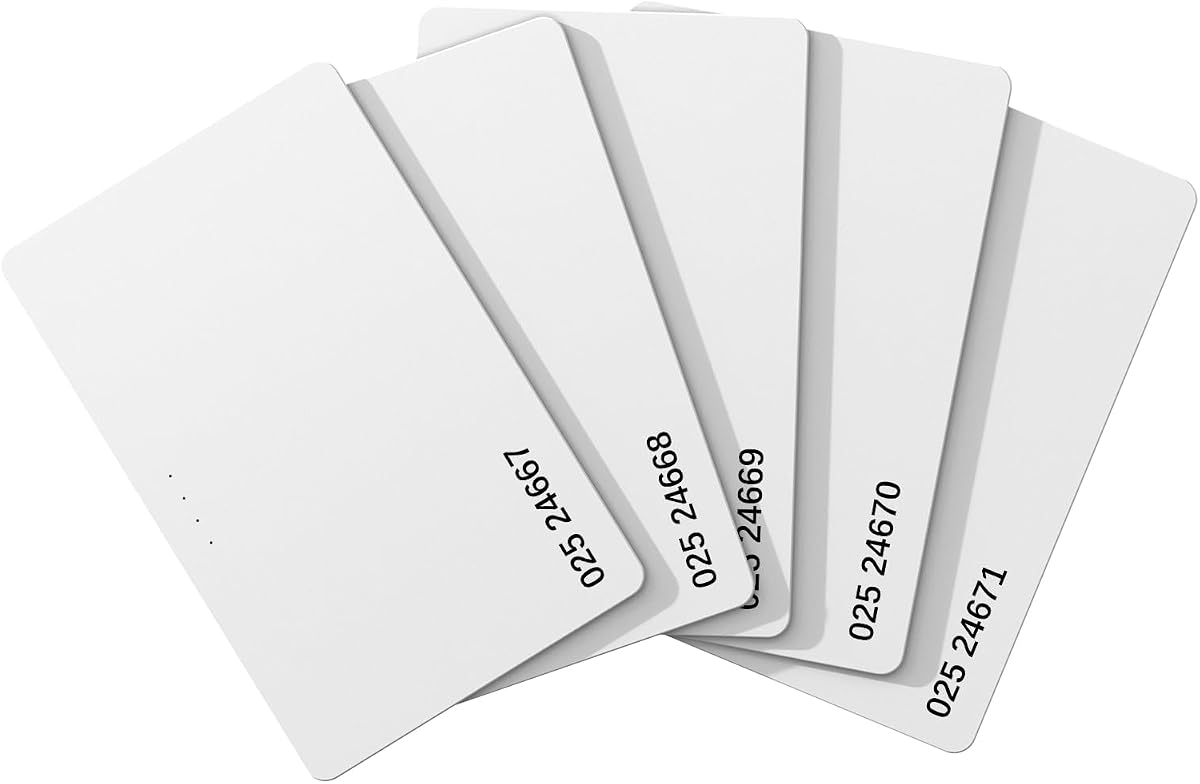
The 5 Pack T5577 Rewritable RFID Cards is the smallest selection here and serves primarily as a sampling or replacement set. The product uses 125kHz T5577 chips that are described as rewritable and erasable, allowing custom information, ID numbers, or credentials to be written through compatible equipment. No numerical customer rating is supplied, so its market reception cannot be compared directly with the rated products.
We may earn a commission when you buy through this link, at no additional cost to you.
Its potential uses include access control, asset tracking, inventory labeling, personal identification, time-and-attendance systems, and DIY RFID work. A five-card quantity is useful for testing a reader and writer combination, checking badge sleeves, or keeping a few spares for a small system. The cards are described as compatible with most common 125kHz reader writers, but actual system support still needs confirmation.
The quantity is the central limitation. Five cards are not sufficient for most businesses that issue credentials to staff, students, members, or visitors. Because the cards are blank, they also provide no value until programming equipment and the desired identifier format are available. The seller appropriately notes that only authorized systems and credentials should be programmed.
This pack is best for an initial compatibility check, a small personal project, or a handful of replacement cards. It is less attractive for a facility-wide deployment, where a 10-, 12-, 20-, 80-, or 100-card option would reduce repeated purchases. Its chief advantage is focused: it lets a buyer validate the workflow with minimal excess.
A five-card sample is ideal for confirming reader, writer, and badge compatibility. It can also help test how IDs are issued and how cards perform in the intended holder.
The erasable T5577 memory allows custom IDs to be rewritten for systems the user owns or is authorized to program. Buyers should follow applicable access-control and privacy rules.
We may earn a commission when you buy through this link, at no additional cost to you.
The 12 PCS T5577 Thick Smart Cards combine a 4.7 rating with a more substantial 1.8-millimeter card profile. They are 125kHz proximity cards using the writable T5577 chip, and compatibility is highlighted for 1386, 1326, and H10301 reader formats. Applications include hotel keys, access control, attendance, ticketing, and packing identification.
We may earn a commission when you buy through this link, at no additional cost to you.
The cards arrive without an identifier and must be written using a 125kHz RFID writer or copier. They support 125kHz ID, H-ID WG, and customizable 26-bit Prox formats, and the listing states that they can be erased and written up to 100,000 times. That makes them suitable for creating new records and maintaining backup credentials within a compatible low-frequency system.
Several exclusions are important. The product does not work with ONITY systems, NFC-enabled phones, or Proxmark3 RDV4 as specifically noted. A thicker card also may not fit readers or badge slots designed only for thin CR80 plastic. Users must not add the blank cards directly to locks; the identifier must be written first.
This selection suits organizations that prefer a thicker, more durable proximity card and already operate compatible 125kHz infrastructure. It is a good option for hotel-style credentials and frequently handled access cards. For thinner cards, broader NFC support, or a smaller experiment, another selection in the guide may align better with the installation.
The approximately 1.8-millimeter thickness offers a sturdier feel than thin 0.8-millimeter cards. It may suit badge holders and reader slots designed for clamshell-style proximity cards.
The listed ability to erase and rewrite the card up to 100,000 times supports reusable credentials. Actual compatibility depends on the reader, writer, target format, and access-control system.
We may earn a commission when you buy through this link, at no additional cost to you.
Choosing blank rewritable RFID cards starts with the reader rather than the card. Frequency, chip, memory, identifier behavior, physical design, and programming workflow must align with the intended system, while legal authorization is essential for any credentials being created.
The first filter is whether the existing reader and writer use 125kHz or 13.56MHz. Most T5577 products in this guide operate at 125kHz and support common legacy proximity formats, while the LEXI, JASAG, MIFARE, and NTAG selections operate at 13.56MHz. These families are not interchangeable merely because both are called RFID cards. A phone's NFC capability normally corresponds to 13.56MHz rather than the 125kHz proximity systems used by many door readers.
A card may be broadly described as compatible while still requiring a particular chip and data format. T5577 is common among writable low-frequency cards, while MIFARE Classic 1K and NTAG Ultralight EV1 belong to different high-frequency ecosystems. Check the reader documentation, writer software, sector structure, identifier length, and supported format before ordering. The MIFARE product also requires authentication before data writes, while the EV1 cards require a specified factory-unlocking sequence before normal programming.
Rewritable data and a rewritable UID are not the same thing. The LEXI and JASAG products explicitly allow their encrypted identifiers to be reprogrammed, making them suitable for reusable credentials. The MIFARE selection keeps its unique four-byte UID factory-locked while allowing authorized writes to data sectors. A T5577 card is also blank until an ID is written, but it does not automatically mean that every system will accept or duplicate that ID.
None of the blank T5577 cards can be read before a compatible writer assigns an identifier. The MIFARE selection can hold programmed data but still requires compatible reading and writing equipment, with authentication needed for write access. The NTAG EV1 package can be handled through NFC Tools after the listed setup commands unlock it. Budget for the correct writer, copier, reader, cables, software, and any format knowledge your installation requires.
MIFARE Classic 1K products provide 1,024 bytes across 16 sectors and support separate A and B access keys, making them appropriate for more structured records and layered permissions. The NTAG EV1 card provides 48 bytes of rewritable user memory but adds a sophisticated security model, including password protection, lock bits, an OTP area, and anti-tamper counters. For a simple ID, memory may matter less than format compatibility; for personalized data or access credentials, both storage and protection deserve attention.
The 125kHz selections include thin cards at approximately 0.8 millimeters and thicker cards at approximately 1.8 millimeters. CR80 30-mil dimensions resemble a standard credit card, but a thicker card may not pass through a slot or fit a holder designed for a thin badge. White PVC surfaces also vary in printer support: some accept professional thermal, UV, retransfer, or sublimation equipment, while ordinary household inkjet printers are generally unsuitable.
Five cards are appropriate for a compatibility test, while 10 or 12 cards are better for small pilots. A 20-card pack provides room for a modest office or hotel-style deployment, and 80- or 100-card packs suit broader rollouts. Consider how many records need to be active, how frequently cards are reissued, and whether staff or visitors will lose them. A larger pack reduces ordering overhead, but unused blank stock has no value until it is programmed.
PVC cards are generally durable, scratch-resistant, and suitable for repeated handling, but performance changes with surface material and reader design. One selection specifically advises against direct use on metal surfaces, and readers may vary in read distance. Water, bending, abrasion, lanyard holes, and cleaning exposure all matter. Test the chosen card in its actual holder and near the equipment because a successful bench reading does not guarantee reliable access in the final environment.
Begin by identifying the exact reader, writer, chip, and identifier format used by the system. Check the hardware and software compatibility lists before connecting a writer or placing a card near a reader. For a blank T5577 card, select the format required by the installation, prepare the desired authorized ID, and write it with a compatible 125kHz writer or copier. For a MIFARE card, authenticate with the correct access key before attempting a data write.
Program one card first and verify it in the intended reader, badge holder, access controller, or phone workflow. For NTAG Ultralight EV1 cards, follow the seller's NFC Tools setup commands before writing ordinary links or records. After successful programming, test both identification and the exact function required, such as door entry, attendance recording, visitor validation, or a personalized NFC link. Keep one unprogrammed card aside as a test sample before deploying an entire batch.
Handle the cards by their edges and keep them away from excessive heat, bending, sharp objects, strong chemicals, and incompatible solvents. Store blank and programmed cards in a clean, dry sleeve, and avoid placing them directly against metal when the manufacturer does not recommend it. Periodically verify that each credential still reads correctly, rotate or erase records only through the authorized system, and dispose of retired cards securely when they are no longer needed.
A blank card generally has writable memory but no usable identifier or application data until it is programmed. A pre-programmed card arrives with an identifier and possibly application information already stored. Blank cards offer more control over numbering and access records, but they require compatible writing equipment and some technical setup.
No. Compatibility depends on operating frequency, chip type, identifier length, memory format, security configuration, and the reader's supported protocols. A 125kHz T5577 card will not work in a 13.56MHz NFC workflow, and even within one frequency, a reader may not support the chosen chip or data format.
Generally, no. The T5577 products in this guide operate at 125kHz, while common phone NFC functions operate at 13.56MHz. A phone-compatible workflow would require a supported 13.56MHz tag such as the NTAG Ultralight EV1 selection, subject to the phone's own reading and writing limitations.
The T5577 chip does not contain a pre-programmed identifier, so it cannot be read as a usable credential until one is written. Connect a compatible 125kHz writer or copier, select the correct target format, write an authorized ID, and then test the card with a compatible reader.
Rewritable card data means authorized sectors or user memory can be changed while the card's identity remains fixed. A rewritable UID allows the identifier itself to be reprogrammed, as offered by the LEXI and JASAG products. The MIFARE selection supports data-sector writes while retaining a factory-locked UID.
The supplied product information says the EV1 cards are factory-locked and provides specific NFC Tools setup commands for unlocking them. Users should follow those instructions carefully, then format the card as required before writing links or other content. The process is more involved than programming a simple tag.
Many of the blank white PVC cards are designed for professional printing, including Zebra, Fargo, Evolis, UV, retransfer, thermal, or sublimation processes depending on the model. The NTAG option supports thermal sublimation and compatible specialized printers. Ordinary household inkjet printers are not suitable for the uncoated surfaces described.
That depends on the system, jurisdiction, and your authorization. Copying a card you own for a legitimate system may be permitted, while duplicating a third party's credential can violate access policies or laws. Only program cards for systems you own or have explicit authorization to administer, and follow the security policies of the organization involved.
The JASAG selection leads for a complete rewritable 13.56MHz package, combining a 4.6 rating, 1K memory, a changeable encrypted UID, extensive rewrite endurance, and a hundred-card quantity. The NTAG Ultralight EV1 option is the premium choice for advanced NFC security and personalized phone-programmable workflows, while the 10-card T5577 set is the practical budget pick for testing compatible 125kHz systems.
Prioritize the reader and writer before the card's appearance or quantity. Confirm frequency, chip, identifier format, memory capacity, physical thickness, and printing method, then determine whether you require a changeable UID, a locked identity with writable sectors, or a simple blank low-frequency credential. For larger rollouts, the bulk T5577 and MIFARE packs can simplify provisioning, but a small sample remains valuable for validating the complete workflow.
Prices, ratings, availability, and product details can change, so review the current listing before ordering. Pay particular attention to pack quantity, included accessories, printer compatibility, and system exclusions. With the correct technical match and a clear authorized use case, a blank rewritable RFID card can provide a flexible and reusable foundation for access, identification, inventory, and NFC projects.