
Fire-Maple Greenpeak 1
4.6Editor score
Compact three-ounce design
Piezo ignition system
Folds to 2.1 by 2.8 inches
Mixed-material durable construction
Compare the best portable backpacking stoves for weight, wind resistance, fuel compatibility, ignition, stability, and packability in this 2026 buying guide.
Portable backpacking stoves make it possible to prepare hot meals and drinks without carrying a heavy camp kitchen. A useful model balances low weight, dependable ignition, stable pot support, effective flame control, and compatibility with the fuel you can actually find along your route.
The ten options in this guide range from ultralight solo stoves to powerful remote-canister systems and complete cookware bundles. We compared the published specifications, fuel connections, burner design, wind protection, packed dimensions, support features, and practical differences between each type.
Each review shows where a stove earns its place, while also identifying limitations involving fuel, power, or cooking capacity. Ratings and product details can change over time, and prices fluctuate, so confirm the current listing and compatibility information before making a purchase.
4.6Editor score
4.8Editor score

4.6Editor score
This side-by-side comparison highlights the major differences in stove weight, fuel support, ignition, wind protection, and cooking output, helping you identify the model that best matches your trip style.




The AOTU Portable Camping Stove is a compact canister burner built for hikers who want a straightforward cooking solution without carrying a full kitchen. Its integrated aluminum-alloy burner, honeycomb wind protection, and four-dimensional support structure give it a useful balance of stability and packability.
We may earn a commission when you buy through this link, at no additional cost to you.
Its most appealing feature is the combination of an adjustable valve and a broad, ventilated burner design. The control valve moves from high heat down to a simmer, while the surrounding structure is designed to improve oxygen circulation and maintain combustion in exposed conditions. The stated 3000W output is suited to quickly preparing a small pot or a single-pan meal for one to three people.
The stove uses a standard 7/16-thread connection for single butane or butane-propane mixed fuel canisters that meet the EN 417 standard. It does not connect directly to propane canisters, which is the most important limitation for anyone expecting broader fuel flexibility. Its small footprint and support area are also less suitable for large cookware.
This is a compelling choice for backpacking, camping, fishing, and other trips where compactness matters more than remote-canister convenience. The included storage box and very small packed dimensions make it easy to organize inside a pack, while the integrated support and wind-resistant design provide more confidence than a bare, minimal burner.
At 4 by 5 by 8 centimeters, the stove takes up relatively little room in a pack. That compact size is particularly useful when every gram and liter of pack volume matters, allowing the cooking system to fit into gear arrangements that are already tightly organized.
The high-temperature honeycomb shield is intended to limit the effect of wind while allowing air to circulate around the flame. It cannot eliminate environmental exposure, but it provides a useful buffer compared with an entirely unprotected burner.
We may earn a commission when you buy through this link, at no additional cost to you.
The Odoland 3500W/6800W Windproof Camp Stove is a larger traditional canister burner aimed at campers who prioritize straightforward operation and a protected flame. It combines an aluminum-alloy structure, stainless-steel components, piezo ignition, flame control, and two kinds of connector in a foldable design.
We may earn a commission when you buy through this link, at no additional cost to you.
The headline power description is somewhat inconsistent, but the supplied specification identifies a maximum of 3500W and states that one liter of water can boil in around three minutes under normal conditions. That performance should suit quick breakfast preparation and camp meals for more than one person, especially when the burner is properly sheltered.
Its primary strength is the built-in windshield. Rather than relying on the user to construct a windscreen, this model surrounds the cooking area with a structure designed to preserve efficient combustion. The foldable construction and included carry case help distinguish it from loose collection of burners, although its larger frame will consume more pack space than a pocket-sized model.
The stove is best suited to campers using 7/16-thread EN 417 canisters who want strong output and a generous wind barrier. It may feel excessive for a solo fast-packing trip, but it is more practical for relaxed weekends, family camping, or hikers carrying a larger pot.
The stated 3500W output and estimated three-minute boil make this model suitable for people who do not want to wait around after a long trail day. Actual results will vary with elevation, weather, fuel, and the cookware placed on the burner.
The folding design and supplied case make the stove easier to keep together in a pack. The case also helps prevent the burner and accessories from becoming scattered among cookware and other camp gear.
We may earn a commission when you buy through this link, at no additional cost to you.
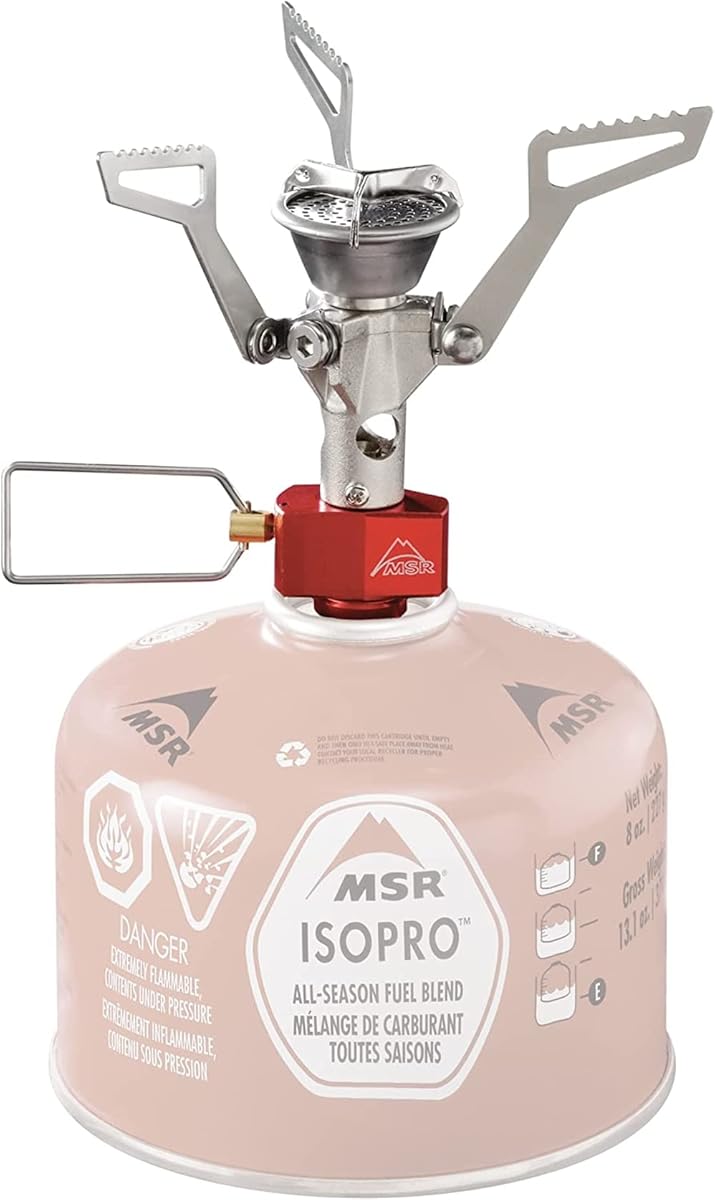
The MSR PocketRocket 2 is a compact canister stove for minimalist hikers, travelers, and campers who treat pack weight as a major concern. At 2.6 ounces without its case, it delivers a rare combination of low mass, quick heating, simple operation, and broad cookware compatibility.
We may earn a commission when you buy through this link, at no additional cost to you.
The stove boils one liter of water in approximately 3.5 minutes and adjusts from a gentle simmer to a rolling boil. Serrated pot supports accommodate a wide range of pot sizes and styles, while the lack of priming, preheating, or pressurizing keeps camp setup uncomplicated. Its threaded fuel connection uses a high-performance isobutane-propane canister, which is not included.
The main limitation is fuel-system rigidity. This is a direct canister stove rather than a remote-canister model, and it does not offer the extended hose arrangement favored by some remote systems. The protective case adds to packed size, and the total package still leaves less space for an integrated cookset than the smallest dedicated ultralight options.
For hikers who want a proven balance of efficiency, power, and low weight, the PocketRocket 2 remains an excellent general recommendation. It is particularly well suited to fast-and-light trips, overnight backpacking, international travel, and campers cooking with one or two compact pots.
The 2.6-ounce stove body is the centerpiece of its appeal. It allows a backpacker to retain real cooking capability without dedicating substantial weight or volume to the burner, which can influence overall trip comfort and gear choices.
A roughly 3.5-minute boil and a flame range extending from simmer to rolling boil make the stove versatile for both quick hydration and more involved meals. Its straightforward start-up process reduces the number of steps required after reaching camp.
We may earn a commission when you buy through this link, at no additional cost to you.
The 6800W Camping Backpacking Stove is a high-output system designed for campers who want strong heating and more separation between the flame and fuel source. It combines three brass burner components, a piezo ignition system, an adjustable controller, a windproof shield, and a 50-centimeter hose.
We may earn a commission when you buy through this link, at no additional cost to you.
Its stated 6800W output is accompanied by a claim of boiling one liter of water in under two minutes. The extended hose can provide a safer and more convenient arrangement than a short connection, while compatibility with isobutane, butane, and a one-pound propane tank gives users more fuel-choice flexibility than direct-canister-only designs.
This is not the most minimalist option. The three-burner arrangement, three sturdy feet, wind shield, long hose, and stated load capacity create a substantial cooking platform. It is better suited to group meals, larger pots, and car-camping overflow than to careful ultralight packing.
The stove is a strong candidate for hikers who cook for several people, need larger cookware, or want remote-fuel capability. Buyers should consider the entire system's size and confirm their preferred fuel and cookware will work together before committing.
The extended hose lets the fuel container remain separate from the cooking area, which can improve organization and reduce crowding around the burner. Multiple connection options broaden the range of compatible fuel arrangements.
Three feet and serrated pot supports create a more substantial platform than a small pocket stove. The stated capacity indicates that the design is intended for cookware and group-cooking demands that exceed minimalist solo use.
We may earn a commission when you buy through this link, at no additional cost to you.
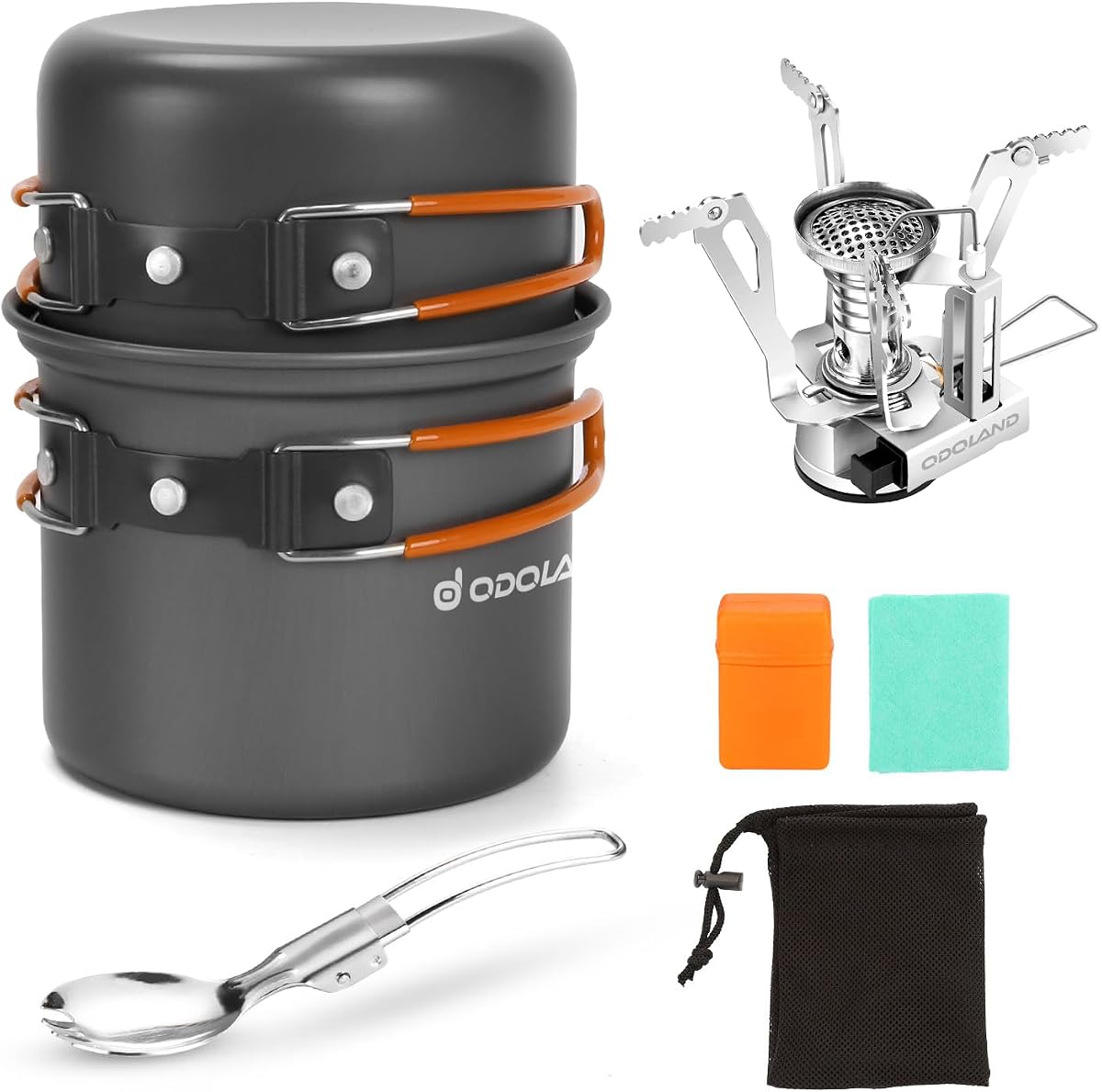
The Odoland Camping Cookware Mess Kit is a compact bundle for campers who want a complete basic kitchen rather than a standalone burner. It includes two aluminum nonstick pots, a folding stove, a spork, a cleaning cloth, and a carry bag that lets the components nest together.
We may earn a commission when you buy through this link, at no additional cost to you.
The cookware is made from anodized aluminum, which keeps the total package light while conducting heat efficiently. Both the pot handles and stove can fold, reducing the space needed inside a pack. The included spork and cloth also cover the two utensils needed for many simple trail meals.
Its limitation is specialization. A bundled system is convenient for a new camper or solo user, but it offers less freedom to choose a different stove, pot, or fuel arrangement later. The cookware is centered on simple one-person or small-meal preparation rather than elaborate group cooking.
The kit is a practical choice for weekend campers, hikers building a first cooking setup, and anyone who values having organized essentials in one place. Experienced backpackers may prefer separate components, while beginners can start cooking with fewer separate purchases.
The mesh carry bag keeps the stove, pots, utensil, and cloth together while allowing the pieces to nest. This reduces the chance that small cookware items will become separated or lost during transport.
The anodized aluminum pots are designed to be lightweight while spreading heat quickly. Their nonstick surfaces simplify preparation and cleanup, and the folding handles make them easier to fit into a compact bag.
We may earn a commission when you buy through this link, at no additional cost to you.
The Gas One GS-3400P is a dual-fuel portable stove for campers who want flexibility between butane cartridges and propane cylinders. It includes a propane converter regulator and a carrying case, making it a practical choice for camping, travel, and emergency-preparedness kits.
We may earn a commission when you buy through this link, at no additional cost to you.
Automatic piezo-electric ignition removes the need to carry a lighter or matches, while the heat dial provides straightforward flame adjustment. Fuel is not included. The stove accepts a single eight-ounce butane cartridge or a 16.4-ounce propane cylinder, giving users more options when planning for different trip environments.
Safety features help distinguish it from a basic burner. The built-in pressure sensor can eject an irregular butane cartridge, and the gas-flow cutoff mechanism is designed to stop fuel flow when conditions are not normal. These features add confidence, although the system remains larger and heavier than a direct-canister ultralight model.
This stove is a good fit for household campers, overlanders, and emergency kits where one appliance must handle more than one fuel type. It is less attractive to backpackers optimizing every gram, but the broader fuel support and included regulator can be more valuable than minimal weight.
The ability to run on either butane or propane makes the stove adaptable to different camping and emergency situations. The included converter regulator reduces the need to source a separate connection for the propane cylinder.
Automatic piezo ignition starts the burner without external fire-starting tools. Pressure sensing and fuel-flow cutoff add protective functions, while the dial keeps flame adjustment simple for users who may be less familiar with compact burners.
We may earn a commission when you buy through this link, at no additional cost to you.
This Portable Backpacking Stove offers a familiar direct-canister layout with useful additions for entry-level campers. It includes push-button piezo ignition, an adjustable flame knob, a wind-resistant honeycomb cover, and an adapter for 16-ounce or one-pound propane tanks.
We may earn a commission when you buy through this link, at no additional cost to you.
Its fuel compatibility is a notable strength. The stove works with 7/16-thread butane-propane mixed canisters meeting the EN 417 standard and can also be paired with a small propane cylinder through the included adapter. That gives users more flexibility than models limited to one connection type.
The three legs, low ground height, and three jagged pot carriers are intended to keep cookware stable on a range of surfaces. The windproof shield can improve combustion efficiency, though outdoor performance still depends heavily on the weather and placement. The product information does not provide a specific water-boil time.
It is a sensible option for campers who want simple ignition, adjustable heat, and more than one fuel option. It may be less attractive to serious fast hikers who know their exact power and weight needs, but it remains a versatile and approachable cooking system.
The included adapter makes the stove useful with both EN 417 mixed-fuel canisters and small propane tanks. This can simplify fuel planning when either format is easier to obtain at a particular campground or destination.
Keeping the burner close to the ground improves the appearance of stability, while the three legs distribute the stove across its support area. The jagged carriers help keep a compatible pot from sliding during normal cooking.
We may earn a commission when you buy through this link, at no additional cost to you.
The YCDMLJC Portable Camping Stove is a compact aluminum-alloy burner aimed at hikers who want a light cooking setup with more pot-support range than a very small pocket model. It offers piezo ignition, a rotary control valve, an expandable cooking surface, and an EN 417 threaded canister connection.
We may earn a commission when you buy through this link, at no additional cost to you.
The stove is listed at 0.24 pounds and arrives in an outer package measuring 3.1 by 2 by 1.6 inches. Its expandable support can accommodate cookware up to eight inches in diameter, a useful feature for campers who want to prepare meals in a wider pan while keeping the burner itself compact.
Operation follows a familiar sequence: attach a compatible canister, place the stove horizontally, open the valve gradually, and press the piezo igniter. If ignition does not occur immediately, the supplied guidance recommends increasing gas slowly and pressing the igniter several times while gas is flowing.
This model is best for ordinary backpackers who want straightforward direct-canister cooking and a wider support area. It does not accept remote propane through an adapter, and the absence of a specified carry case means users may need to organize it separately within their pack.
The support can expand to accommodate pots as large as eight inches in diameter. This gives the stove more cooking versatility than compact burners designed primarily for a small personal cup or mug.
The rotary valve allows the user to introduce gas gradually and then select a suitable flame. This control is important for both safe ignition and adjusting from a simmer to a stronger boil.
We may earn a commission when you buy through this link, at no additional cost to you.
The Fire-Maple Greenpeak 1 is a compact gas stove for hikers, trekkers, anglers, hunters, and emergency kits where pack economy is important. It weighs only 85 grams, or three ounces, and folds to 2.1 by 2.8 inches for convenient storage.
We may earn a commission when you buy through this link, at no additional cost to you.
Its construction combines stainless steel, ceramic, aluminum alloy, and silicone. Piezo ignition removes the need for a separate lighter or matches, while the design is intended to use fuel efficiently and support everyday outdoor cooking. The model is especially relevant to campers who already own a small pot and need a dedicated burner rather than a complete cookset.
The Greenpeak 1 is not compatible with the Z1 adapter, so buyers who plan to use that particular connection need another model. Its compact design is also better matched to small cookware than large group pots, although the dimensions should not be treated as a restriction on every pan because support geometry and balance still matter.
This stove is an excellent choice for the budget-conscious ultralight camper. It offers an attractive balance of low weight, small volume, simple ignition, and dedicated cooking capability, making it especially useful for trips where a larger traditional burner would feel excessive.
A folded footprint of just 2.1 by 2.8 inches makes the Greenpeak 1 easy to fit into small pockets, lid compartments, or tightly packed cookware bags. This is one of its clearest advantages over bulkier burner systems.
The burner is designed to balance useful power with fuel efficiency. That makes it a sensible match for meals and drinks that can be prepared in a compact pot without carrying a large multi-person cooking system.
We may earn a commission when you buy through this link, at no additional cost to you.
The Odoland 11-Piece Camping Cookware Backpacking Stove Set is a comprehensive kitchen bundle for hikers and family campers who want most utensils and cookware in one organized package. It includes a mini stove, two aluminum nonstick pots, a spoon, fork, knife, stainless-steel cup, silicone cup protector, tank bracket, and two carry bags.
We may earn a commission when you buy through this link, at no additional cost to you.
The cookware uses lightweight anodized aluminum and strong construction, while the folding pot handles and stove help the set occupy less space. Anti-slip, anti-heat handles are intended to protect the user's hands, and the silicone cup protector provides an additional barrier around the stainless-steel cup.
Compared with a stove-only purchase, the set offers much more value for a new camper who lacks cookware and utensils. Its drawback is that experienced minimalists may carry redundant pieces or prefer to select each component based on personal needs. The inclusion of multiple parts also means more opportunities for small accessories to be misplaced.
The bundle is a strong option for weekend campers, picnic users, and hikers building a functional kitchen without assembling one item at a time. It is especially helpful for groups because two pots and a fuller utensil set can support more varied meals than the smallest solo cooking systems.
The two pots, utensils, cup, protector, stove, bracket, and bags cover the basic needs of preparing and serving simple outdoor food. It removes the need to search separately for every small kitchen essential before a trip.
Anti-slip handles and the silicone cup protector are designed to reduce direct contact with hot surfaces. Folding components and two carry bags offer several ways to organize the larger set efficiently.
We may earn a commission when you buy through this link, at no additional cost to you.
Weight, cooking capacity, fuel availability, and wind exposure are the most important considerations. The right stove is the one that fits your pack, menu, and campsite without creating unnecessary fuel or equipment complications.
Start with the combined weight of the burner, fuel, pot, windscreen, and ignition equipment. A burner advertised as ultralight may still become heavy once a full fuel canister and compatible cookware are included. Small canister stoves are generally best for solo trips, while remote-fuel and high-output systems become more attractive when several people need hot food.
Choose the lightest complete setup that can support your real meals. An ultralight stove is valuable on foot, but it should still be stable and powerful enough for the pots you plan to use.
Check the exact thread, cartridge size, and cylinder type before buying. Many compact stoves use 7/16-thread EN 417 canisters for butane, isobutane, or mixed fuel, but they will not accept standard propane cylinders. Remote-capable systems may include a hose and adapter for one-pound propane tanks, which can be useful in areas where small threaded canisters are harder to find.
Fuel compatibility should be based on availability where you camp, not merely on the number of fuel types printed on a box. Also consider whether a converter regulator is included and whether the intended canister fits your storage plan.
A higher rated output can reduce wait times, especially when melting snow, boiling water, or cooking in cold conditions. Published wattage and boil-time figures are useful comparisons, but actual results depend on elevation, weather, fuel, pot material, and the amount of water being heated.
For quick drinks and dehydrated meals, moderate output is usually enough. For larger pots, repeated boiling, or group meals, choose a higher-output system and evaluate the stability of its support platform.
A wind-resistant shield or windshield helps preserve flame efficiency and can keep the burner from extinguishing in a breeze. A full surrounding windshield is useful at exposed camps, while minimalist hikers may prefer to add their own folding windscreen and use the saved weight on other essentials.
Look for an open burner design that promotes airflow alongside wind protection. A sealed-looking structure that limits oxygen can be less effective even when it shields the flame from moving air.
The support should match the diameter and shape of your cookware. Serrated arms reduce slipping, broad feet improve balance on uneven ground, and a wider platform can handle a larger pan. For solo cooking, a small stable base may be preferable to a heavy structure that cannot fit inside a compact pot.
Test the fit of your intended cookware whenever possible. A burner that accepts a small pot securely is more useful than a larger model whose supports are too wide for the only pot you carry.
Piezo ignition is convenient because it removes the need for matches or a lighter, but reliability varies with dirt, moisture, altitude, and the condition of the ignition mechanism. A backup fire-starting method remains sensible for remote trips even when a stove has automatic ignition.
A responsive control valve makes it easier to move from a simmer to a strong boil without extinguishing the flame. Rotary knobs and lever controls are common, so choose whichever feels more natural and offers a clearly visible flame-control range.
A stove that folds to a compact size can be stored inside a cookpot, reducing the amount of loose space it requires. Some models also include a case, while bundle systems use a bag or mesh organizer for the entire kitchen. A case is useful for keeping the valve and ignition mechanism away from dirt and cookware.
Compare the packed dimensions with the actual space available in your pack. A slightly larger stove that nests neatly may be more practical than a tiny burner surrounded by empty space or packed separately from its accessories.
A standalone stove is ideal for backpackers who already own compatible cookware. Complete kits are more convenient for beginners, picnickers, and family campers because they include pots, utensils, and storage. The trade-off is bulk, duplicate equipment, and less freedom to customize individual pieces.
If you already have lightweight cookware, select the burner based on performance and packability. If you are starting from nothing, a coordinated kit can reduce both the number of items needed and the effort required to build a functional outdoor kitchen.
Set up the stove on a stable, level surface, ideally with a windscreen positioned to block moving air without blocking the burner's airflow. Check the fuel connection, ensure the stove is level, and keep flammable fabrics, vegetation, and dry cookware away from the flame. Read the instructions for the specific connection because threading and regulator arrangements vary.
Attach the approved canister or cylinder, open the control valve gradually, and use the piezo igniter according to the manufacturer's directions. Start with a moderate flame and increase it as needed. Never leave a burning stove unattended, and turn off the fuel before changing cookware or moving the burner.
After cooking, turn the valve off and let the burner cool before disconnecting fuel. Inspect the threads, hose, seals, and connectors for damage, wipe away dirt, and store the stove dry in its case or bag. Replace any questionable seal and never modify the fuel connection yourself.
Only if the stove is designed for remote propane use and includes the correct hose and regulator. Most pocket-sized stoves connect directly to 7/16-thread EN 417 canisters for butane, isobutane, or mixed fuel, and they will not attach to a standard screw-on propane cylinder. Check the product specifications before purchasing a propane cylinder or adapter.
Not always, although larger stoves often have room for more substantial burners, wind protection, and wider pot supports. Power depends on burner design rather than weight alone. Compare rated output, boil time, stability, and packed size together instead of assuming the heaviest model is the most capable.
Most compact burners are designed for small pots, mugs, and frying pans whose bases match the available support arms. Wider models can accept larger cookware, but a nominal pot diameter is not enough to guarantee stability. Consider the support geometry, serrated edges, burner height, and the weight of a full pot.
A windproof design can improve reliability, but it cannot completely prevent cold, altitude, moisture, or poor fuel pressure from affecting performance. Use a suitable fuel, keep the flame clean, and allow enough preheating time. Expect longer boiling times in cold conditions because the pot and surrounding air lose more heat.
A backup method is prudent even when the stove has piezo ignition. Moisture, dirt, cold, or a damaged igniter can prevent a successful start. Carrying a compact lighter or waterproof matches adds little weight and provides a useful backup in emergencies.
A complete set is usually easier for a new camper because it includes pots, utensils, and storage together. A separate stove offers more customization and can be lighter if you already own efficient cookware. Choose according to your existing gear, menu, and packing limits rather than the number of pieces alone.
Let the stove cool completely, disconnect the fuel, and remove dirt or food residue from the valve and supports. Store it dry in a protective case or organizer so the ignition and connection do not collect grit. Inspect fuel seals and check for corrosion before the next trip.
The amount depends on meals, water volume, cooking time, temperature, and the burner’s efficiency. Hot drinks and boiling large quantities of water consume more fuel than simple reheating. For a first trip, plan conservatively and learn the burner’s behavior before relying on a tight fuel budget.
The MSR PocketRocket 2 stands out as the strongest all-around option, combining a very low listed weight, quick heating, simple operation, and useful pot-support versatility. Fire-Maple Greenpeak 1 provides exceptional compactness for value-focused ultralight campers, while Gas One GS-3400P offers broader fuel flexibility and added safety features.
Prioritize the complete system rather than burner specifications alone. A lightweight stove is useful only when it accepts your fuel, pot, and cooking method, while a high-output design is unnecessary if your meals consist of small portions. Stability, wind protection, ignition reliability, and pack organization often affect daily usability more than a small wattage difference.
Before buying, verify the current product listing, fuel connection, packed dimensions, and included accessories. Ratings, product configurations, and prices can change, and fuel availability varies by destination. Checking those details at the time of purchase helps ensure that the selected stove fits your backpacking setup as planned.