
FLYDIGI Direwolf 4
4.5Editor score
Adjustable 40–80gf stick tension
Wired, Bluetooth, and 2.4GHz
Six-axis gyro with 1000Hz polling
Discover the best Controller with Gyro for PC Gaming, compared for polling, sticks, triggers, compatibility, customization, and overall value.
A controller with gyro support can give PC players motion-assisted aiming, adaptive controls, and a more console-like experience in compatible games. The best models combine accurate six-axis sensors with dependable sticks, responsive inputs, useful customization, and straightforward Windows compatibility, while the strongest options also serve Switch, mobile, or Steam Deck users.
This guide compares ten gyro-equipped controllers across polling rate, stick technology, trigger behavior, connectivity, remapping options, motion controls, ergonomics, and platform support. It covers wired, Bluetooth, and 2.4 GHz models for competitive shooters, racing games, action titles, and everyday play, with particular attention to the features that affect real PC gaming performance.
The list includes a practical budget option, versatile wireless models, and PC-focused esports controllers with advanced polling rates and macros. Each section explains the strongest reasons to consider the controller, its meaningful limitations, and the type of gamer it suits best. Product listings and prices change, so confirm current specifications and compatibility before purchasing.
4.5Editor score

4.3Editor score

4.1Editor score
The table below compares every controller in the guide by its headline polling rate, stick system, motion support, and connection style. It highlights how each model approaches gyro aiming and helps distinguish dedicated PC esports controllers from versatile multi-platform designs.



The FLYDIGI Direwolf 4 combines a 6-axis gyroscope, 1000Hz polling, adjustable stick tension, and flexible triggers at a notably accessible tier. Its 4.5 rating reflects a well-rounded feature set, particularly for players who want gyro control without paying for a dedicated esports model. It also supports PC, Nintendo Switch, Android, TV, and laptops, making it useful beyond a single PC setup.
We may earn a commission when you buy through this link, at no additional cost to you.
The FORCEFLEX sticks can be tuned from 40gf to 80gf, which lets players choose a lighter or firmer feel instead of accepting one fixed spring tension. The stated design emphasizes stable recentering and drift resistance, while the FORCESWITCH triggers alternate between a fast Micro mode and a linear Hall Effect-style mode. That makes the controller adaptable to shooters requiring immediate trigger travel and racing games that benefit from proportional braking and acceleration.
Wired, Bluetooth, and 2.4GHz connectivity provide useful flexibility, although charging through the proprietary Direwolf 4 dock requires an additional purchase. The controller does not support Xbox or PlayStation systems, and some of its more playful customization features depend on Flydigi software. The important convenience is that basic operation does not require that software, so the device remains practical for users who prefer a straightforward setup.
The Direwolf 4 is a compelling choice for budget-conscious PC and Switch players who value adjustable sticks, multiple trigger styles, and motion aiming. Its 1000Hz polling is not competitive with the 8000Hz models in this list, but the practical feature set and accessible positioning make it an unusually complete entry point. For gamers who want control over stick feel without navigating a complex setup, it is the strongest budget recommendation here.
Its unusual feature set makes it a good match for players willing to experiment with tension and trigger settings rather than simply plug in and play. For players who need the lowest possible input latency in a tournament, the premium alternatives make more sense.
The 40–80gf tension range is the Direwolf 4's most distinctive feature. A lighter setting can favor quick directional corrections, while a firmer setting may feel steadier during movement-heavy games. Because the adjustment is made through the stick design rather than software, it can also help different users find a more comfortable physical feel.
The six-axis gyro provides motion sensing for supported PC, Switch, and mobile games, while 1000Hz polling supports responsive input registration. Basic controls work without Flydigi software, although profiles, remapping, and additional customization are more accessible once the companion software is installed.
We may earn a commission when you buy through this link, at no additional cost to you.
The EasySMX X20 is a versatile gyro controller aimed at players who move between PC, Steam Deck, Switch, Android, and iOS. Its 4.0 rating reflects a capable but less specialized design, with 1000Hz polling over the 2.4GHz receiver and wired USB-C connection, two-stage Hall Effect sticks, a built-in gyro, and programmable RGB lighting.
We may earn a commission when you buy through this link, at no additional cost to you.
One of its most useful features is the pair of detachable sticks with adjustable height. This gives users a way to tailor the controller to different grips and can make one setup more comfortable across games. The magnetic sensing system is designed to avoid the physical contact associated with conventional stick drift, supporting steadier aim over extended use.
The mecha-tactile ABXY buttons and D-pad deliver a sharper, more pronounced feel than membrane controls. A two-stage trigger lock lets players select fast hair-trigger behavior for shooters or a longer, smooth pull for racing titles. Four programmable inputs expand the available mapping choices, while the gyro adds motion-oriented control in supported Switch and PC games.
Compatibility is broad but has clear limits: it does not support Xbox, PlayStation, Luna, or GeForce Now. The included 1000mAh battery is specified for roughly eight to ten hours of play, which should work for many sessions but may be less convenient than the dock-based options. A documented recalibration sequence involving the Home, Back, and B buttons helps address stick behavior when needed.
The X20 makes sense for a household that shares controllers across PC, Steam Deck, Switch, and mobile devices. It is particularly attractive for players who want magnetic sticks, gyro aiming, adjustable stick heights, and RGB effects without moving to the upper esports tier. Those wanting a more focused Windows controller with higher polling can look toward the GameSir G7 Pro instead.
Bluetooth, a 2.4GHz USB receiver, and wired USB-C make the X20 straightforward to use across its supported platforms. The receiver is included in the box, as are a USB-C data cable and manual. The range of systems makes this a practical shared controller rather than one tied permanently to a desktop.
Both sticks detach and can be adjusted in height, which is unusual and useful for matching a controller to a user's grip. The two-stage Hall Effect sensing approach is intended to reduce contact wear and stick drift, while the tactile face buttons and D-pad provide clear feedback for fighting, action, and platforming games.
We may earn a commission when you buy through this link, at no additional cost to you.
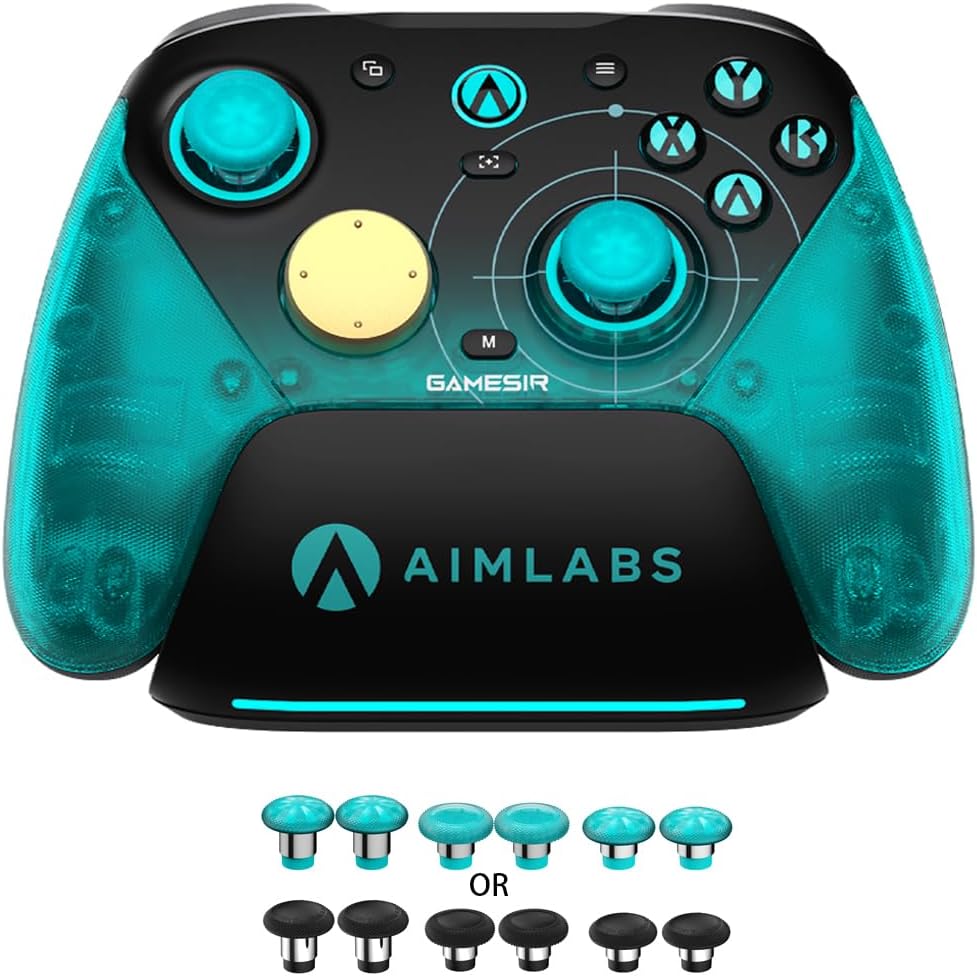
The GameSir G7 Pro 8K is the most complete competitive PC controller in this guide, combining 8000Hz polling over wired USB and 2.4GHz wireless with Gen-2 magnetic TMR sticks and a six-axis gyroscope. Its 4.3 rating and extensive input suite make it well suited to FPS, racing, and fighting games where latency, trigger control, and rapid remapping matter.
We may earn a commission when you buy through this link, at no additional cost to you.
The 8000Hz polling rate is its headline feature, registering inputs more frequently than the 1000Hz options elsewhere in the list. Gen-2 Mag-Res TMR sticks use magnetic sensing to eliminate physical contact within the stick mechanism, supporting smooth, linear movement and long-term drift resistance. The controller also uses optical ABXY buttons for fast actuation and a mechanical micro-switch D-pad for directional input.
Trigger stops provide another meaningful competitive advantage. Players can switch between linear Hall Effect analog triggers for smooth acceleration and braking or clicky micro-switch triggers for immediate digital response. Two lockable back buttons and two mini bumpers support up to 32-step macros, allowing repeated commands to be executed with fewer inputs. Asymmetric rumble motors add impact feedback, while the 3.5mm audio jack supports wired headset connections.
The trade-off is platform focus. This edition is designed for Windows 10 and 11 and is explicitly not compatible with Xbox Series X/S or Xbox One. It is therefore less appealing as a multi-console controller than several lower-ranked alternatives, but that focus is an advantage for a player who wants PC-specific features and does not need console compatibility.
For competitive PC gamers seeking low-latency input, anti-drift sticks, precise trigger modes, macros, and gyro aiming in one package, the G7 Pro 8K is the strongest all-around recommendation. It handles competitive shooters particularly well, though racing players may prefer an analog-friendly controller with comparable refinement.
The 8000Hz polling rate applies to both wired USB and 2.4GHz wireless operation. That broad high-frequency support is more useful than having it available through only one connection method. It sits alongside magnetic sticks and rapid optical buttons to minimize the delay between a player's physical action and its in-game response.
Four macro controls with up to 32 recorded steps each can automate combinations that would otherwise require several inputs. The physical trigger toggle adds a second layer of adaptability, allowing players to move between linear and digital behavior without relying entirely on software settings.
We may earn a commission when you buy through this link, at no additional cost to you.
The GameSir Tarantula 8K has the highest customer rating in this selection at 4.7, reflecting a strong reception for its wired esports design. It focuses on Windows PC gaming and combines 8000Hz polling, Gen-2 TMR sticks, dual-mode trigger stops, a six-axis gyroscope, and extensive programmable controls for competitive players.
We may earn a commission when you buy through this link, at no additional cost to you.
TMR sensing is designed to reduce physical stick contact while delivering smooth, linear movement and low power use. The trigger system can be configured as precision Hall Effect analog or clicky micro-switch behavior, making it suitable for both racing and shooters. The built-in gyroscope adds motion aiming and fine control in compatible PC games, while five additional programmable buttons support up to 32-step macro recording.
GameSir Connect expands the customization options with button mapping, performance adjustments, and macro management. Two lockable back buttons, two mini bumpers, and five front buttons create substantial control options, although beginners may need to spend time learning an interface designed for more committed players.
Its main limitation is connectivity. The Tarantula 8K is a wired controller rather than a wireless one, and the supplied information identifies it specifically for Windows. That restriction can simplify setup and eliminate wireless-related concerns, but it also limits portability and excludes console or mobile users.
For a desktop gaming setup where cable stability and maximum polling matter, the Tarantula 8K is an excellent fit. Its combination of a 4.7 rating, 8000Hz polling, magnetic sticks, trigger switching, and gyro support places it among the strongest competitive options in the guide. Wireless enthusiasts should examine the G7 Pro or other tri-mode models.
A dedicated wired design removes the need to manage a receiver, wireless pairing, or battery level. For a stationary gaming setup, that simplicity can be as valuable as portability. The 8000Hz polling rate then delivers the performance benefit most relevant to fast competitive input.
The two lockable rear buttons, two mini bumpers, and five front buttons give the Tarantula a deep customization toolkit. Combined with 32-step macros and software-based mapping, it is well suited to players who build specific control layouts for competitive titles.
We may earn a commission when you buy through this link, at no additional cost to you.
The GameSir Cyclone 2 is a well-rounded wireless controller with a 4.4 rating, 1000Hz polling, TMR sticks, a six-axis gyroscope, and an included aluminum charging dock. It supports PC, Switch, Android, and Steam-oriented setups, offering a useful balance of features without specializing exclusively in esports input polling.
We may earn a commission when you buy through this link, at no additional cost to you.
Its 2.4GHz wireless, Bluetooth, and USB-C wired modes make it flexible for different setups. The aluminum alloy dock serves as both a charging stand and storage location for the 2.4GHz dongle. Micro-switch ABXY buttons are rated for five million clicks, while dual asymmetric rumble motors provide differentiated impact feedback.
The trigger system can switch between linear Hall Effect analog behavior for racing and a fast digital mode for shooters. GameSir Connect controls mapping, trigger sensitivity, dead zones, vibration intensity, and gyro settings. Two remappable rear buttons and three instant-switchable profiles make it easy to move between shooter, racing, and role-playing configurations.
Unlike the G7 Pro and Tarantula, the Cyclone 2 does not offer 8000Hz polling or extensive multi-step macros. That means it may not be the strongest choice for a player whose entire setup revolves around tournament-level input speed. Its strongest appeal lies in everyday flexibility and a generous accessory package.
The Cyclone 2 is ideal for PC and Switch players who want wireless freedom, motion controls, an included dock, and broad configuration options without moving to a premium esports controller. It also fits players who alternate genres and appreciate quick profile switching between them.
The included aluminum dock makes recharging straightforward and gives the 2.4GHz receiver a dedicated home. Its presence avoids the need to keep the dongle loose or to remember that it was stored in the controller. The dock's design helps the product feel more like a complete gaming setup.
Three customized profiles can be changed through button combinations, reducing the interruption associated with reopening software between games. Gyro sensitivity, dead zones, trigger behavior, and vibration can all be adjusted, giving players a faster path to a suitable setup for each title.
We may earn a commission when you buy through this link, at no additional cost to you.
The GameSir Super Nova is an approachable wireless controller with a 4.3 rating, 1000Hz polling, Hall Effect sticks and triggers, and a six-axis gyroscope. It supports PC, Switch, Android, and iOS through Bluetooth, wired USB, and a wireless dongle, making it useful for players with several compatible devices.
We may earn a commission when you buy through this link, at no additional cost to you.
The Hall Effect stick system is specified to resist drift through five million cycles, while the triggers support adjustable stops and a hair-trigger mode. Silent buttons and anti-slip grips focus on comfort during longer sessions. The controller also includes programmable rear buttons, customizable RGB lighting, a detachable faceplate, and a swappable ABXY layout.
GameSir app and GameSir Connect support firmware updates, dead-zone adjustment, vibration customization, and button testing. Dual vibration motors provide standard impact feedback, and the gyro adds motion control for supported games, particularly within the Switch ecosystem.
Compatibility limitations should be considered before purchase. The Super Nova is not compatible with Xbox systems and requires Windows 10 or a newer version. It also does not match the 8000Hz polling of the dedicated esports controllers, so competitive players who prioritize maximum input frequency may prefer a G7 Pro or Tarantula.
The Super Nova is a strong choice for new or casual PC gamers who also play on Switch or mobile devices. Its anti-drift sticks, quiet buttons, gyro, remapping, and swappable layout offer more capability than a basic gamepad without imposing the complexity of the highest-end esports models.
The detachable faceplate and swappable ABXY layout offer a more tactile form of personalization than lighting alone. Rear buttons and configurable trigger stops further expand the setup options, making it easier to adapt the controller to different genres or personal control preferences.
Silent buttons can be useful in shared spaces or during late-night play. Rubberized grips support steadier handling over long sessions, while the 1000Hz polling rate delivers fast response over the supported wired and 2.4GHz connections.
We may earn a commission when you buy through this link, at no additional cost to you.
This GameSir G7 Pro 8K combines 8000Hz polling over wired and 2.4GHz connections with Gen-2 magnetic sticks, a six-axis gyroscope, and a rechargeable battery. Its 4.2 rating reflects a premium competitive package, and the included charging dock makes it a more convenient wireless choice than barebones alternatives.
We may earn a commission when you buy through this link, at no additional cost to you.
The Gen-2 TMR sticks are designed around magnetic sensing to reduce contact-related drift while preserving smooth analog movement. Players can choose between linear Hall Effect triggers and clicky micro-switch stops with a physical toggle, allowing rapid adaptation between racing and shooter requirements. Optical ABXY buttons provide quick, crisp actuation, while the mechanical D-pad focuses on consistent directional feedback.
The gyro can be mapped to sticks, buttons, or mouse controls, offering more flexibility than a fixed gyro implementation. Two lockable back buttons and two mini bumpers support up to 32-step macros, while GameSir Connect expands access to mapping, trigger configuration, stick settings, and macro functions. A 3.5mm audio jack supports wired headsets through both wired and 2.4GHz modes.
As with other controllers in the G7 Pro range, Windows is the intended environment, and Xbox support is absent. It also faces competition from the Razer Wolverine V3 Pro 8K, which provides a more premium construction, carrying case, mouse-click-style rear buttons, and swappable stick caps. The GameSir option nevertheless delivers a more explicit macro and gyro feature set for PC-focused buyers.
This is an excellent choice for a competitive PC gamer who wants top-tier polling without giving up wireless flexibility. The included battery and dock, combined with extensive remapping, make it particularly attractive for players who alternate between high-intensity shooters, action games, and gyro-assisted aiming.
The ability to sustain 8000Hz polling over 2.4GHz is the defining feature for wireless competitive players. It removes the need to trade mobility for maximum input frequency. Wired USB remains available when absolute connection simplicity is preferred.
Gyro input can be mapped to sticks, buttons, or mouse controls, allowing players to design motion-assisted aiming around a particular title. The 3.5mm headset jack provides a convenient option for private wired audio without relying entirely on a separate headset connection method.
We may earn a commission when you buy through this link, at no additional cost to you.
The Razer Wolverine V3 Pro 8K is a premium PC controller built around 8000Hz hyperpolling, magnetic TMR thumbsticks, hybrid triggers, and an unusually extensive set of rear inputs. It carries a 4.1 rating and targets players who value premium ergonomics and mouse-like actuation alongside strong wireless performance.
We may earn a commission when you buy through this link, at no additional cost to you.
Razer describes the controller as its lightest wireless esports model, with a form developed around input from competitive players. Four mouse-click buttons embedded in the rubberized handles and two claw-grip bumpers offer more rear controls than most standard gamepads. This can be valuable for bindings that would otherwise require uncomfortable finger movement.
The Pro HyperTriggers can operate as lightning-fast digital mouse clicks or analog controls with a physical switch. Doubleshot PBT ABXY buttons use hybrid microswitches, while the eight-way floating D-pad provides directional movement. TMR thumbsticks include replaceable caps, allowing users to alter their shape or feel. Up to four onboard profiles can be saved, and six buttons can be mapped to keyboard keys.
There is an important compatibility caveat: this model is designed for Windows 11 PCs with USB-A and does not support macOS, mobile devices, Xbox consoles, or PlayStation. The supplied product details do not identify a built-in gyroscope, so buyers searching specifically for motion controls should confirm that requirement separately rather than assuming it is present.
The Razer is most appropriate for Windows 11 esports players who want premium ergonomics, extensive rear controls, flexible triggers, and a complete carrying solution. The included case, two spare thumbstick caps, and braided cable create a polished package, but its narrower platform support and unspecified gyro functionality make it less obviously aligned with the keyword than several rivals.
Four rear buttons modeled on gaming-mouse clicks can make common bindings faster to execute without moving a thumb away from the sticks. The two claw-grip bumpers add another set of inputs, while the rubberized handles are designed to maintain a secure grip during long sessions.
The custom carrying case holds the controller and accessories, while two replacement TMR caps and a two-meter braided cable are included. These extras add convenience for travel and storage, although compatibility remains limited to the specified Windows 11 environment.
We may earn a commission when you buy through this link, at no additional cost to you.
The 8BitDo Ultimate 2 earns a 4.5 rating through a refined mix of stable wireless performance, TMR sticks, customizable motion controls, and extensive input options. It supports PC, Apple devices, Steam, and Android, making it an attractive choice for users who want a controller that can move between desktop and mobile gaming.
We may earn a commission when you buy through this link, at no additional cost to you.
Its 8Speed 2.4GHz technology is specified to deliver sub-1ms latency over a range of up to 10 meters with strong anti-interference performance. The 1000Hz polling rate applies to both 2.4GHz and wired connections. TMR sticks are described as offering greater sensitivity, precision, and durability, while the trigger mode switch alternates between linear Hall Effect behavior and non-linear tactile triggers.
Motion control is customizable through a six-axis system, accompanied by a turbo function and rumble vibration. Two professional back paddles, extra R4 and L4 bumpers, tactile bumpers, and a tactile D-pad expand the layout beyond a basic six-button gamepad. Ultimate Software V2 provides another route to configuration.
The included multifunctional charging dock and USB-C adapter make the wireless setup easier to organize, although the controller's 1000Hz polling is clearly below the 8000Hz offered by the leading esports models. Users should also verify individual game compatibility because the advertised platform list covers PC, Apple, Steam, and Android rather than every possible system.
The Ultimate 2 is a refined general-purpose choice for players who prioritize stable low-latency wireless, attractive controls, motion customization, and broad device use. It may be especially attractive to Steam Deck, PC, and Android users who do not need tournament-level polling but do want modern stick construction and extensive remapping.
The 8Speed system focuses on a stable 2.4GHz connection, sub-1ms latency, and resistance to interference. For compatible PC and Steam experiences, that focus can make the controller feel more responsive than a standard Bluetooth gamepad while retaining wireless convenience.
Two rear paddles and additional R4 and L4 bumpers give players more available inputs than a standard controller. The switch between linear and tactile trigger behavior allows the same controller to suit both precision-oriented racing and action games that benefit from a defined physical pull.
We may earn a commission when you buy through this link, at no additional cost to you.
The ManbaOne Interactive Screen is the most unconventional option in the guide, using a two-inch display to put controller configuration directly in front of the player. Its 4.3 rating reflects a feature set that includes a six-axis gyroscope, Hall Effect anti-drift sticks, four saved configurations, macro-capable rear keys, and a smart charging station.
We may earn a commission when you buy through this link, at no additional cost to you.
The display allows vibration, lighting, buttons, joysticks, and other settings to be changed without an app, complex key combinations, or a Windows utility. Four configurations can be stored for different games or play styles. Each of the four rear buttons supports macro definitions, which could be used to activate a character's ultimate move or other multi-step command with one press.
Connectivity includes wired, Bluetooth, and a wireless dongle. The manufacturer recommends the dongle for PC Bluetooth connections because it is described as more stable, while the wired mode provides an 800Hz-plus polling rate. Hall Effect joysticks are designed to resist drift, and the controller offers four joystick customization modes along with adjustable stick heights.
The intelligent screen is useful, but it also makes the controller visually larger than a conventional gamepad. Some users may prefer a minimal layout, while others will appreciate immediate visual feedback. The supplied compatibility information covers Switch, Switch 2, iOS, Android, and Windows PC, but excludes Xbox, PlayStation, and GeForce Now.
The ManbaOne is worth considering for players who enjoy experimenting with profiles or want a controller whose settings are easy to understand at a glance. Its gyro and macro support meet the core needs of the category, while the charging station and included receiver receiver make the wireless experience more complete.
The interactive screen acts as a built-in control center for buttons, sticks, lighting, vibration, and saved configurations. This reduces dependence on companion software and makes it easier to understand which settings are currently active while the controller is in hand.
Four configurations allow separate setups for different games, while the four rear keys can carry macro definitions. The result is a controller aimed at users who value visible, immediate customization as much as traditional software flexibility.
We may earn a commission when you buy through this link, at no additional cost to you.
The most important choices are platform compatibility, gyro implementation, stick precision, trigger behavior, polling rate, connection method, and the amount of customization you need. A controller that excels in one area may be less suitable for another, so begin with the games and devices you actually use.
Start by verifying operating-system and game support rather than assuming every PC controller behaves identically. Several products in this guide are specifically designed for Windows, while others extend to Switch, Steam Deck, Android, iOS, Apple devices, or Steam. Console support is separate from PC support: most of the listed controllers explicitly exclude Xbox or PlayStation compatibility. Check that your preferred games accept a third-party controller and that any required Steam Input or platform configuration is available for the title you want to play.
Choose a Windows-only esports controller when your setup is dedicated to competitive PC play. Choose a multi-platform model if you also use Steam Deck, Switch, or mobile devices and need one controller to cover them. Always read the current product listing because support and firmware behavior can change.
A six-axis gyroscope senses movement across multiple axes, but the presence of a sensor does not guarantee that every PC game will use it. Some controllers offer stronger customization, including sensitivity controls, axis mapping, or the ability to map gyro input to sticks, buttons, or mouse controls. This matters for motion-assisted aiming, where an overly sensitive response can make a target difficult to track.
Look for a clear recalibration procedure as well. Stick calibration helps the controller return to a neutral position correctly, while software settings can reduce dead zones or tune gyro response. For beginners, an interface that exposes gyro sensitivity and button mapping is easier to use than a controller that offers motion control with limited guidance.
Polling rate describes how frequently the controller reports input to the computer. Models in this guide range from 800Hz-plus to 8000Hz, with several using 1000Hz. Higher polling can represent a meaningful advantage in fast competitive games because it increases the frequency with which changes in stick or button position are communicated. It does not automatically make every controller better, and display performance, game behavior, connection stability, and configuration also shape the experience.
Competitive players should favor 8000Hz if their budget and preferred platform allow it. The GameSir G7 Pro, Tarantula 8K, and Razer Wolverine V3 Pro target that segment. For casual gaming, racing, and mixed use, a 1000Hz controller can still offer a responsive and consistent experience.
Traditional potentiometer sticks rely on physical contact between internal components, which can gradually produce unwanted drift. Hall Effect and TMR approaches use magnetic sensing to reduce or avoid that contact. The TMR and Gen-2 Mag-Res sticks in this guide are positioned as long-term drift-resistant options, while Hall Effect sticks offer a similar magnetic operating principle.
Compare stick feel as well as the sensor type. The FLYDIGI Direwolf 4 offers adjustable tension from 40gf to 80gf, while the EasySMX X20 has detachable, height-adjustable sticks. Anti-drift specifications are valuable, but correct calibration, firmware, dead-zone tuning, and a clean physical connection remain important parts of maintaining consistent behavior.
Digital triggers provide a short, consistent pull and suit shooters where immediate firing is the priority. Analog triggers travel proportionally, allowing gradual braking, acceleration, and other inputs in racing games. Many controllers in this guide offer both through physical trigger stops, a switch, or a software-controlled mode.
Look for a hair-trigger setting if you play fast-paced shooters and linear analog travel if precision racing matters. Players using both genres benefit from a physical toggle because they can change behavior without entering a configuration menu. Test the default trigger range as well, since a trigger that feels too stiff or too loose can undermine an otherwise precise control system.
Wired USB-C offers a dependable direct connection and makes sense for a stationary gaming desk. Wireless 2.4GHz dongles generally prioritize low latency and stable input for PC gaming, making them attractive for competitive users who want to move around without accepting a potentially less stable Bluetooth connection. Bluetooth is convenient for mixed-device use but may not provide the same connection characteristics as a dedicated receiver.
Account for battery life and charging method. Some models include a charging dock, while others require a cable or an additional proprietary dock. The FLYDIGI Direwolf 4 supports wired charging but its exclusive dock is an extra purchase. The ManbaOne and several GameSir products include dedicated stations, which can simplify storage as well as charging.
Rear buttons, additional bumpers, and configurable profiles can save time in games where several actions need to be available at once. The more advanced GameSir models support multi-step macros, while the ManbaOne can store four configurations and assign macros to four rear keys. These features are useful for advanced players, but they can also add complexity for beginners.
Count the actual controls rather than relying on a total button number. A smaller set of clearly placed rear buttons may be more useful than many crowded inputs. Confirm that lockable buttons can be disabled when a game or title requires a simpler layout, and check whether macro and profile functions work through the device's app, software, or built-in display.
A controller can have excellent specifications and still feel uncomfortable after a long session. Grip texture, weight, button placement, D-pad construction, and stick shape all influence the experience. Rubberized or anti-slip grips can help during extended play, while tactile, clicky, or silent face buttons cater to different preferences. The Razer model places four mouse-style buttons in its handles, while other products emphasize portability or a familiar traditional layout.
Rumble and trigger feedback also vary. Dual asymmetric motors can distinguish heavier impacts from lighter feedback, while silent buttons may be preferable around other people. Choose according to your sensitivity to vibration. For motion aiming, the gyro should complement the controller's physical handling rather than require constant wrist movement.
Begin with the connection method best suited to your PC. Connect the USB-C cable, pair the 2.4GHz receiver through its USB connection, or select Bluetooth from the controller and Windows settings. If the device includes a dock, charge it fully before the first session and store the receiver in the dock when it is not in use. For PC Bluetooth models, the 2.4GHz receiver may offer a more stable low-latency connection.
Install the appropriate companion software when you need remapping, profiles, firmware updates, dead-zone adjustments, or gyro settings. Calibrate the sticks by following the supplied procedure, then test every face button, D-pad, bumper, trigger, and rear button. If using gyro aiming, begin with conservative sensitivity, map motion to the desired input, and increase the rate gradually. Recalibrate again if the controller seems to rest away from center.
Clean the controller with a soft, dry cloth and avoid liquid cleaners around buttons, ports, and the charging contacts. Keep the device away from moisture, excessive heat, and crowded surfaces that could press the sticks or triggers. Charge the battery before it is completely depleted, inspect the cable and receiver for damage, and update firmware when instructed. Store the controller on its dock or in a protective case to reduce accidental input from impact or pressure.
No. Gyro input is useful only when the game or input layer supports motion controls. Support varies by title, and some games require particular remapping tools or platform-specific configuration. A controller can contain a six-axis sensor and still provide little practical benefit in a game that does not accept gyro input. Confirm compatibility before purchasing and begin with moderate sensitivity if the game exposes motion controls.
The controller reports input more frequently at 8000Hz, which can benefit fast competitive games where immediate input registration matters. It does not change every aspect of performance or guarantee a visible improvement in every game. For many players, stick precision, trigger feel, stable connectivity, and correct configuration have a broader effect on the overall experience. Competitive PC gamers are the group most likely to value the highest polling option.
Hall Effect and TMR sensing reduce or eliminate the physical contact responsible for common potentiometer stick drift, but no controller should be treated as immune to every issue. Calibration, firmware, debris, magnetic interference, or a damaged component can still affect behavior. If a stick moves while untouched, use the recalibration procedure and check the connection before assuming permanent damage.
Wired controllers are simple and dependable for a fixed gaming desk. A 2.4GHz receiver generally offers the most consistent low-latency wireless experience for PC gaming, while Bluetooth is more convenient across computers and mobile devices. Consider battery life, preferred platform support, and whether the included dock or receiver storage makes one option easier to organize than another.
Most of the models in this guide are explicitly designed for Windows PC rather than Xbox or PlayStation consoles. Compatibility with a PC also does not guarantee support for every cloud gaming service. Check the individual listing for console exclusions, operating-system requirements, and supported platforms before ordering, particularly if you expect to use more than one gaming device.
Start with the lowest practical sensitivity or the preset recommended by the game. Increase it only after confirming that normal aim remains comfortable and that unwanted camera movement is not occurring. Use axis mapping and dead-zone controls where available, and recalibrate the sticks before changing multiple gyro settings at once. Small adjustments are generally easier to evaluate than a large initial change.
Basic controller operation usually works through standard Windows input, but companion software can be necessary for gyro remapping, custom button layouts, profiles, trigger behavior, dead zones, and firmware updates. The ManbaOne stands apart by placing many settings on its built-in display, while the FLYDIGI Direwolf 4 also works without its software for standard functions. Check which features you need before deciding whether a desktop configuration tool is essential.
A wired model such as the GameSir Tarantula 8K avoids receiver storage and battery management, making it straightforward for a compact setup. The ManbaOne offers an integrated screen but takes up more visual space, while wireless models require somewhere to store their receiver and charging dock. Choose based on desk area, cable preference, and how often you expect to move the controller.
The GameSir G7 Pro 8K stands out as the strongest overall choice because it combines 8000Hz polling, Gen-2 TMR sticks, dual-mode triggers, programmable macros, and six-axis gyro control in a focused PC package. The FLYDIGI Direwolf 4 is the most compelling budget option, offering adjustable stick tension and flexible triggers, while the Razer Wolverine V3 Pro 8K provides the most premium physical design and extensive rear controls.
Prioritize the features that affect your actual games. Competitive players should examine polling rate, magnetic stick construction, trigger travel, and remapping tools. Multi-platform users should verify Windows, Steam Deck, Switch, mobile, and service compatibility. If you need motion aiming, confirm that the game supports gyro input and that the controller provides understandable sensitivity and axis-mapping controls.
Product specifications, software behavior, and prices can change, so check the current listing before making a final decision. Use the comparison table to narrow the field, then confirm platform support, connection method, battery requirements, included accessories, and the exact game modes you plan to play.