
LeapFrog 2-in-1 LeapTop Touch
4.7Editor score
Convertible keyboard and tablet design
Five interactive learning modes
Suited for ages two through five
Compare the best laptop for 5 year old options, covering offline learning, bilingual activities, screens, games, parental features, and age-appropriate design.
Finding the best laptop for a 5 year old means balancing play with age-appropriate learning, a child-sized design, and a screen that is engaging without being overwhelming. Young learners benefit most when activities are intuitive, rewarding, and easy to begin without extensive parent assistance. The right device should also fit comfortably into a five-year-old’s daily routine.
We compared all 10 products in this guide by examining their age guidance, educational subjects, language support, screen size and type, physical controls, entertainment features, parent controls, and portability. The list includes offline educational laptops, bilingual models, camera-equipped toys, a full-size family tablet, and a more advanced touchscreen computer with apps and Google Play.
Each review identifies the features that make a particular model useful at age five, along with any limitations visible in the supplied product information. The top picks highlight the strongest choices for general learning, budget-conscious play, and a feature-rich educational experience. Product listings and prices can change, so confirm current details and availability before buying.
4.7Editor score

4.5Editor score
4.6Editor score
This side-by-side comparison highlights each laptop's age range, learning breadth, language support, entertainment options, and physical design, helping parents identify the most appropriate match for a five-year-old.


The VTech Genio Bilingual JuniorBook is a strong all-around choice for a five-year-old because it combines a grown-up-looking design with a large collection of age-appropriate activities. It carries a 4.5 rating and is intended for ages five and older, aligning directly with the age range in this guide. Its library covers math, science, language arts, music, and Spanish rather than focusing on a single narrow subject. That breadth makes it useful for varied play sessions and gives parents a convenient way to introduce computers without beginning with a general-purpose device.
We may earn a commission when you buy through this link, at no additional cost to you.
The standout feature is full bilingual support. Every activity can be played in English or Spanish, allowing the child to immerse in another language throughout the learning experience rather than seeing it isolated to a single exercise. More than 80 activities include practical tools such as a weekly calendar, notebook, and music player alongside educational games. Because everything is preloaded and works offline, the laptop is ready for use without a connection, account setup, or unpredictable online content. The full-size QWERTY keyboard and separate cursor controller also make it feel like a real computer and can help build early typing and mouse-handling skills.
The most important trade-off is its dependence on four AA batteries. Batteries are included only for demonstration purposes, so regular use calls for a fresh set. It also uses a dedicated activity-laptop interface rather than the open app environment of a full touchscreen computer. For most families, those limitations are acceptable because the immediate-play design, offline reliability, and carefully paced content are more relevant at age five than the flexibility of a general operating system. The product is not a replacement for supervised computer learning or a school device, but it is a focused educational toy rather than an unrestricted machine.
This is the best general pick for parents who want a five-year-old to practice familiar computer actions while accessing a substantial mix of education and entertainment. Its subject range, bilingual approach, and offline design provide more versatility than many similarly focused kids' laptops. Choose it when the priority is a self-contained learning experience that feels substantial without introducing the distractions and setup demands of an adult computer.
The ability to switch the entire activity library between English and Spanish is unusually valuable for a child at this age. Preloaded, offline content means the learning experience begins immediately and remains dependable during travel, bad weather, or limited connectivity.
A full-size QWERTY keyboard and separate mouse introduce the basic actions associated with computer use. The familiar layout, notebook, calendar, and music player help the child see learning tools alongside entertainment in a realistic-looking device.
We may earn a commission when you buy through this link, at no additional cost to you.
The Lexibook Unicorn Educational Laptop is a charming choice for a five-year-old who responds to a colorful, imaginative theme. Its 4.3 rating reflects a generally favorable reception, while the listed subjects include English and Spanish, mathematics, dactylology, general knowledge, logic, music, and clock reading. This is a broader foundation than a basic alphabet toy, and the Unicorn design may make the device especially inviting as a pretend-computer accessory.
We may earn a commission when you buy through this link, at no additional cost to you.
The activities are organized around learning, testing, and improvement. Different levels let a child revisit familiar material with either easier or more challenging tasks, which is useful as skills develop. After the learning sections, the laptop also offers games centered on logic, memory, and speed. Those games provide a natural change of pace while reinforcing skills introduced earlier. Musical activities are another highlight: children can learn notes, compose simple material, and play melodies, adding a creative outlet to an otherwise academic set of subjects.
Its design is explicitly inspired by real laptops, with a realistic mouse and keyboard, a slim profile, and a convenient size for small hands. The primary uncertainty is that the supplied listing does not specify the screen dimensions or confirm offline behavior. Those details matter when comparing it with models that publish a clear display size and preloaded activity system. Even so, the product's focus on a realistic form factor, multiple activity levels, and a Unicorn theme gives it a distinct identity. It is particularly appropriate for a child who is motivated by characters and fantasy rather than a plain toy-computer appearance.
The Unicorn Laptop is best for families prioritizing engaging presentation and a balanced mix of curriculum, games, and music. It may also appeal to a child who is just beginning to explore the idea of a computer and needs a friendly, approachable form. Verify the current display and connectivity details on the listing, but for a themed educational experience with age-progression features, this model is a strong contender.
A recognizable fantasy theme can make an educational device feel like a special toy. The Unicorn styling gives the laptop visual appeal while the keyboard, mouse, and leveled activities preserve the core learning experience.
The inclusion of melody creation and logical games broadens the experience beyond rote recognition. Music activities can support early coordination, while logic and memory games provide skills that transfer to problem-solving.
We may earn a commission when you buy through this link, at no additional cost to you.
This 48-mode learning laptop is a straightforward educational option for a child turning five. Its 4.2 rating indicates solid customer reception, and the stated age guidance begins at five. The activity library covers the alphabet, mathematics, colors, animals, general knowledge, logic, music, clock reading, and the calendar. This mix of foundational subjects is well suited to a child who is learning basic facts while becoming familiar with a keyboard.
We may earn a commission when you buy through this link, at no additional cost to you.
A 4.3-inch TFT color screen is the product's most visible advantage over minimal two-color educational devices. The listing describes lifelike visuals intended to make the screen clearer and more comfortable, while the compact 11 by 8 by 1.2-inch body should be manageable for small hands. The mouse and keyboard mimic the arrangement of a real laptop, making it easy to explain the device as a miniature computer. Kids answer activity questions and play games with the keyboard, which helps connect the learning content with a practical computer skill.
There is one setup step worth noticing: a protective film is installed on the screen and must be torn off. The listing also does not identify whether internet connectivity is required, so parents should check the current product details before assuming it works entirely offline. The reported activity count is large, but the names of the modes do not reveal how much new material each one contains. Even so, the color display, varied subjects, and post-lesson games create a balanced setup for daily use.
This laptop is a good fit for parents who want a conventional first educational computer with a more colorful display and a clearly age-targeted list of activities. It is particularly useful for a five-year-old working on letters, numbers, colors, animal facts, and early logic. Choose it over more generic toy laptops when visual clarity and a broad range of subject categories are the leading priorities.
The TFT color display can make pictures, animals, colors, and other visual subjects more engaging. It also makes the device feel less like a basic learning machine and more like a compact personal computer.
Alphabet, arithmetic, clock reading, music, animals, and general knowledge cover several common preschool topics. Logical and memory-based games then extend those lessons into entertaining challenges.
We may earn a commission when you buy through this link, at no additional cost to you.
The LeapFrog 2-in-1 LeapTop Touch is the most highly rated model in this roundup, earning a 4.7. It is designed for ages two through five, making it a natural choice for a child who is just reaching the lower end of the target age. Its defining feature is a screen that flips, allowing the device to work as a traditional keyboard laptop or a touch tablet. That adaptability makes it useful as a child transitions from simple button play toward more interactive exploration.
We may earn a commission when you buy through this link, at no additional cost to you.
The keyboard includes letters A through Z and numbers 1 through 10. Five learning modes cover ABCs, numbers, games, music, and messages. Role-play activities such as pretending to email Scout introduce communication concepts in a way that feels appropriate for a preschooler. Parents can also customize the experience so a child can spell their own name. This personalization increases relevance and makes the learning content feel connected to the child's daily life rather than remaining generic.
The convertible design is the main compromise as well as the main advantage. Some activities may work best in one mode than the other, and parents may need to show a five-year-old how to rotate the screen correctly. It also requires three AA batteries, with the included batteries intended only for demonstration. The feature set is more modest than that of devices advertising dozens or even more than 100 activities. However, the simpler structure can be helpful for a young child because it reduces the number of choices and keeps the learning goals visible.
The LeapTop Touch is the strongest option for parents who want a compact, highly rated educational toy that can grow with a child nearing kindergarten age. It works especially well for alphabet practice, number recognition, music, and gentle role-play, all without introducing a full-size adult computer. It is also an excellent budget-oriented choice when simplicity and convertibility matter more than a massive activity library.
The flip-screen construction lets children alternate between typing and touch interaction. This can reinforce the idea that different digital tasks call for different ways of navigating a screen.
The ability to spell the child's own name turns a standard letter activity into a more meaningful exercise. Personalized role-play and messaging themes can also make early computer concepts easier to understand.
We may earn a commission when you buy through this link, at no additional cost to you.
The VTech Play Smart Preschool Laptop has a 4.6 rating and an age range of three to six, covering a five-year-old comfortably. Although it is presented in pink, its black-and-pink styling and grown-up appearance are likely to appeal more broadly than an intensely character-based toy. Thirty activities use leveled learning, allowing a child to move through material at an appropriate pace rather than being offered one fixed level for every subject.
We may earn a commission when you buy through this link, at no additional cost to you.
Personalization is a notable strength. A child can add a name, age, avatar, and other details, making the laptop feel like an individual device. Lessons introduce beginning Spanish words, letters, and numbers. Additional activities identify letters, explore letter sounds, examine shapes and numbers, and sort foods into fruits and vegetables. Logic games, animal sounds and footprints, and instrument recognition add variety through sound and visual content. The result is a well-rounded first computer for children still building literacy and number familiarity.
Two AA batteries power the laptop, and the included cells are only for demonstration. The 30-activity count is smaller than the 48, 64, 80-plus, 124, and 164-activity libraries found elsewhere in this guide. For some parents that sounds limiting, but a carefully chosen set of activities can be easier for a young child to navigate. The listing does not state whether activities work offline, so buyers who value dependable no-internet use should verify this point on the current product page. It also remains a toy-style learning computer rather than an open tablet or notebook computer.
This model is best for a five-year-old who benefits from personalization and progressive activities. It can serve as a strong bridge into computer routines, particularly when the child is mastering letter sounds, basic numbers, shapes, and early Spanish vocabulary. Choose it for its polished preschool focus, wide intended age range, and strong rating rather than for raw activity quantity or access to a large app ecosystem.
Adding a name, age, and avatar makes the device feel connected to the child. That sense of ownership can be useful when establishing a regular routine around learning and responsible computer use.
Activities progress from identification to sounds, categories, and games. The variety supports early literacy and numeracy without requiring a child to read extensive instructions independently.
We may earn a commission when you buy through this link, at no additional cost to you.
The LEXiBOOK LAPTAB 10 inch is the closest option here to a general-purpose family laptop, offering a 10.1-inch HD touchscreen, an octa-core processor, 128GB of storage, and access to Google Play. It carries a 4.2 rating. For a five-year-old, the larger display and app flexibility are meaningful advantages, but they also make adult supervision and thoughtful account management much more important than with a self-contained educational toy.
We may earn a commission when you buy through this link, at no additional cost to you.
Learning is supported through the Power Academy app, 300 eBooks through ReadEra, and a 15-language translator. The stated Google Play access provides additional games and apps, allowing the device to grow beyond a single curated curriculum. Family-friendly features include customizable profiles, robust parental controls, time and app management, and the Qwant Junior browser. A 2MP front camera supports video calls, while Bluetooth 5.0, Wi-Fi, two USB-A ports, and one USB-C port make the tablet usable with a wider range of accessories.
The main trade-off is complexity. A full app environment offers more freedom but also creates more opportunities to encounter unsuitable content or confusing menus. Parents would need to configure profiles, limits, and browser controls carefully, and they should not expect the same focused, automatically safe experience provided by a laptop with a limited preloaded library. The larger screen may also be less comfortable for small hands during extended independent use. Nevertheless, the slim, light construction and rechargeable 4,000mAh battery make it practical for travel and shared family use.
The LAPTAB is best for a family that wants a five-year-old to begin using a more capable touchscreen computer while retaining meaningful learning and safety tools. It is less appropriate when the goal is a sealed, toy-like experience with no setup or online management. For parents willing to configure the device and guide its use, it offers the greatest long-term flexibility in this list.
The 10.1-inch HD display gives books, videos, translator tools, and educational apps more room. That makes the device useful for shared reading, video calls, and longer learning sessions with an adult.
Google Play access expands the range of possible activities, while profiles, time limits, app management, and a child-oriented browser help adults keep the environment structured. Safeguards remain most effective when they are configured before independent use.
We may earn a commission when you buy through this link, at no additional cost to you.
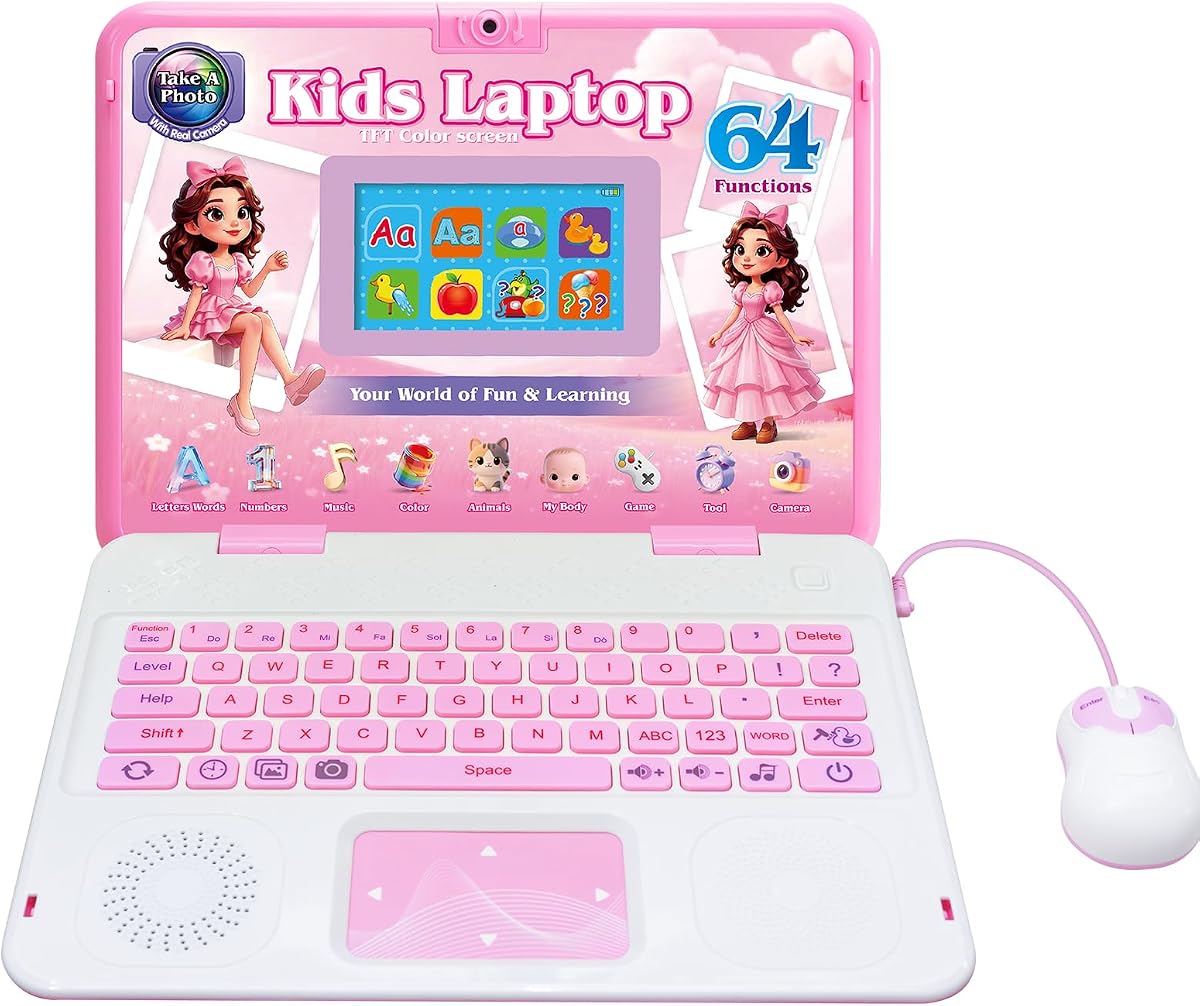
The Kids Laptop with Camera stands out because it combines 64 activities with a built-in camera and creative photo tools. It has a 4.6 rating and is intended for children age five and older. The camera is supported by clear lenses, colorful frames, and filter effects, giving a five-year-old a playful way to take pictures of family members, pets, drawings, or other creative subjects.
We may earn a commission when you buy through this link, at no additional cost to you.
Education remains central, with activities spanning the alphabet, mathematics, colors, animals, music, and games. The product includes a 4.3-inch TFT color display that balances portability with comfortable handling. Its realistic mouse and keyboard borrow from conventional laptop ergonomics, helping the device feel recognizable as a computer. Once the child has mastered the learning activities, the camera and games provide alternative forms of entertainment rather than leaving the device with a single purpose.
The camera is both the most attractive premium feature and the factor that deserves the most parental attention. A five-year-old can create entertaining images, but adults should establish clear rules about when and where photography is permitted, especially around other children. The listing does not state whether the laptop needs an internet connection, and it does not describe a detailed parent-control system, so buyers should not assume it offers the same online management as the LAPTAB. If used under supervision, however, that limitation is manageable.
This is the best pick for a child who enjoys creative expression and wants more than worksheets on a screen. The combination of a camera, filters, color visuals, games, and a substantial activity library gives it a strong entertainment factor while still supporting foundational learning. It is a particularly good choice for a five-year-old who responds to taking pictures, making pretend scenes, and sharing visual projects with family.
The camera and photo filters can make simple family moments into playful projects. This creative outlet complements the academic activities and may keep a child engaged when traditional exercises feel repetitive.
With 64 activities, the laptop has enough variety for multiple subjects and games. The 4.3-inch color display supports both educational visuals and the camera experience without making the device too large to handle.
We may earn a commission when you buy through this link, at no additional cost to you.
The LeapFrog LeapPad Academy Kids’ Learning Tablet is not shaped like a laptop, but it deserves serious consideration for a five-year-old who is ready for a tablet. It has a 4.3 rating, is intended for ages three through eight, and supports development across math, reading, writing, coding, problem-solving, and creativity. Its range of skills makes it more of a durable early-learning platform than a single-purpose educational laptop.
We may earn a commission when you buy through this link, at no additional cost to you.
More than 20 educator-approved learning apps come included, with additional games, videos, music, and eBooks available through the LeapFrog App Center. A three-month trial of LeapFrog Academy adds access to a large collection of adventures, activities, books, videos, and songs. A stylus, tough bumper, kickstand, and seven-inch shatter-safe screen create a practical setup for a young child. The rechargeable lithium-ion battery also removes the need for routine battery replacement.
The important trade-off is the cost of expanding the library. Some additional content is sold separately, and some of the advertised experience depends on a trial or subscription. Parents should also understand the distinction between the included apps and the broader catalog. As a tablet, it offers fewer built-in controls than a physical keyboard laptop, although the stylus creates valuable opportunities for handwriting and drawing practice. The included screen protection and bumper are especially helpful for normal use by a five-year-old.
The LeapPad is best for families seeking durability, writing practice, and a long usable age range. It can serve a five-year-old well through preschool and into early elementary learning, especially if the child enjoys drawing, letters, and structured app-based activities. Choose it over a laptop-shaped toy when screen protection, a rechargeable battery, and stylus interaction matter more than having a built-in keyboard.
The tough bumper, kickstand, and shatter-safe screen address common concerns with children's tablets. A seven-inch display is large enough for detailed apps while remaining manageable for a five-year-old.
Reading, writing, math, coding, creativity, and problem-solving are represented in the app collection. The stylus is particularly useful for letter formation, drawing, and hands-on activities that a mouse would not support as naturally.
We may earn a commission when you buy through this link, at no additional cost to you.
The Lexibook Barbie Educational Laptop combines a popular theme with 124 activities, giving it broad appeal for children who enjoy Barbie-inspired play. It carries a 4.3 rating. The educational content includes math, clock reading, logic, and music in both English and Spanish, with each activity offering multiple levels so a child can learn, test, and improve at a suitable pace.
We may earn a commission when you buy through this link, at no additional cost to you.
The design is slim and styled after an authentic laptop, including a realistic mouse and keyboard. This helps children practice familiar computer interactions rather than merely tapping buttons on a toy. A compact size of 24 by 18 by 3.6 centimeters when closed makes it convenient for use at home, in a car, or during family trips. After working through lessons, children can play Snake, Memory, and Puzzle games, providing an enjoyable transition from educational practice to lighter entertainment.
The screen measures 5.1 by 9.7 centimeters according to the supplied description, so it is small even relative to other toy laptops. That may limit the visual impact of some games or detailed activities, and children with visual needs may prefer a larger display. The Barbie theme is also a subjective advantage: it can make the device highly motivating for one child while feeling less relevant to another. Its activity quantity is impressive, but the number of modes does not guarantee equal depth in every category.
This laptop is best for a five-year-old who is excited by Barbie and wants a broad collection of lessons within a familiar computer design. It works well for portable family use and for children who need several levels of challenge across math, logic, music, and general skills. Parents should consider the small screen and theme fit, but those limitations are reasonable when the device's personality and activity variety are major advantages for the intended child.
A familiar character can make the laptop feel like a personal accessory rather than an impersonal teaching tool. That enthusiasm may encourage a child to return to the math, logic, and music activities independently.
The 124 activities cover several categories and multiple difficulty levels. A substantial selection of games afterward helps balance focused learning with recreational play.
We may earn a commission when you buy through this link, at no additional cost to you.
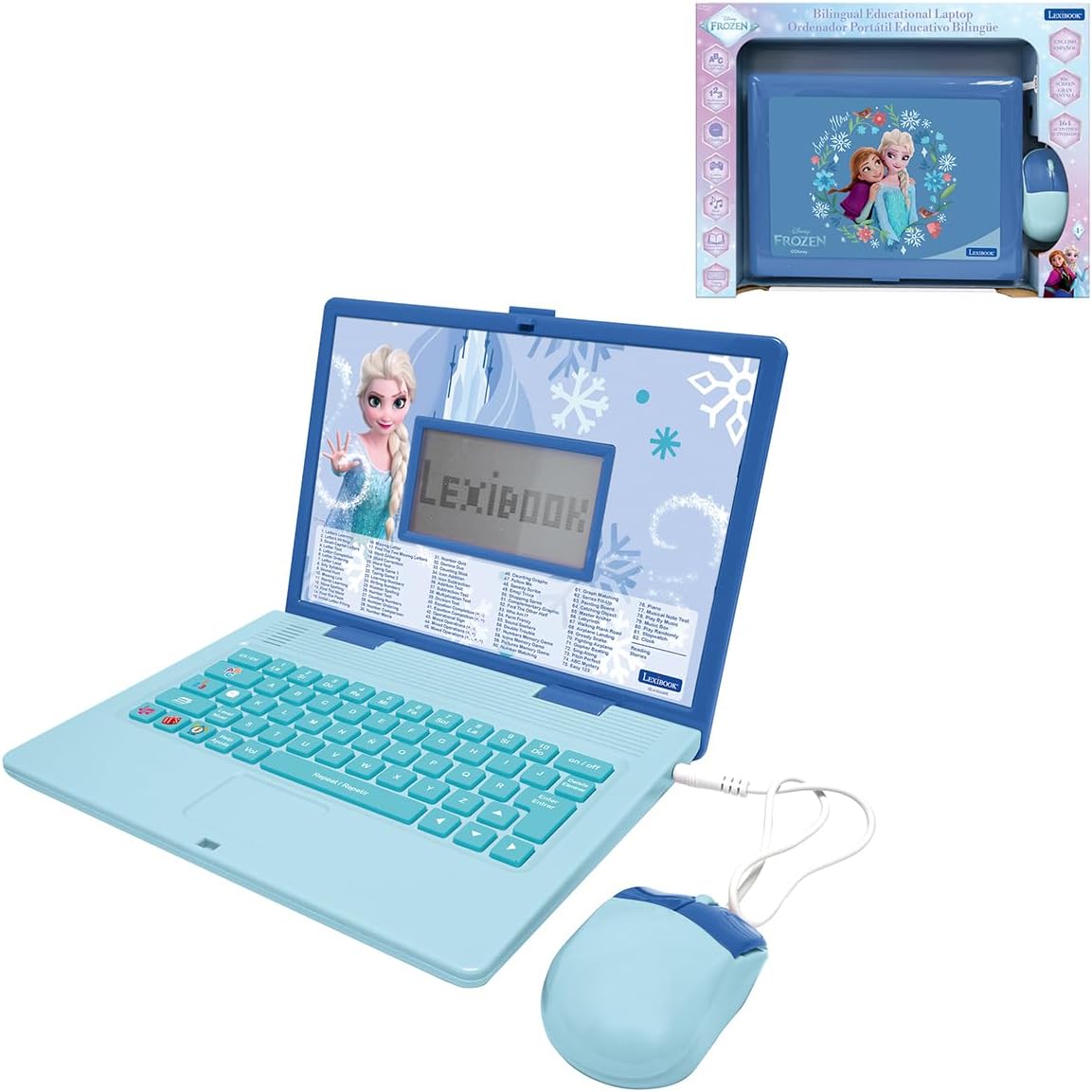
The LEXiBOOK Frozen Educational Laptop is a feature-rich themed option with 164 activities, the largest dedicated activity count among the laptops in this guide. It is designed around a Frozen theme and covers vocabulary, spelling, mathematics, logic games, and music. A five-year-old who already enjoys the characters may find the combination of familiar entertainment and educational exercises especially appealing.
We may earn a commission when you buy through this link, at no additional cost to you.
Every exercise can be switched between English and Spanish, allowing bilingual learning to be woven throughout the device rather than isolated in a single language section. Quiz challenges encourage recall, while logic games and music modes add variety. Voice guidance can help a child understand prompts and navigate the LCD screen, reducing reliance on adult reading assistance. The comfortable keyboard, clear display, and lightweight construction also support use at home or while traveling.
Because no customer rating is supplied for this product, it is difficult to compare its proven satisfaction level with the rated models in the list. The listing also does not explicitly confirm offline operation, parental controls, or detailed screen dimensions. Those omissions do not negate the advertised learning range, but they are relevant when buying for a young child. A large number of activities may also require adult help at first, particularly if the interface includes many categories. The Frozen theme itself is a preference rather than a measurable advantage.
This laptop is best for a child who loves Frozen and wants extensive bilingual activities with voice support. It offers a particularly large curriculum for a dedicated learning toy, but parents should confirm the current technical details and evaluate whether the child remains interested in the theme over time. For a five-year-old who enjoys the character, it is a fun, focused way to introduce vocabulary, spelling, arithmetic, and logic through a laptop format.
With 164 activities and full language switching, the laptop offers considerable variety. Vocabulary, spelling, and comprehension exercises can be repeated in either English or Spanish without relying on an internet connection if the activities are preloaded as described.
Spoken prompts can make an activity easier for a child who is still learning to read quickly. This guidance also helps the device feel more interactive during independent practice.
We may earn a commission when you buy through this link, at no additional cost to you.
A useful first computer should be engaging, easy to understand, and appropriately matched to a five-year-old's developmental stage. The most important choices include learning content, interaction style, parental safeguards, display comfort, and how much supervision the family is prepared to provide.
Begin with the manufacturer's stated age range rather than assuming that every learning laptop suits every preschooler. A model intended for ages five and up may be a better fit for a child entering kindergarten, while devices covering ages three through six or two through five can remain useful for less experienced users. Also consider whether activities are leveled. A five-year-old who has mastered letters and numbers may need more advanced logic, spelling, or arithmetic content rather than an introduction to the same basics.
Choose a model whose stated age range includes your child and whose difficulty can match current skills. Leveled activities are especially useful for children developing at different rates.
A strong educational laptop should offer more than a single alphabet song or a small set of color-identification games. Useful categories include letters and letter sounds, numbers, shapes, clock reading, calendar awareness, music, logic, memory, general knowledge, and age-appropriate reading or spelling. The number of activities is useful, but depth matters too. A device with dozens of clearly described modes may be more valuable than a much larger but vague library, so compare the listed subjects and progression.
Prioritize varied, leveled activities that cover the child's immediate learning needs. Check whether the library includes both instruction and games that reinforce the same skills.
English and Spanish options can introduce a second language without making the experience feel like a separate textbook. The strongest implementation is one in which the entire set of activities can be switched between languages, allowing vocabulary, logic, music, and games to support both. Voice guidance is also helpful for early learners because it reduces dependence on adults for reading instructions. Look for age-appropriate vocabulary, sounds, spelling, and comprehension rather than advanced translation features intended for older children.
Full bilingual switching offers more value than a token set of translated activities. Voice prompts can further help children who are still developing reading fluency.
Screen size affects both visual engagement and portability. A 4.3-inch color screen is common among compact educational laptops, while a 7-inch tablet or 10.1-inch touchscreen provides more room for books, games, and adult-guided activities. Consider whether the child will use the device independently or with an adult nearby. A compact display may be easier for small hands to handle, but very small screens can make detailed text or complex games harder to follow. Color screens add appeal for visual subjects such as animals, shapes, and photography.
Match screen size to the way the device will be used. Prioritize comfortable visibility and manageable handling over sheer display size for independent preschool use.
The physical interaction method shapes the skills a child develops. A full-size QWERTY keyboard and mouse encourage early typing, cursor control, and familiarity with standard computer layout. A convertible touchscreen can introduce touch interaction while preserving a keyboard mode. A stylus is especially valuable for handwriting, tracing, and drawing, and a camera can support creative play. Choose a method that matches the child's current motor skills and the type of content you want to encourage, rather than selecting the largest number of features.
Use the controls to reinforce the intended developmental skill: keyboard for typing, stylus for writing, touchscreen for navigation, or mouse for cursor practice.
Closed educational laptops often provide a simpler and more predictable experience, although the listing should confirm whether every activity is preloaded. Devices with Google Play and a wider application catalog offer more flexibility but require account management, adult supervision, and careful parental controls. For a five-year-old, a curated offline library is often easier to start with, while a full touchscreen computer may be appropriate for shared family use, educational apps, video calls, and a longer-term transition toward ordinary computers.
Decide whether curated simplicity or app flexibility is the priority. Never assume open app access is safe until profiles, browser settings, and content controls are configured.
A five-year-old benefits from adult involvement regardless of how much technical control a device offers. Look for customizable profiles, time limits, app management, child-friendly browsers, and clear camera rules. Open app ecosystems need more configuration because they can expose children to advertising, purchases, communication tools, and varied content. A toy-style laptop with a limited activity set can reduce exposure to such risks, although supervision remains important. Establish short, purposeful sessions and use the device to introduce routines rather than allowing unstructured screen time.
Prioritize a product that fits your family's supervision plan. The safest choice is not automatically the most restricted; it is the one with controls you understand and will actively maintain.
Young children may drop, fold, or scratch devices, so consider the stated construction and included protective features. A bumper and shatter-safe screen are useful for a tablet, while a compact folding design makes a laptop easier to carry. Check whether the product needs batteries and whether those batteries are included only for demonstrations. Rechargeable power is convenient for regular use, and AA-powered devices are manageable if fresh batteries are readily available. Also consider storage, cleaning, and access to replacement accessories before making a selection.
For regular travel or shared family use, prioritize durability, a manageable size, and a dependable power source. Check accessory and battery requirements before purchase.
Begin with a short demonstration rather than handing over the entire device at once. Show the child how to open it, locate the mouse or touchscreen, choose an activity, return to the main menu, and power it down correctly. For a five-year-old, a predictable sequence of two or three activities works better than allowing unstructured switching through every category. Explain that the computer is a tool for learning, creating, and playing rather than a replacement for sleep, outdoor activity, or interaction with adults.
Set household rules that fit the device. Limit session length, keep breaks regular, and decide in advance whether the camera, web access, messaging, downloads, or additional apps may be used. If a child can browse an open app store, establish clear purchasing protections and review permissions. For a camera-equipped toy, discuss privacy and obtain adult permission before photographing other people, particularly children. Routine conversations are more effective than relying solely on technical controls.
Care for the device by keeping it on a clean, dry surface and avoiding food or drinks near the screen. Follow the stated battery guidance, using fresh batteries when required and following the manufacturer's charging instructions for rechargeable models. Clean screens and controls with a soft, lightly damp cloth rather than abrasive cleaners. Inspect the case, keyboard, battery compartment, and charging connection periodically, and store the device safely when it is not in use.
For most five-year-olds, a dedicated educational laptop with age-appropriate activities, simple controls, and limited online access is easiest to use safely. A convertible model is useful if touch interaction is important, while a full tablet or general touchscreen computer offers more flexibility for shared family learning. The best choice depends on the child's skills, interests, and the amount of supervision available.
A real touchscreen computer can be appropriate when it is used with active parent guidance and strong parental controls. It offers access to larger educational ecosystems, eBooks, video calls, and creative applications, but it also provides more opportunities to encounter unsuitable content. A dedicated kids' laptop is usually simpler and more predictable for independent or occasional use.
Several models in this guide support English and Spanish, with activities that can be switched between both languages. This is more useful for immersion than a single translated lesson because vocabulary, games, logic, and music all become bilingual. A child will still benefit from speaking, listening, and using the language in real-life situations beyond the device.
Some are explicitly designed for offline use, including the VTech Genio Bilingual JuniorBook, whose activities are preloaded and do not require an internet connection. The supplied information does not confirm offline operation for every model, so parents should check the current listing. Any product relying on downloads, app stores, web content, or subscriptions may need a connection for part of its content.
A laptop is often better for practicing a full-size keyboard, mouse control, and familiar computer routines. A tablet is often better for touch-based exploration, drawing with a stylus, and reading apps. The best device depends on the skills a parent wants to encourage and on screen size, durability, and parental-control requirements.
There is no single duration that works for every child, but sessions should be short, purposeful, and broken by movement and rest. Adults should participate, especially when a device includes games, camera tools, communication, or an open app store. Using the laptop for a defined learning activity followed by a transition away from the screen is generally more manageable than open-ended use.
The most useful features include limited app access, a child-friendly browser, parent controls, time limits, and no purchases without approval. Camera privacy rules matter as well for models with photography functions. A restricted activity library can reduce exposure to online risks, but it does not replace active adult supervision.
Both can work for a five-year-old, depending on current development. A two-to-five model may offer a gentler introduction and simpler interface, while a five-and-up model may provide more advanced activities. Consider the child's reading level, motor control, attention span, and interest rather than relying only on chronological age.
The VTech Genio Bilingual JuniorBook is the strongest all-around pick because it combines more than 80 activities, complete English-Spanish switching, familiar computer controls, and reliable offline use. The LeapFrog 2-in-1 LeapTop Touch is the most approachable and highly rated option for a child near the younger edge of the age range, while the camera-equipped 64-activity model stands out for creative play and a broader mix of learning and entertainment.
For most families, prioritize age guidance, a clear activity library, controls the child can understand, and the level of supervision the device requires. Bilingual support is especially valuable when the family wants language practice, while leveled activities, a stylus, a camera, or a larger screen can serve different developmental interests. Avoid choosing on activity count alone; the quality, variety, and usability of the content matter more than a single impressive number.
Before purchasing, confirm the current screen size, connectivity, battery requirements, included accessories, and parental features on the live product listing. Product details and prices can change, and availability may also vary. With those final checks in place, the right laptop can become a useful introduction to technology, a focused learning tool, and an engaging source of creative play for a five-year-old.