
Motorcycle Helmet Chin Mount for DJI Osmo Action 6 & Osmo Nano
4.3Editor score
Magnetic quick-release attachment
Authentic 3M adhesive base
Adjustable extension arm
Included safety tether
Lightweight ABS construction
This guide compares the best Helmet Mount for DJI Osmo Action 6 options, covering attachments, compatibility, stability, and installation.
A helmet mount for DJI Osmo Action 6 can transform riding footage by placing the camera near your natural line of sight, but the right mount must balance security, stability, weight, and helmet compatibility. Chin mounts often feel more immersive than top-mounted options, while adhesive bases can be simpler and more compact.
This guide compares ten action-camera mounts using the supplied compatibility information, mounting methods, adjustability, included hardware, weight where stated, and customer ratings. The list covers magnetic quick-release designs, flexible adhesive bases, chin-strap attachments, locking-screw mounts, and universal systems for DJI cameras and competing action cameras.
Each review explains the mount's strongest feature, important trade-offs, and ideal riding setup. The top three are highlighted for budget, overall versatility, and premium construction, while the remaining products provide alternatives for different helmet styles and attachment preferences. Product listings and availability can change, so confirm current details before ordering.
4.3Editor score

4.6Editor score

4.6Editor score
The comparison covers the major differences among these ten mounts: how they attach, whether they use a chin strap or adhesive, which interfaces they support, how the camera angle is adjusted, and what hardware is included.


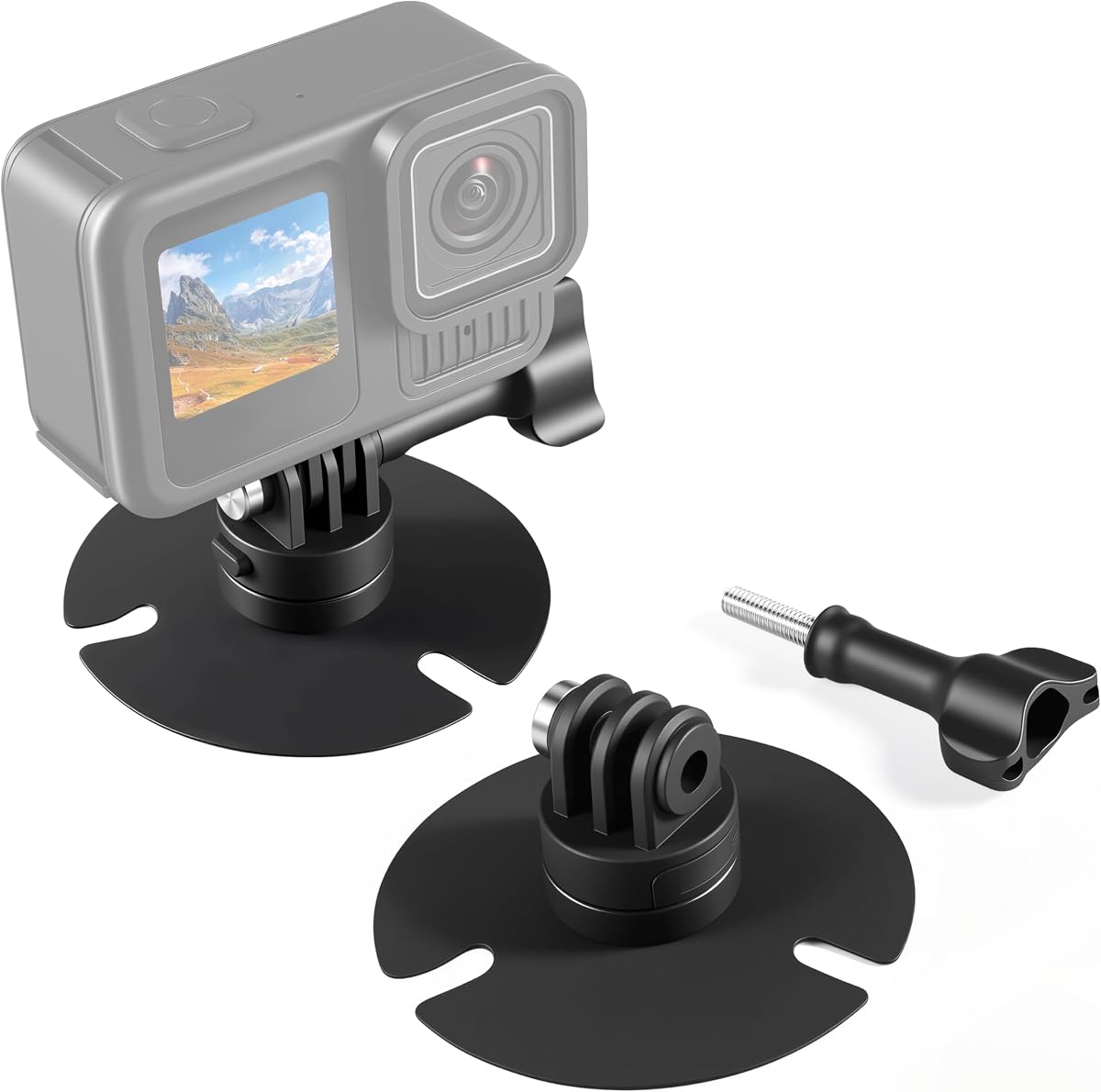
This motorcycle chin mount combines a magnetic quick-release base with an adjustable extension arm and a curved adhesive mounting point designed for DJI Osmo Action 6 and Osmo Nano cameras. Its 4.3 rating reflects a practical package aimed at riders who want fast camera changes and a natural point-of-view angle without working with screws every time they stop.
We may earn a commission when you buy through this link, at no additional cost to you.
The magnetic base is the product's most useful feature. Once the extension arm is secured, attaching and removing the camera becomes a quick magnetic action rather than a multi-part fastening process. The included extension arm can be tilted or swiveled, which is valuable when a tucked riding position would otherwise direct the lens toward the road. A safety tether adds another layer of protection if the camera is knocked or the main connection loosens.
Installation relies on pre-applied authentic 3M VHB adhesive, so the mounting area must be clean and the helmet shape should suit a curved chin placement. The stated weight of approximately 0.04 kilograms is also a strong point, because the mount should not create an obvious imbalance on the helmet. The complete package includes the chin mount, magnetic base, two adhesive stickers, extension arm, tether, screws, and wrench.
This is a strong choice for a full-face motorcycle, dirt-bike, motocross, snowmobile, BMX, or mountain-bike helmet used with the Osmo Action 6. It is particularly attractive for riders who frequently move between recording positions. Be sure to position the camera carefully before the adhesive sets, and inspect the mount and tether before every ride.
The magnetic quick-release connection makes this mount more convenient than a fixed screw arrangement. It is particularly useful for riders who remove the camera at stops or switch between the chin and another supported position.
The extension arm provides tilt and swivel control, helping the camera remain aimed toward the action rather than the pavement when the rider leans forward. The safety tether supplements the primary connection.
We may earn a commission when you buy through this link, at no additional cost to you.
This DJI Osmo Action Helmet Chin Mount is the strongest all-around choice in the group, combining a 4.6 rating with broad support for current and earlier DJI action cameras. Its chin position mimics the rider's line of sight more closely than a top or side mount, making it especially useful for motorcycle, mountain-bike, dirt-bike, motocross, and snowmobile footage.
We may earn a commission when you buy through this link, at no additional cost to you.
The mount is designed for straightforward assembly and disassembly. It works with Osmo Action 6 directly according to the supplied compatibility information, along with Osmo Action 5 Pro, Osmo Action 4, Osmo Action 3, DJI Action 2, and the original Osmo Action. Osmo Nano and Osmo 360 can also be used, but the appropriate quick-release adapter must be purchased separately.
At 48 grams, the mount offers a reasonably light chin installation without taking on excessive bulk. The box includes one chin mount and one Osmo locking screw, which keeps the setup focused and straightforward. The main limitation is that the package is not universally self-contained for every listed camera: compatibility depends on the exact model and its required interface.
Riders who want a dedicated chin position and already own an Osmo Action 6 should give this product a close look. It offers a strong balance of viewpoint, simplicity, weight, and cross-generation DJI compatibility. It is the easiest recommendation for most riders, especially those who may change between supported Osmo Action cameras.
Mounting at the chin places the camera closer to the direction in which the rider is looking. This can make road, trail, and obstacle footage feel more immediate than footage recorded from the top of a helmet.
The mount supports a wide range of DJI action-camera models. Check the exact camera and adapter requirements, particularly when using Osmo Nano or Osmo 360, because those configurations require separate hardware.
We may earn a commission when you buy through this link, at no additional cost to you.
This universal chin-strap mount is designed for riders who alternate between action-camera brands. It supports the DJI Osmo Action 6 while also listing compatibility with GoPro Hero models, Insta360 cameras, Osmo Nano, Osmo 360, Pocket 3, and numerous other action cameras. Its 4.3 rating reflects a versatile approach built around a familiar strap-and-hook design.
We may earn a commission when you buy through this link, at no additional cost to you.
The extension J-hook provides 180-degree adjustment, allowing the camera to be repositioned as the shape of the helmet or riding position changes. Soft non-slip silicone is used at the contact area to reduce scratching and improve grip, while an upgraded elastic strap is designed for one-hand installation and removal. A high-quality ABS Y-shape base rounds off the main support structure.
Its broad advertised compatibility is useful but should be checked carefully against the chosen camera. The product information notes that some camera models require a frame case or an extra adapter, and those pieces are not included. As a result, a rider using a less common camera configuration may need another connection accessory even though Action 6 is listed as compatible.
This is a good option for a mixed equipment collection or a rider who wants a strap-based mount that can fit both round and angular helmet shapes. It is less convenient for users who want every possible adapter included in one box, but the broad camera support and substantial angle adjustment make it a flexible choice for everyday riding.
The 180-degree adjustment helps the camera follow the angle of different helmet shapes. This is especially helpful for riders who alternate between an upright road posture and a lower, more aerodynamic position.
The soft silicone contact and rounded ABS base are intended to grip the chin area without presenting sharp edges. Confirm that the strap lies flat and does not interfere with the helmet's fastening system.
We may earn a commission when you buy through this link, at no additional cost to you.
The K&F CONCEPT mount emphasizes secure retention through a dual-buckle strap and an ABS Y-shaped base. It is intended to reduce movement associated with body motion during cycling, skiing, and other dynamic activities. Its 4.2 rating makes it a credible alternative for riders who value a firmly fastened chin mount over a magnetic or adhesive design.
We may earn a commission when you buy through this link, at no additional cost to you.
The quick-release buckle is adjustable to fit different chin shapes and sizes, while the dual buckle helps prevent loosening during a ride. The base follows the helmet chin to avoid scratching and is described as anti-slip and shock-resistant. It is compatible with full-face helmets used for motorcycling, mountain biking, dirt biking, slopestyle, motocross, and snowmobiling.
Camera compatibility is broad because the mount supports the standard two-prong action-camera interface and cameras with a quarter-inch interface. Listed support includes DJI Osmo Action 6, Action 5 Pro, Action 4, Action 3, Osmo 360, and Osmo Nano, as well as GoPro and Insta360 models. The important point is that the camera-side connection may still require an appropriate frame or adapter, depending on the body used.
Riders who often record in rough conditions may appreciate the emphasis on buckle security. The trade-off is that chin-strap mounts depend on helmet geometry and strap routing, so the mount should be checked for interference with padding, visors, or the helmet closure. For compatible full-face helmets, it offers a firm and straightforward way to carry the Osmo Action 6.
The dual-buckle arrangement is designed to resist loosening during movement. This makes the mount appealing for riders who want a more mechanically secured chin connection.
Support for both two-prong and quarter-inch camera interfaces expands the practical camera options. The Action 6 can be mounted, but the correct connecting hardware must match the camera configuration.
We may earn a commission when you buy through this link, at no additional cost to you.
The DJI Curved Adhesive Base Kit offers a straightforward top-of-helmet mounting option for the Osmo Action 6. Its curved construction is intended to fit securely to many bike helmets, and the package includes two bases and two locking screws. The 4.3 rating is solid for a simple, purpose-built accessory with broad DJI compatibility.
We may earn a commission when you buy through this link, at no additional cost to you.
The curved profile is particularly relevant on rounded helmet shells because it can follow the surface rather than forcing a flat base to sit awkwardly. With the appropriate quick-release adapter, the camera can be moved swiftly between positions. Supported models include Osmo Action 6, Osmo Action 5 Pro, Osmo Action 4, Osmo Action 3, DJI Action 2, Osmo Nano, Osmo 360, and the original Osmo Action.
Osmo Nano and Osmo 360 require a separately sold adapter. Some riders may also prefer a chin mount because its perspective more closely follows the eyes. Adhesive installation is permanent enough to discourage frequent repositioning, and the base must be attached to a clean, suitable surface with adequate preparation and curing time.
This kit is best for a rider who values simple installation, a low-profile helmet connection, and the option to prepare two mounting locations. It is less appropriate for someone who specifically wants an immersive chin perspective or frequently changes camera position without dealing with an adhesive base. For those needs, one of the strap-based alternatives offers greater flexibility.
The curved base is intended to conform to rounded bike helmets. This can create a neater and more stable surface than forcing a completely flat adhesive pad onto a strongly curved shell.
Two bases and two locking screws are included, allowing the rider to prepare more than one mounting point. Extra locations are useful when the same helmet is used for different activities.
We may earn a commission when you buy through this link, at no additional cost to you.
This accessory kit is the most versatile collection of adhesive bases and quick-release buckles in the list. It includes three curved adhesive sticky mounts, three flat adhesive mounts, two horizontal quick-release buckles, two vertical J-hook buckles, and two long thumb screws. Its 4.6 rating indicates strong customer reception for a broad replacement and expansion kit.
We may earn a commission when you buy through this link, at no additional cost to you.
The bases use original 3M-manufactured VHB 4991 adhesive, while the hardware uses polycarbonate and stainless steel. Rubber locking plugs help prevent accidental quick-release disengagement and tighten the camera connection to reduce vibration. Both curved and flat pads are included, making the package useful for rounded helmets, flatter shells, and other smooth surfaces.
Compatibility covers a wide selection of GoPro Hero cameras, DJI Osmo cameras, and action-camera brands such as AKASO, SJCAM, APEMAN, and Campark. The Osmo Action 6 is included within the stated DJI compatibility, although the correct buckle and camera interface must be selected. The kit is also suitable for snowboards, kayaks, dashboards, and other sporting equipment.
This is the strongest option for a rider who wants several mounting configurations rather than one specialized chin bracket. Its limitation is that adhesive installation requires care: the pad should be pressed firmly and left in a suitable environment for at least 24 hours before use. It is less convenient for frequent relocation than a strap or magnetic mounting system.
Curved bases, flat bases, and multiple buckle orientations allow the same kit to serve different helmet shapes and activities. This makes it more than a single-purpose helmet accessory.
The rubber locking plugs are intended to keep quick-release buckles secured and tighten the camera fit. That can help limit movement and unwanted vibration after installation.
We may earn a commission when you buy through this link, at no additional cost to you.
The Kewig Universal Motorcycle Helmet Chin Camera Mount is a premium modular option with a flexible mounting base, two different tripod adapters, backup adhesive pads, and a safety tether. Its 4.6 rating places it alongside the highest-rated products in the comparison, while the supplied component list gives it a notably complete installation package.
We may earn a commission when you buy through this link, at no additional cost to you.
The flexible base is intended to fit most full-face motorcycle helmets, while the two tripod adapters provide 180-degree angle adjustment and allow the camera to be configured for different shooting positions. A snap-fit design supports fast connection and removal. Compatibility includes the DJI Osmo Action 6, Action 5 Pro, Action 4, Action 3, Osmo 360, and Osmo Nano, plus extensive GoPro and Insta360 support.
Installation deserves attention. The helmet surface should be clean, and the adhesive should be warmed briefly before application. After mounting, the product instructions call for the assembly to sit for 24 hours before use. The mount should not be used on a helmet with a screen protector, and the safety tether should be attached to reduce the consequences of an adhesive failure.
This mount suits riders who want extensive modularity and a full set of installation components. Its main disadvantages are the 24-hour waiting period and restrictions around screen protectors. For a compatible full-face helmet, however, the two-adapter system, broad camera support, and 180-degree positioning make it a refined and flexible setup.
Including two tripod adapters gives the rider greater freedom to select a camera connection and shooting angle. The stated 180-degree adjustment is useful for matching the mount to different helmet geometry.
Two sets of strong adhesive pads and a safety tether add redundancy to the installation. The tether is particularly important because adhesive performance can be affected by surface condition and environmental exposure.
We may earn a commission when you buy through this link, at no additional cost to you.
The Suptig Helmet Chin Mount is sold as a two-pack, making it convenient for riders who use multiple helmets or want a spare adhesive mounting unit. It supports the DJI Osmo Action 6 and a wide range of GoPro, Insta360, and other action cameras. Its 4.2 rating reflects a versatile design with a 180-degree adjustment and a stated compatibility range.
We may earn a commission when you buy through this link, at no additional cost to you.
Each set includes a helmet chin mount with 3M adhesive backing, while the package also includes two additional adhesive pieces, two quarter-inch adapters, and two thumb screws. The flexible mounting structure is designed to fit both rounded and angular full-face helmets used in motorcycling, mountain biking, slopestyle, motocross, and snowmobiling.
The PET construction is described as lightweight, durable, reusable, and less likely to scratch a helmet. The 3M adhesive backing is intended to remain secure in rainy conditions. As with any adhesive setup, however, the surface must be prepared properly, and the mount should be pressed firmly and left in an environment above 10°C for at least 12 hours before riding.
This product is a practical choice for anyone who wants two chin mounts or operates more than one helmet. It provides broad camera compatibility and a full set of basic components, although the adhesive installation makes it less convenient than a reusable strap system for riders who change positions frequently. The included quarter-inch adapters also make it useful with cameras outside the standard two-prong category.
The two-pack format is useful for riders with more than one helmet, riders who keep a backup, or users who want one adhesive base left ready for a later installation.
The 180-degree adjustment allows the mount to follow differing helmet shapes. The soft PET design is intended to avoid scratching the shell while maintaining a stable connection.
We may earn a commission when you buy through this link, at no additional cost to you.
This helmet mount focuses on DJI Osmo Action 6 and Osmo Nano cameras, using a magnetic quick-release adapter base and a chin-strap clamp. It is intended for riders who want quick camera removal without manipulating screws or clips. Its 3.7 rating is the lowest in this group, making careful attention to construction and fit especially important.
We may earn a commission when you buy through this link, at no additional cost to you.
The chin-strap clamp is designed to attach to motorcycle, bicycle, dirt-bike, and other helmets. Its secure grip is intended to minimize vibration and camera shake during fast road riding or rough terrain. The magnetic base then handles the camera-side connection, allowing the Osmo Action 6 or a compatible Osmo Nano setup to be attached or removed more quickly.
The product information is less detailed than that of several competing mounts. It does not provide a stated weight, a precise angle-adjustment range, or a detailed list of included installation components. That makes it harder to compare the hardware package with products that explicitly identify their adapters, tether, pads, and fasteners.
The mount may appeal to an Action 6 owner who prioritizes magnetic convenience and a focused DJI-specific design. However, riders who want clearly documented included hardware, a known weight, or a more extensively described installation system may prefer the DJI chin mount or the Kewig package. Confirm the exact contents and connection method before purchasing.
The magnetic adapter allows the camera to be removed without working with a threaded fastener. This can be convenient at rest, during setup changes, or when the camera needs to be stored away from the helmet.
The clamp is intended to grip the chin strap and reduce camera movement. Riders should confirm that the strap and helmet geometry create a stable, unobstructed mounting point.
We may earn a commission when you buy through this link, at no additional cost to you.
The Flexible Adhesive Helmet Mount combines a flexible 3M VHB adhesive with TPU nylon and stainless steel components. It supports the DJI Osmo Action 6, Action 5 Pro, Action 4, Action 3, Osmo Nano, and Osmo 360, along with Insta360, GoPro, and AKASO cameras. Its 4.4 rating makes it one of the stronger-rated adhesive alternatives.
We may earn a commission when you buy through this link, at no additional cost to you.
The flexible adhesive is designed to conform to different helmet shapes, and the product information states compatibility with a wide range of helmet types. The same base can also be attached to dashboards, motorcycles, kayaks, surfboards, and other sporting equipment. The materials are described as waterproof and suitable for plastic, leather, and enamel surfaces.
The adhesive creates a semi-permanent installation rather than a quick strap or clamp arrangement. It is therefore best for a prepared mounting point that the rider does not expect to change frequently. A quick-release buckle or adapter must also be matched to the camera, and users should check whether a frame or additional adapter is needed for their exact camera configuration.
This is a versatile option for a rider who wants one mounting method across several activities or surfaces. Its flexibility is especially useful where a rigid pad would not follow the contour of the object. For the Osmo Action 6, the main trade-off is that the adhesive cannot be repositioned as quickly as a magnetic, buckle, or chin-strap system.
The flexible pad is intended to follow helmet and equipment contours that would be difficult for a rigid adhesive base. This can improve contact across a broader range of shapes.
The mount can move beyond helmets to dashboards, kayaks, surfboards, and other equipment. This makes it useful for creators who record several kinds of outdoor footage.
We may earn a commission when you buy through this link, at no additional cost to you.
The right helmet mount depends on the desired camera angle, the shape and fastening system of your helmet, the interfaces required by the Osmo Action 6, and how often you expect to reposition the camera.
A chin mount places the Osmo Action 6 closer to the rider's eye line, which can create a more immersive first-person perspective during road, trail, and downhill footage. It may also feel more natural because the camera is aimed in roughly the same direction as the rider's head. A top or curved-shell base is easier to install on some helmets and can leave the front of the helmet less obstructed, but its view is generally higher and less closely connected to the wearer's gaze.
In short, choose a chin mount for an immersive perspective and a top adhesive base for simple placement or a broader collection of mounting surfaces.
Adhesive bases are compact and can follow curved helmet shells, but they require careful surface preparation and a curing period. Chin straps and clamps are reusable and generally easier to reposition, although their stability depends on helmet shape, strap placement, and buckle tension. Magnetic quick-release systems provide convenient camera removal, but they still need a stable helmet-side base. The best choice is the method that matches how often the camera or mount will be moved.
Prioritize a magnetic or strap system for frequent changes, and choose adhesive only when a semi-permanent attachment point is acceptable.
The Osmo Action 6 must connect through the correct camera-side interface. Some products in this comparison are specifically designed around DJI's quick-release system, while others use a two-prong action-camera mount, a quarter-inch connection, or a combination of adapters. Also check whether the camera is inside a protective frame and whether that frame changes the required adapter. The product information for several universal mounts explicitly notes that extra frames or adapters are not always included.
Confirm the stated Action 6 compatibility and identify any separate adapter before ordering, rather than assuming every universal mount includes the necessary connector.
A helmet mount that works on a rounded road helmet may not fit a race helmet with a pointed chin section, pronounced chin bar, or unusual padding. Chin-style products generally need enough clearance for the camera body, the connecting arm, and the rider's helmet fastening system. Adhesive bases need a smooth, clean area that matches the size of the pad. Before purchasing, compare the mount's geometry with the area where it will actually sit on your helmet.
Choose a flexible or adjustable mount for unusual helmet shapes, and check the clearance around visors, vents, padding, and strap closures.
A secure connection helps preserve image stability during rough roads, high-speed travel, and active sports. Look for rigid base construction, positive buckle locking, a close-fitting chin strap, and a secondary tether where available. Angle adjustment is also useful because the camera should remain aimed toward the horizon when the rider leans forward. Magnetic connections are convenient, but the magnetic joint must still be secured correctly rather than relying on magnetic attraction alone.
Prioritize positive locks, anti-slip contact, and a tether for demanding rides, and make sure the camera is firmly seated before every recording session.
Helmet-mounted equipment should feel balanced and unobtrusive. The stated weights among the more clearly documented options are approximately 0.04 kilograms for the magnetic chin mount, 48 grams for the DJI chin mount, and approximately 60 grams for the Kewig universal mount. These figures illustrate the range of compact options available. A lower chin position can also affect balance differently from a top mount, so comfort should be evaluated with a short trial ride.
Compare stated weight, choose a low-profile design, and confirm that the mount does not pull unevenly on the helmet shell.
A complete package can simplify setup. Look for included bases, screws, adapters, adhesive pads, tools, and safety tethers. Adhesive mounts should be installed in a suitable environment above 10°C and left undisturbed for the stated curing period, which varies among products. Reusable strap mounts require fewer waiting steps but take more space on the chin. Spare adhesive pads are useful because the helmet surface, weather, and aging can affect the bond over time.
Choose a package that includes the connectors you need, and follow its installation and curing instructions before attaching the camera.
A fixed mount can point toward the ground when the rider adopts a tucked position. Adjustable arms, swivels, or 180-degree joints allow the camera to be repositioned as helmet geometry or riding posture changes. The Kewig product includes two different tripod adapters, the magnetic chin mount includes an adjustable extension arm, and several strap mounts provide flexible positioning. More adjustment is useful, but it should lock firmly enough to prevent drift during a ride.
Look for positive angle control, test the camera under a realistic riding posture, and tighten every joint before recording.
Begin by identifying the camera interface, helmet attachment area, and intended shooting angle. Clean the helmet surface thoroughly and inspect it for damage, loose padding, or sharp edges. If using a chin-strap system, route the strap so it lies flat, avoids the visor, and does not interfere with the helmet's buckle. If using adhesive, follow the product-specific preparation and curing instructions rather than attaching the camera immediately.
Install the helmet-side base first, then connect the appropriate camera adapter. Make sure the camera is fully seated, then tighten the locking screw, thumb screw, buckle, or magnetic joint. Set the angle while viewing the camera screen from its normal riding position. A rider seated upright can align the horizon incorrectly when leaning forward, so check the framing before each ride.
For maintenance, inspect the mount, screws, strap, buckle, adhesive edges, and tether before use. Remove the camera from the helmet when it is not needed, particularly with an adhesive or magnetic system. Keep adhesive bases away from prolonged moisture and heat when possible, and never pull the camera off by the camera body alone. If an adhesive bond weakens, remove it according to the product guidance, clean the surface, and install a fresh pad rather than reusing a compromised mount.
Many action cameras share two-prong or quarter-inch-style interfaces, but compatibility still depends on the exact adapter and whether the Osmo Action 6 is enclosed in a frame. Several mounts in this guide list Action 6 compatibility directly, while others state that a frame case or extra adapter may be required. Confirm the interface and included components before ordering.
A chin mount usually provides a more natural first-person view because it sits closer to the rider's line of sight. A top mount may be simpler to install and works well when the desired perspective is higher. The best choice depends on helmet shape, framing preference, and whether a low chin position interferes with the helmet's padding or fastening system.
A flexible or curved adhesive base can perform well when the product is designed for that surface and the installation instructions are followed. Surface cleaning, pad pressure, environmental conditions, and curing time all matter. Riders who require frequent repositioning may prefer a strap or magnetic system, while those using adhesive should inspect the bond before each ride.
A tether is still sensible because it provides a backup if the camera is struck or the primary magnetic connection is released unexpectedly. It does not replace a correct installation, but it can reduce the chance of the camera falling away from the helmet. Several products in this comparison include a tether for that reason.
The waiting time depends on the specific product. The supplied instructions range from at least 12 hours for the Suptig mount to 24 hours for the Kewig, 3M VHB sticky-mount kit, and related adhesive guidance. Follow the instructions included with the chosen mount and wait until the recommended period has passed before riding.
Many of the listed products are designed for motorcycle, mountain-bike, dirt-bike, motocross, BMX, and snowmobile helmets. However, chin-style mounts need adequate clearance and a suitable strap path, while adhesive bases need a clean surface large enough for the pad. Always confirm the fit before relying on the mount in high-speed or rough conditions.
Confirm that the camera is fully seated, all screws and joints are tightened, the strap or buckle is secure, and the tether is attached where provided. Watch the live view to confirm that the camera remains aimed correctly when you lean forward. Stop and correct any looseness, interference, or camera movement before beginning the ride.
Use the correct adapter, tighten every connection, and make sure the helmet mount sits firmly without flexing. A positive buckle lock, rigid base, or secure magnetic connection can help. Position the camera toward the horizon and avoid loose strap sections. If vibration persists, check for an adapter gap or a mount that is not fully seated.
The magnetic motorcycle chin mount is the best budget-oriented choice because it combines a quick-release camera connection, an adjustable arm, a lightweight construction, a safety tether, and a complete installation kit. The DJI Osmo Action Helmet Chin Mount is the strongest overall option, offering a 4.6 rating, a natural first-person perspective, and broad compatibility across several DJI action-camera generations.
The Kewig universal chin mount stands out as the premium pick because it includes a flexible base, two tripod adapters, backup adhesive pads, a safety tether, and 180-degree adjustment. Whichever option you choose, prioritize a secure helmet-side connection, the correct camera adapter, positive angle locking, and a viewing position that remains stable when you lean forward. Strap mounts suit frequent repositioning, while adhesive systems work best for prepared, semi-permanent mounting locations.
Before ordering, verify the latest product details, included components, and exact Osmo Action 6 configuration on the current listing. Listings, included accessories, compatibility details, and availability can change, so confirming those points will help avoid an adapter mismatch and ensure the chosen mount suits your helmet and riding style.