
dbx 266xs
4.6Editor score
Program-adaptive expander and gate
Precise threshold and gain-reduction displays
Flexible sidechain insert routing
Explore 10 hardware compressors for home studios, comparing sound, channels, controls, gating, sidechain, routing, and rack fit for informed decisions today.
Hardware compressors give home studio signals the consistent level control, punch, and cohesion that software plugins often struggle to replicate. A well-chosen unit can smooth vocals, tighten drums, control bass, and glue a mix, while its physical controls make monitoring and adjustment intuitive. The right model depends on your room, workflow, sources, and level of experience.
We compared all ten models by examining their channel counts, compression styles, metering, gating, sidechain options, signal routing, transformer and circuit designs, and intended studio roles. The list includes single-channel classics, stereo bus compressors, dual-channel processors, channel strips, and mastering-oriented units, so it covers everything from focused vocal control to full-mix dynamics.
Each pick demonstrates what it does best, from versatile all-purpose compression to characterful optical leveling and precise bus control. Ratings and listed features provide a factual starting point, but your own speakers, instruments, and recording goals should guide the final decision. Product prices and availability change, so verify current details before purchasing.
4.6Editor score
4.3Editor score

4.1Editor score
The comparison below highlights each compressor's core architecture, channel capacity, principal controls, and most useful studio function, making it easier to match a hardware unit to your sources and rack space.


The dbx 266xs earns the leading position because it combines broad studio usefulness with a remarkably focused feature set. Its 4.6 rating reflects its strong reception, while the combination of compression, expansion, gating, program-adaptive behavior, and sidechain routing gives it more range than many basic single-channel units. It is particularly effective when a recording needs dependable leveling without becoming overworked.
We may earn a commission when you buy through this link, at no additional cost to you.
The processor is designed to smooth uneven levels while preserving the character of guitars, drums, vocals, and other program material. Separate displays show gain reduction, compression threshold, and gate threshold, allowing precise adjustments without constantly relying on sound alone. The sidechain insert expands the creative possibilities, particularly when linked to another processor for frequency-dependent control. Its program-adaptive expander and gate are designed to deliver smooth release behavior.
The main limitation is that this is a single-channel processor, so it cannot handle a complete stereo mix or two independent channels at once. A home studio working on both front-of-house and mix tasks would need another unit for simultaneous processing. It also belongs to a traditional rack-processor format rather than a modern all-in-one channel strip. Neither drawback diminishes its value when the goal is precise, repeatable dynamics control in a compact space.
Choose the 266xs if you want one dependable compressor that can handle individual tracks, instruments, or a stereo sum used mono. It is a strong first hardware compressor because the important controls are clearly indicated, the gate is integrated, and the sidechain input adds genuine flexibility. For most home studios seeking a versatile one-rack-space solution, it remains the most complete recommendation in this list.
Rather than specializing in a narrow type of dynamics, the 266xs combines leveling, compression, gating, and sidechain access. That breadth makes it useful for recording sessions, mix buses, and less predictable live sources without tying the purchase to one genre.
The separate LED displays for gain reduction and both thresholds improve setup speed. You can watch the compressor and gate independently, making it easier to identify the point at which each processor begins affecting the signal.
We may earn a commission when you buy through this link, at no additional cost to you.
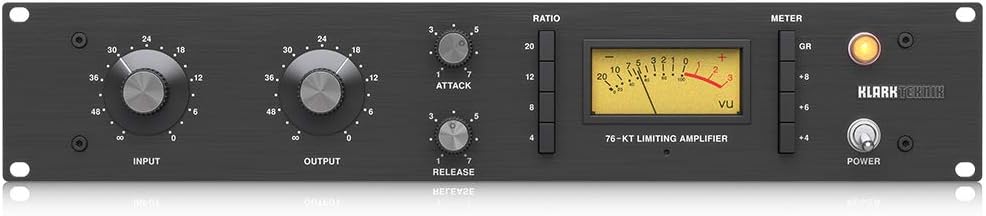
The Klark Teknik 76-KT offers an accessible route into characterful FET-style compression. Its 4.3 rating indicates a favorable user reception, and the design focuses on a completely discrete signal path, Class-A line-level output stage, and custom-built MIDAS transformers. Rather than trying to imitate every characteristic of the referenced classic units, it distills that style into a manageable single-channel processor.
We may earn a commission when you buy through this link, at no additional cost to you.
Compression ratios are selected with push buttons at 4:1, 8:1, 12:1, and 20:1. Those choices cover moderate leveling, assertive control, and highly determined reduction without requiring continuous adjustment for each ratio. The circuit is modeled after iconic 1176LN-style revisions, making it relevant for punchy vocals, tight bass, forceful drums, and parallel drum or guitar treatments.
The absence of a gate is the clearest functional limitation. Owners who need to control vocal room noise or bleed will need a separate gate or a different processor. It also remains a one-channel unit, so it cannot independently handle the left and right sides of a stereo mix. Its transformered topology is intentionally more specialized than a general-purpose compressor, which is attractive for enthusiasts but less comprehensive for a simple first purchase.
This is a strong recommendation for a home studio that wants the character and immediacy of a classic FET compressor without beginning with a large, complex outboard. It is especially useful for tracking with strong intentional compression or adding aggressive parallel weight. If those priorities sound familiar and separate gating is not required, the 76-KT delivers substantial musical character in a compact format.
Four fixed ratios simplify day-to-day operation. Once you find a ratio that suits the source, you can concentrate on input level, threshold, and gain rather than navigating a dense control surface.
The discrete path, Class-A output amplifier, and MIDAS transformers give the unit a clear hardware identity. That topology is especially appealing when you want compression to contribute audible weight and texture.
We may earn a commission when you buy through this link, at no additional cost to you.
The Warm Audio WA-1B is the specialist choice in this roundup. Its 3.4 rating is lower than those of the other products, so buyers should approach it with realistic expectations and prioritize its circuit design over broad customer consensus. It is a one-channel tube optical compressor, placing it in the premium outboard category and targeting users who specifically want an optical leveling response.
We may earn a commission when you buy through this link, at no additional cost to you.
Optical compression is associated with smooth gain reduction and a gradual response, which can be valuable on vocals, bass, strings, and other material that benefits from a consistent level without abrupt threshold transitions. The tube-based architecture may also complement a studio built around discrete analog outboard gear. A home recording setup can use this focused sound to create a distinct sonic layer rather than relying on the compressor for every track.
Its one-channel format is restrictive for modern stereo production, and the listed information provides fewer setup details than the more extensively documented processors in this guide. The lower rating also signals that buyers should carefully consider whether the specific tube optical format suits their system and workflow. It is not as immediately versatile as a stereo unit with gating, sidechain, or limiter sections.
Buy the WA-1B if you are specifically seeking a premium, characterful optical compressor and already have the rest of a solid analog signal chain. It is less appropriate as a universal first purchase or as the only dynamics unit in a small project studio. For the right user, however, the specialized tube optical topology may be exactly the missing piece for polished, level-consistent recording.
The optical element is the central reason to consider this model. It offers a focused alternative to the more aggressive, ratio-driven character associated with many FET-style compressors.
Rather than covering every processing task, the WA-1B concentrates on one compressor architecture. Studios seeking a distinctive analog layer can pair it with gates, channel preamps, or other dynamics processors as needed.
We may earn a commission when you buy through this link, at no additional cost to you.
This dual-channel compressor has the highest listed rating at 4.7, making it a compelling general-purpose option for modern home studios. Its appeal comes from having two channels, Overeasy compression, automatic attack and release settings, a noise gate, a sidechain insert, and professional XLR and TRS connectivity in one rack-unit chassis. That combination covers many common recording and mixing needs.
We may earn a commission when you buy through this link, at no additional cost to you.
The classic VCA-based circuitry is intended to provide natural dynamics control while enhancing vocal warmth, clarity, and presence. Independent indicators for gain reduction, compression, and gate thresholds make it easier to monitor both channels and avoid making changes by ear alone. The sidechain insert supports frequency ducking for bass, kick, and other low-end sources, while automatic timing settings reduce setup time for routine compression.
The trade-off is that this is a relatively generic processor without the celebrated circuit history associated with several premium alternatives. Its auto timing behavior may not provide as much manual sculpting as a dedicated specialist unit, and the supplied information does not detail any program-adaptive release system. Buyers seeking a particular classic tone should look elsewhere. For general utility, though, the concentration of features is difficult to dismiss.
This model suits home studios that want to compress two sources independently, process a stereo pair, or combine vocal gating with bass ducking. It also works for streaming and live use where standard mic and line connectivity matters. Choose it for feature coverage, convenient two-channel operation, and a strong user rating; choose a more specialized unit when a specific analog topology is the priority.
The dual-channel layout supports paired drums, stereo synths, or two separate microphone chains. Independent meters and controls make it more useful than buying two unrelated single-channel processors with separate feature sets.
The integrated noise gate helps control unwanted room sound and bleed, while the sidechain insert makes frequency-dependent bass or kick control possible. Together they reduce the need for extra dynamics boxes.
We may earn a commission when you buy through this link, at no additional cost to you.
The ART Solo VLA posts a 4.9 rating, the highest in the roundup, and it stands apart through its multi-voice architecture. It combines a mastering-quality signal path, selectable tube and solid-state control modes, analog optical isolators, and a variable blend between compressed and uncompressed signals. That makes it unusually flexible for a single-channel compressor.
We may earn a commission when you buy through this link, at no additional cost to you.
Its most interesting feature is the blend control. Instead of relying only on threshold and ratio to determine how much coloration enters the signal, you can gradually introduce the compressed path. This supports parallel-compression techniques and makes it easier to increase density without losing the original transient character. The selectable voices also let you compare different circuit emphases within the same processor.
Operating-level switching between +4dBu and -10dBV improves compatibility with different studio systems. Optical isolation is a notable part of the signal path, potentially helping the unit behave more consistently when connected to other analog equipment. The tradeoff is that it is still a single-channel device with no noise gate or sidechain, so it is not the most self-contained choice for every recording task.
The Solo VLA is a strong recommendation for engineers who enjoy comparing multiple compression personalities and care about blending parallel compression into a track. It also suits mastering-oriented single-channel work where signal transparency and controlled coloration matter. For a straightforward beginner, the controls may demand more experimentation, but the high rating and broad internal choices give this model unusual potential.
The variable blend is valuable because it separates the amount of compression from the amount of processed signal. You can preserve more of the original articulation while retaining some of the processor's stabilizing and colorating effect.
Selectable tube and solid-state modes make the unit more than a single fixed compressor. This is valuable for source-dependent decisions and for building a more considered parallel-compression layer.
We may earn a commission when you buy through this link, at no additional cost to you.
The dbx 286s is more than a compressor; it is a complete channel-strip processor with a 4.5 rating. It accepts microphones and instruments, then adds compression, de-essing, an enhancer, and an expander or gate. That consolidation makes it especially appealing to a home studio trying to build a practical recording chain without giving up common vocal-processing tools.
We may earn a commission when you buy through this link, at no additional cost to you.
Its floating balanced XLR microphone input supports professional microphone connections, while two quarter-inch TRS inputs accept balanced or unbalanced line and instrument signals. The insert or loop-out can route the signal between the preamp and processing sections, allowing external gear to participate in the chain. A full LED status array provides at-a-glance monitoring of level and processor activity.
The main compromise is consolidation rather than specialized control. Each included effect is useful, but the 286s cannot offer the same deep manual range as a dedicated compressor or the same automation and recall systems as a large digital console. The listed operating voltages are also specific to 120VAC 60Hz and 100VAC 50/60Hz, so buyers outside supported regions should verify compatibility.
Choose the 286s when you want to compress a vocal or instrument while also solving sibilance, adding high- and low-frequency definition, and controlling unwanted noise. It is less suitable for a studio needing broad channel counts or a compressor with a very specific classic sound. For a tidy, functional channel strip, however, it delivers an unusually capable package.
The preamp, compressor, de-esser, enhancer, and expander or gate can handle most basic vocal decisions in one place. This reduces rack clutter and makes the unit approachable for singers recording at home.
The loop-out allows other processors to be inserted between the preamp and the onboard processing chain. That flexibility keeps the channel strip from becoming a closed system when a project needs more specialized treatment.
We may earn a commission when you buy through this link, at no additional cost to you.
This dual-channel rackmount compressor is aimed at studios that move between recording, streaming, live performance, and broadcast-style voice work. Its 4.1 rating reflects a positive but less emphatic user response than the leaders. The feature set is broad: two channels, compression and limiting, Overeasy response, adjustable timing, a noise gate, a sidechain insert, and professional balanced connections.
We may earn a commission when you buy through this link, at no additional cost to you.
Its VCA-based design is positioned to improve vocal clarity, warmth, and presence, which makes it a natural fit for voiceovers, podcasting, streaming, and live vocals. LEDs indicate gain reduction, compression level, and gate threshold, providing better setup feedback than a processor with only a single status light. The sidechain input can create targeted ducking against bass or kick sources.
Compared with similarly featured compressors, its specification is less complete in the supplied details. There is no mention of program-adaptive release, manual and automatic timing, link control, or transformer-based signal paths. That means buyers should confirm the exact control behavior and routing requirements before committing. It also may offer less tonal nuance than premium hardware built around a distinctive compressor circuit.
This model is most attractive to creators who want one rack unit for multiple applications and value practical features over specialist circuit pedigree. Its combination of XLR and TRS connections, two channels, gating, and ducking can simplify a compact studio or streaming setup. Choose it for workflow coverage, then audition its behavior carefully against your sources.
The same rack processor can serve a studio mix, a live vocal rack, or a streaming signal chain. That flexibility is valuable for creators whose setup serves several kinds of content.
The sidechain insert is useful when low-frequency instruments need to make room for a vocal or other priority source. It gives the compressor a broader role than simple level control.
We may earn a commission when you buy through this link, at no additional cost to you.
The Behringer Classic 369 is a substantial dual-channel dynamics processor inspired by the Neve 33609. Its 4.1 rating indicates a favorable reception, and the design targets the smooth, cohesive compression associated with vintage mix-bus processing. With separate compressor and limiter sections, custom-built MIDAS transformers, and a two-rack-unit chassis, it sits firmly in the premium outboard category.
We may earn a commission when you buy through this link, at no additional cost to you.
The compressor offers adjustable threshold, recovery, gain, and ratio, with ratios from 1.5:1 through 6:1. Presets on the recovery control adapt to the input signal, helping produce consistent reduction while preserving musical character. The limiter includes threshold, attack, and a wide 50–800 ms recovery range, allowing either peak control or a more assertive pumping effect. Stereo or mono operation and individual channel bypass add useful mix-control flexibility.
Its chief disadvantage is physical size. A two-unit chassis consumes considerably more rack space than a single-channel compressor or one-unit dual processor. The program-adaptive recovery presets also reduce the immediacy of manual timing changes compared with a unit that exposes conventional attack and release controls across both sections. Buyers who require precise transient shaping may find that limitation worth considering.
The 369 is an excellent choice for engineers seeking smooth mix glue, vintage-inspired tone, and the ability to move between compression and limiting. It suits a dedicated project studio or an established rack where transformer-based processing is a priority. Choose it for tonal purpose and stereo versatility, not for maximum rack efficiency.
The relatively restrained ratio range and program-adaptive recovery emphasize repeatable, cohesive dynamics. This makes the unit well suited to processing full mixes or dense stereo arrangements.
A dedicated limiter section gives the unit two related but distinct tools. Subtle peak control and aggressive limiting can be explored without relying entirely on settings from the compressor section.
We may earn a commission when you buy through this link, at no additional cost to you.
The ART SCL-2 is a well-rounded dual-channel compressor, limiter, expander, and gate with a 4.4 rating. It gives home studios a practical way to control either two individual channels or one linked stereo pair. The combination of balanced XLR and quarter-inch TRS inputs and precise LED meters makes it straightforward to integrate into a conventional studio signal path.
We may earn a commission when you buy through this link, at no additional cost to you.
Stereo linking is particularly useful for full mixes, drum overheads, stereo synth beds, and mastering-style bus work. A stereo balance control allows the relationship between the channels to be adjusted, while the automatic or manual attack and release modes support both quick results and deliberate setup. Its multi-function design also means the expander and gate are available without occupying another rack space.
The SCL-2 does not list a sidechain insert, so it cannot provide direct frequency-triggered ducking in the way several dual-channel competitors can. It also belongs to a more conventional processing generation rather than offering multiple selectable compressor voices or elaborate tone blending. Those limitations may not matter if consistent level management, stereo operation, and metering are the central requirements.
This is a sensible recommendation for a home studio that wants one unit to handle tracks, pairs, and stereo buses. It is especially attractive when reliable LED feedback and selectable timing modes matter more than a signature topology. For advanced sidechain work, choose one of the newer dual-channel models; for balanced all-purpose dynamics, the SCL-2 remains a compelling option.
Switching between dual-channel and linked stereo modes lets the same processor serve different parts of a session. Linked operation is particularly convenient for maintaining consistent behavior across a stereo image.
Automatic timing provides a convenient starting point, while manual control allows more deliberate shaping. That choice makes the unit approachable for routine work without removing deeper adjustment when needed.
We may earn a commission when you buy through this link, at no additional cost to you.
The Warm Audio Bus-Comp is a focused two-channel stereo VCA bus compressor with a 4.6 rating. Rather than trying to serve every dynamics-processing role, it concentrates on the final mix stage, where a dedicated bus compressor can improve cohesion, level stability, and perceived loudness. Its five compression ratios, sidechain input filter, and Cinemag transformers form the core of that proposition.
We may earn a commission when you buy through this link, at no additional cost to you.
Stereo operation makes it a natural choice for a mix bus, a mastering chain, or a paired recording stage. The selectable ratios offer more tonal and dynamic options than a fixed-ratio unit, while the sidechain filter lets the triggering behavior focus on relevant frequencies rather than reacting indiscriminately. Transformer-based input and output stages can contribute a distinct hardware character to the finished signal.
The unit is less appropriate when you need a microphone preamp, built-in noise gate, or a broad set of track-processing tools. The supplied information does not mention a gate, so noise management must come from elsewhere. A dedicated bus compressor also makes the most sense when the source is already balanced, edited, and close to its intended mix level rather than needing heavy corrective leveling.
Choose the Bus-Comp when your main goal is a consistent, cohesive stereo finish. It is well suited to project studios that want a dedicated mix-stage processor and value the interplay between VCA compression, selectable ratios, transformer coloration, and filtered sidechain behavior. For first-stage recording control, choose a channel compressor or dual-channel processor instead.
A dedicated stereo bus compressor encourages you to shape a finished mix as a whole. This can be more musical than applying aggressive reduction separately to every individual track.
The sidechain input filter gives more control over which frequencies influence the compressor. That can support cleaner, more targeted behavior when a low-end source would otherwise dominate the trigger.
We may earn a commission when you buy through this link, at no additional cost to you.
The most useful compressor is the one whose circuit style, channel count, controls, and routing match your sources and workflow. Consider how you record, what needs controlling, and whether you want subtle leveling, punch, optical smoothness, or mix-bus cohesion.
Choose the character that matches your source and taste rather than assuming one circuit is universally superior. Audition several styles if possible.
Prioritize adequate channel count and a chassis that fits your available rack space.
If your room is acoustically reflective, prioritize a usable gate with clear threshold monitoring.
Select sidechain support when your mixes need precise low-end or vocal ducking without software processing.
Look for independent gain-reduction and threshold indicators to speed accurate setup.
Match connectors and operating levels to your interface, preamps, mixer, and recording chain.
Balance quick setup with the manual control required by your most demanding sources.
Verify fit, power compatibility, and physical access before committing to a model.
Begin by placing the compressor after the preamp or interface that feeds it, then bypass it while setting input gain for a clean peak. Listen to the uncompressed source at a moderate monitoring level. Adjust the threshold gradually until gain reduction appears on peaks, watch the meter, and make small changes rather than attempting to achieve the entire sound from one aggressive setting.
Set the compression amount to suit the source. Use a restrained ratio and moderate reduction for natural leveling, increase the ratio for more deliberate control, and listen for changes in punch as well as loudness. If the unit has a gate, open it enough to preserve intended breaths and musical tails. For sidechain operation, connect the trigger signal and use the filter to keep only the relevant frequencies influencing the compressor.
After setting the compressor, compare bypassed and compressed signals at matched levels. Store notes for every important setting, since a patch that works for one vocal may be wrong for another. Keep the unit ventilated, use proper rack support, avoid pushing inputs or outputs beyond their intended range, and check the manual for cleaning, grounding, and service requirements.
Neither is universally better. Hardware compressors can provide a particular circuit character, physical controls, and predictable latency-free monitoring, while software offers extensive recall, automation, and flexible workflow tools. The right choice depends on your interface, mixing approach, and whether you prioritize convenience or a specific analog sound.
A compressor is useful but not required for every recording. Most studios benefit from one for vocal consistency, bass control, drum punch, or mix-bus cohesion. A good preamp, recording technique, and room treatment remain more important than adding a processor, so consider your actual problems before purchasing.
A compressor reduces dynamic range over a range of signal levels according to threshold, ratio, attack, and release settings. A limiter is designed primarily to prevent peaks from exceeding a ceiling. Some units include both functions, while others focus on compression or mix-bus limiting.
It can be extremely helpful in an untreated room because vocal breaths, reflections, and bleed can become distracting after compression. Set the threshold carefully so it reduces unwanted noise without cutting off quiet phrases, breaths, or instrument decay. A dedicated gate may provide more control than a compressor's basic integrated gate.
It can be enough for one mix bus or one primary source at a time. A dual-channel model offers more flexibility for paired microphones, stereo instruments, and independent processing. Choose based on how many signals need simultaneous control and the rack space available to you.
No. A compressor with a sidechain insert can receive an external trigger through a cable, and the relevant signal can be routed through an analog mixer, interface, or patchbay. The compressor then responds to that trigger, although a mixer makes routing and level matching easier.
There is no universal gain-reduction target. Many natural vocal treatments use modest reduction with the goal of stabilizing inconsistent levels rather than forcing a heavily limited sound. Watch the meter, listen for preserved consonants and natural breaths, and reduce the amount if the vocal begins to sound flat or excessively compressed.
Usually, as long as the interface provides balanced line-level outputs and inputs, or you use suitable conversion and routing. Connect the compressor between the interface and the rest of your chain, match operating levels, and verify that there is no unacceptable noise or signal loss. Consult both manuals before routing the signal.
The dbx 266xs is the strongest all-purpose recommendation because it combines compression, gating, sidechain routing, and clear displays in one compact channel. The Klark Teknik 76-KT serves as a strong value choice for classic FET-style character, while the Behringer Classic 369 targets studios wanting premium stereo compression and limiting with vintage-inspired tone.
Your priorities should determine which feature matters most: channel count for simultaneous work, a gate for a noisy room, sidechain access for frequency ducking, selectable voices for tonal exploration, or a dedicated bus design for final mix cohesion. Match the compressor to the source and signal chain, then adjust it while listening critically at consistent monitoring levels.
Finally, verify current product details, availability, rack dimensions, and operating requirements before ordering. Prices and configurations can change, and a compressor that suits your room today may be joined by others as your project needs grow. The best hardware compressor is ultimately the one that solves a real recording or mixing problem without obscuring the performance.
