
Tapo T300
4.6Editor score
One-second rapid response
Six dual-sided probes
Up to three-year battery life
IP67 waterproof housing
Our Smart Water Leak Detector Sensor guide compares ten top-rated options for app alerts, probe coverage, alarms, wireless range, battery life, and setup at
A smart water leak detector sensor adds an early-warning layer between hidden plumbing failures and serious water damage. The best units combine sensitive probes, audible alarms, phone notifications, dependable wireless connections, and placement options that work around appliances, sinks, pipes, and other high-risk areas.
This guide compares ten smart water leak detector sensors across detection method, alert coverage, power requirements, app support, wireless range, environmental resistance, and compatibility. It includes standalone Wi-Fi models, hub-based systems, a Zigbee option, and an Eve model designed for Apple HomeKit, giving both simple and advanced buyers useful choices.
Each pick highlights the product's strongest practical qualities and the compromises buyers should understand before installing it. Ratings, features, and ecosystem requirements can change over time, and current prices and promotions vary, so readers should verify the latest listing details before making a purchase.
4.6Editor score
4.5Editor score

3.6Editor score
The comparison below highlights each detector's sensor coverage, alert method, connectivity, and best placement scenario, making it easier to identify the right system for your home.


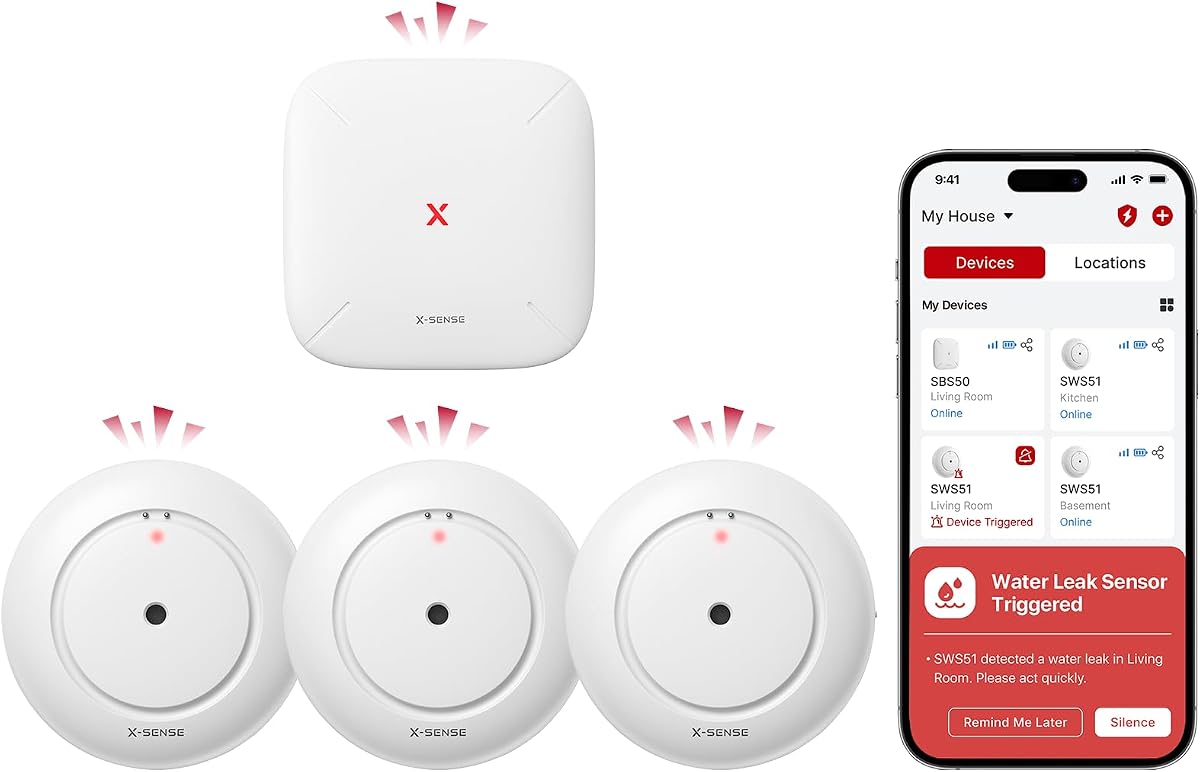
The X-Sense SWS54 is a complete three-sensor kit that earns a 4.5 rating and stands out for its balanced combination of detection sensitivity, audible coverage, and flexible app-based alerts. Each compact sensor combines two upper probes for dripping water with four lower probes that can identify pooled water as shallow as 0.4 millimeters.
We may earn a commission when you buy through this link, at no additional cost to you.
Its most impressive feature is the coordinated response from both the sensor and base station. When a leak is recognized, both sound 120 dB alarms, improving the chance that a warning is heard in a basement, laundry room, garage, or utility space. The base also provides phone notifications, shared access for as many as 12 users, and reminder intervals ranging from 10 minutes to 12 hours.
The stated wireless range of up to 1,804 feet in open areas gives the system room to cover larger homes and outbuildings. Its IP66-rated housings are suitable around washing machines, water heaters, dishwashers, sinks, sump pumps, toilets, and refrigerators. The main compromises are dependence on a 2.4 GHz network and the need to place the powered base where it can communicate with the sensors.
This is the strongest all-around choice for households seeking several monitored locations without assembling sensors from separate devices. It is especially useful for renters or homeowners who want audible alarms and phone notifications but do not need an automatic whole-home shutoff system.
Six-probe sensing gives the SWS54 an advantage in locations where water may arrive from above, below, or through a small pooling area. The shallow-water capability is particularly useful beneath appliances and beside plumbing fixtures where a slow leak may not immediately become visible.
Dual 120 dB alarms make the warning difficult to miss at home, while app notifications provide awareness while occupants are elsewhere. Shared access and delayed reminders make the system practical for families, landlords, and anyone responsible for a larger property.
We may earn a commission when you buy through this link, at no additional cost to you.
The Tapo T300 carries a 4.6 rating and is a cost-conscious choice for people already invested in the Tapo ecosystem. Its defining strength is speed: the product information states that six sensitive probes can trigger the built-in siren in as little as one second when both dripping and pooling conditions are detected.
We may earn a commission when you buy through this link, at no additional cost to you.
Two upper probes and four lower probes give it useful directional coverage. The detector includes an adjustable 90 dB alarm, and the sound can also trigger the connected hub for wider audible coverage. Phone notifications arrive when water or a low battery condition is detected, allowing owners to respond even while away from home.
Two replaceable AAA batteries can last up to three years under the stated laboratory conditions, although real-world life varies with temperature, humidity, and usage. The IP67 housing supports placement in humid and dusty environments. The main drawback is that a Tapo hub is required, which adds setup complexity and may make the sensor less attractive to someone seeking a completely standalone product.
For budget-conscious buyers with a compatible hub, the T300 offers fast detection, long maintenance intervals, and clear multi-channel sensing. It is a particularly good fit for renters, apartments, and single leak-risk locations that need reliable protection without a larger multi-sensor kit.
The stated one-second trigger time helps distinguish the T300 from conventional alarms that may require water to build up before sounding. That makes it appealing beneath sinks, beside water heaters, and near washing machines where a small leak can become a larger problem quickly.
A battery life of up to three years reduces routine replacement concerns, while low-battery notifications help prevent an unnoticed power failure. The sealed housing also supports placement in environments where humidity and dust are common.
We may earn a commission when you buy through this link, at no additional cost to you.
The Moen Flo Detector is a three-pack of Wi-Fi-enabled water and moisture sensors with a 4.6 rating for its broader home-protection capabilities. Its standout feature is the included extension cable and remote sensing disc, which extends detection up to 48 inches into tight or inconvenient locations.
We may earn a commission when you buy through this link, at no additional cost to you.
The detectors can be used independently through the Moen Smart Water Network App, which sends real-time moisture notifications to a smartphone. Multiple units can be added for broader coverage, while compatibility with the separately sold Flo Smart Water Monitor and Shutoff creates a path to automatic water-flow control.
That shutoff capability is the reason this product earns the premium designation. It is more than a conventional alarm and can participate in a connected system designed to limit damage after a leak is detected. On the other hand, its 3.6 rating is the lowest among the products in this guide, and the full automatic-control experience requires additional hardware.
The Moen Flo Detector is best for homeowners willing to invest in a broader smart-water ecosystem or those who specifically need the remote sensing disc. It is less suitable for buyers who only want a simple standalone alarm and will not use the optional shutoff integration.
The 48-inch remote sensing disc is valuable beneath appliances and inside cabinets where a detector's main body cannot sit directly beside the potential moisture source. It extends the practical monitored area without requiring several separate sensors.
Connecting the detectors to the separately sold Flo Smart Water Monitor and Shutoff can add an automatic response beyond sound and phone alerts. This makes the three-pack more relevant to homeowners seeking a connected leak-mitigation system.
We may earn a commission when you buy through this link, at no additional cost to you.
The X-Sense SWS0A41 is a four-sensor Wi-Fi kit with a 4.5 rating, designed for buyers who need to monitor several locations without using much installation space. At just 0.7 inches thick and 3 inches in diameter, each detector is easy to slide behind appliances, beside pipes, or into narrow corners.
We may earn a commission when you buy through this link, at no additional cost to you.
Every sensor combines two sensitive upper probes with four bottom probes, allowing it to recognize drips from above and water about 0.4 millimeters deep. The base station provides an alarm up to 100 dB, a red flashing warning appears on the detector, and app notifications support remote awareness.
The app adds practical controls, including alarm-volume adjustment, temporary muting, alarm history, low-battery warnings, testing, and reminder periods from 10 minutes through 12 hours. A stated open-area range of up to 1,700 feet offers generous placement flexibility. The trade-off is a base alarm rated slightly below the dual 120 dB output of the SWS54.
This kit is an excellent fit for renters, apartments, and constrained utility spaces where sensor thickness matters. It also works well for users who want four discrete monitoring points with app history and flexible reminders.
The 0.7-inch profile is the defining advantage over bulkier alternatives. It allows the detector to sit close to appliances or inside tight cabinetry without interfering with doors, drawers, hoses, or maintenance access.
Alarm history, low-battery warnings, device testing, and selectable reminder periods give owners more control than a simple siren-only detector. These functions also make it easier to verify that the system remains ready.
We may earn a commission when you buy through this link, at no additional cost to you.
This three-pack of smart water leak detectors earns a 4.5 rating and stands apart through its expandable architecture. The included gateway can support as many as 24 WD71 sensors, making it a practical starting point for a home with numerous leak risks or for someone who expects to expand coverage gradually.
We may earn a commission when you buy through this link, at no additional cost to you.
Each compact unit uses two top probes and four bottom probes to detect dripping and pooled water. A test button, low-battery alarm, and flashing indicator simplify maintenance, while IP66 housings are designed for splash-prone areas. The sensors can be used again after drying.
The gateway communicates with the Tuya Smart app, offering phone push notifications, adjustable sensor and gateway alarm volumes, alarm history, and a timer for automatic arming or disarming. The stated gateway range is up to 328 feet in open areas, but approximately 150 feet indoors. SMS and phone-call notifications may require a third-party subscription service.
This system is best for buyers who value capacity, scheduling, and app customization. Its two-bottom-probe activation rule may delay warnings compared with sensors that react to a single wet probe, but that behavior can also help reduce nuisance alarms caused by isolated splashes.
A 24-sensor gateway capacity is unusually flexible for a residential detector package. Homeowners can begin with three units and add sensors around plumbing, laundry equipment, bathrooms, and utility areas without changing the core gateway.
The app's arming and disarming timer can reduce unnecessary disturbances during quiet hours. It can also let users skip arming on selected rainy days when transient outdoor moisture is more likely.
We may earn a commission when you buy through this link, at no additional cost to you.
The Aeotec SmartThings Water Leak Sensor has a 4.5 rating and is built for homes that already use SmartThings or another compatible Zigbee hub. It monitors both excess moisture and temperature, providing a more complete environmental picture than a sensor designed only for standing water.
We may earn a commission when you buy through this link, at no additional cost to you.
When connected to a hub and the SmartThings app, the detector can issue phone alerts and support either a light-up or siren response. Its automation capabilities extend further: other connected smart devices can be programmed to stop water flow or shut down electronics when moisture or abnormal temperatures are detected.
Battery power keeps installation simple, and the package includes a battery, quick-start guide, and safety guide. Zigbee range varies from 50 to 130 feet depending on building construction. The detector requires a hub and is intended strictly for indoor use, which narrows its appeal for exposed exterior locations.
This is the most automation-focused option in the guide. It is well suited to SmartThings users who want a leak event to trigger a larger home response, while the hub requirement and shorter range make it less convenient for standalone placement.
The ability to shut off water-related systems or deactivate electronics can help limit secondary damage after a leak. That turns the sensor from a simple alarm into one component of a broader SmartThings automation.
Temperature monitoring adds useful context in areas where a slow moisture event may coincide with freezing conditions or unusual heat. Users can choose the notification style that best suits each monitored location.
We may earn a commission when you buy through this link, at no additional cost to you.
The TECKNET WiFi Water Leak Detector is a two-sensor package with a 4.2 rating that offers a direct route to app alerts without a separate hub. It connects to a 2.4 GHz Wi-Fi network and uses the Tuya Smart app, making it approachable for buyers who do not want to configure another gateway.
We may earn a commission when you buy through this link, at no additional cost to you.
Both sensors include two top probes and four bottom probes, enabling detection from several directions. Their built-in siren reaches an adjustable 120 dB, while the app provides instant push notifications. The IP67 housing suits basements, laundry rooms, kitchens, and areas near water heaters, while two AAA batteries offer up to two years of operation.
Low-battery reminders reduce the risk of missing an event because a sensor has lost power. Buyers should note that 5 GHz networks are not supported, and SMS or telephone-call notifications require a third-party subscription service. The product listing also advises checking dimensions before purchase to confirm that the sensors will fit the intended location.
This is a practical choice for apartments and smaller homes that need two high-risk locations covered. It offers strong audible output and direct Wi-Fi convenience, although it offers less expansion potential than a multi-sensor gateway system.
Connecting directly to a 2.4 GHz network removes the need to purchase or configure a dedicated hub. That convenience makes the detectors more approachable for first-time smart-home users.
The adjustable 120 dB siren can be tuned for different spaces, from busy utility rooms to quieter living areas. Push notifications provide remote awareness, while the included batteries help the system begin monitoring without separate power wiring.
We may earn a commission when you buy through this link, at no additional cost to you.
WaterWatcher earns a 4.6 rating by focusing on a specialized promise: detecting water and turning off a connected appliance automatically. Its enhanced sensor is designed to pinpoint even small traces, while the alarm provides a local warning when moisture reaches the device.
We may earn a commission when you buy through this link, at no additional cost to you.
Once water is detected, the system keeps the connected appliance off until the owner manually resets it. This safety-first behavior is useful for dehumidifiers, aquariums, hydroponic setups, washing machines, well pumps, and other equipment that should not remain active when water is present.
The detector is described as pure water capable, making it less dependent on conductivity changes that can affect some moisture sensors. A five-year warranty and customer support add reassurance. Its important limitation is that the supplied information does not list Wi-Fi, app notifications, or remote monitoring, so it functions differently from most connected detectors in this roundup.
WaterWatcher is best for buyers with a specific appliance or setup that should shut off immediately at the first sign of water. It is less suitable for users who want phone-based alerts across an entire house, but it offers a focused solution for local damage prevention.
Automatically turning off the connected appliance can prevent a minor leak from becoming a major equipment failure. The manual-reset requirement ensures the device does not silently restart while moisture remains unresolved.
The product is designed for multiple water-sensitive uses rather than a single household location. Buyers can pair it with equipment suited to its shutdown function, from dehumidifiers and aquariums to washing machines and well pumps.
We may earn a commission when you buy through this link, at no additional cost to you.
This smart Wi-Fi detector package has the highest listed rating in the guide at 5.0. It includes two compact sensors, a Wi-Fi gateway, and batteries, with a design centered on flexible alert volume and discreet placement around pipes, appliances, bathrooms, and basements.
We may earn a commission when you buy through this link, at no additional cost to you.
Each sensor uses two stainless-steel strips for detecting drips and four bottom probes for leaks and damp floors. Both sensing methods operate together, and the unit can emit an alarm up to 110 dB. The app provides push notifications, while the alarm can be muted after the source is found.
The IP66-rated construction is intended to withstand humidity and harsh indoor conditions, and the sensors can be reused after drying. The gateway connects to a 2.4 GHz Wi-Fi network and the Tuya Smart app, automatically linking the sensors after the initial connection. It does not support 5 GHz networks.
This package is a good fit for users who want several monitoring options, adjustable nighttime volume, and a compact design. Its main drawback is that the listed package includes two sensors rather than three, despite the product title referring to three sensors and one gateway.
The 110 dB maximum provides a strong warning in basements and utility rooms, while multiple volume levels allow quieter operation near bedrooms or living spaces. App-based muting makes it easier to acknowledge an alert after investigating.
The compact wireless sensors can be positioned near water heaters, bathtubs, toilets, sinks, washing machines, and pipe runs. Their IP66 housings support installation in high-humidity areas, and reusability helps reduce replacement concerns.
We may earn a commission when you buy through this link, at no additional cost to you.
The Eve Water Guard earns a 4.6 rating and takes a different approach from probe-based sensors by using a 6.5-foot cable to monitor a larger area. The cable can extend up to 490 feet, making it useful along a pipe run, beside several appliances, or across a bathroom or utility-room floor.
We may earn a commission when you buy through this link, at no additional cost to you.
When water is detected, the device sounds a 100 dB siren, flashes a red warning light, and sends notifications to an iPhone, iPad, or Apple Watch. It joins a Thread network automatically and also supports Bluetooth. As a router node, it can improve the stability and reach of a compatible Thread smart home.
HomeKit support is a central advantage, and the product does not require a separate bridge or gateway. Its privacy design is also notable: Eve states that there is no Eve cloud, registration, or tracking, with local intelligence and direct communication emphasized.
This detector is best for Apple-centric households that want Thread, HomeKit, and Watch notifications. It requires a recent iPhone or iPad with the latest iOS or iPadOS, which makes it less suitable for mixed or Android-only homes. The cable design also requires suitable routing space where a small puck sensor would be easier to position.
A long sensing cable can follow a water line, trace the edge of a room, or surround an appliance base. Its extendable design makes it especially effective where a small point sensor could miss water traveling along a surface.
Automatic Thread joining and Bluetooth support simplify setup for compatible HomeKit users. The router-node function can also strengthen the smart-home mesh, while the stated no-cloud privacy approach keeps control focused on the user's local network.
We may earn a commission when you buy through this link, at no additional cost to you.
The right smart water leak detector sensor depends on your home layout, smart-home ecosystem, notification preferences, and whether you need local alarms, remote alerts, or automatic shutoff capabilities.
Connectivity determines how sensors communicate with the app and how much additional equipment you need. Direct Wi-Fi models such as the TECKNET and Tuya-based systems generally require a 2.4 GHz network and can work without a dedicated hub, while Tapo and SmartThings-compatible options need compatible central hardware. Eve uses Bluetooth and Thread within an Apple HomeKit setup, and Moen integrates through its own smart-water platform.
Most Wi-Fi products in this guide support 2.4 GHz only, so check your router settings before installation. A hub-based system can be worthwhile in a large or already smart home, but the hub and sensors must be compatible.
Probe-based sensors are well suited to small pools, appliance corners, and locations where water may collect from above or below. Cable-based systems such as Eve Water Guard work better where a leak may run along a pipe, wall base, or broad floor area. The Moen remote sensing disc offers another solution for tight spaces where the detector body cannot sit beside the source.
Consider whether you need dripping detection, pooled-water detection, damp-floor sensing, or broad perimeter coverage. More sensing surfaces can improve detection odds, but they may also make the sensor more sensitive to ordinary condensation or splashes.
A loud local alarm is essential when occupants are asleep or away from the phone. Products range from a 90 dB built-in siren to 120 dB alerts, with some systems using both sensor and base-station alarms. Adjustable volume and app-based muting are useful in bedrooms and other quiet areas.
Look for a red indicator or visual warning as a secondary signal. The best system combines a local siren with phone notifications, because audible alerts reach people nearby while app alerts help remote users respond.
A three-pack is often more practical than buying individual sensors when a home has multiple plumbing risks. The X-Sense kits cover several points, the Moen bundle includes three detectors, and the Driping Leakage system can expand to 24 sensors. Tapo and Apple HomeKit systems can also scale through compatible ecosystems, although hub compatibility must be confirmed.
Compare the cost and inconvenience of adding sensors later rather than buying only what seems necessary today. A flexible system helps users expand as appliances age, remodeling plans change, or additional leak-prone areas become apparent.
Basements, laundry rooms, bathrooms, and utility spaces may contain high humidity, dust, or occasional splashes. IP66 and IP67 ratings indicate stronger resistance to water and dust than an ordinary indoor device. No rating, however, should be interpreted as permission to submerge a sensor unless the manufacturer explicitly says so.
For outdoor, pool, or exposed sump-pump locations, verify the stated environmental limits carefully. Several products are specifically intended for indoor use, and cable routing or power availability may limit outdoor installation.
Battery-operated sensors are convenient because they can be placed near appliances without wiring, but battery life varies with temperature, humidity, alert frequency, and wireless conditions. Stated figures range from about two years for several Wi-Fi models to as much as three years for the Tapo T300. Low-battery notifications are valuable because they help owners replace power before monitoring stops.
Test buttons, status lights, and accessible battery compartments make routine care easier. Periodically test the unit and inspect the probes for dust, soap residue, or mineral deposits that could affect sensitivity.
App notifications are the defining advantage of connected detectors over basic local alarms. They can tell you about a leak while you are at work, traveling, or asleep. Tapo, X-Sense, Moen, TECKNET, SmartThings, and the Tuya-based products support this form of remote awareness, though their app ecosystems and sharing options differ.
Watch for notification limitations. Some third-party SMS or telephone-call services require subscriptions, and the WaterWatcher focuses on local appliance shutoff rather than listed phone alerts. Evaluate the exact alert functions you need rather than assuming every smart detector provides the same coverage.
Automatic shutoff can be more valuable than an additional alarm in some homes. Moen detectors can connect with the separately sold Flo Smart Water Monitor and Shutoff, while WaterWatcher is designed to switch off a connected appliance and remain off until manually reset.
These options require additional equipment, compatible systems, or compatible appliances, so confirm the complete installation path before buying. A shutoff device may also require professional plumbing work, making it a separate decision from choosing a simple battery-powered sensor.
Begin by identifying leak-prone locations such as beneath sinks, behind washing machines and dishwashers, beside water heaters, near toilets, under refrigerators, along basement walls, and near sump pumps. For cable-based systems, lay the sensing cable along the likely path of water. For probe sensors, place the sensing surface flat where liquid will collect, then confirm the unit remains accessible for testing and battery changes.
Install the app, connect the hub or gateway if required, and join the sensor using the manufacturer's instructions. Confirm that the device appears online and that a test or demo alert reaches the phone. If a model supports only 2.4 GHz Wi-Fi, temporarily disable or separate a 5 GHz network during setup. For automation systems, create the desired notifications only after basic leak alerts are working correctly.
Test each sensor periodically, clean the probes gently, and remove dust or residue that could interfere with detection. Replace batteries according to low-battery warnings and the manufacturer's guidance. After a leak, dry a reusable sensor fully before returning it to service, and never bypass a manual reset or automatic shutoff until the source of the water and all affected components have been inspected.
It depends on the model. TECKNET and several Tuya-based systems connect directly to a 2.4 GHz Wi-Fi network, while Tapo requires a compatible Tapo hub and the Aeotec SmartThings sensor requires a compatible hub. Eve uses Bluetooth and Thread and needs a compatible Apple HomeKit environment. Check the ecosystem requirements before purchasing additional sensors.
A point sensor is most effective near the likely leak source rather than in the center of a room. A long cable model such as Eve Water Guard can monitor a broader line, floor edge, or pipe route. The Moen remote sensing disc can also extend detection into a confined area. For broad coverage, combining several point sensors is often more reliable than using one detector.
Both ratings indicate substantial protection against dust and water, but IP67 also specifies temporary immersion protection under defined test conditions. Neither rating means a sensor is intended for permanent submersion. Follow the manufacturer's placement and operating instructions, especially in bathrooms, basements, and near sump pumps.
Most models only sound an alarm and send notifications. The Moen detector can work with the separately sold Flo Smart Water Monitor and Shutoff, while WaterWatcher is designed to turn off a connected appliance. Automatic whole-property water control requires compatible hardware and may involve professional plumbing installation.
A local alarm may still sound when a sensor detects water even if internet connectivity is unavailable, but remote phone notifications generally require the associated hub or gateway to remain online. Buyers who depend on alerts while away should choose a system with a stable connection and consider adding internet failover or a cellular backup for critical monitoring.
Testing monthly and after any maintenance, power outage, or suspected false event is a sensible routine. Use the manufacturer's test button or app test function, then confirm that both the audible alarm and notification appear. Inspect the probes at the same time because dirt, detergent residue, and mineral deposits can reduce sensitivity.
Most of the Wi-Fi models in this guide support 2.4 GHz only, including the X-Sense, TECKNET, and Tuya-based products. A router can often broadcast both bands, but the sensor may still need the 2.4 GHz network isolated during setup. Confirm the exact band requirement on the product listing before installation.
Prioritize locations where a hidden leak could cause major damage, including beneath sinks and appliances, near water heaters, beside toilets, around HVAC condensate lines, in laundry rooms, and near plumbing entering the basement. Place probe surfaces where water would naturally collect, and avoid hiding sensors in a way that prevents testing, battery replacement, or visual status checks.
The X-Sense SWS54 is the strongest all-around recommendation for its three-sensor kit, dual 120 dB alarms, long wireless range, and flexible app tools. The Tapo T300 is the best budget-oriented choice for compatible hub users, while the Moen Flo Detector is the premium option for buyers who want remote sensing and a path to automatic water shutoff.
Prioritize the requirements that matter most: direct Wi-Fi for simplicity, a hub for automation, a cable for broad floor coverage, multiple sensors for whole-home monitoring, and automatic shutoff for immediate damage control. Also consider probe design, alarm volume, environmental rating, battery notifications, and whether your phone or smart-home platform is already compatible.
Current prices, promotions, app features, and product packages can change, so review the latest listing information before buying. Confirm the number of sensors included, network band, hub requirement, and alert services, then choose the detector that offers the most practical coverage for your home's highest-risk areas.
