
OEG Parts 94A Alternator
4.2Editor score
Marine replacement unit
Detailed OEM references
V1 pulley configuration
Compare the best 100 amp marine alternator options for durability, marine certification, charging performance, fitment, and dependable electrical support.
A 100 amp marine alternator is built to keep a boat’s electrical system dependable in environments where vibration, moisture, heat, and constant demand can punish ordinary automotive charging components. The right unit should provide ample output without compromising fit, corrosion resistance, cooling, or compatibility with the engine and charging system.
This guide compares ten marine-focused and marine-compatible alternators using the information supplied for each product. It considers output, voltage, pulley arrangement, regulator and fan design, marine certification, replacement references, warranty coverage, and the engines or applications each listing identifies. Products with different architectures are included because matching a boat’s requirements matters more than matching a headline amperage figure.
The reviews show why a nominal 100 amp rating alone cannot decide the purchase. Some listings emphasize SAEJ1171 certification, others focus on direct replacements, and some target specific Mercruiser, Indmar, Pleasurecraft, or other marine applications. Check the current listing details and seller information carefully, because availability, ratings, specifications, and prices can change over time.
4.2Editor score

5.0Editor score

This side-by-side comparison highlights the differences in charging output, mounting references, pulley design, cooling arrangement, and documented application coverage among the ten featured marine alternator listings.


This 100 amp marine alternator earns an Editor’s Choice position because it combines a clearly stated high-output rating with SAEJ1171 marine certification and an unusually broad set of OEM references. Its 4.2 rating reflects a generally positive customer history, although the rating alone should not be treated as a substitute for verifying the boat’s charging requirements.
We may earn a commission when you buy through this link, at no additional cost to you.
The listing is aimed at a substantial group of MerCruiser engines, including the 4.3L, 5.7L, 6.2L, and 7.4L families, along with several common engine displacements. Its references include AC165610, AC165616, 805447, 805884, and related variations, giving buyers several ways to cross-check the existing alternator. The stated one-year warranty and commitment to meet or exceed OEM specifications add useful reassurance.
Potential drawbacks are the absence of detailed pulley, rotation, lead, and mounting information in the supplied description, along with a compatibility list that is more concentrated on MerCruiser applications than some alternatives. The buyer must still confirm dimensions and electrical connections. It is also important to distinguish a marine certification claim from a guarantee that every part of the boat’s wiring system is compatible.
This is a strong candidate for owners of the listed 1994–2004 MerCruiser applications who want an explicitly marine-certified unit and a generous reference list. Before ordering, locate the current alternator’s label or part number, compare the pulley and case arrangement, and confirm the charging-system requirements. For those matches, it offers a persuasive combination of fitment data, certification, warranty coverage, and proven user interest.
SAEJ1171 certification is especially relevant in a wet, vibration-heavy environment. It indicates that the alternator was evaluated against a recognized marine-use standard, helping buyers distinguish it from an ordinary automotive unit with no stated marine qualification.
The extensive replacement references are valuable when an old alternator’s label is faded. Match at least one number and still inspect pulley style, rotation, lead configuration, and physical clearance before purchase.
We may earn a commission when you buy through this link, at no additional cost to you.
This Professional Grade Alternator targets a wide range of Cummins and MerCruiser marine engines from 2.8L through 8.2L, making it a flexible option for owners comparing several applications. It has a 12-volt, 100-amp design, an internal regulator, an external fan, and a six-groove pulley, but the supplied listing has no numerical customer rating.
We may earn a commission when you buy through this link, at no additional cost to you.
Its claimed compatibility includes Black Scorpion and ski-boat applications and references AC165617, M50924, M59207, 807653, and 807653T. A one-year warranty and computer load testing are both useful features in a category where buyers want confidence that the replacement will operate consistently under a meaningful electrical load.
The key limitation is that the description does not explicitly identify SAEJ1171 marine certification. That does not mean the product lacks marine suitability, especially given its listed marine applications, but a buyer who requires documented certification should ask the seller for verification. The lack of a customer rating also leaves fewer historical signals than are available for established listings.
The product is most appropriate for a boat whose engine and OEM references appear in the supplied compatibility information and whose pulley and electrical arrangement match the listing. Its broad displacement coverage is the main attraction, but a precise installation still depends on the exact engine variant. Buyers should verify the old unit’s part number, pulley position, wiring needs, and charging-system configuration before ordering.
Coverage across multiple engine displacements can simplify research when the boat uses a common MerCruiser or Cummins platform. Fitment still depends on the precise model and the alternator’s original part number, not displacement alone.
The internal regulator and external fan describe a familiar serviceable layout, while two bullet leads and a six-groove pulley help define the electrical and mechanical connection. Both should be compared with the existing installation.
We may earn a commission when you buy through this link, at no additional cost to you.
The Powermaster 8500 is a 100 amp alternator based on the GM 12SI platform, with a natural output design, V1 pulley, and screens for marine or off-road applications. Its 5.0 rating makes it one of the strongest customer-rated options in this group, though the supplied information does not provide a review count or detailed narrative feedback.
We may earn a commission when you buy through this link, at no additional cost to you.
The 12SI background is useful for boat owners familiar with that alternator family, while the natural output arrangement and screen package are presented as practical attributes for demanding service environments. The listing describes it as a popular upgrade made from top-quality materials and manufactured to meet or exceed strict quality requirements.
The main uncertainty is the limited application information. The supplied description does not list a broad set of OEM replacement numbers, rotation, lead configuration, or explicit SAEJ1171 certification. Buyers whose boats use a 12SI-family unit may find that familiarity helpful, but the absence of detailed fitment data means dimensions and original part numbers must be checked independently.
This is an attractive choice for a boater seeking a well-rated, recognizable 12SI-based unit intended for marine or off-road work. It is especially relevant when the current alternator is a compatible natural-output 12SI design. Confirm the V1 pulley, case dimensions, mounting ears, electrical connections, and system voltage before committing. With those details confirmed, the 5.0 rating and purpose-built positioning make it a compelling option.
The GM 12SI platform is broadly recognizable, which can help owners identify the correct physical configuration. Familiarity does not remove the need to verify the pulley, leads, and mounting dimensions.
The included screens are presented as suitable for marine and off-road applications, where guarding the alternator from debris and harsh operating conditions is useful. Their presence adds application-specific value beyond the amperage rating.
We may earn a commission when you buy through this link, at no additional cost to you.
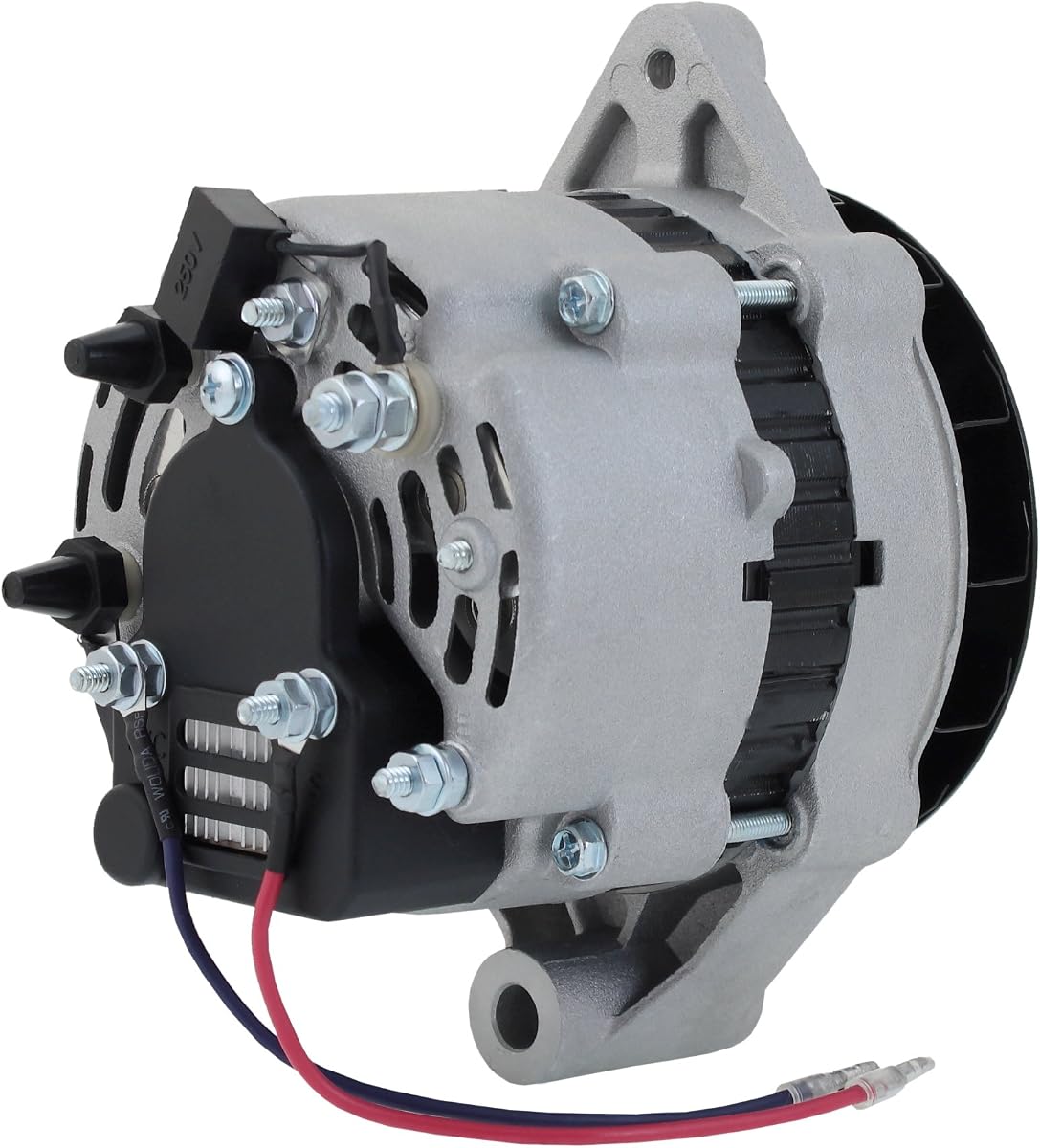
The OEG Parts 94A is technically a 94 amp, 12-volt replacement rather than a unit rated at a full 100 amps. That distinction makes it most relevant to boats whose original system used this alternator family and whose electrical loads remain within the design’s capacity. Its 4.2 rating indicates positive customer reception, while its unusually detailed description is one of its strongest attributes.
We may earn a commission when you buy through this link, at no additional cost to you.
The specification section identifies a new 10SI unit with clockwise rotation, an internal regulator, external fan, V1 pulley, one-wire operation, and a spark arrester. It also supplies a long list of replacement numbers, including 70-01-7152HO, 90-01-3103A, ADR0334, and numerous 7152-series references. Compatibility entries cover specific older MerCruiser and OMC applications rather than making a broad engine claim.
As a budget-oriented direct replacement, it has clear trade-offs. The output is below the 100 amp figure sought by many modern electrical-heavy boats, and mounting hardware is not included. The older application focus also means it is a poor choice for someone with a newer electrical system unless the original alternator and all electrical requirements have been carefully checked.
This product suits owners of the listed 1970s–1980s MerCruiser and OMC models who need a correctly referenced 94 amp replacement and prefer a straightforward one-wire configuration. It can be an economical solution when the original design called for this unit. Confirm the pulley, rotation, mounting points, one-wire hookup, and total load before purchase, and remember that the lower output rating may limit future expansion.
The long replacement-number list reduces uncertainty when the original label is damaged or missing. Use those references to establish the correct baseline, then confirm the physical and electrical configuration.
The one-wire system, spark arrester, internal regulator, and external fan provide a clear picture of the installation. Legacy one-wire arrangements should be checked for proper grounding and charging-control compatibility.
We may earn a commission when you buy through this link, at no additional cost to you.
This Balmar listing stands apart from the direct-replacement alternators because its supplied description emphasizes a compact small-case package, patented Smart Ready internal regulator technology, dual fan cooling, and a high-airflow frame. It carries a 5.0 rating, although the generic product title and limited supplied specifications make exact application matching especially important.
We may earn a commission when you buy through this link, at no additional cost to you.
Its design priorities appear to be high output in a compact package and improved thermal management. Dual fan cooling can help maintain performance in hot engine compartments, while the high-airflow frame supports sustained charging demands. The Smart Ready internal regulator suggests attention to modern charging controls and potentially adaptable battery-management requirements.
The obvious drawback is missing detail in the supplied information. There is no explicit 100 amp statement, voltage, rotation, pulley specification, OEM replacement list, or named engine compatibility. Although the listing is associated with a 5.0 customer rating, buyers should not infer from that score that it is a universal direct replacement for every boat using a nominal 100 amp alternator.
The Balmar option is best for a boater seeking a premium-style compact charging component with advanced regulator and cooling features rather than a simple cross-reference purchase. Check the full manufacturer specifications, charging-system requirements, physical dimensions, and installation instructions before buying. If those details align with the boat’s system, the compact format, high airflow, dual fans, and positive rating make it particularly interesting.
A small-case package can make installation easier where engine-bay clearance is limited. Measure the available area and compare mounting points rather than assuming a compact unit will clear existing brackets or belts.
Dual fan cooling and a high-airflow frame are meaningful benefits in hot marine environments. Adequate cooling helps the alternator manage heat while supplying the current demanded by the vessel’s electrical system.
We may earn a commission when you buy through this link, at no additional cost to you.
This 12-volt Professional Grade Alternator combines a 100 amp output with compatibility for Cummins and MerCruiser marine engines from 2.8L to 8.2L, plus a stated range of Cushman models from 1995–2005. Like the closely related second-ranked listing, it lacks a numerical customer rating in the supplied data.
We may earn a commission when you buy through this link, at no additional cost to you.
Its core configuration includes an internal regulator, external fan, six-groove pulley, and two bullet leads. The replacement references AC165617, M50924, M59207, 807653, and 807653T provide concrete identification points. A one-year warranty and a claim of 100 percent computer load testing make the listing more informative about manufacturer quality controls.
Compatibility across brands is useful, but buyers should be alert to differences in brackets, pulley positions, wire routing, and engine variants. The supplied description also does not mention SAEJ1171 certification. Although the product is explicitly marketed for marine engines, certification should be verified if it is a mandatory procurement requirement for the owner or repair facility.
This alternator is a practical candidate for a boat using one of the named Cummins, MerCruiser, or Cushman applications and requiring a six-groove, 100-amp replacement. It is most attractive when the original part number appears in the supplied list. Verify the physical mounting arrangement, electrical connections, and model year before ordering, and consider requesting more installation or certification details if those details are not visible in the listing.
Compatibility with several marine equipment brands can simplify a search when a known OEM number is available. The range is still model-specific, so displacement and year should be treated as screening information rather than sufficient proof of fit.
The stated computer load test indicates an attempt to evaluate the alternator under simulated demand. It is useful supporting information, but buyers should still consider ventilation, belt tension, grounding, and the actual electrical load on the vessel.
We may earn a commission when you buy through this link, at no additional cost to you.
The RAREELECTRICAL 12V 100A Alternator is a high-output replacement for numerous GM V8 marine inboards from 1997–2008, including applications associated with Crusader, Pleasurecraft, Marine Power, and Indmar. It has no numerical customer rating in the supplied data, but its extensive application and part-number information is useful for preliminary fitment work.
We may earn a commission when you buy through this link, at no additional cost to you.
The unit is described as a 7Si-series alternator with clockwise rotation, an internal fan, an internal regulator, and six grooves on the pulley. The output is 100 amps, positioned as an upgrade from a stock 70 amp alternator. The listing includes references associated with Delco, Hyster, Pleasurecraft, Crusader, Indmar, and Marine Power, giving owners multiple ways to identify a match.
Its broad list is a strength, but not every supported model necessarily uses identical brackets or wiring. The description also does not explicitly state SAEJ1171 certification. Boats with extensive modern electronics may require careful review of charging-control compatibility, grounding, and cable size, especially when replacing a lower-output original unit.
This alternator is well suited to owners of the named 1997–2008 GM V8 inboard applications who need a documented 100 amp replacement and can verify the original part number. It may also appeal to a boat owner seeking more charging headroom than a 70 amp system provided. Confirm the 7Si case geometry, pulley position, rotation, mounting points, and regulator behavior before installation.
The stated increase from a stock 70 amp rating to 100 amp can be valuable for boats with added electronics, lighting, pumps, or accessories. Confirm that the rest of the charging and wiring system is designed to support the additional output safely.
An internal fan and regulator keep the unit’s external layout relatively compact, which can be helpful in confined engine spaces. The pulley and case must still match the original installation.
We may earn a commission when you buy through this link, at no additional cost to you.
This High Output 100A Marine Alternator is the clearest premium selection because it explicitly combines 12-volt, 100-amp output with SAEJ1171 marine certification. Its stated compatibility spans MerCruiser, Pleasurecraft, Chrysler Marine, Jacuzzi Jet, Indmar, Lehman, and other marine engines, although the supplied listing does not include a numerical customer rating.
We may earn a commission when you buy through this link, at no additional cost to you.
The product data highlights model coverage across numerous MerCruiser stern-drive, ski, and MIE applications from 3.0L to 8.2L. It also provides a useful set of replacement references, including AC165610, AC165616, MES 3144M, 3145M, 3159M, RSM RA00123, RA00127, and Valeo TA000B32201, which helps buyers perform direct-replacement checks.
The main weakness in the supplied information is the lack of pulley, rotation, lead, and mounting details. Broad brand compatibility also cannot substitute for confirming the exact engine version, original alternator, and electrical arrangement. A premium price position should be evaluated against the documented marine certification, not assumed from the appearance or brand alone.
This alternator is a strong candidate for a boat owner who values explicit SAEJ1171 certification, broad marine application coverage, and a substantial list of replacement numbers. It is particularly relevant when the existing unit matches one of the listed OEM references. Before ordering, verify mechanical dimensions, pulley configuration, grounding, and charging-control compatibility, then purchase from a seller capable of answering model-specific questions.
SAEJ1171 certification is a key advantage in a category where moisture, corrosion, vibration, and elevated temperatures are constant concerns. The certification should be matched with correct sealing, wiring, and mounting practices.
The broad list of brands and OEM references can shorten the identification process. A confirmed number is still the best starting point, followed by a comparison of pulley, rotation, and case geometry.
We may earn a commission when you buy through this link, at no additional cost to you.
The DB Electrical 400-12300 is a 12-volt, 95-amp Indmar marine alternator based on the GM 11SI design. It has a 4.0 customer rating and is aimed at owners seeking a direct replacement for several established Indmar-related part numbers rather than a general-purpose high-output marine unit.
We may earn a commission when you buy through this link, at no additional cost to you.
Its pulley is a six-groove design with a stated 63 mm outer diameter, while the direct-fit concept is intended to simplify installation without vehicle modifications. The replacement list includes 20827, ADR0424, D8600002, 8400013, 4-6451, 575014, 400-12213, 400-12300, and 8723, giving owners several ways to match the component they are removing.
Its limitations are straightforward: the rated output is 95 amps, below the nominal 100 amp focus of this guide, and the supplied information gives less specific engine-model coverage than some alternatives. The general claims about high-quality construction and easy installation are less useful than the concrete references, so the buyer should not rely on a broad “marine” label without confirming exact fit.
This alternator is best for an Indmar boat whose original unit matches the listed numbers and whose electrical load is appropriate for a 95-amp charging system. It is a practical choice for a like-for-like replacement where the main goal is restoring the original charging architecture. Measure the pulley, verify the 11SI configuration, check the mounting points, and confirm the lead arrangement before purchase.
The DB Electrical product is built around a specific 11SI application and several recognizable OEM references. That specificity can be more helpful than a broad compatibility claim when the buyer knows exactly which unit is being replaced.
The stated 63 mm, six-groove pulley allows a useful preliminary comparison with the old alternator. Belt alignment and engine-bay clearance should still be checked before ordering.
We may earn a commission when you buy through this link, at no additional cost to you.
The New Premium Alternator offers a documented 12-volt, 100-amp high-output configuration for Mando Marine, Cushman, and MerCruiser applications from 1993–1999. Its 5.0 rating makes it one of the most positively reviewed products in the group, although the supplied data does not include the number of reviews behind that score.
We may earn a commission when you buy through this link, at no additional cost to you.
The alternator uses an internal regulator, external fan, and a single-groove pulley. Its reference list includes AC165617, AC165610, AC165616, 805447, 805884, 893876, and AR150-120AMP, giving buyers a substantial set of numbers to check against the removed unit. The stated one-year warranty, OEM-specification commitment, and 100 percent computer load testing support buyer confidence.
The pulley is the most important possible limitation. A one-groove arrangement can be correct for a specific older system, but it will not match a multi-groove belt setup. The listing also does not state SAEJ1171 certification in the supplied description, so a buyer who requires that documentation should request it rather than infer it from the marine-compatible applications.
This is a compelling choice for an owner of a listed 1993–1999 Mando Marine, Cushman, or MerCruiser boat whose original alternator used a compatible single-groove pulley. The 5.0 rating, 100-amp output, useful replacement references, warranty, and load-testing claim make it a strong fit once the mechanical configuration is confirmed. Verify the pulley, mounting bracket, wiring, and original part number before ordering.
The 100-amp rating provides useful charging headroom, while the stated computer load test and one-year warranty add manufacturing and service assurances. These features complement, rather than replace, proper installation and system checks.
A single-groove pulley is a defining characteristic rather than a minor detail. It must match the belt system exactly, and buyers should also compare the alternator’s position and the direction of the belt run.
We may earn a commission when you buy through this link, at no additional cost to you.
A useful marine alternator purchase depends on more than a 100 amp headline. The buyer should match charging needs, engine application, pulley configuration, electrical connections, environmental requirements, and serviceability before choosing a replacement.
Start by estimating the vessel’s simultaneous electrical demand. Batteries require charging current, while electronics, lighting, pumps, navigation equipment, refrigeration, and engine accessories add further load. A 100 amp alternator is a meaningful increase over many older marine systems, but the rating alone does not guarantee that the entire charging path is designed for that output. Cable gauges, fusible links, grounds, battery condition, voltage drop, and the engine’s charging controller all affect real-world performance.
A boat with modest electronics may operate comfortably with a correctly matched lower-output unit, while a heavily equipped vessel may benefit from genuine 100-amp capacity. Confirm whether the alternator is intended as the primary source of charging current, and ensure the battery bank is appropriate for the expected load. Choose output that supports present demand with sensible reserve rather than relying on a single specification.
In short, match 100 amps to the actual electrical system, including its wiring and controls.
The engine family is only the starting point because a single model can use different alternator configurations over production years. Compare the original alternator’s part number, case design, pulley position, rotation, mounting ears, and wiring with the replacement. Listings such as the OEG, DB Electrical, and RAREELECTRICAL products provide extensive references for older MerCruiser, OMC, and Indmar applications, while several newer units target specific 1993–2004 or 1993–1999 groups.
A wide engine-displacement range is convenient, but it should not override a direct-fit requirement. Confirm the exact engine variant, production year, stern-drive or inboard configuration, and any manufacturer revisions. When the old unit is removed, photograph its label and take measurements so the comparison is based on the boat rather than an incomplete online fitment claim.
In short, use OEM numbers and physical measurements to establish a true direct match.
Marine service is more demanding than ordinary road use because the alternator faces moisture, salt-laden air, vibration, heat, and restricted maintenance windows. SAEJ1171 certification is explicitly identified for the first- and eighth-ranked products and can help distinguish a purpose-oriented marine unit from an automotive replacement marketed for selected boat applications. Buyers should also consider sealed or corrosion-resistant construction, the alternator’s mounting position, and the quality of external connections.
Certification does not make a poorly installed alternator waterproof, nor does it guarantee compatibility with every charging controller. It is one sign of a product evaluated for the environment. Review the manufacturer details, ask for documentation where needed, and ensure that the wiring, grounds, belt tension, and protective covers are also suitable for the boat.
In short, favor documented marine suitability and installation practices that address corrosion and vibration.
Pulley compatibility is essential because the groove count, diameter, position, and orientation determine whether the alternator can mount and drive the belt correctly. The six-groove alternatives, V1 pulley products, and single-groove replacement in the final listing are not interchangeable without confirmation. A unit can have the correct electrical output and still require belt changes or bracket modification, which can undermine the value of a direct replacement.
Compare the new pulley with the old one, check the manufacturer’s serpentine or V-belt arrangement, and note the alternator’s position relative to the engine. Confirm that the belt will track correctly and that the tensioner or manual adjustment will hold proper tension. When a listing omits pulley details, obtain them from the manufacturer or seller before ordering.
In short, treat the pulley specification as a hard requirement rather than a minor visual detail.
The regulator controls charging voltage, while the fan moves air through or across the alternator to dissipate heat. Several of the direct replacements use an internal regulator and external fan; the Balmar product emphasizes dual fans and a high-airflow frame, while the Powermaster listing highlights screens for marine and off-road use. Internal designs can simplify packaging, but external cooling remains important in hot engine compartments.
A smart regulator may support modern battery-management requirements, though the charging-control protocol must be compatible with the alternator and the boat’s wiring. Heat management matters because alternator output can decline if the unit becomes overheated. Check that the alternator has sufficient airflow, that protective screens do not restrict cooling, and that mounting locations remain clear of hoses, wiring, and exhaust components.
In short, verify both voltage regulation and cooling because dependable output depends on heat control.
Correct output cannot be achieved if the alternator is wired incorrectly. Some products in the list use a one-wire system, while others specify two bullet leads, and several use internal regulators. Compare the connection scheme, wire gauge, sense-wire arrangement, and grounding path with the existing installation. Rotation also matters, particularly with pulley and belt arrangements that constrain installation orientation.
The OEG product explicitly notes a one-wire system and spark arrester, while the Professional Grade options identify two bullet leads. These details help distinguish otherwise similar 12-volt, 100-amp units. Follow the installation instructions, use suitable marine-grade cable and connections, protect leads from chafing and heat, and confirm that the engine provides the intended ground path.
In short, match the alternator’s electrical architecture and establish a sound marine-grade connection.
Several listings state a one-year warranty, which provides a useful baseline for resolving defects, while three products claim computer load testing. These are useful indicators of manufacturer confidence but should be considered alongside the clarity of the fitment information and the seller’s ability to answer technical questions. A long warranty cannot compensate for an incorrect application, and a strong output claim does not replace proper installation.
For an established or discontinued boat, replacement-number lists are particularly valuable because original documentation may be difficult to find. A seller should be able to connect the listed OEM reference to the relevant engine and provide installation guidance. Save the order confirmation and installation records, and retain the removed alternator until the replacement has been properly assessed.
In short, prefer transparent specifications, responsive support, and documented warranty coverage.
The supplied product information is a starting point rather than a permanent record. Stock, seller conditions, product variations, ratings, and prices can change, and a listing that shows one image may offer several alternator configurations under the same page. Check the selected variation carefully to ensure that the amperage, pulley, terminal layout, and application correspond to the title and description being reviewed.
A 4.0 or 5.0 rating can be helpful, but a small number of reviews should not be treated as equivalent to a long-term laboratory record. Read available customer feedback for comments about fitment, noise, charging behavior, and packaging, while remembering that installation quality and an incorrect baseline unit can also influence outcomes. Confirm the seller and warranty terms at the time of purchase.
In short, recheck the live listing and selected variation because marine-alternator availability can be inconsistent.
Begin replacement with a cool engine and the boat’s battery system isolated according to the manufacturer’s service instructions. Photograph the wiring and belt arrangement, label each connection, and record the alternator’s part number, rotation, pulley, and mounting position. Compare every feature with the replacement before removing hardware, and consult a qualified marine technician when the installation is unfamiliar.
Install the alternator with the correct pulley, rotation, mounting hardware, belt tension, and electrical connections. Use the specified marine-grade cable and secure it away from sharp edges, moving parts, hot exhaust components, and moisture traps. A one-wire installation must have a sound engine-ground path, while a multi-lead system must follow the specified regulator or sense-wire instructions.
After installation, inspect the belt and connections, then operate the engine while monitoring charging voltage, current, and warning indicators. Compare system behavior with the manufacturer’s specifications, and investigate unusual noise, overheating, voltage fluctuation, or electrical warnings promptly. Keep the alternator clean, maintain the belt, protect wiring from moisture and abrasion, and inspect the unit regularly for corrosion, loose mounting, or damaged insulation.
A 100 amp alternator may suit your boat if the engine application, pulley, wiring, voltage system, and electrical load all match. Start with the old alternator’s part number, then verify the replacement against the boat’s manufacturer information. A higher rating alone does not guarantee safe operation if the rest of the charging system was not designed for that output.
The primary difference is rated output, with 100 amps providing slightly greater charging capacity. Compatibility also depends on case design, pulley, rotation, regulator, and wiring rather than amperage alone. A 94-amp unit may be the correct original replacement for an older boat, while a 100-amp unit may be preferable when the electrical system and mounting arrangement are designed for it.
Yes. SAEJ1171 is a recognized marine-use standard, so it provides useful evidence that the product was evaluated for the demands of marine service. Certification should still be combined with correct installation, suitable wiring, sound grounding, and adequate cooling. A listing that does not state certification may still be usable, but the buyer should request documentation if that standard is required.
It may be possible if the engine, mounting points, pulley, belt, wiring, grounding, and charging control are all compatible. Older boats often used lower-output alternators, so the electrical system may need an upgrade rather than a simple swap. Have the installation assessed and sized correctly before increasing alternator output.
The pulley must match the belt type, groove count, diameter, and tracking path. A six-groove alternator cannot simply replace a one-groove unit without corresponding belt and possibly bracket changes. Comparing the removed alternator with the new unit is one of the most important steps in preventing installation problems.
The alternator’s regulator architecture determines whether it uses one wire, multiple leads, a separate sense connection, or another configuration. Marine applications also require robust conductors, secure connections, good grounding, chafe protection, and careful routing. Follow the alternator and boat manufacturers’ wiring diagrams rather than assuming a generic automotive connection applies.
Repeated undercharging, voltage warnings, abnormal noises, visible damage, overheating, or a charging output far outside the manufacturer’s specifications can indicate a problem. Before replacing the alternator, test the battery, grounds, cables, fuses, belt tension, and voltage drop. A defective alternator is only one possible cause of poor charging.
Keep the unit and wiring clean, maintain proper belt tension, protect connections from moisture and salt, and inspect for loose mounting, corrosion, damaged insulation, or belt misalignment. Check charging performance periodically and address unusual voltage behavior promptly. Good installation practices and routine visual inspections are especially important in confined marine engine compartments.
The New Premium Alternator stands out for its 5.0 rating, 100-amp output, 1993–1999 application range, extensive replacement references, computer load testing, and one-year warranty. The OEG Parts 94A is the budget-focused historical replacement for compatible older MerCruiser and OMC systems, while the High Output 100A Marine Alternator is the premium choice for buyers who prioritize explicit SAEJ1171 certification and broad marine coverage.
Prioritize a confirmed OEM number, correct pulley, suitable rotation, matching wiring, and a physically compatible case before focusing on output alone. Also consider the alternator’s cooling design, regulatory requirements, warranty, and the demands placed on the boat’s charging cables and battery bank. The best replacement is the one that fits the complete electrical and mechanical system, not merely the one with the most impressive specification.
Before placing an order, review the current product page, selected variation, seller information, customer feedback, warranty terms, and return policy. Marine alternator availability and prices can change, and fitment information may vary between listings. Reconfirm the model year, original part number, and installation dimensions to make the final decision confidently.