
Ideal Security Pressure Floor Mat Home Alarm System
4.1Editor score
Wired pressure sensor setup
Loud alarm and chime modes
Thirty-foot connection cable
A floor mat alarm and pager system can help caregivers respond sooner when a loved one leaves a bed, approaches a doorway, or wanders into another area. The most useful models combine a pressure-sensitive mat with audible, vibrating, or visual alerts that can be monitored from another room.
We compared the ten systems in this guide by examining sensor dimensions, wireless range, alert controls, power requirements, included accessories, and suitability for bedside or doorway placement. The list includes caregiver-focused systems, a security-oriented floor mat, and wireless bed and chair alarm options.
Each review explains the product's strongest features, practical limitations, and ideal placement. Ratings reflect the supplied customer feedback, while specifications and included components are based on the available product information. Current prices and availability can change, so confirm those details before buying.
4.1Editor score
4.6Editor score

4.1Editor score
As an Amazon Associate we earn from qualifying purchases.
This side-by-side comparison highlights the sensor size, alert delivery, connection method, and most notable caregiver feature of each system, helping readers identify the right balance of coverage, flexibility, and ease of use.




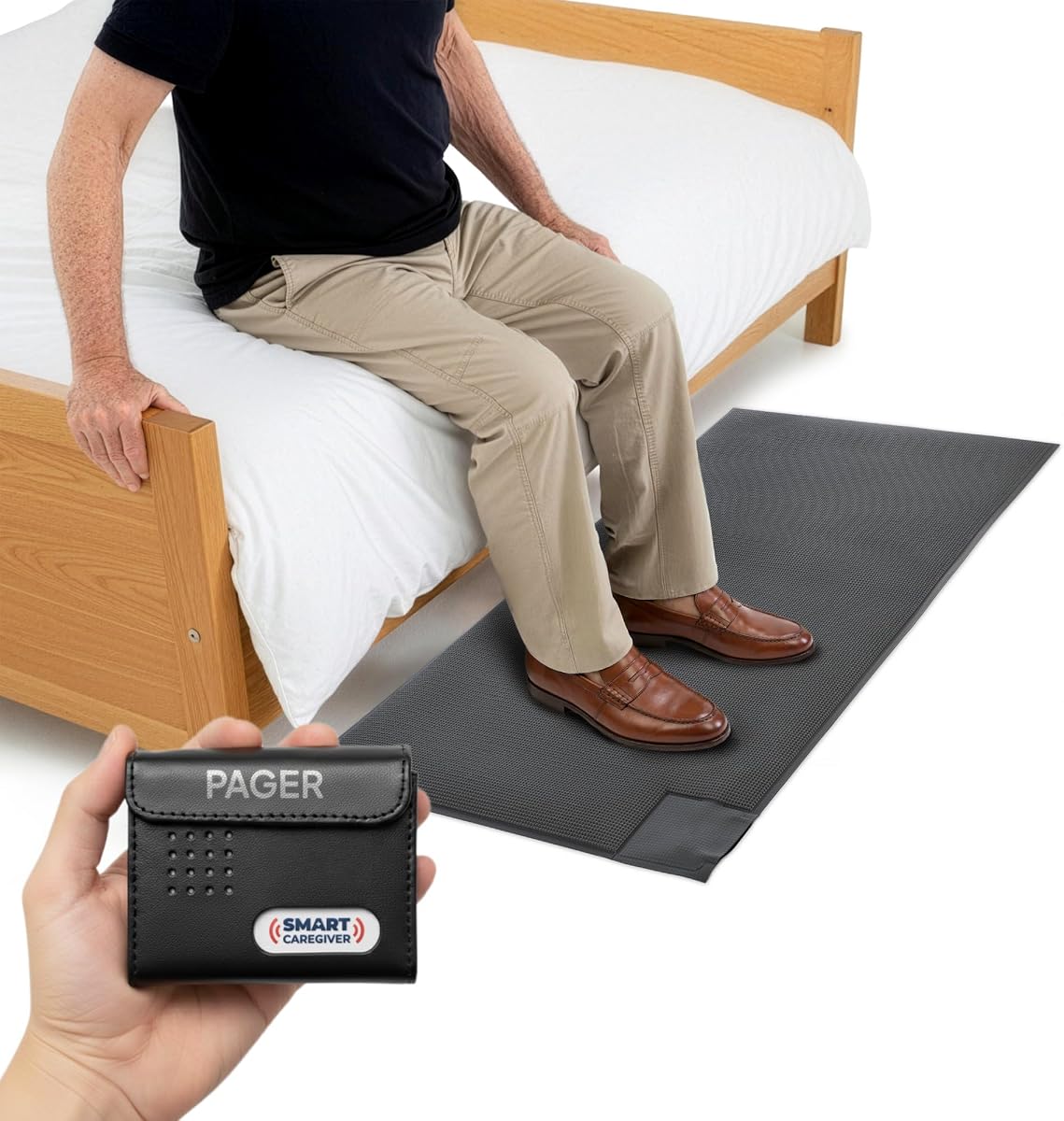
The Smart Caregiver Floor Mat Alarm and Pager System is a well-rounded caregiver monitoring solution with a 4.6 rating. It combines a durable 24-by-48-inch pressure-sensitive mat with a wearable wireless pager, giving caregivers an immediate signal when someone steps on the mat. Its flexible placement makes it useful beside a bed, near a chair, or along a route toward an exit.
We may earn a commission when you buy through this link, at no additional cost to you.
One of the system's most useful qualities is the choice between a sound alarm and vibration. A caregiver who is nearby but does not want a loud noise in the patient's room can rely on the pager's vibration mode, while the audible setting remains available for greater distance. The stated wireless range reaches up to 300 feet, and the pager can be carried or placed in a convenient location. The monitor can also be paired with compatible bed pads, chair pads, motion sensors, call buttons, and other Smart Caregiver devices sold separately.
The large floor mat offers more coverage than many compact pressure mats, while its cordless design avoids a trailing cable near the sleeping area. The included pager is appropriate for a caregiver who needs alerts while moving between rooms, and the on-board controls make it possible to adjust the alert style. The main drawback is that the pager requires two AA batteries that are not included. It also ships with one floor mat rather than a complete multi-sensor setup, so households wanting broader coverage may need compatible accessories.
This is the strongest general recommendation for someone who wants a balance of floor-mat coverage, wireless paging, and discreet alerts. It is particularly appropriate for overnight monitoring, dementia-related wandering concerns, and situations where an audible bedside alarm could be disruptive. Caregivers should confirm that 300 feet of wireless range suits the home or facility and purchase the required batteries before setup.
The vibration option is a meaningful benefit for nighttime use because it allows a caregiver to receive an alert without filling the room with a loud tone. Users can switch to audible mode when a more noticeable signal is needed or when the patient is farther from the caregiver.
Compatibility with other Smart Caregiver sensors makes this more than a single-purpose doorway alarm. A household can add compatible bed, chair, door, motion, and call-button accessories to create a broader monitoring network, although those extras are purchased separately.
We may earn a commission when you buy through this link, at no additional cost to you.
The Smart Caregiver Wireless Floor Mat Alarm and Monitor is a 4.6-rated system designed around a cordless 24-by-36-inch mat and cordless monitor. It is especially relevant to caregivers who want to detect movement toward a doorway without operating a wired mat beside the bed. The monitor gives the user control over low, medium, and high volume, along with a chime switch and off setting.
We may earn a commission when you buy through this link, at no additional cost to you.
Its cordless construction simplifies placement because the mat does not need a cable running back to the alarm unit. The monitor can be positioned where staff or family members are likely to hear it, while the mat covers a meaningful portion of a doorway or exit route. The low-battery indicator is useful for maintenance, and the monitor can run on three C batteries or an AC-04 adapter.
Compared with the top-ranked model, this system does not provide a wearable caregiver pager in the described package. It is therefore better suited to a home or facility where someone remains within hearing distance of the monitor. Another limitation is that neither the three C batteries nor the optional AC-04 adapter are included, so users need to decide on a power method before installation.
This is a practical choice for anti-wandering monitoring at a door or exit. It is less appropriate when the caregiver must leave the room, move around a large home, or receive discreet vibration alerts. Its strongest advantages are straightforward cordless setup, adjustable sound controls, and enough mat area to detect a person crossing a monitored point.
Because the floor mat communicates with a cordless monitor, it can be positioned at an exit without running a cable across the walking area. This makes the system visually and operationally cleaner for many bedroom and hallway arrangements.
Three volume levels, a chime option, and an off switch make the monitor adaptable to shared spaces. Caregivers can use a softer setting during routine periods and a louder alert when prompt notification matters more.
We may earn a commission when you buy through this link, at no additional cost to you.
The Smart Caregiver Floor Alarm Mat is a 4.3-rated system built around a large 24-by-48-inch mat and an advanced wireless caregiver pager. It is designed for elderly dementia and Alzheimer's patients who may attempt to leave a bed, enter a doorway, or wander through the home. The mat's full-contact pressure sensor should be more forgiving than a small contact pad when movement crosses only part of the mat.
We may earn a commission when you buy through this link, at no additional cost to you.
The pager offers low, medium, and high volume plus a silent vibration mode, allowing caregivers to choose how alerts are delivered. Its LCD display can identify which paired sensor triggered an alert. Bed, chair, door, motion, and call-button sensors can be added to the system, creating a coordinated network instead of limiting monitoring to one floor location. The pager can be clipped to clothing, carried in a pocket, or placed on a countertop.
Safety and maintenance features add value. The attached monitor has an on/off control for silencing alerts when the caregiver is in the room, a status light, a patient call button, a low-battery light, and a signal-lost notification. The rubber mat has a nonslip surface and beveled edges intended to reduce tripping risk. The tradeoff is that additional sensor types are not included and must be bought separately, and the multi-device design may take more time to configure than a simple standalone alarm.
This system is a strong fit for caregivers who want one pager to monitor several risk points. It offers a better information-rich experience than a basic audible monitor because the screen identifies the source of an alert. Buyers should verify compatible add-on sensors before planning a whole-home installation and test the pager from the locations they expect to monitor.
The LCD screen and compatibility with multiple sensor types make this system useful for coordinated monitoring. Rather than carrying separate alarms for the bed, door, chair, and hallway, a caregiver can receive a pager alert that identifies the source.
The nonslip rubber surface and beveled edges address common hazards associated with placing a sensor on a walking route. The large mat also provides a broad target when a person steps near rather than directly in the center of the sensor.
We may earn a commission when you buy through this link, at no additional cost to you.
The Smart Caregiver Wireless Floor Mat Alarm and Monitor is a 4.4-rated bed-exit monitoring system with a cordless 24-by-48-inch floor mat. It is larger than many bedside mats and is intended to alert a caregiver when a resident steps out of bed. A large sensor area can be advantageous in a room where the resident tends to move around the bed before fully standing.
We may earn a commission when you buy through this link, at no additional cost to you.
The 433-EC monitor includes low, medium, and high volume controls, a low-battery indicator, and a chime/off switch. Because the mat is cordless, it can sit beside the bed without a power lead running toward the resident. The monitor may be placed in another room or near a caregiver's station, and it supports either three C batteries or an AC-04 adapter.
The absence of a wearable pager in the described package is the central limitation. This setup depends on someone being within earshot of the monitor, so it is less suitable for caregivers who need to move freely through a larger home. Users must also supply three C batteries or the separately available AC-04 adapter, and the monitor's off or chime settings need to be coordinated with nighttime routines.
For a household seeking a simple, large-mat bed exit alarm with no trailing mat cable, this is a straightforward option. It may be especially useful in a bedroom where the caregiver has a fixed listening position. Confirm the intended power source and conduct a full range test before relying on the system overnight.
At 24 by 48 inches, the mat offers substantial coverage beside a bed. That size can improve the chance of registering a first step or movement away from the sleeping area, particularly when the resident's path varies.
Low, medium, and high volume controls allow caregivers to tune the monitor for daytime and overnight use. The chime and off settings add further flexibility, though the off position should be used only when a caregiver can reliably monitor the room.
We may earn a commission when you buy through this link, at no additional cost to you.
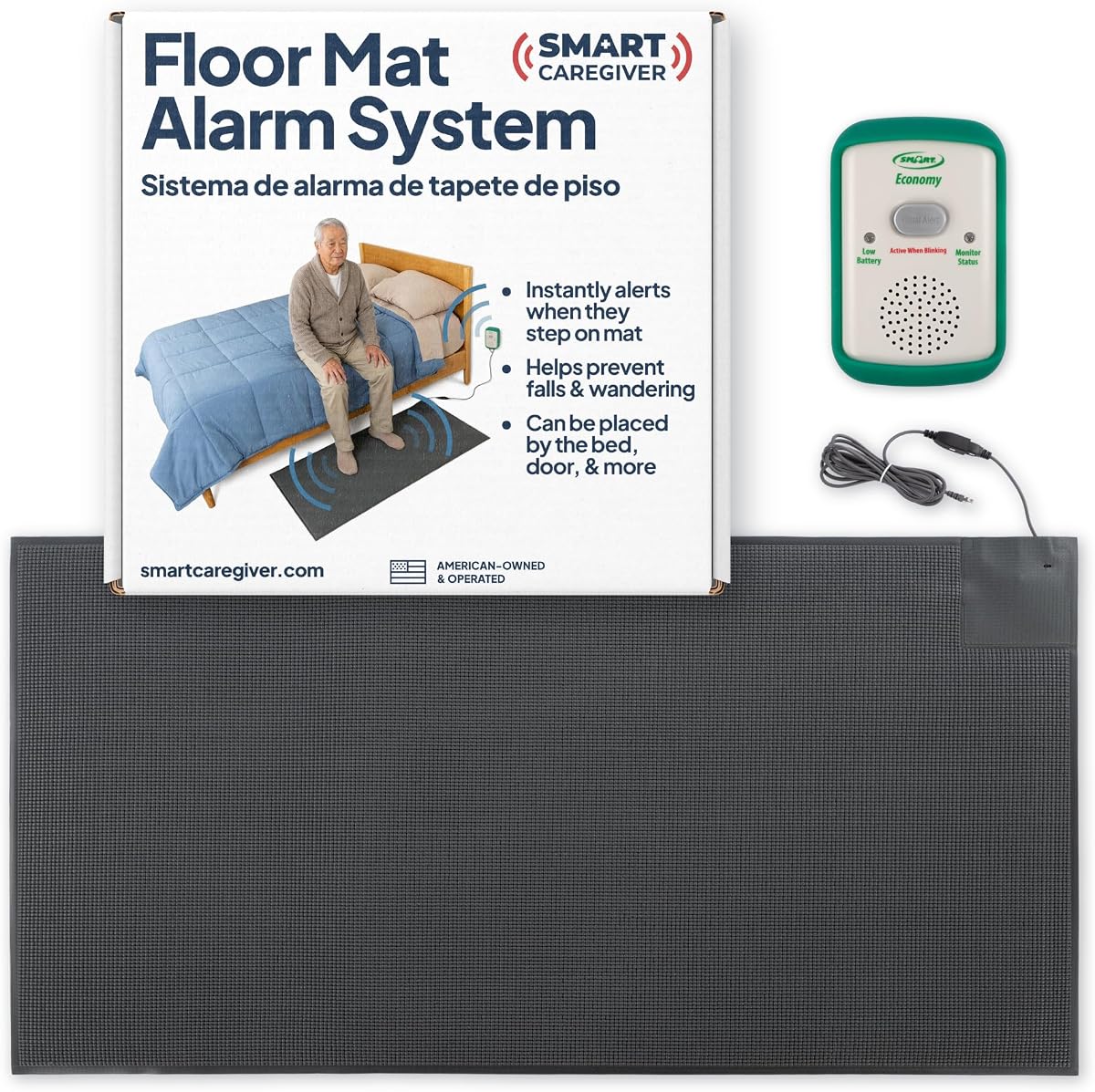
The Floor Mat Exit Alarm Economy System is a 4.4-rated caregiver alarm built around a 24-by-48-inch gray pressure-sensitive mat and a local audible alarm. It can be placed by a bed, chair, or doorway to notify a caregiver when a resident steps onto the sensor. The system is designed around a simple goal: provide a noticeable exit signal without requiring a wearable pager.
We may earn a commission when you buy through this link, at no additional cost to you.
The alarm includes an on/off reset control, a status light, a low-battery warning, a blinking visual alert, adjustable volume, and variable tones. These features let caregivers distinguish the alarm from other household sounds and confirm at a glance that the monitor is operational. The mat is made from heavy-duty nonslip material with beveled edges, and an eight-foot cord connects it to the alarm unit. A protective boot and hanging strap are also included.
There are some important limitations. The system is battery only, using three AA batteries that are not included, and it explicitly does not work with AC adapters. The wired connection can also be less convenient than a cordless mat, particularly in a modern bedroom or near a doorway. Finally, because the alert comes from the monitor rather than a remote pager, response depends on someone being close enough to hear it.
This is a sensible economy choice for a basic bed, chair, or exit alarm where a large sensor and an audible local alert are the priorities. It may suit a caregiver who sits nearby, works in a room adjacent to the monitored area, or wants visual and audible confirmation. Buyers should secure the cord out of the walking path and test the tone from across the room.
The status lamp and low-battery warning help distinguish an actual exit alert from a power or setup issue. Variable tones and adjustable volume make it easier to choose a sound that is noticeable without being unnecessarily harsh.
A 24-by-48-inch mat provides ample detection area, while its nonslip construction and beveled edges support safer placement. The included cord still needs to be routed carefully so it does not create a trip hazard.
We may earn a commission when you buy through this link, at no additional cost to you.
The Ideal Security Pressure Floor Mat Home Alarm System is a 4.1-rated, budget-oriented pressure sensor designed to notify occupants when someone crosses the mat. Unlike most caregiver-focused products in this guide, its primary use is general home security, including awareness of visitors, family members, intruders, or pets. It can also serve as a basic entry alert.
We may earn a commission when you buy through this link, at no additional cost to you.
The system includes a small 21.75-by-13.75-inch pressure mat connected to a battery-operated alarm by a thin 30-foot wire. The alarm can be wall-mounted using the included hardware or positioned on a surface. It offers three modes: a loud alarm, a pleasant chime, and off. The supplied information lists the alarm volume as 105 dB and the chime as 90 dB, making the distinction between a security signal and a routine visitor notification clear.
Installation is straightforward, but the wire is the main limitation. Unlike a wireless caregiver pager, it cannot provide a discreet remote vibration or reach a receiver hundreds of feet away. Its trigger sensitivity is listed as one pound per square inch, and the operating range is from -10°C to 50°C. The mat may be used outdoors if protected by a waterproof welcome mat, but the floor sensor itself should not be exposed to uncontrolled weather.
This system is best for a homeowner seeking a basic, affordable entry alert rather than a comprehensive senior monitoring system. It is less appropriate for bed-exit care where a large mat, wireless paging, and quiet alerts are priorities. Position the sensor where it will not be shifted, secure the cable out of the walkway, and select the chime or alarm mode according to the intended use.
The pleasant chime is suitable for routine arrivals, while the louder alarm provides a stronger security signal. An off mode allows the user to disable the system during periods when notification is unnecessary.
The wall-mountable alarm and 30-foot connection give some freedom in positioning. The mat can also be placed beneath a waterproof welcome mat for covered outdoor use, but weather protection is essential.
We may earn a commission when you buy through this link, at no additional cost to you.
The Lunderg Wireless Early Alert Bed and Chair Alarm Set is a 4.4-rated system that uses two sensor pads with one portable caregiver pager. It is not a traditional pressure-sensitive floor mat, but it serves a closely related purpose: detecting bed exits and chair departures before a person can wander. Both the 10-by-33-inch bed sensor and the chair sensor connect wirelessly to the same handheld receiver.
We may earn a commission when you buy through this link, at no additional cost to you.
The bed pad is designed to sit at hip level, which the manufacturer says can provide an earlier warning than a pad positioned under the shoulders. The chair sensor is intended to alert the caregiver when the monitored person stands. The pager reaches up to 400 feet and supports adjustable volume or vibration only, making it suitable for a caregiver who carries a receiver around a home or care setting.
The system is designed to be approachable. It requires no Wi-Fi, app, or tools, and the product information states that all batteries are included. Both pads have soft foam interiors, are incontinence resistant, and can be wiped clean. The included pager can be carried in a pocket or attached using the clip and wall-mount bracket. The principal drawback is that it does not provide the broad floor coverage of a true exit mat, and it lacks the included nurse call button found in some caregiver alarm sets.
This set is a strong option for a care plan that includes both a bed and a chair. It may be particularly useful when early notification is more important than detecting movement through a doorway. Verify that the sensor positions suit the user's mattress, chair, and normal movement patterns, and test the pager throughout the relevant areas of the home.
The bed sensor's hip-level position and separate chair pad create two practical monitoring points. This approach can help a caregiver intervene during the early stages of a stand or exit rather than waiting until the person reaches a doorway.
The portable pager supports vibration-only operation and a stated range of up to 400 feet. That flexibility is useful for nighttime monitoring because the caregiver can receive a signal without creating a loud alarm in the patient's room.
We may earn a commission when you buy through this link, at no additional cost to you.
The Secure Caregiver Alert System Bed Alarm for Seniors is a 4.1-rated caregiver package that combines a 24-by-36-inch floor mat, a wireless pager, a monitor, and a corded nurse call button. It is designed for fall-risk and dementia patients in homes, nursing homes, hospitals, or other care environments. The inclusion of both a floor sensor and a patient call button gives residents two ways to request assistance.
We may earn a commission when you buy through this link, at no additional cost to you.
The pager is the system's standout feature. It offers a stated 500-foot wireless range, three alert modes—alarm, vibration, or both—and LED indicators for up to four paired zones. It can be worn with a belt clip, carried, or placed nearby. When the mat receives pressure, the sensor triggers the alarm monitor and sends a wireless alert to the caregiver pager. The nurse call button offers an additional way for a patient to summon help.
The floor mat is described as durable, waterproof, and latex-free, which supports use across varied healthcare settings. The larger package also gives a caregiver more ways to identify the source of an alert than a basic single-mat system. On the other hand, the supplied information does not state a wireless range for this model, and its 4.1 rating is lower than most alternatives in the guide. Setup also involves programming four zones, making it more complex than a single-purpose alarm.
This is the best premium option when a comprehensive monitoring package and extended wireless coverage are the priority. It is well suited to facilities or large homes where different sensors may need to be distinguished. Before purchasing, confirm that the system's zone setup and range work in the intended environment, and avoid relying on any monitoring alarm as a replacement for direct supervision.
A stated 500-foot range offers substantial freedom to move through a home, hallway, or care facility. The wearable pager means the caregiver does not need to remain directly beside the monitor.
The floor mat detects movement automatically, while the nurse call button lets a patient request help directly. Together, they provide complementary ways to notify a caregiver and can support a more comprehensive response plan.
We may earn a commission when you buy through this link, at no additional cost to you.
The Lunderg Wireless Bed Alarm System is a 4.6-rated, focused solution for caregivers who mainly need to know when a person gets out of bed. It includes a 10-by-30-inch sensor pad and a handheld pager with a stated range of up to 400 feet. This is a narrower use case than a floor-mat-and-pager system, but its simplicity makes it a practical option for overnight bed-exit monitoring.
We may earn a commission when you buy through this link, at no additional cost to you.
The pager offers adjustable volume and a vibration-only mode. It can be carried in a pocket or attached with the included clip and wall-mount bracket, and the product does not require a Wi-Fi connection, app, or special tools. The sensor pad has a soft foam interior, an incontinence-resistant surface, and a surface that can be wiped clean. Anti-slip stickers are included to help keep the pad from shifting, which the manufacturer identifies as a common source of false alerts.
All batteries are listed as included, removing a common setup step. The limitation is that this is a bed sensor, not a floor mat, so it cannot cover a doorway or detect general movement through a hallway. The product information also distinguishes it from the company's early-alert model, which places a pad at hip level for advance notice. This system's basic role is to alert the caregiver when the monitored person stands.
This is a good choice for a straightforward bed-exit alert with strong customer feedback and a wireless pager. It may be less appropriate if the main concern is wandering through doorways, if a patient might remove or shift the pad, or if multiple monitored locations are required. Place the sensor according to the manufacturer's guidance and test stability before nighttime use.
The included pager, adjustable volume, and vibration mode provide the essentials for caregiver notification without bedside noise. Its wireless design also removes the need for a cord running from the bed to an alarm unit.
Anti-slip stickers help reduce movement of the sensor, while the wipe-clean, incontinence-resistant surface suits practical caregiving environments. A stable position is important for maintaining reliable detection.
We may earn a commission when you buy through this link, at no additional cost to you.
The Smart Caregiver Smart Light Outlet, Wireless Floor Mat, and Alarm is a 4.6-rated system that adds automatic lighting to caregiver monitoring. It includes a smart light outlet, a cordless 24-by-48-inch gray floor mat, and a cordless monitor. When someone steps on the mat, the outlet can turn on a connected lamp or light, helping illuminate a bedroom or hallway at night.
We may earn a commission when you buy through this link, at no additional cost to you.
The light outlet fits a grounded power outlet and receives a signal from the floor mat. The mat also sends a signal to the cordless monitor when pressure is applied, so the bundle provides both a visual lighting response and an alarm function. This dual response can be useful when a person gets out of bed in a dark room, because the path becomes visible while the monitor also alerts a nearby caregiver.
The main limitation is that the automatic lighting is not a substitute for a pager. There is no wearable remote pager listed in the package, and users need a lamp or light compatible with the outlet. The 24-by-48-inch mat is generous, but as with other floor systems, placement and trip prevention require attention. Users should also test the mat's trigger and the outlet's switching behavior in their specific room.
This system is ideal for households seeking a floor mat alarm with a helpful nighttime lighting feature. It can improve visibility and reduce the need to enter a dark room before an alert, although a separate wireless pager may be preferable for caregivers who need to be farther away. It is most useful as a combined safety and convenience setup beside a bed or along a nighttime route.
Connecting a lamp to the smart outlet allows a room to illuminate as soon as the mat is triggered. This adds a practical visual cue for a person stepping into a dark bedroom, hallway, or path.
The floor mat sends signals to both the smart outlet and cordless monitor. Users can therefore combine automatic lighting with an audible alert without assembling separate floor-sensor components.
We may earn a commission when you buy through this link, at no additional cost to you.
The right floor mat alarm and pager system depends on where the risk occurs, how far caregivers are from the patient, and whether quiet or audible alerts are preferred. Sensor coverage, alert functions, power, and expansion potential should be considered together.
Sensor size affects how easily a system detects a first step or partial contact. The 24-by-48-inch mats in this guide provide broad coverage and can be positioned beside a bed, near a chair, or across a monitored route. A smaller mat may require a more deliberate step to trigger and is more common in compact entry-alert systems. Consider the width of the patient's path, how they typically move, and whether a larger mat could interfere with furniture or walking.
Choose a mat whose dimensions cover the intended movement area without creating an obstruction. Placement should account for trip risk, footwear, mobility aids, and nighttime visibility.
Wireless range determines how far a caregiver can move while still receiving an alert. The listed systems range from a portable bed pager with up to 400 feet of range to a Secure Caregiver package with a stated 500 feet. The top-ranked Smart Caregiver system offers up to 300 feet. Range figures are most useful when compared with the actual distances between the mat, monitor, and caregiver's normal location.
Do not rely solely on the maximum stated distance. Walls, floors, and household electronics may affect performance, so test the receiver in every area where an alert must be noticed.
Alert design should reflect the sleeping environment and caregiving routine. Audible alarms are effective when a caregiver is nearby, while vibration-only paging is valuable at night or in a shared room. Some systems also provide chimes, flashing LEDs, or automatic light activation. The top-ranked model supports audible and vibration alerts, and the Secure Caregiver system offers alarm, vibration, or a combination of both.
Prioritize a system with more than one alert method if the caregiver moves around the home. A vibration pager reduces bedroom noise, while a visual or light response can illuminate a nighttime path.
A local monitor sounds where it is placed, while a caregiver pager carries the notification to the person who needs it. For a large home, facility, or caregiver who cannot remain near the bedroom, paging is usually more useful. For a small room with a nearby caregiver, a cordless monitor with adjustable volume may be sufficient and can offer a simpler setup.
Check whether the package includes a wearable pager, a wall bracket, a belt clip, or simply a monitor. The distinction is important because a floor mat and monitor alone cannot offer the same freedom as a remote pager.
Power requirements affect installation and maintenance. Some monitor systems accept three C batteries or a separate AC adapter, while one economy floor alarm uses three AA batteries and explicitly does not support AC adapters. The Lunderg systems list batteries as included, whereas several Smart Caregiver packages require batteries that are not included. Confirm the exact battery type and quantity before setup.
Choose a power method that suits the installation location and your ability to check it regularly. A low-battery indicator is helpful, but it should not replace routine testing and timely replacement.
A single floor mat can address one important exit point, but many caregivers need to monitor a bed, chair, doorway, and hallway. Systems that support additional sensors or display the triggered zone save the caregiver from carrying multiple independent devices. The Smart Caregiver Floor Alarm Mat can identify a triggered sensor on its LCD, while the Secure Caregiver package uses LED indicators for up to four paired zones.
Check compatibility before planning an expansion. Additional sensors may be sold separately, and each system may support different accessories or programming methods.
Not every pressure mat is designed for the same purpose. Caregiver systems focus on bedside exits, wandering, and fall-risk monitoring, often providing large mats, quiet paging, and patient call buttons. The Ideal Security model is smaller, wired, and intended mainly to announce entries through an alarm or chime. It can serve as a basic entry alert but does not offer the feature set of a dedicated caregiver system.
Match the product to the primary goal. A security mat may be sufficient for awareness at a doorway, while a senior-care system offers the status indicators, alert modes, and expansion options needed for continuous monitoring.
A good alarm should notify caregivers both when a sensor activates and when the system is not operating as expected. Signal-lost notifications, operational status lights, low-battery warnings, and patient call buttons add layers of protection. Durable rubber, waterproof surfaces, nonslip materials, and beveled edges can improve everyday safety around the mat.
Inspect the mat, wiring, batteries, and receiver regularly. A monitoring device can support a response plan, but it cannot replace direct supervision, good lighting, appropriate furniture placement, or emergency services.
Begin by identifying the movement that needs to be detected, such as a bed exit, a trip to the bathroom, or an approach to an exterior door. Position the mat where the person's normal path will activate it, keeping the sensor flat, unobstructed, and away from furniture. For wired systems, route the cable along the wall or beneath suitable floor protection and secure it so it cannot be stepped on.
Program and pair the monitor, pager, mat, and any additional sensors according to the manufacturer's instructions. Test each alert at a normal walking pace, then test a partial step to determine how much contact is required. Carry the pager throughout the intended monitoring area to confirm that alerts remain noticeable. Set the volume or vibration preference during realistic daytime and nighttime conditions rather than testing only at close range.
Care for the system by checking batteries on a regular schedule, cleaning the mat with a suitable damp cloth, and making sure the sensor has not shifted. Replace the pager batteries before they expire, especially if the system provides a low-battery warning. Periodically test the alarm after cleaning or moving furniture, and keep emergency contact procedures separate from the automated monitoring function.
The main benefit is early notification when a person steps onto a monitored mat, such as beside a bed or near a doorway. A remote pager can bring the alert to a caregiver who is carrying it in another room. It supports response plans but does not replace supervision or emergency services.
They can be useful when wandering or leaving a bed is a concern, provided placement and response procedures are thoughtfully planned. A large mat, discreet vibration alert, and multiple sensor options can make monitoring less disruptive than a loud bedside alarm. Care teams should also consider broader safeguards and the individual's response to alarms.
Some systems can be expanded to monitor multiple sensors. The Smart Caregiver Floor Alarm Mat can pair with compatible bed, chair, door, motion, and call-button accessories, while the Secure Caregiver system supports up to four zones. Compatibility varies, and extra sensors are generally sold separately.
An audible alarm uses sound and can be heard from a monitor within its range. A vibration alert provides a quieter signal through a wearable pager, making it useful during sleep or in a shared room. Systems that support both offer flexibility for changing caregiving conditions.
Place it where the person's normal movement will cross the sensor, such as beside a bed, in front of a chair, or along a route toward a door. Keep the mat flat and stable, avoid placing furniture on it, and route any cable away from walking paths. Test the trigger after positioning to confirm reliable detection.
Most of the listed caregiver systems operate through local wireless connections and do not require Wi-Fi. The Lunderg sets are explicitly described as requiring no Wi-Fi, app, or tools. Buyers should still read the current manufacturer instructions because setup requirements can vary by model.
Test the system regularly and follow the manufacturer's recommended battery schedule. Replace batteries promptly when a low-battery indicator appears, and perform a complete trigger test after a battery change or major repositioning. A regular test helps confirm that the mat, monitor, and pager still communicate correctly.
A floor mat detects movement automatically, while a nurse call button lets a patient request help directly. The two functions complement each other but are not identical. The Secure Caregiver package includes both, whereas most floor-focused systems in this guide do not include a patient call button.
The Smart Caregiver Floor Mat Alarm and Pager System stands out as the most balanced general option because it combines a large mat, a 300-foot wireless pager, and audible or vibration alerts. The Ideal Security Pressure Floor Mat is the economical choice for basic entry awareness, while the Secure Caregiver Alert System offers the most extensive package with a nurse call button, four-zone indicators, and a stated 500-foot range.
Prioritize the placement where the risk occurs, the distance between the patient and caregiver, and the type of alert that will be noticed without creating unnecessary noise. Also account for batteries, wiring, sensor expansion, and routine maintenance before choosing a model. A system that fits the actual routine is more useful than one with features that will not be used.
Ratings, prices, and availability can change, so review the current listing and manufacturer instructions before purchasing. Confirm the included components, required power supplies, and wireless range, then test the complete system in every location where the caregiver needs to receive an alert.