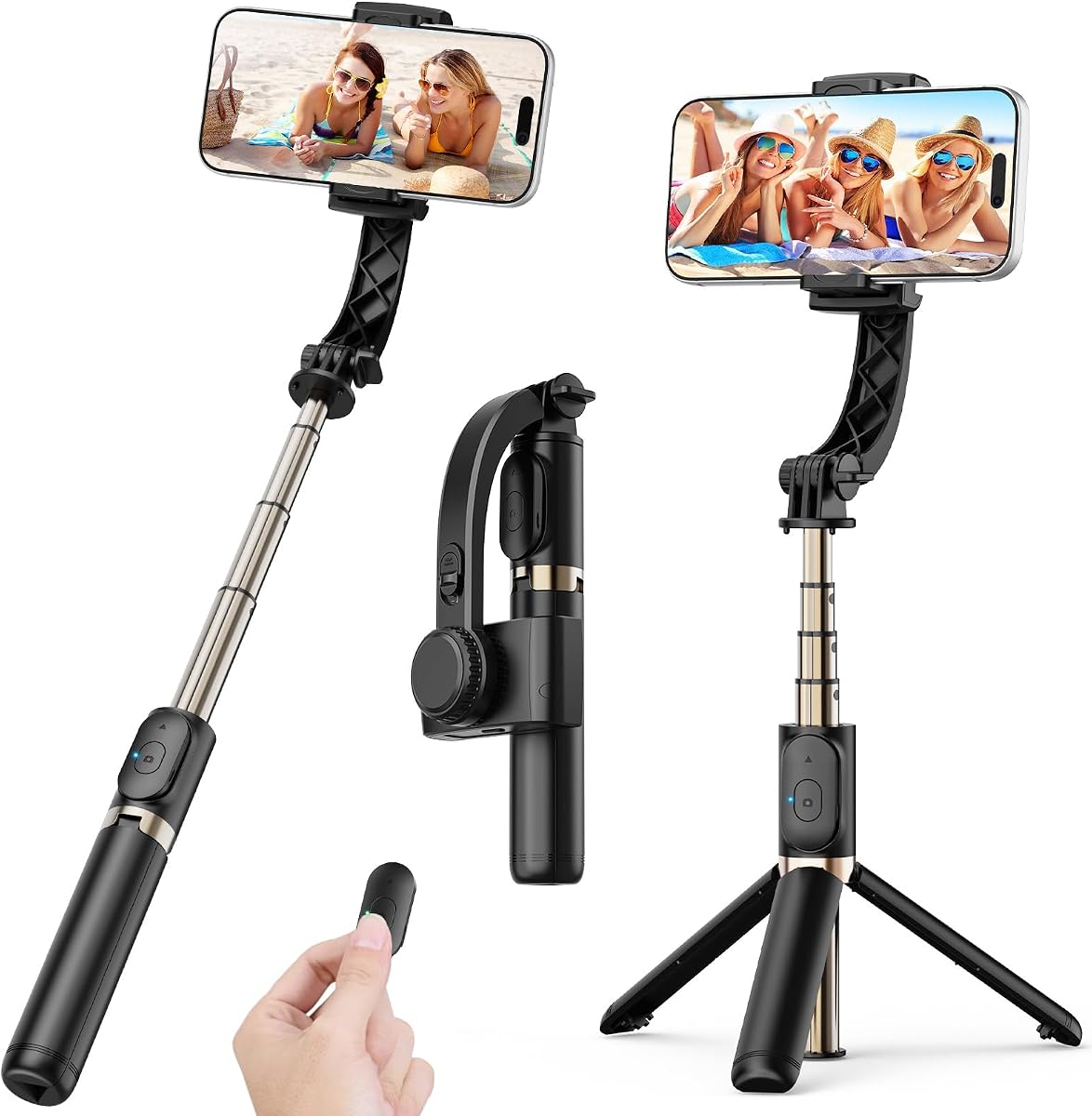
1-Axis Gimbal Stabilizer for iPhone
4.5Editor score
One-axis horizon leveling
App-free one-button operation
Folding 31.5-inch aluminum rod
Built-in tripod and remote
450mAh rechargeable battery
Smartphone for Manual Photography guide comparing stabilizers, telephoto and macro lenses, tripods, camera apps, and photography books for better shots.
Smartphone for Manual Photography is less about finding one perfect phone and more about building a controllable shooting setup. A manual-oriented workflow benefits from physical focus, stabilization, optical reach, compatible lighting, and dependable support, all of which can be added without replacing the camera already in your pocket.
This guide compares ten practical additions for photographers who want greater control over framing, exposure, focus, and movement. It covers phone stabilizers, wide-angle and macro attachments, telephoto optics, a camera-app guidebook, dedicated mirrorless equipment, and educational resources, with particular attention to compatibility and intended shooting conditions.
Each pick demonstrates a different way to improve smartphone images, from steadier handheld video to more distant wildlife photographs. Ratings and product details reflect the supplied information, while prices and availability can change, so confirm the current listing and accessory compatibility before making a final purchase.
4.5Editor score

4.1Editor score

4.0Editor score
The products below serve very different parts of a manual photography workflow, from simple stabilization and close-up optics to instruction and dedicated camera hardware. Their placement reflects the overall balance of usefulness, control, compatibility, and versatility rather than a claim that every accessory belongs in the same kit.


The 1-Axis Gimbal Stabilizer for iPhone is a straightforward way to add mechanical control to mobile video without relying on software stabilization alone. It holds a 4.5 rating and stands out for its built-in gyroscope, which automatically levels the phone as the operator pans, walks, or holds the device outward. The result is a more level horizon and fewer visibly tilted frames in ordinary family, travel, and group-video situations.
We may earn a commission when you buy through this link, at no additional cost to you.
Its operation is refreshingly simple. A one-button control switches between horizontal and vertical shooting, while the absence of a required app reduces setup friction and makes the stabilizer more useful when a spontaneous clip matters more than a complex menu. The aluminum rod extends to 31.5 inches, and the phone holder rotates through 360 degrees, allowing low, high, side, and group-shot perspectives. Opening the grip legs turns the unit into a hands-free stand for calls, tutorials, and group photographs.
The central limitation is stated clearly in the product information: this is a one-axis device, not a three-axis cinematic gimbal. It corrects side-to-side tilt but does not eliminate the up-and-down bounce generated by footsteps or running. That makes it a better fit for walking shots, family clips, and everyday recording than for action footage or situations where a full three-axis stabilizer would be necessary.
This is a compelling pick for a photographer who wants steadier phone video, flexible framing, and an integrated tripod without managing another application. It is especially useful for beginners learning how support and framing affect moving images. The included detachable Bluetooth remote reaches up to 32 feet, and the 450mAh battery provides up to two hours of use after a stated 1.5-hour charge. For everyday stabilization rather than advanced cinematic movement, it offers a useful combination of portability and function.
The built-in gyroscope handles horizontal correction automatically, so the photographer can concentrate on movement and framing rather than constantly adjusting the phone. This makes the device especially approachable for family recordings, casual travel clips, and hands-free group content.
The folding 7.5-inch form expands to 31.5 inches, while the rotating holder and integrated tripod legs provide several distinct compositions. These features help a small rig work for selfies, wide group shots, tutorials, and low-placed video.
We may earn a commission when you buy through this link, at no additional cost to you.
The Xenvo Pro Lens Kit combines a 0.45x wide-angle lens, a 15x macro lens, a rechargeable LED light, and a universal mounting clip in one travel-oriented package. Its 4.1 rating reflects a broadly practical set of features rather than a single-purpose specialist tool. For smartphone photographers who alternate between expansive travel compositions and close observations of small details, the kit provides a convenient way to change optical character without carrying several separate products.
We may earn a commission when you buy through this link, at no additional cost to you.
The TruView wide-angle attachment is described as capturing 45% more of the scene, making it useful for landscapes, architecture, group selfies, and crowded travel environments. Its multi-element coated glass is designed to reduce ghosting, reflections, flare, and dark corners. The Clarus macro attachment shifts attention in the opposite direction, magnifying nearby subjects for flowers, textures, and small objects. The included TruGrip clip improves grip while an attachment is in use, which is important because close-up work places the lens and phone close to the subject.
The GlowClip fill light is another meaningful addition. It offers three brightness levels and provides warm, continuous illumination that can be gentler than a phone's built-in flash. That makes it useful in restaurants, shops, dim rooms, and other places where a sudden burst of direct light would be harsh. A quick-release lanyard keeps the accessories accessible, while the supplied case protects the lenses and small components during travel.
This kit is best for photographers who want to work closer and wider with their phone rather than extend dramatically toward distant subjects. The macro lens is specifically intended for subjects about half an inch away, not for zooming toward faraway objects. Users should also confirm that the clip clears their phone case and that the lens is aligned with the intended camera. When those conditions are met, the package offers an unusually balanced combination of framing, lighting, portability, and attachment storage.
The wide-angle lens broadens the scene for architecture, landscapes, and group photographs, while the macro lens reveals detail in nearby subjects. Together they let a photographer move between expansive environmental images and intimate close-ups with a small, coordinated kit.
The rechargeable GlowClip provides warm continuous illumination at three brightness levels. It is particularly useful in darker venues where a direct phone flash can create an unnatural result, and the adjustable output gives the photographer some control over intensity.
We may earn a commission when you buy through this link, at no additional cost to you.
The MIAO LAB 28X Telephoto Lens offers the strongest supplied rating in this group at 5.0. It is designed to make distant everyday subjects more accessible without the extremely narrow field of view associated with many higher-power phone telescopes. That wider framing is a practical advantage for beginners because birds, boats, landmarks, and sports participants are easier to locate and keep within the frame before the focus ring is adjusted.
We may earn a commission when you buy through this link, at no additional cost to you.
This accessory is intended for relatively stable outdoor subjects at approximately 49 to 262 feet, or 15 to 80 meters. Its manual focus ring provides a more deliberate alternative to depending entirely on automatic phone focus. The aluminum body also functions as a handheld monocular, giving the user a way to inspect a scene before committing to a photograph. The design therefore supports both image capture and field observation.
Edge darkening can vary because phone sensors, camera layouts, and automatic lens switching differ between models. The supplied guidance recommends centering the attachment over the main 1x camera, removing a thick case when necessary, and disabling automatic macro or lens switching when the phone permits it. At 28x magnification, even slight hand movement becomes visible, so bracing the arms or adding a tripod is important for crisp photographs and video. The recommended tripod is sold separately.
The lens is best for a smartphone photographer who wants dedicated optical reach for sports, wildlife, boats, and travel landmarks but values a more natural view than an extremely narrow telescope. It is not the right tool for close subjects that require macro focus, nor is it a replacement for stabilization in fast-moving situations. For a stationary subject, however, the combination of manual focus, a wider 28x field, and monocular use makes it a focused and versatile tool.
The 28x design is wider than many high-power phone telescopes, reducing the difficulty of locating a distant subject. That makes it more suitable for beginners and casual nature observers who want meaningful magnification without an extremely restrictive view.
Turning the focus ring slowly lets the photographer lock onto a distant subject before the decisive moment. Because magnification exposes small hand movements, using a stable support or tripod is the more reliable route to crisp results.
We may earn a commission when you buy through this link, at no additional cost to you.
The Blackmagic Camera App Complete Guide is a 4.5-rated instructional resource for filmmakers, YouTubers, and content creators who want to extract more control from a smartphone production app. Unlike a physical stabilizer or lens, it does not alter the camera's optics or mechanical support. Instead, it teaches the operator how to navigate the app's professional interface and make deliberate decisions about recording.
We may earn a commission when you buy through this link, at no additional cost to you.
The guide breaks down the head-up display, interface colors, ISO, shutter angle, and white balance. It also covers manual focus pulls, histograms, zebras, and false-color monitoring, helping creators recognize focus or exposure problems before they become obvious in the final edit. These are important concepts for anyone moving beyond fully automatic phone operation, where the camera makes most decisions without clear visual feedback.
More advanced sections cover Apple ProRes, ProRes RAW, and Apple Log, as well as recording directly to external SSDs, anamorphic lens workflows, de-squeeze, and collaboration through Blackmagic Cloud. It also addresses multi-camera synchronization with Remote Camera Control and direct streaming to YouTube or Twitch. That breadth makes the book a roadmap for a full production process rather than a short tutorial focused on one screen.
This resource is best for a creator whose phone supports the required app features and who is ready to learn the vocabulary of professional video. It cannot make an incompatible phone capable of those workflows, and it does not replace a physical camera for every type of shoot. Even so, it offers a structured route toward manual exposure, focus, monitoring, and codec control. It is particularly valuable for users who want to understand why each setting changes the look of recorded footage.
A professional camera app can place important controls and monitoring tools in unfamiliar locations. The guide's structured walkthrough makes it easier to find those functions, understand their color coding, and adjust settings with greater speed during a production.
Histograms, zebras, and false-color views reveal exposure and focus issues that may not be obvious on the phone screen. Learning to read those tools helps a creator catch problems while recording rather than after the footage has already been captured.
We may earn a commission when you buy through this link, at no additional cost to you.
The OM SYSTEM Pen Body is not a phone accessory, but it serves an important role in this comparison: it represents the most direct path to dedicated manual photography. The compact 393-gram body provides a viewfinder, shutter button, dials, interchangeable lenses, and in-body image stabilization, recreating the physical shooting experience many photographers want when they move beyond a touchscreen phone.
We may earn a commission when you buy through this link, at no additional cost to you.
Its control layout gives the photographer direct access to exposure-related settings without searching through a touchscreen menu. Color, monochrome, and CP-button controls support distinctive in-camera looks, while interchangeable lenses allow the shooting system to be matched to a particular creative need. The body is designed for everyday photography and travel, where its compact weight can be easier to carry than a larger camera system.
Image stabilization supports steadier handheld work, and AI Human and Pet Detection AF is intended to reduce the need to reacquire moving subjects. That assistance can be particularly useful in family, pet, and spontaneous travel photography. It does not remove the value of understanding focus, exposure, and composition, but it can help a photographer keep attention on the moment while the camera handles some subject tracking.
This is the pick for someone ready to use a dedicated camera for manual photography rather than extend a phone setup. The supplied listing provides no numerical customer rating, so there is no score to weigh here. Buyers should also recognize that the body is only part of a camera system and may need an appropriate lens. Its advantage is tactile operation, physical controls, stabilization, and optical flexibility in a compact format designed for carrying on trips.
A viewfinder, shutter button, and dials support a direct relationship between the photographer's hands and the camera. Physical operation can be especially satisfying for users who want deliberate exposure changes without navigating a phone's small touchscreen.
At 393 grams, the body is positioned for everyday travel rather than a bulky studio setup. Its weather-sealed construction and image stabilization also make it appealing for photographers who want a compact camera that can accompany them on varied outings.
We may earn a commission when you buy through this link, at no additional cost to you.
National Geographic Photo Basics is an educational book for digital camera and smartphone users who want to understand the principles behind stronger images. With a 4.8 rating, it is the highest-rated educational resource in this group. Written by photographer and Photo Ark founder Joel Sartore, it covers focus, exposure, composition, lighting, editing, archiving, F-stops, and the choice of camera and gear.
We may earn a commission when you buy through this link, at no additional cost to you.
The value of the book lies in transferable skills. A lens does not automatically produce a better photograph if the operator cannot isolate a subject, recognize attractive light, or build a balanced composition. By applying the same core ideas to family, pet, travel, nature, and street photography, the guide helps a smartphone photographer diagnose why a frame works and why another version feels weak.
The material is supported by examples from Sartore's own work, behind-the-lens stories, pro tips, and quick assignments. Targeted smartphone advice is included for readers who may never use a DSLR. Assignments are particularly useful because photography knowledge improves through deliberate repetition: the reader can practice focus placement, exposure choices, and framing instead of merely reading about them.
This is the strongest choice for a beginner who wants a broad foundation before investing in more specialized hardware. It includes no lenses, stands, or other equipment, so it is an addition to a kit rather than a piece of hardware in it. For a photographer who already understands the basics, the book may feel less urgent, but it remains a practical reference covering everyday genres, infrared, astrophotography, and the core discipline of seeing a photograph before pressing the shutter.
Composition, light, focus, and exposure influence every camera system. Building those skills first prevents accessory ownership from being mistaken for photographic progress and helps the reader use even a basic phone more deliberately.
Short practical exercises encourage active learning rather than passive reading. Applying a single concept to family, travel, nature, or street photographs also makes it easier to recognize which techniques transfer between shooting situations.
We may earn a commission when you buy through this link, at no additional cost to you.
The Zeadio Camera Smartphone Handheld Stabilizer is built for creators who want a flexible physical rig rather than a single-purpose selfie stick. It carries a 4.4 rating and includes two side handles plus a removable handle, allowing the operator to change the grip arrangement for different movements and angles. The mounting system uses the standard 1/4-20 thread, which expands the potential equipment combinations considerably.
We may earn a commission when you buy through this link, at no additional cost to you.
A smartphone video rig is included, and the handles can also support cameras, camcorders, action cameras, and DSLRs that accept the relevant threaded connection. The triple cold-shoe arrangement is especially useful for accessories such as video lights, flashes, LED lights, and microphones. That flexibility lets a creator bring lighting and sound into one coherent setup instead of balancing several independent accessories by hand.
The product information identifies the rig as useful for activities including skateboarding, rollerblading, motor racing, biking, surfing, snowboarding, and skiing. Low-angle moving shots are another stated use. A removable wireless shutter adds basic remote control for compatible smartphones, helping frame shots without touching the device. However, this is a mechanical support system rather than a motorized or automatic leveling unit, so its effectiveness depends on how the photographer moves and balances the mounted equipment.
This stabilizer is best for mobile filmmakers or action-camera users who need a modular grip and accessory mounting points. The broad camera compatibility is useful for people whose equipment changes from one project to another. It is less appropriate for a photographer seeking automatic horizon correction or a motorized smooth pan. Within its intended category, however, it offers a practical way to assemble a more complete shooting rig around a phone, camera, or action camera.
Removable side and bottom handles let the photographer change grip positions for a low angle, a conventional hold, or a movement-oriented setup. That flexibility is useful when one rigid selfie-stick format cannot handle every composition.
Three cold-shoe mounts provide locations for lights, flashes, LED panels, and microphones. Combining those accessories on one handle can simplify a more professional mobile video setup and keep essential controls closer at hand.
We may earn a commission when you buy through this link, at no additional cost to you.
The APEXEL 4-in-1 Phone Photography Kit is a broad experimentation kit with an 18x telephoto lens, a 198-degree fisheye lens, a 15x macro lens, and a 0.63x wide-angle lens. It also includes a flexible tripod, phone holder, lens clip, eyecup, cleaning cloth, and zipped case. Its 3.3 rating is the lowest among the ten products, so it is best approached as a value-oriented collection of effects rather than a set of specialist optics.
We may earn a commission when you buy through this link, at no additional cost to you.
The telephoto can magnify distant subjects, the fisheye creates a rounded and deliberately distorted result, the macro attachment is intended for flowers, insects, and other small objects, and the wide-angle expands the visible field. The supplied information describes the wide-angle as producing broad perspectives with virtually no distortion, although the fisheye intentionally creates a very different visual character. Keeping those functions distinct helps a photographer choose an effect rather than expecting every lens to serve the same purpose.
Compatibility is a strength because the clip's lens screw ring can slide to locate the main camera on models with multiple cameras. The kit is listed for iPhone, Samsung, Google Pixel, and other smartphones. The wide-angle and macro lenses arrive screwed together, so the user must unscrew the wide lens to use the macro attachment. Two clips are included for the different lens groups, and the eyecup allows the telephoto to function as a monocular.
This kit is best for a creative smartphone photographer who wants to experiment with wide, close, distant, and distorted imagery in one package. The flexible tripod adds a basic support option and can reduce blur caused by shaky hands or wind. Users should keep the many threaded components organized and clean the phone lens before shooting, as the included cloth is intended for that routine maintenance. It offers creative range, but a photographer needing one highly specialized capability may prefer a dedicated product.
Wide, close, distant, and fisheye perspectives provide a useful way to explore different visual styles. The included holder, clips, case, and cloth keep the collection ready to carry and reduce the chance of losing small components.
The wide-angle and macro lenses arrive attached, while separate clips serve the other lens groups. Learning that changeover prevents confusion at the moment of shooting and makes it quicker to move from a broad view to a close detail.
We may earn a commission when you buy through this link, at no additional cost to you.
The MIAO LAB 28X HD Telephoto Lens is a compact optical accessory for bringing distant subjects closer to a smartphone. Its 3.9 rating places it below the more highly rated MIAO LAB 28x model, but its design priorities are clear: a wider field of view, easier framing, reduced edge darkening, and straightforward use for sports, concerts, wildlife, and travel.
We may earn a commission when you buy through this link, at no additional cost to you.
The product is described as having a wider field of view than most 28x lenses, which reduces the challenge of finding a target. A field-of-view ring and revised light path are intended to improve light intake and limit dark corners, though results can vary with the phone model. High-resolution glass and a durable, lightweight housing make it suitable for portable outdoor use, and the aluminum-style body also supports use as a monocular for birdwatching, wildlife observation, and scenery.
Compatibility extends across iPhone, Samsung, Huawei, Xiaomi, OPPO, Vivo, and most other smartphones. The universal clip secures the optic over the camera, but users still need to align it carefully and may need to remove a thick case. Magnification magnifies movement as well as subject detail, so a stable hold or support is valuable when trying to obtain crisp photos and video.
The lens is best for a photographer who wants a 28x viewing option with an emphasis on finding and framing distant subjects. It may appeal to concertgoers, sports spectators, and casual nature observers who do not need the included tripod and other equipment offered by a larger telephoto kit. The trade-off is a lower supplied rating and fewer details about physical focus and filtering. For a portable, fixed 28x accessory, it remains a focused tool for bringing the outside world closer.
A wider field of view gives the operator more room to locate birds, performers, athletes, or distant scenery. That makes the 28x magnification more approachable than an extremely narrow telephoto design that can be difficult to aim.
The stated field-of-view ring and light-path design are intended to reduce edge darkening and improve light intake. Phone camera placement still affects the final image, so centering the attachment over the correct lens remains an important setup step.
We may earn a commission when you buy through this link, at no additional cost to you.
The MIAO LAB 20-60X Zoom Telephoto Lens is the most comprehensive long-range kit in this comparison. Its 4.0 rating is supported by a broad feature set: a 20-60x magnification range, a 13-element, 10-group optical design, an included tripod, an eyecup, a universal adjustable clamp, and a 58mm filter thread. It is built for photographers who want manual control over both focal length and focus rather than a single fixed telephoto view.
We may earn a commission when you buy through this link, at no additional cost to you.
Rotating the focus ring adjusts the focal length from a wider view at 20x to a detailed perspective at 60x. The stated equivalent focal length spans 480mm to 1440mm. Multilayer coatings are intended to reduce ghosting, reflections, and flare, while the optical specification lists at least 99% light transmittance, approximately 95% reflectance, and approximately 3% distortion. A 45mm objective supports light gathering, and the filter thread allows UV, variable neutral-density, circular polarizer, star, and other specialty filters.
The included tripod is a substantial part of the package. Its four-section legs extend from 34 to 88 centimeters, triple anti-slip locks support a stated 3-kilogram capacity, and a smooth 360-degree pan-tilt head provides a standard 1/4-20 mount. That stability is especially important at high magnification, where a small movement can be obvious in the final frame. The universal clamp has a locking knob and an adjustable range of 7 to 10 centimeters, while the eyecup converts the lens into a monocular.
This is the pick for a serious mobile photographer who wants one long-range system capable of wildlife, sports, concert, fishing, hiking, golf, camping, moon watching, and stargazing. It requires careful camera alignment, and its size makes it less convenient for casual pocket use than a small clip-on telephoto. It is also excluded from some older iPhone models according to the supplied compatibility information. For a photographer who values range, manual adjustment, filters, and dedicated support, however, it offers the most complete package.
The 20-60x range lets the photographer start with a wider view to locate a subject and then increase magnification for detail. That flexibility makes one accessory more useful across changing distances than a fixed-power telephoto.
The included four-section tripod, anti-slip locks, and pan-tilt head provide a stable base for settings where small hand movements would be magnified. The head also allows controlled repositioning when tracking a distant subject.
The standard 58mm filter thread accepts common visual and exposure filters. Circular polarizers, variable neutral-density filters, and star filters can help manage reflections, exposure range, and point-light appearance in specific conditions.
We may earn a commission when you buy through this link, at no additional cost to you.
The right choice depends on the part of the shooting process that needs more control. Consider the subjects, movement, lighting, and portability before comparing stabilizers, lenses, tripods, apps, cameras, and instruction.
A manual photography setup can fail if every component is expected to solve the same problem. Stabilizers reduce movement, telephoto lenses bring distant subjects closer, macro lenses reveal small nearby details, and fill lights add controllable illumination. A book or app guide develops technique but changes no hardware. Start with the result you cannot currently achieve, such as steadier walking video, distant wildlife, close-up texture, or accurate manual exposure, and match the product category to that gap.
Buy for a specific limitation, not simply because a category sounds advanced. Prioritize the capability that appears most often in your intended images. A modular stabilizer is more valuable to an action creator, while a 20-60x telephoto system is better suited to a patient nature photographer.
Clip-on optics must sit over the intended lens without covering adjacent cameras, sensors, microphones, or flash elements. Phone models place their main cameras differently, and thick cases can alter alignment. Some products include a sliding ring for this reason. Check whether the attachment is designed for the phone's 1x camera and whether the phone's automatic lens or macro switching could interrupt the manual setup. The MIAO LAB products specifically recommend identifying and centering the main camera.
Alignment determines whether you receive a clear image or dark edges and unexpected changes. If a case prevents a flush fit, removing it is often simpler than forcing the clip. Treat exact camera placement as part of the purchase decision rather than an adjustment to solve later.
A one-axis stabilizer primarily corrects side-to-side tilt and is appropriate for ordinary walking, family video, and static framing. It does not remove the vertical bounce of running. A modular handheld grip provides physical support and accessory mounting but does not automatically level the frame. A tripod is essential for high-magnification stills because minute movements become visible. For serious action video with rapid multidirectional movement, a full three-axis gimbal would be a more appropriate category, although it is not included here.
Consider both the movement of the subject and the movement of the operator. A support that feels stable while standing can still be inadequate for running, skating, or cycling. Match the rig to the shot and add stability rather than assuming every stabilizer controls the same motions.
Telephoto magnification makes distant subjects larger but narrows the field of view, narrows the working distance, and exposes camera movement. A wider 28x design is easier to aim than a very narrow optic, while a 20-60x zoom provides more framing flexibility at the cost of bulk and manual complexity. Manual focus requires turning or adjusting a ring and then refining the focus while maintaining a steady position. Macro is a different mode entirely and works with nearby subjects rather than distant ones.
Choose magnification based on the distance you can realistically observe and support. If a subject cannot initially be found at high power, begin at a lower setting. A tripod is strongly recommended for long-distance stills, and the telephoto kit with an included stand offers the most integrated support.
Useful specifications include coated optical elements, light transmittance, lens diameter, filter compatibility, and resistance to flare and ghosting. These details indicate how the optic may handle contrast, reflections, and lower light. The 20-60x model includes a 45mm objective and 58mm filter thread, while the 28x products focus on a wider field and reduced edge darkening. Wide-angle and macro kits should also be judged on corner darkness, distortion, and close-focus practicality.
Read optical claims in the context of the phone. Small sensors, automatic lens switching, and imperfect alignment can change the result. A good accessory adds useful capability, but the phone's native camera still determines the underlying image quality and processing behavior.
Portability includes more than the stated weight. Consider the folded length, required accessories, case, lanyard, and whether the product can be operated one-handed. The 1-axis gimbal folds to 7.5 inches and includes a built-in tripod, while the Xenvo kit stores its components in a dedicated case. The 20-60x telephoto is more specialized and includes a full tripod, making it better suited to a deliberate shoot than spontaneous pocket photography.
Choose the amount of equipment you will genuinely carry. A compact system used often is more useful than a technically capable collection left at home. Make sure the carrying solution protects optical elements and keeps small clips, adapters, and cables together.
A professional camera app can provide manual ISO, shutter angle, white balance, focus, codecs, and monitoring, but only when the device supports them. Check the operating-system and hardware requirements before buying a guide centered on a particular app. The Blackmagic Camera App guide discusses advanced tools such as external SSD recording, Apple Log, ProRes, remote control, and streaming; those functions should not be assumed to work on every smartphone. A dedicated camera body is a separate option for users willing to leave the phone workflow entirely.
Device support is not a minor detail in a manual setup. An advanced control that the phone cannot deliver, or a workflow requiring incompatible hardware, can leave money spent without the intended benefit. Confirm the product's requirements against your own device before ordering.
Manual controls are useful only when the photographer understands what they change. Learning focus placement, shutter speed, aperture, ISO, white balance, and composition creates a foundation that works with almost any camera. Books such as National Geographic Photo Basics offer a structured introduction and assignments, while a specialized app guide can provide deeper instruction for a particular production workflow. Neither replaces practice, and no accessory can substitute for attention to the scene.
Pair every major purchase with a deliberate practice plan. Review the manual, test the attachment under the conditions you expect to use it, and record notes about focus or alignment. Better technique and more reliable operation usually produce larger improvements than adding another unused accessory.
Begin by identifying the correct camera, cleaning both the phone lens and the attachment, and mounting the accessory without blocking neighboring sensors. For clip-on lenses, slide the clip until the optic is centered over the selected 1x camera, then test the framing on a nearby subject. If the phone changes cameras automatically, disable automatic macro or lens switching where possible and verify that the attachment remains centered.
Use manual controls gradually. Establish focus first, then adjust exposure and white balance while consulting the camera's histogram or other monitoring tools. Stabilizers should be balanced rather than forced into an angle that strains the motor, and tripods should have their legs fully opened and locks engaged. At high telephoto magnification, brace the rig or use the included tripod before focusing on the distant subject.
After the shoot, switch off connected accessories, retract extendable sections, and detach optics before placing them in a case. Clean glass with the supplied soft cloth, avoid touching optical surfaces, and keep threaded adapters organized. Check the clip, tripod locks, battery contacts, and remote connection before the next outing, and recharge the stabilizer according to its stated charging guidance.
Start by learning focus, exposure, white balance, and composition in the native camera app. Use a compatible manual app or dedicated camera when greater control is needed, and add a lens, stabilizer, tripod, or light only for a specific creative requirement. Practice each control separately before combining them in a complex production.
A phone's built-in stabilization is designed mainly for recording and can still leave visible movement in difficult conditions. A physical gimbal or grip can improve framing and provide accessory mounting, but it does not automatically correct every axis. A one-axis model primarily handles tilt, while a tripod is generally better for high-magnification still photography.
No. The lens must be compatible with the phone's dimensions, case, and camera placement, and the optic must center correctly over the intended camera. Multi-camera phones may switch lenses unexpectedly, so check the manufacturer's instructions and test the result before relying on the attachment in an important shoot.
A fixed 28x lens is generally simpler and more portable, with a wider view that makes subjects easier to locate. A 20-60x lens offers more framing flexibility, larger physical specifications, filter support, and an included tripod, but it is bulkier and requires more deliberate operation. Choose based on portability versus adjustment and support needs.
A macro attachment is designed to magnify small nearby subjects, while the 15x Xenvo lens is intended to be positioned approximately half an inch from the subject. A small support and controlled light can improve sharpness. A wide-angle lens does not replace macro capability, even if both appear in the same kit.
Center the lens carefully over the correct camera and make sure the clip sits flush without obstruction. Remove a thick case if it shifts the lens away from the phone's optical axis. Disable automatic lens switching when possible, because the phone may move to another camera and leave the attachment partly over the frame.
A broad photography book is more useful when you need to understand focus, exposure, lighting, and composition across subjects. An app guide is better when you already understand the basics and want to operate one professional application. For beginners, learning the fundamentals first usually makes both hardware and software easier to use.
Powering down the phone and laying it on a clean, stable surface reduces the risk of dropping it while changing a clip or optical attachment. Keep fingers away from the glass, and do not force a lens that does not appear to thread correctly. A small protective case is useful when changing accessories away from home.
The best setup is the one that solves a specific creative need. The 1-Axis Gimbal Stabilizer is the most approachable everyday video addition, the Xenvo Pro Lens Kit provides the strongest mix of wide-angle, macro, and fill-light functions, and the MIAO LAB 20-60X Zoom Telephoto Lens offers the most complete long-range control with a tripod and filter support.
Prioritize the limitation that appears most often in your photography. Choose a stabilizer for movement, a fill light for dark scenes, a macro lens for nearby detail, or a telephoto system for distant subjects. Also prioritize correct alignment, usable manual controls, and a setup you will carry; those practical considerations matter more than accumulating attachments with overlapping functions.
Before buying, recheck the current price, availability, and exact phone compatibility, since prices and product details can change. A case, camera layout, or operating-system difference may affect the result, so the current product listing and the manufacturer's instructions should guide the final decision.
