
energeaster 10AWG 20 Feet Solar Extension Cable
4.7Editor score
Tinned copper conductors
IP67 weather protection
Self-locking solar connectors
Solar extension cable guide comparing 10 top models for wire gauge, length, weather resistance, connectors, installation needs, and reliable off-grid power.
A solar extension cable connects a photovoltaic panel to a charge controller, inverter, or another panel while adding flexibility to where the equipment can be installed. A worthwhile cable needs suitable wire gauge, dependable connectors, effective outdoor insulation, and enough length to reach without creating unnecessary excess.
The products in this guide were compared using their stated wire gauges, conductor materials, cable lengths, connector arrangements, certifications, temperature ratings, and environmental protections. The list covers general-purpose 10AWG and 12AWG options, along with short, medium, and extended runs for RVs, boats, homes, and off-grid systems.
Each review explains the product's strongest construction features, practical trade-offs, and most suitable installation. The top selections offer especially convincing combinations of connectivity, protection, and installation convenience, while pricing and availability can change, so readers should confirm current details before purchasing.
4.7Editor score

4.8Editor score

4.7Editor score
This side-by-side comparison highlights each cable's conductor, stated length, connector configuration, and most important outdoor construction features, helping readers match a cable to a particular solar installation.
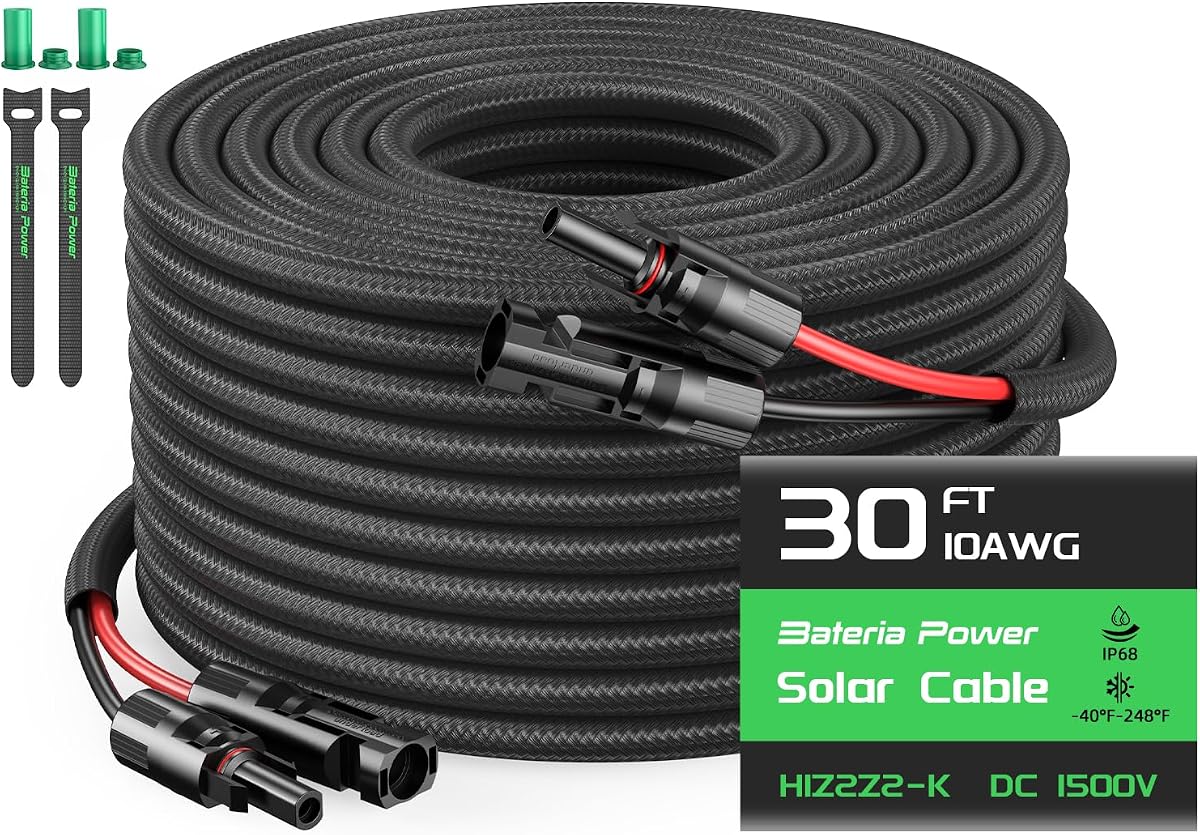


The Bateria Power 10AWG 30FT Solar Panel Extension Cable combines a useful 30-foot length with 10AWG conductors, weather-resistant insulation, and IP68 male and female connectors. Its 4.8 rating places it among the strongest products in this guide, and its distinctive protective sleeving gives it an edge in installations where the cable will be handled, coiled, or dragged regularly.
We may earn a commission when you buy through this link, at no additional cost to you.
The heavy-duty flame-retardant sleeve is especially useful for RV and portable setups because it adds an outer layer of protection around the underlying wire. The product description states that the sleeve resists abrasion, simplifies coiling, and tolerates temperatures up to 248°F. TÜV-approved XLPO insulation and jacket construction also provide flame resistance, UV protection, and an operating range from -40°F to 248°F, covering demanding outdoor environments exposed to sun, rain, or snow.
Its IP68 female and male connectors, complete with dust caps, offer a higher stated sealing level than many competing cables. The 10AWG gauge is also appropriate when minimizing power loss matters over a moderate-to-long run. The main compromise is that 30 feet may be longer than needed for a compact panel-to-controller installation, while the heavier gauge can add bulk and is unnecessary for every low-current application.
This is an excellent choice for RV owners, homeowners, and installers who want one cable to handle both outdoor resilience and frequent handling. It is particularly attractive when the cable may cross exposed areas, run through a compartment, or be repositioned. For a system with unusually short cable needs or modest current requirements, a lighter 12AWG option may be more efficient, but the Bateria Power remains the most balanced overall selection here.
The flame-retardant outer sleeve adds meaningful protection for RV, boat, and portable-system installations. It helps limit visible wear where a cable may rub against a roof rack, pass through a narrow opening, or be repeatedly coiled for storage.
The stated IP68 connector protection and included dust caps help preserve clean, secure connections. The locking connector format also supports a more dependable panel-to-controller or panel-to-inverter installation.
We may earn a commission when you buy through this link, at no additional cost to you.
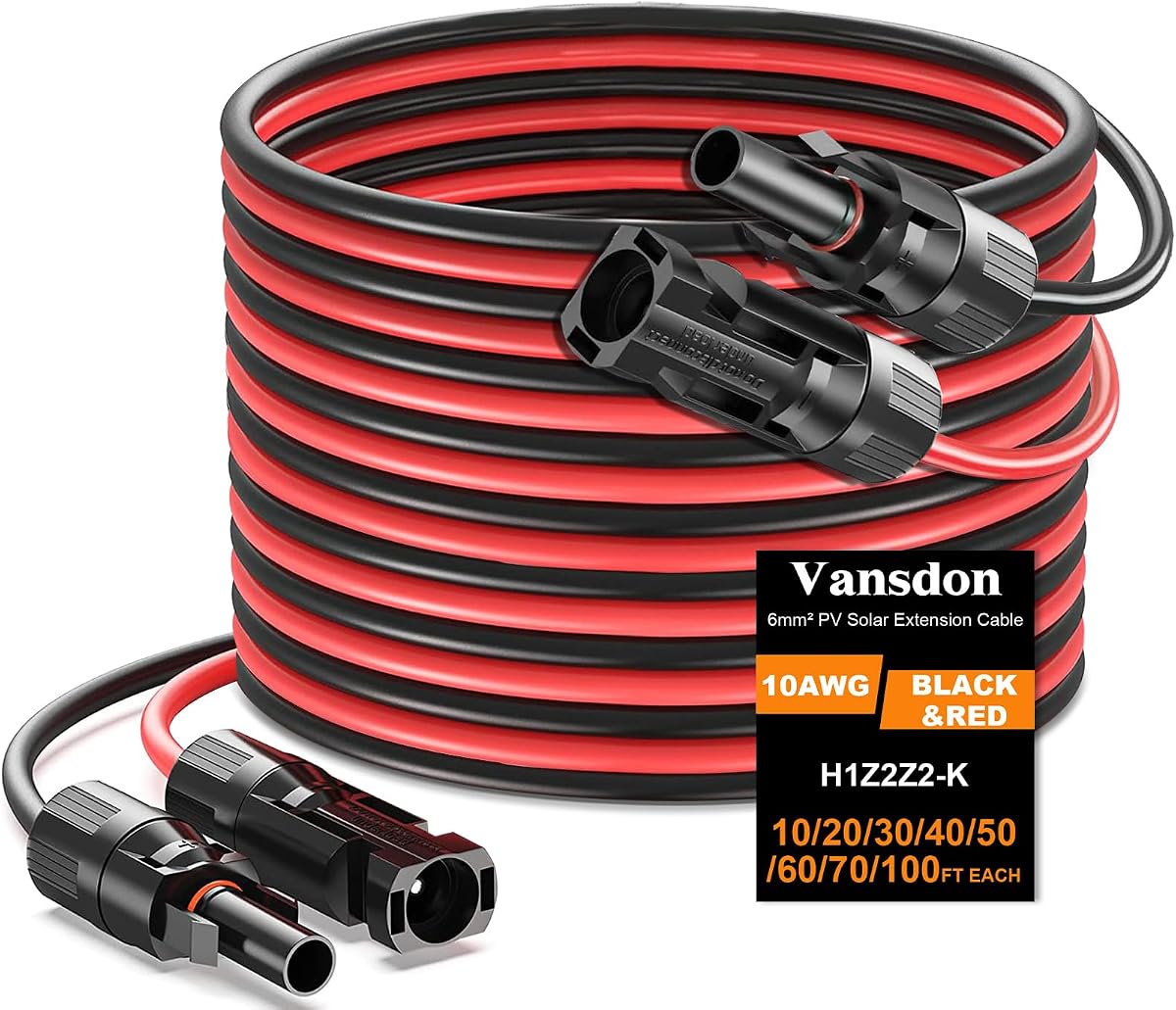
The Vansdon 2×50 Feet Solar Panel Extension Cable provides two 50-foot conductors, one black and one red, creating a lengthy 10AWG connection for distant panels. Its 4.7 rating and extensive specification details make it a strong candidate for RV installations, solar farms, remote cabins, and other systems where the distance between components is substantial.
We may earn a commission when you buy through this link, at no additional cost to you.
Tin-plated copper is used for the conductor, providing conductivity, thermal performance, and corrosion resistance while reducing potential power loss. The product is described as TÜV and CE certified, with a 6mm² cross-sectional area, a 57A rated current, UV resistance, and a tested operating range from -40°C to 90°C. The PPO flame-retardant shell is reinforced for outdoor use, and the manufacturer states that the cable can be buried directly in the ground.
The self-locking male and female connectors simplify joining runs and support extended installations. One can be attached to a panel and the other to a charge controller, with additional cables connected when more distance is required. The important trade-off is that long cable runs inherently add resistance, so users should avoid leaving unnecessary cable coiled in hot or poorly ventilated areas and should route the cable carefully to prevent damage.
This cable is best for users who genuinely need a long run and value a complete positive-and-negative set. It is less compelling when the controller sits just a few feet from the panels, because carrying 100 feet of 10AWG cable adds weight and bulk without providing a practical benefit. For a substantial off-grid or mobile installation, however, its length and low-resistance construction make it a practical choice.
Tin-plated copper and 10AWG construction help address voltage loss over longer cable routes. The substantial 57A current rating also provides useful headroom for appropriately engineered solar systems.
The installed self-locking connectors make it straightforward to link sections when a full run exceeds one cable. This is especially convenient for temporary, mobile, or expandable solar arrangements.
We may earn a commission when you buy through this link, at no additional cost to you.
The Renogy 20FT 12AWG Solar Extension Cables offer a straightforward black-and-red pair with male and female connectors already fitted to both cables. The 4.8 rating reflects a well-regarded option for creating additional distance between solar panels and a charge controller without introducing a complicated installation.
We may earn a commission when you buy through this link, at no additional cost to you.
Its defining strengths are simplicity and appropriate everyday sizing. The 12AWG conductors are lighter than 10AWG cables, making the pair easier to route, coil, and carry. The cable is described as UV resistant, waterproof, sunlight resistant, and TUV tested, while the repeated TUV logo print along the cable helps identify compliance with PV solar application standards. Hard plastic connectors add a secure physical interface at each end.
The main limitation is reach. Twenty feet may be ideal for a panel rack, portable array, or RV installation, but it cannot address a widely separated controller without another compatible cable. A 12AWG conductor also has less cross-sectional area than 10AWG, making it most appropriate for shorter runs and systems where current requirements remain within its design range. Buyers with unusually long cables should consider a thicker gauge.
The Renogy is a strong recommendation for new users because it removes much of the selection complexity. The matching connectors and identified positive and negative wires make installation approachable, while the stated outdoor protections suit a broad range of climates. It is especially well matched to compact residential, RV, and portable systems that need a modest extension between the panel and controller.
Both conductors arrive with appropriate connectors attached, reducing the need for separate parts. This makes the cable convenient for users who want a direct panel-to-controller extension without additional assembly.
The 20-foot length and 12AWG gauge offer a useful middle ground for portable panels and small installations. The lighter construction is easier to manage while retaining stated UV and water resistance.
We may earn a commission when you buy through this link, at no additional cost to you.
The BougeRV 20 Feet 10AWG Solar Extension Cable is a compact 10AWG extension that combines tinned copper, strong insulation, and tool-free connectors. With a 4.7 rating, it offers an appealing balance for RV users and residential solar builders who want thicker conductors without handling a very long cable.
We may earn a commission when you buy through this link, at no additional cost to you.
The conductor uses tin-coated pure copper to provide good electrical conductivity along with improved corrosion and oxidation resistance. Compared with lighter 14AWG and 12AWG alternatives, the 10AWG construction is intended to minimize power loss. Its XLPE dual sheath is stated to remain stable from -40°F to 194°F, and the product carries TÜV and UL certifications along with UV resistance for outdoor array use.
One particularly useful feature is the extra set of solar connectors, which can be valuable when a controller has a different input arrangement or when the installer needs to prepare a custom connection. The product description notes that one cable end has connectors installed while the other may have bare wire, so checking the exact configuration before installation is important. The male connector's built-in locking mechanism provides a secure hold, while an IP67 sealing ring helps protect against water and dust.
The BougeRV is best for users who want 10AWG performance in a manageable 20-foot run. It is particularly useful for RV panels, small off-grid systems, and installations where a lighter cable would be unnecessary but a longer run would be cumbersome. Buyers who prefer identical factory-terminated ends should verify connector placement, while others may appreciate the extra pair for a custom connection.
The additional connector pair gives installers flexibility for a second extension or a custom controller lead. It can reduce the need to source matching solar connectors separately for a straightforward project.
The 20-foot length keeps a higher-capacity conductor practical for portable systems. It offers a reasonable route between a nearby panel and controller without introducing excess cable or unnecessary handling weight.
We may earn a commission when you buy through this link, at no additional cost to you.
The energeaster 10AWG 20 Feet Solar Extension Cable is a well-rounded general-purpose lead for panel-to-controller and panel-to-inverter connections. Its 4.7 rating is supported by a clear list of construction features, including 10AWG tinned copper, dual XLPE insulation, IP67 protection, and locking connectors.
We may earn a commission when you buy through this link, at no additional cost to you.
Tin-coated copper is chosen for conductivity and resistance to oxidation and corrosion, while the 10AWG size helps reduce potential power loss over the cable run. The dual sheath is stated to handle temperatures from -40°F to 194°F, outperforming the heat limit attributed to PVC in the product information. UV, moisture, dust, and corrosion resistance make the cable suitable for regular outdoor array exposure.
The included male and female connectors use a self-locking design and are already installed at the ends. That configuration allows a fast panel-to-controller connection and makes it possible to join multiple compatible cables for a longer route. Compared with specialist extra-long or multi-connector kits, this package is intentionally focused: it provides one straightforward extension rather than a broad collection of installation accessories.
This cable suits buyers seeking a dependable middle ground between compact 12AWG leads and heavier 10AWG runs. The stated certifications and environmental specifications make it appropriate for an RV, cabin, boat, or residential installation where the controller is moderately distant from the array. Verify connector compatibility and system requirements before ordering, but for a common 20-foot extension, the feature set is notably complete.
The 10AWG tinned copper conductor supports efficient power transfer while resisting corrosion. It is a sensible middle ground for systems that need more capacity than light 12AWG wire but not a very long cable.
Dual-sheath insulation, UV resistance, and IP67 connector protection address both the cable and its termination points. This matters in outdoor installations where sunlight, moisture, and temperature changes are routine.
We may earn a commission when you buy through this link, at no additional cost to you.
The Oududianzi Solar Extension Cable 100Ft provides a complete 10AWG black-and-red cable set for large residential, commercial, mobile, or off-grid installations. Its 4.7 rating and detailed technical specifications make it the strongest premium option in this guide for projects where reaching a distant controller or array is essential.
We may earn a commission when you buy through this link, at no additional cost to you.
The tinned copper conductors are specified for low DC resistance, good conductivity, and improved corrosion and oxidation performance. The dual XLPE insulation and XLPO jacket are stated to operate from -40°F to 194°F, with UV, weather, moisture, and corrosion resistance. The product also lists TÜV, CE, RoHS, IEC 62930, and IEC 60332 standards, along with a 1500V DC rating, 1800V maximum DC voltage, 1000V AC rating, and 40A rated current.
At the termination points, an IP68 waterproof ring on the male connector helps prevent water and dust from entering. The paired male and female connectors lock together, providing a stable connection designed to reduce voltage drop and intermittent contact. Installation is tool-free: pressing the fingers on either side of the built-in lock releases or joins the connectors.
This set is ideal for a cabin, large rooftop project, boat, RV, or remote installation requiring substantial separation. Its extensive length is the decisive advantage, but it can also be excessive for compact arrays. Longer conductors increase installation complexity and may be heavier to route, so users should measure the actual distance, plan secure supports, and avoid folded coils that could create avoidable resistance or heat.
The cable provides unusually comprehensive stated electrical and environmental information, including voltage, current, resistance, temperature, and certification details. These figures help installers assess suitability before committing to a long run.
IP68 connector sealing is especially valuable where a distant panel cannot be inspected frequently. The locking interface supports a stable connection while reducing exposure to moisture and dust.
We may earn a commission when you buy through this link, at no additional cost to you.
The Solar Cable Extension 20Ft 10AWG is built around quick installation and straightforward panel positioning. Its 4.7 rating makes it a credible general-purpose option for homes, boats, RVs, and other systems that need a modest extension between a solar array and the rest of the installation.
We may earn a commission when you buy through this link, at no additional cost to you.
The cable uses 10AWG conductors with a stated 6mm² cross-sectional area, supporting efficient power transfer over a moderate run. Tool-free solar connectors can be attached or removed without special tools, while the locking design helps maintain a tight connection. The stated weather-resistant materials are intended to handle UV exposure, moisture, and changing temperatures encountered by outdoor photovoltaic wiring.
Installation flexibility is a major benefit. The extension allows the panels to be positioned where they receive suitable sunlight while the controller or inverter remains closer to other system components. Secure, stable connections are particularly helpful because poor contact can contribute to voltage drop or intermittent operation. Compatibility with many panels, inverters, and related components makes the cable broadly useful, though the buyer should still compare connector types with the system.
The primary limitation is the relatively brief 20-foot length. Its certification details are also less extensive than those provided by several other 10AWG choices in the guide. Even so, it is a sensible pick for straightforward extensions where tool-free handling and flexible positioning matter more than specialist long-distance specification data. It can suit a compact portable array or a modest permanent installation.
Tool-free connectors reduce the amount of installation work required for common panel connections. The locking mechanism also provides positive physical engagement without a separate clamp or special tool.
A 20-foot extension gives an installer more freedom to find a suitable solar exposure position. It can bridge the distance between a panel location and a controller without requiring a much heavier or longer cable.
We may earn a commission when you buy through this link, at no additional cost to you.
The Vansdon 2×30 Feet Solar Panel Extension Cable supplies one 30-foot black cable and one 30-foot red cable, creating a versatile 10AWG pair for RV and photovoltaic systems. Its 4.6 rating is slightly below the leaders, but the detailed electrical ratings and durable construction make it a well-rounded option for medium-length runs.
We may earn a commission when you buy through this link, at no additional cost to you.
Tin-plated copper is used for low resistance, conductivity, thermal performance, and oxidation resistance. The 10AWG wire corresponds to 6mm² and carries a stated 54A current rating, 1500V DC rating, and 1800V maximum DC voltage. Its XLPE and XLPO double sheath provides fire resistance, UV resistance, and protection across a stated -40°F to 194°F range. The manufacturer also states that the cable may be buried directly in the ground.
Each conductor has installed male and female connectors with a self-locking system, allowing users to connect panels to a controller or link multiple sections. This makes the cable flexible for both permanent and expandable systems. The main practical concern is matching the actual route to 60 feet of paired cable, since excess length can become cumbersome if the controller is nearby.
The Vansdon is a sensible choice for medium-sized installations that need more reach than a 20-foot extension but less bulk than a 100-foot set. It is especially relevant to RV arrays, larger portable systems, and small off-grid projects with separated components. Buyers should verify the 54A rating against their system design and ensure any buried section is routed in accordance with applicable electrical requirements.
The two 30-foot runs provide enough reach for many RV and residential arrangements while remaining easier to manage than a much longer paired set. It is a practical middle tier for installers.
The stated voltage, current, and conductor-resistance figures make it easier to compare the cable with system requirements. The 10AWG construction also provides more capacity than lighter alternatives.
We may earn a commission when you buy through this link, at no additional cost to you.
The Twin Wire 100FT Solar Extension Cable distinguishes itself with a large accessory set: six pairs of IP67 male and female solar connectors and an included wire stripper accompany the 10AWG photovoltaic wire. Its 4.7 rating makes it appealing for installers who want to customize a connection rather than rely on one preassembled configuration.
We may earn a commission when you buy through this link, at no additional cost to you.
Tinned copper forms the conductor base and is described as offering good conductivity while limiting energy loss. Weather-resistant insulation is intended to withstand UV radiation, moisture, and extreme temperatures. The product information also emphasizes appropriate cable sizing for longer distances, where thicker conductors help reduce voltage drop. That guidance is important because the 100-foot length gives the cable substantial installation flexibility.
The connector assortment provides useful options for panel, controller, inverter, or battery-bank connections. The wire stripper assists with preparing terminated cable ends, although users still need appropriate electrical knowledge and should follow applicable wiring procedures. The extra connectors are not necessary for every installation, but they make the package useful for custom projects, repairs, or multiple array branches.
This cable is best for technically confident users creating a bespoke solar lead or assembling several related connections. It may be excessive for a small installation that needs only one short extension, and custom termination introduces more responsibility than a factory-ready lead. For complex mobile, marine, or off-grid work where flexibility and connector availability matter, however, the kit is unusually complete.
The generous connector count can accommodate several branches, repairs, or future expansion. It is particularly useful when a project includes multiple solar modules, controllers, or auxiliary equipment.
The included wire stripper supports cable preparation and reduces the need for separate basic tooling. Users should still confirm conductor size and follow safe, code-appropriate termination practices.
We may earn a commission when you buy through this link, at no additional cost to you.
The GEYA 10AWG 20FT Solar Cable is a compact extension package with a 20-foot positive-and-negative set and two pairs of male and female photovoltaic connectors. Its 4.4 rating is the lowest among the products reviewed, but the detailed compliance information and generous connector package keep it relevant for off-grid, RV, and panel-to-controller connections.
We may earn a commission when you buy through this link, at no additional cost to you.
The cable is TUV approved with a stated DC 2000V rating, an environment range of -40°C to 90°C, and a 120°C maximum conductor temperature. It is also described as compliant with EN50289-4-17 and EN60068-2-78. A TCA tinned copper conductor is specified for conductivity and current-carrying capacity, while the XLPO sheath adds UV, temperature, mechanical-stress, and corrosion resistance.
Its IP67 photovoltaic connectors are designed to fit mainstream solar connector formats and suit complex outdoor environments. Two pairs provide extra options for creating more than one connection or replacing a damaged termination. The principal limitation is the 20-foot combined cable length, which is shorter than the total reach of many paired sets in this guide and may require an additional lead for a distant controller.
The GEYA is best for users who value certification details, standardized connectors, and a compact 10AWG lead for a nearby array. It is a sensible option for a small off-grid system, an RV installation, or a project requiring two connector pairs. Buyers should compare the shorter run and their equipment's exact connector format before installation, but the package offers useful flexibility for its size.
The stated TUV approval and named compliance standards provide useful documentation for system planning. The 2000V DC rating also gives installers a clear reference when evaluating suitability.
The additional connector set allows installers to prepare more than one connection or keep a spare available. This is helpful for portable systems where components may be disconnected and reconfigured.
We may earn a commission when you buy through this link, at no additional cost to you.
Choosing a solar extension cable involves matching conductor size, length, connector type, and environmental protection to the layout and operating requirements of the photovoltaic system.
Wire gauge determines how much current a cable can carry and how much resistance it contributes to the system. The products here include 10AWG and 12AWG options, with 10AWG offering a larger conductor cross-section and 12AWG providing a lighter alternative for shorter runs. A thicker cable is generally more appropriate when the panel-to-controller distance is long, the array output is higher, or voltage drop must be minimized.
Choose 10AWG for greater capacity and longer routes; choose 12AWG when the cable will be shorter, lighter handling is important, and the system load remains within the cable's design limits.
Cable length should reflect the real distance between the panel and the next component, plus enough service loop to prevent terminals from being strained. Extending a cable through sharp bends or leaving large coils in an exposed area can create installation problems. Paired products use one positive and one negative conductor, so calculate the full route for each rather than measuring only the panel's closest point.
Measure the complete path, include a little slack, and avoid excess cable that cannot be safely supported or ventilated.
Most listed cables use male and female photovoltaic connectors with a locking interface, but buyers should confirm that the connector format matches the panel, charge controller, inverter, or junction box. Some products arrive with connectors installed on both ends, while the BougeRV description notes that one end may have bare wire and includes an extra pair. Factory-terminated leads are more convenient, while extra connectors provide useful customization options.
Match the connector type, polarity, and termination layout to the equipment before ordering; do not rely solely on the product's general solar-panel wording.
Solar cables are routinely exposed to ultraviolet radiation, rain, dust, snow, and temperature changes. Look for UV-resistant insulation, a durable outer jacket, and water-resistant or waterproof connector seals. IP67 appears across many of the selections, while the Bateria Power and Oududianzi products specify IP68 connector protection. These ratings concern specific components, so the complete connection should be protected rather than relying on a rating for only one end.
Choose UV-resistant jackets and sealed, locking connectors for outdoor use, and protect any exposed terminations even when the cable itself is weather rated.
The listed cables use insulation and jacket systems such as XLPE, XLPO, PPO, and TÜV-approved materials, with stated operating ranges varying by product. These figures help distinguish cables intended for harsh seasonal conditions from general-purpose wiring. Temperature ratings are especially relevant on vehicle roofs, boats, and exposed residential arrays where conductors may heat considerably in direct sunlight.
Compare the stated operating range with the hottest and coldest conditions at the installation site, and pay attention to the conductor and jacket ratings separately when both are provided.
TÜV, UL, CE, RoHS, and IEC references provide evidence of testing or standards compliance, although their presence does not mean every product is appropriate for every system. Detailed voltage, current, resistance, and cross-sectional-area data can also help identify whether a cable is appropriately engineered for a particular installation. More transparent specifications are useful when cable performance affects system design.
Use certifications and electrical specifications as objective selection criteria, while still matching the cable to the equipment's voltage, current, and connector requirements.
Weight and flexibility matter most in RV, boat, and portable systems. Ten-gauge 100-foot sets are substantial compared with 20-foot 12AWG leads, while the Bateria Power model's protective sleeving is intended to improve coiling, abrasion resistance, and everyday handling. A rugged outer sleeve may also be useful where the cable crosses a roof, passes through a compartment, or is repeatedly assembled and disconnected.
Balance conductor capacity against cable weight for mobile systems, and consider a protective sleeve when the lead will be handled frequently or routed across exposed surfaces.
An extension cable is one component of a larger system that may include panels, junction boxes, charge controllers, inverters, batteries, and disconnects. Verify polarity, the location of the controller, system voltage, and any manufacturer-specific requirements. Extension cables should support the intended architecture rather than compensate for a poorly planned component layout or be used to bypass required protective equipment.
Design the full electrical path first, then select the cable that fits its route, load, environment, and connector requirements.
Before installation, disconnect power sources and identify the positive and negative conductors. Compare the cable's connectors with the panel and controller or inverter, then confirm that the connector format and polarity match. Route the cable along the intended support path, keeping it away from sharp edges, moving parts, hot exhaust areas, and locations where standing water can collect.
Connect the solar equipment in the sequence recommended by its manufacturer. Seat the locking connectors fully and verify that the latches engage without forcing them. If the cable includes bare ends or extra connectors, use appropriate tools and established electrical procedures to prepare the termination. Avoid twisting individual conductors together as a substitute for a proper connector or terminal.
During use and maintenance, inspect the jacket for cracking, abrasion, or pinholes, and check connectors for moisture, dirt, corrosion, or a loose locking fit. Keep connectors dry and closed when not in use, but do not route the cable in a tight bundle. Coil excess cable loosely in a ventilated location, and follow the system's periodic inspection schedule.
The correct gauge depends on cable length, system current, and acceptable voltage drop. Ten-AWG is generally the more capable choice for longer runs or higher-current arrays, while 12AWG can work well for shorter, lower-demand installations. Compare the product's stated current and voltage ratings with the panel and controller specifications before purchasing.
They may use the same type of solar connector, but they are not electrically or physically identical. A 12AWG cable has less conductor cross-section and is generally lighter, while 10AWG offers more current capacity and lower resistance. Use the gauge specified or approved for the system, especially for long cable routes.
Choose the shortest practical length that reaches from the panel to the next system component while leaving enough slack to prevent strain. A 20-foot lead suits many compact or RV installations, while 60- and 100-foot sets are more appropriate for widely separated components. Excess cable should be supported and routed rather than left tightly coiled.
These ratings describe the ingress protection of a specific enclosure or connector, usually its ability to resist dust and water. They should not automatically be treated as a rating for every part of an assembled system. Sealed connectors, properly seated locks, protected cable entries, and sound workmanship all contribute to a reliable outdoor installation.
Many products use compatible self-locking male and female connectors specifically for linking sections. Check the connector format, current rating, and system design before extending a run. Every added connection creates another potential interruption point, so secure the cable and inspect the joints during routine system maintenance.
Only use a cable if its manufacturer specifically states that it is designed for direct burial, and follow all applicable electrical requirements. The Vansdon products in this guide include direct-burial claims, but the installation should still account for soil conditions, vehicle loads, moisture, and local regulations. Other cables may require conduit or another approved protective route.
It depends on how the cable is terminated and how many connections the project requires. A preassembled pair may be sufficient for one panel-to-controller link, while extra connectors can support custom endings, additional branches, or future expansion. Confirm whether both ends are factory terminated before deciding that additional parts are necessary.
Inspect the outer jacket and connectors periodically for cracking, abrasion, corrosion, moisture, or loose locking mechanisms. Keep connector interfaces clean and protected when disconnected, and ensure the cable is supported without sharp bends or strain on the terminations. Replace a cable whose insulation or connector integrity appears compromised rather than covering the damage with tape.
The Renogy 20FT 12AWG stands out as the most practical general choice because it combines a manageable length, lightweight construction, installed connectors, and stated UV and water resistance. The energeaster 10AWG 20 Feet provides a strong budget-oriented alternative with thicker conductors, while the Oududianzi 100Ft set is the premium choice for long-distance, technically specified installations.
Prioritize wire gauge, measured route length, exact connector compatibility, and outdoor sealing before choosing a cable. A lighter 12AWG lead is often easier to manage for short runs, while 10AWG is more useful when distance, voltage drop, or current capacity is important. For mobile systems, handling weight and protective sleeving can be just as valuable as raw electrical specifications.
Finally, check the current listing for availability, included components, connector layout, and manufacturer instructions before ordering. Product details and pricing can change, and the most suitable extension cable is ultimately the one that matches the full solar system rather than simply having the longest stated reach or most connectors.