
Master Heavy Duty Utility Blower
4.7Editor score
Three-speed airflow control
Pivoting directional blower head
Built-in accessory power outlet
Squirrel cage fans for air conditioners can restore focused airflow to compatible HVAC equipment, workshop ducts, electronic enclosures, and other systems that need a compact centrifugal blower. A good match must deliver suitable air volume, fit the available space, and operate safely with the intended power source and ductwork.
We compared the ten products by examining their stated airflow, motor design, dimensions, speed controls, noise levels, mounting options, protective features, and compatibility information. The list includes AC blower wheels, inline duct fans, high-velocity utility blowers, and smaller squirrel cage blowers designed for targeted applications.
Each review explains what makes the product relevant, where it performs best, and what limitations buyers should consider. The top selections represent the strongest combinations of compatibility, capacity, and convenience, although ratings, availability, and pricing can change over time.
4.7Editor score

5.0Editor score

4.5Editor score
As an Amazon Associate we earn from qualifying purchases.
This side-by-side comparison highlights each fan's intended role, power requirements, airflow characteristics, physical design, and most important buyer consideration.


This is a lower blower wheel intended specifically for several Hisense air conditioner model numbers: AP1021TR1GD, AP1022TW1GD, and AP1022HW1GD. Its 5.0 rating is the strongest listed customer score in this guide, making it an especially relevant option when the goal is to replace a failed lower blower component rather than install an unrelated auxiliary fan.
We may earn a commission when you buy through this link, at no additional cost to you.
The defining benefit is compatibility. The listing clearly identifies the part as the lower blower wheel and lists the supported model numbers, reducing the ambiguity that can accompany universal HVAC components. Buyers also receive one off-beige blower wheel, which is important when appearance and fit need to align with the original cabinet and airflow path.
This is not a complete air conditioner blower motor, housing, control system, or installation kit. Installation instructions are explicitly not included, so the listing is most appropriate for experienced DIY owners or technicians who already understand the relevant cabinet, motor, wiring, and mounting arrangement. The absence of a motor specification also means it should not be evaluated as a standalone fan.
The final recommendation is straightforward: choose this replacement wheel if the model on the appliance label matches one of the three listed identifiers. Verify dimensions, rotation, and physical clearance before ordering, and arrange qualified assistance if the old blower must be removed or the system's electrical components must be disconnected.
A model-specific blower wheel is generally easier to reconcile with an original HVAC assembly than a generic wheel. The listed identifiers allow buyers to perform a direct cabinet-label check before purchase, which is the most important first step for any replacement component.
This product works best when the existing blower wheel is damaged while the rest of the lower assembly remains serviceable. It should not be mistaken for a complete auxiliary blower or a universal retrofit kit.
We may earn a commission when you buy through this link, at no additional cost to you.
The Master Heavy Duty Utility Blower is a portable, three-speed air mover designed for garages, basements, workshops, job sites, and general circulation tasks. It carries a 4.7 customer rating and stands out for its combination of directional control, rugged construction, and a built-in accessory outlet, even though it is not a conventional squirrel cage replacement wheel.
We may earn a commission when you buy through this link, at no additional cost to you.
Its pivoting head allows the airflow to be redirected toward floors, equipment, drying areas, or confined work zones. Three speed settings provide a practical range between quieter circulation and stronger movement. The integrated accessory outlet can support compatible auxiliary equipment, making the fan more useful than a basic single-speed air mover.
The trade-off is its physical format. This is a floor-style utility blower rather than a compact centrifugal wheel meant for an AC cabinet, narrow duct, or electronics enclosure. It may also move more air than required in a residential cooling setup, and no detailed CFM or noise figure appears in the supplied product information.
Buyers seeking a dedicated squirrel cage component should continue down the list, but this model is a strong choice for temporary cooling, ventilation, and air circulation around an air conditioner or workshop system. Its versatility, directional head, and integrated outlet make it the most complete premium utility option here.
The pivoting head is especially useful where a fixed fan position would be inefficient. Buyers can redirect the stream toward a drying surface, floor-level dust, a workbench, or a confined area without moving the entire unit each time.
The speed settings allow airflow to be matched more closely to the task. Lower settings can support routine circulation, while higher settings suit drying, ventilation, and stronger cooling where noise is less important.
We may earn a commission when you buy through this link, at no additional cost to you.
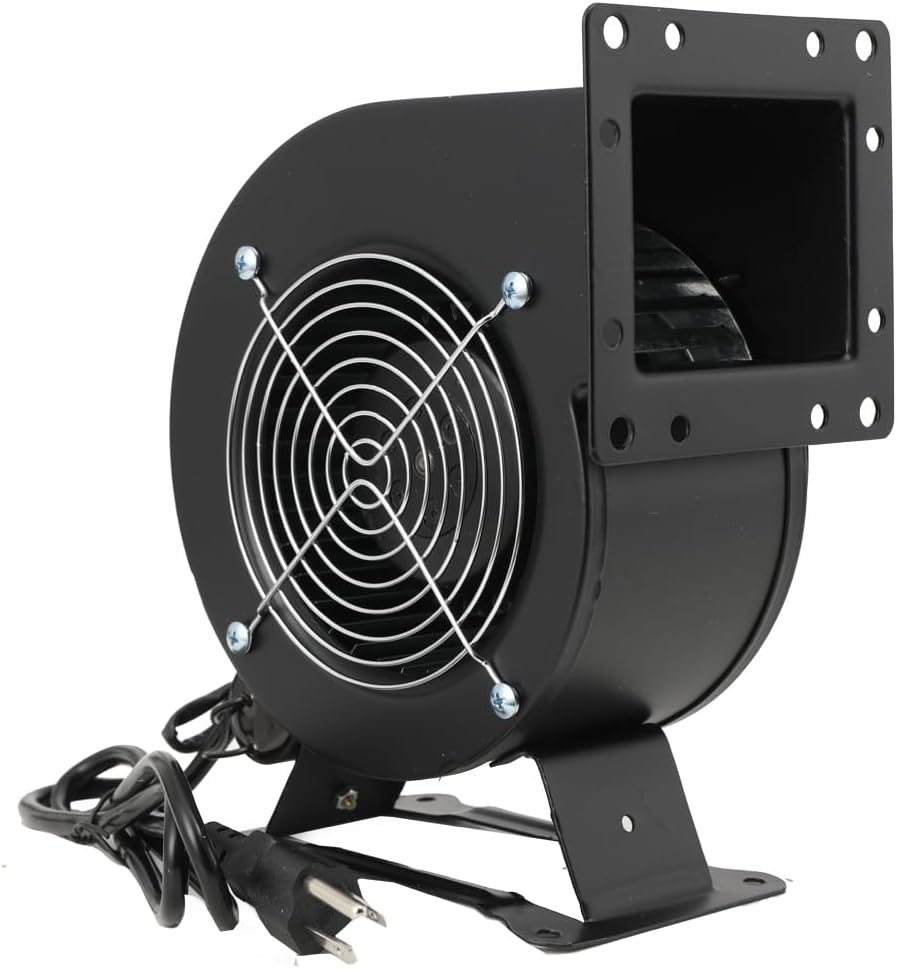
This squirrel cage blower is a 120W centrifugal unit built around a pure copper motor, 2,600 RPM speed, 196 CFM airflow, and up to 350Pa of static pressure. Its 4.4 rating and substantial specifications make it appealing for installations where moving air through resistance is more important than finding a model-specific AC component.
We may earn a commission when you buy through this link, at no additional cost to you.
Static pressure is a particularly relevant consideration for HVAC and ducted projects. The stated 350Pa rating suggests this blower can push air through restrictive pathways more effectively than a small general-purpose fan. The all-metal carbon steel shell, protective grille, and pre-drilled holes also give it a workshop-oriented construction that suits fixed installations.
It is important to distinguish this complete squirrel cage fan from a bare replacement blower wheel. Although the product description references furnace and wood boiler applications, it does not provide a specific air conditioner model list. Buyers would need to confirm physical dimensions, electrical requirements, mounting arrangement, and airflow direction independently.
This is a strong option for HVAC ventilation, electronics cooling, workshop equipment, and ductwork that requires a higher-capacity centrifugal blower. It earns the Best Budget label among the top three for its unusually substantial airflow and pressure specifications, provided it is not being purchased as a direct replacement for a specific Hisense cabinet.
The listed 350Pa capability gives this blower a meaningful advantage when air must pass through ducts, filters, or narrow outlets. Buyers should still compare their planned system resistance with the manufacturer's stated operating specification.
The carbon steel shell and metal guard support repeated service in demanding environments. Pre-drilled mounting holes simplify the process of positioning the blower in a fixed installation.
We may earn a commission when you buy through this link, at no additional cost to you.
This 120mm squirrel cage blower is designed for compact cooling, ventilation, and forced-air applications where space is limited. It provides 41 CFM of airflow, reaches a maximum of 3,000 RPM, and has a listed maximum noise level of 52 dBA. Its 4.5 rating reflects a favorable balance of useful specifications and positive customer feedback.
We may earn a commission when you buy through this link, at no additional cost to you.
The motor is rated for 12V and the included speed control accepts 100V to 240V input while offering 4V to 12V output. This makes it practical for projects with an appropriate low-voltage blower arrangement, although a buyer must ensure that the selected controller and power source are compatible with the installation.
The housing measures 173 by 120 by 32mm, making it far easier to fit inside compact equipment than a large utility blower. A finger guard and air gathering vents add protection, while dual ball bearings are stated to support up to 60,000 hours under a 25-degree ambient temperature. Actual longevity will depend on load, environment, and maintenance.
This is a better fit for electronics cooling, furnace airflow, fire-related accessories, inflatable devices, and small ventilation projects than for replacing a large room air conditioner's main blower. Its strongest attraction is the combination of compact size, adjustable speed, and dedicated centrifugal output.
At 120mm across the housing, the blower can be integrated into equipment where an axial fan would be awkward or inefficient. Its shallow depth also helps when internal clearance is limited.
The controller lets users reduce or increase output rather than operating continuously at maximum speed. This flexibility is useful for balancing airflow, noise, and energy use in a compact installation.
We may earn a commission when you buy through this link, at no additional cost to you.
This second Hisense-compatible lower blower wheel supports AP10CW2G, AP1219CR1W, AP12CR1G, and AP12CR2G model numbers. It offers another direct replacement route for owners with one of those exact systems, although the supplied listing does not include a customer rating.
We may earn a commission when you buy through this link, at no additional cost to you.
Its primary advantage is the clearly stated position within the unit. This is the lower blower wheel, not a generic fan or a complete motor assembly. The off-beige color and the listed model identifiers help buyers narrow the search to a part that closely matches the intended cabinet and airflow configuration.
As with the other replacement wheel in this guide, installation instructions are not included and the package contains one blower fan wheel. The absence of electrical details makes sense for a wheel-only component, but it also means the listing should not be treated as a complete self-contained blower package.
The recommendation is conditional but practical. If the appliance's model number matches, this is a focused repair part with no unnecessary extras. Before ordering, confirm the model's exact suffix, measure the cabinet opening, and consider whether the wheel's condition, shaft fit, and rotation arrangement align with the existing assembly.
The four compatible identifiers provide a clear first filter for shoppers. A careful comparison with the label inside the outdoor or indoor cabinet is more reliable than selecting solely by appearance.
Choosing the correct wheel can restore movement in a compatible unit without replacing the entire air conditioner. The buyer still must evaluate the motor, controls, wiring, and cabinet condition independently.
We may earn a commission when you buy through this link, at no additional cost to you.
This universal squirrel cage blower wheel measures 6.5 by 7 by 0.5 inches and is designed for counterclockwise rotation. It is one of the few products here that is explicitly a bare replacement wheel intended for a broader range of possible assemblies rather than a complete powered fan.
We may earn a commission when you buy through this link, at no additional cost to you.
The listing supplies three useful dimensional references and identifies the rotation as CCW. Those details can help a buyer compare the wheel with an existing installation, especially when the original is visibly damaged or worn. The universal format may suit replacement projects involving cabinets, ducts, or equipment that share the same dimensions.
Universal does not mean interchangeable with every squirrel cage fan. No shaft size, hub detail, material specification, balance specification, or complete fitment list appears in the supplied information. A precise match may also require checking blade clearance, airflow direction, and whether the existing motor turns in the required direction.
This wheel is best for a technically confident buyer who has removed or measured the original component and can validate all dimensions. It is less appropriate for someone seeking a ready-to-install blower, since the product contains no stated motor, controller, guard, or installation hardware.
The listed dimensions are a useful starting point, but hub geometry, shaft fit, blade depth, and cabinet clearance also matter. A replacement should be compared with the original rather than ordered on diameter alone.
A CCW wheel must be compatible with the motor and intended airflow path. Installing a wheel that turns in the wrong direction can move air backward through a duct or create unsafe operating conditions.
We may earn a commission when you buy through this link, at no additional cost to you.
The Wathai 140mm small blower fan combines a squirrel cage housing with a 7.7-foot controller cable and compatibility from 100V to 240V input. It has a 4.5 rating and is positioned for electronics cooling, ventilation, heat circulation, and several furnace or fire-related applications.
We may earn a commission when you buy through this link, at no additional cost to you.
Its 140 by 135 by 40mm size makes it slightly larger than the 120mm compact blower but still appropriate for equipment enclosures and other confined installations. Dual ball bearings are listed as having a 50,000-hour lifespan, while the included mounting hardware and variable speed control simplify setup.
The product information does not provide a specific CFM rating, maximum RPM figure, or noise level, making direct comparison with more fully specified blowers difficult. It is also a complete small blower rather than a replacement wheel, so it should not be selected simply because an air conditioner contains a similarly shaped wheel.
This model makes sense for DIY builders needing a small centrifugal fan with broad input compatibility and adjustable output. It is particularly relevant for cooling electronics, moving warm air in a workshop, or supporting ventilation where a 140mm housing and controller lead fit the available space.
The stated 100V to 240V input range can simplify sharing equipment between different workshop power systems. Users should still follow the controller and fan instructions and confirm the local supply is within the specified range.
The small centrifugal format is useful where exhaust openings are limited or where airflow must be directed through a narrow outlet. Its controller helps users tune output to the enclosure's actual heat load.
We may earn a commission when you buy through this link, at no additional cost to you.
This variable-speed centrifugal blower is built around a 3V to 12V output range and an independent rotary speed regulator. Its 4.1 rating places it below several alternatives, but the stepless control and integrated stainless steel outlet tube distinguish it for combustion and forced-draft projects.
We may earn a commission when you buy through this link, at no additional cost to you.
The metal duct is described as high-temperature resistant and rust resistant, allowing the outlet to connect to a wood stove, fire pit, forge, grill, or furnace air inlet. The housing uses hard plastic, while a thickened metal grille helps keep foreign objects away from the impeller. A U.S. plug power adapter is included for household AC supply.
The product is not positioned as an air conditioner replacement component, and the listing provides no CFM, RPM, or noise specifications. That makes it difficult to compare quantitatively with the 196 CFM blower or the 265 CFM inline duct fan. It is also a forced-draft device, so its suitability depends on the specific accessory port and combustion setup.
The best use is a controlled, compact auxiliary airflow source for fire-related equipment or a DIY forced-air system. It is less suitable for a conventional room air conditioner unless the buyer has independently confirmed airflow, electrical, and safety requirements for that application.
Stepless adjustment can be useful when a fire or furnace needs a low, steady stream at one moment and a stronger stream for ignition at another. The wider control range offers more flexibility than a simple on/off blower.
The stainless steel tube is intended to withstand a heat-exposed connection and resist rust. It should be fitted only where its temperature rating, diameter, and attachment method match the equipment being served.
We may earn a commission when you buy through this link, at no additional cost to you.
The Air King 9020 is an industrial-grade, 20-inch wall-mount fan with a stated maximum airflow of 3,670 CFM. Its 4.2 rating and one-sixth horsepower motor make it the highest-capacity airflow product in this guide, though it operates on a very different principle from a squirrel cage blower.
We may earn a commission when you buy through this link, at no additional cost to you.
The powder-coated metal blade, three-speed 120V motor, rear pull-cord switch, and nine-foot power cord support dependable facility use. The totally enclosed ball bearing motor is designed to reduce routine motor maintenance, while the wall-mounted format saves floor space in workshops, garages, warehouses, or commercial areas.
At 20 inches, the fan requires considerably more space than the compact blowers and replacement wheels listed here. Its maximum sound level of 62 dB is substantial, and axial airflow does not provide the same pressure characteristics as a centrifugal squirrel cage fan. It is therefore not a direct substitute for a damaged AC blower wheel.
This model is worth considering when the requirement is moving a very large volume of air across an open area rather than forcing air through a narrow duct. For ventilation, temporary cooling, and large workshop circulation, its stated capacity is impressive, but the mounting structure and noise need to be evaluated first.
The stated 3,670 CFM output is suited to moving air through broad, open spaces where resistance is low. It can create useful circulation in a large workshop or garage when positioned and directed carefully.
Mounting the fan above floor level keeps work areas open and can improve airflow distribution. Installation must account for the fan's size, vibration control, electrical supply, and safe clearance from people and objects.
We may earn a commission when you buy through this link, at no additional cost to you.
The AC Infinity RAXIAL S6 is a six-inch inline duct fan intended to increase airflow in HVAC systems and ventilate spaces such as attics and workshops. It combines 265 CFM airflow with a relatively low listed noise level of 35 dBA and a variable fan speed controller.
We may earn a commission when you buy through this link, at no additional cost to you.
Its unibody die-cast construction uses no welded seams, which helps reduce vibration and supports smoother airflow. An AC brushless motor, steel blades, and dual ball bearings are listed as core components. The speed controller allows users to balance increased airflow against operating noise for a particular installation.
The product includes a clear limitation: it is not suitable in restricted airflow applications. That warning matters because an undersized duct, tight bend, filter, or blocked outlet can increase system resistance and reduce performance. It is also an axial inline fan, so it should not be confused with a squirrel cage blower wheel or a high-static-pressure centrifugal unit.
This is an excellent choice for increasing airflow along an accessible six-inch duct run in an HVAC or ventilation system. It is less relevant to direct AC cabinet repairs, but highly useful when the goal is to improve air delivery through an existing duct where adequate clearance is available.
The listed 35 dBA noise level makes this fan attractive for occupied spaces where a conventional industrial blower would be intrusive. Variable speed control provides further opportunities to reduce sound during lighter demand.
Because the manufacturer excludes restricted airflow applications, every bend, filter, transition, and outlet should be reviewed before installation. A straight, adequately sized duct path is essential to achieving the rated performance.
We may earn a commission when you buy through this link, at no additional cost to you.
The right blower depends on whether you need an exact replacement component, a compact auxiliary fan, or a high-capacity duct booster. Compatibility, airflow pressure, electrical requirements, and installation clearance should be evaluated before appearance or general fan features.
For a replacement blower wheel, compatibility begins with the complete model number printed on the air conditioner's cabinet. The first product in this guide fits three named Hisense models, while the fifth fits four different identifiers. Do not rely on cabinet color, wheel diameter, or an informal description such as universal without checking the required dimensions and rotation. A visually similar wheel can have a different hub, shaft fit, depth, or airflow direction.
Centrifugal squirrel cage blowers generate pressure and are well suited to narrow ducts, furnace-related airflow, electronics cooling, and forced-air applications. Axial fans move large volumes of air through open spaces and straight ducts but generally handle restricted airflow less effectively. A bare wheel is only one part of an assembly, while a complete blower includes a motor and may include a controller or housing.
An airflow figure alone does not show how a blower will perform in a real system. Static pressure indicates the fan's ability to push air through filters, ducts, bends, and outlets. This guide includes one product with a 196 CFM rating and 350Pa of static pressure, as well as compact and axial alternatives with different performance profiles. Match the fan's curve to the duct's resistance rather than comparing CFM figures alone.
Power specifications range from low-voltage DC output to universal AC input. Some products include a variable controller, while others use a simple pull-cord switch or fixed speed. Confirm the plug type, input voltage, output current, controller requirements, and whether the installation needs a grounded outlet. A low-voltage blower still requires a suitable power supply even when its controller accepts household AC input.
Squirrel cage blowers need enough room for the housing, intake grille, outlet connection, wiring, and protective clearance. The compact products measure approximately 120mm or 140mm across, while the 20-inch Air King model requires a wall or similar mounting structure. For a replacement wheel, measure the old unit and check shaft, hub, depth, and clearance rather than considering only the listed diameter.
Noise ranges from a listed 35 dBA for the inline booster to 52 dBA for the 120mm blower and 62 dBA maximum for the industrial wall fan. Lower noise can matter near bedrooms, offices, or occupied work areas, while louder equipment may be acceptable in a garage. Also consider temperature, dust, moisture, and airflow restrictions; the 120W metal-shell blower carries an IP54 protection rating.
A finger guard, metal protection grille, enclosed motor, and properly grounded housing all help reduce operating risks. Some compact products include mounting hardware, while the bare replacement wheels do not. Installation instructions are not included with the Hisense wheels, so buyers should be comfortable with HVAC component handling or use a qualified technician.
A blower wheel is not the same as a complete fan. The two Hisense products and the universal wheel each provide one wheel, while complete blowers may include a motor, controller, cable, duct, grille, or mounting hardware. Reviewing the contents prevents a buyer from expecting a motor, power supply, or installation kit that is not included.
Begin by identifying whether the product is a replacement wheel or a complete blower. For a wheel, disconnect power according to the appliance manufacturer's instructions, photograph the original assembly, record its rotation and orientation, and confirm the part number before removal. For a new blower, check voltage, controller output, mounting space, duct diameter, and intended direction of airflow before installation.
Mount the unit on a stable, vibration-resistant surface and maintain clearance around the intake grille and outlet. Connect only the specified power source, keep electrical connections dry, and use a grounded outlet where applicable. When attaching ductwork, avoid kinks and compression that could restrict airflow. For combustion-related equipment, follow both the blower manufacturer's instructions and the appliance's ventilation requirements.
During operation, listen for rubbing, vibration, unusual noise, or changes in airflow. Inspect guards and connections periodically, remove accumulated dust when the power is disconnected, and never allow water to enter the motor. A replacement wheel should be checked for correct rotation and balanced operation. If airflow drops, the housing overheats, the breaker trips, or the blower does not start, stop using it and inspect the power supply, connections, duct restrictions, and compatible components.
No. A replacement wheel must match the appliance's model requirements, dimensions, hub or shaft arrangement, rotation, and airflow design. The two Hisense wheels are intended only for their listed model numbers, while the universal wheel still requires careful comparison with the original. Never assume that similar appearance or diameter proves compatibility.
A centrifugal squirrel cage fan pulls air into its wheel and directs it outward at higher pressure, making it effective for ducts and narrow outlets. An axial fan moves air along the fan's axis and can produce high volume across open areas or straight ducts. The right choice depends on the available space, duct resistance, airflow direction, and noise requirements.
It can be suitable when the device is specifically compatible with the appliance or when an auxiliary installation is designed for HVAC airflow. It is not automatically a replacement for the main blower, evaporator fan, or outdoor condenser fan. Model-specific wheels should only replace matching components, while complete auxiliary blowers need careful electrical and airflow planning.
Static pressure describes how much resistance the fan can overcome while moving air. Higher-pressure centrifugal blowers are generally better for restrictive ducts, filters, and small outlets. The stated 350Pa capability of the 120W squirrel cage blower makes it relevant to such projects, but the complete air path still needs to be evaluated.
Only if the controller and power supply match the fan's electrical specifications. Some compact products accept household AC input and provide a selectable low-voltage output, while others require a separate 12V source. Check rated voltage, current, wattage, connector type, and grounding before connecting anything.
Noise depends on the model, speed, airflow, installation, and nearby surfaces. The 120mm 12V blower is listed at a maximum of 52 dBA, while the six-inch inline booster is listed at 35 dBA. Variable control can reduce noise in some installations, and soft or reflective surfaces may also change how sound is perceived.
Not always. The Hisense-compatible wheels and the universal wheel are component listings, and the Hisense products explicitly state that installation instructions are not included. They should not be assumed to include a motor, shaft, bracket, control switch, wiring, or fasteners. Check the original assembly and the listing contents before purchase.
Disconnect power before inspection and remove accumulated dust from the intake and impeller using methods appropriate for the housing. Check that the grille, mounting points, cable, and duct connection remain secure, and listen for rubbing or vibration during operation. Replace the blower if it overheats, becomes noisy, stops unexpectedly, or repeatedly trips a protective circuit.
The Hisense-compatible lower blower wheel earns the Editor's Choice position for shoppers who need a direct component replacement and can match one of the three listed model numbers. The Master Heavy Duty Utility Blower offers the most versatile general airflow setup, while the compact 120mm blower provides an accessible option for controlled low-voltage projects and confined equipment.
Prioritize exact compatibility above all other features when repairing an existing air conditioner. For a new auxiliary installation, compare airflow, static pressure, electrical requirements, noise, physical clearance, and the restrictions of the duct or equipment involved. A large airflow number cannot compensate for an incompatible shaft, undersized duct, blocked intake, or mismatched power supply.
Finally, confirm the package contents, current model details, available installation space, and current seller information before ordering. Product ratings, availability, configurations, and pricing can change, so checking the latest listing and manufacturer guidance helps ensure that the selected fan is appropriate for the actual air conditioner or HVAC project.