
AIPER Scuba X1
4.8Editor score
6,600 GPH dual-jet suction
Three-micron fine filtration
Two-inch waterline extension
Wireless charging dock
Explore the 10 best cordless robotic pool cleaner options, comparing suction, navigation, filtration, runtime, wall cleaning, app control, coverage, and pool
Cordless robotic pool cleaners remove the need to drag hoses, operate external pumps, or manually vacuum large pool floors. The best units combine dependable suction, systematic navigation, strong filtration, wall climbing, and enough runtime to complete a cleaning cycle with minimal supervision.
We compared these ten cleaners by examining pool compatibility, suction and filtration, navigation methods, floor and waterline coverage, runtime, retrieval features, filtration maintenance, app support, and warranty coverage. The list includes models for inground pools, above-ground pools, and combination households across several feature levels.
Each review explains the product's most useful strengths, limitations, and ideal pool environment. Ratings and specifications reflect the supplied product information, while availability, promotions, and prices can change, so readers should confirm current listing details before purchasing.
4.8Editor score

4.6Editor score

4.9Editor score
The comparison below highlights the major differences among these cordless robotic pool cleaners, including their suction, filtration, coverage, runtime, navigation, and maintenance features.



The AIPER Scuba S3 is an inground cordless robotic pool cleaner rated 4.3 out of 5. Its defining combination is sensor-based path planning, five cleaning modes, dual filtration, and an unusually long Eco runtime. It is designed to clean more than the floor, with dedicated attention to walls, waterline scum, fine particles, and routine debris.
We may earn a commission when you buy through this link, at no additional cost to you.
Structured sensor navigation gives the robot a more purposeful route than a cleaner that moves randomly. Its waterline behavior is particularly distinctive: rather than repeatedly moving vertically, the machine travels sideways at a stated five feet per minute while scrubbing up to two inches above the water's surface. That approach targets sunscreen film, pollen lines, and scum rings directly while the dual brushes and 18-pound weight support easier handling.
The filtration system offers a practical choice between a 180-micron mesh and a replaceable three-micron ultra-fine layer. App scheduling and cleaning history are useful for recurring maintenance, but the important limitation is that real-time app control is unavailable while the robot is submerged. Users must plan settings on shore and cannot intervene manually during an active cleaning cycle.
This is a strong option for inground owners who value long runtime, fine-particle filtration, and serious waterline attention without moving to the highest feature tier. The extended Eco cycle suits owners who want frequent maintenance, while the five modes accommodate deeper cleaning. Confirm that its cleaning area and pool geometry fit your pool before choosing it.
High-precision sensors create a structured route tailored to the pool's shape, helping reduce wasted movement in freeform and uneven designs. The sideward waterline pass gives this model a clear advantage when the visible scum ring needs sustained scrubbing.
Choose the larger mesh for leaves and coarse material or the replaceable three-micron layer for sand and fine dust. This flexibility makes the Scuba S3 useful for both routine cycles and more demanding cleanup periods.
We may earn a commission when you buy through this link, at no additional cost to you.
The Beatbot Sora 10 is rated 4.6 out of 5 and stands out for its combination of 6,800 GPH suction, 300 minutes of continuous cleaning, and compatibility with both inground and above-ground pools. Its HydroBalance structure is designed to capture leaves, sand, and debris while maintaining steady operation and resisting clogging.
We may earn a commission when you buy through this link, at no additional cost to you.
The robot addresses nearly every major pool zone. It can clean floors, walls, and the waterline, including shallow areas and tanning ledges as shallow as 12 inches. A 7,310mAh battery and stated maximum area of 3,229 square feet reduce the chance of an interrupted cycle, while a five-liter basket can hold up to 650 leaves before needing attention.
Retrieval and maintenance are well considered. The Sora 10 returns to the waterline and remains there for ten minutes after its cycle, reducing the need to reach into the pool. Optional three-micron filtration can further improve fine-debris capture, but it is not included as standard. Wi-Fi or Bluetooth control and over-the-air updates add flexibility, though software maintenance is an additional consideration.
This is the most broadly versatile choice for households that need more than a floor-only robot. It is especially attractive if an above-ground pool is in the same setup, the pool has shallow shelves, or maximum uninterrupted runtime matters. Saltwater compatibility below 5,000 parts per million and a two-year protection plan further strengthen its ownership proposition.
A stated 300-minute operating window and 7,310mAh battery make the Sora 10 suited to larger cleaning areas. The five-liter basket reduces emptying frequency, especially useful during periods when leaves collect rapidly.
Floor, wall, waterline, and shallow-zone cleaning give this model broader utility. Its ability to handle sun shelves and areas as shallow as 12 inches reduces the need for separate manual touch-ups.
We may earn a commission when you buy through this link, at no additional cost to you.
The AIPER Scuba X1 has the highest supplied rating in this guide at 4.8 out of 5. It is an advanced inground pool cleaner built around 6,600 GPH suction, dual jets, multi-layer filtration, and WaveLine 2.0 wall and waterline cleaning. The product information emphasizes performance and precision rather than simple floor coverage.
We may earn a commission when you buy through this link, at no additional cost to you.
Its dual-jet arrangement is designed to remove fine sand, pebbles, and algae with greater force than a single-jet approach. The filtration system captures debris as fine as three microns, while a MicroMesh Ultra-Fine Filter targets daily maintenance. Twin front PVC brushes clean walls, and the waterline system reaches two inches beyond the line with a stated 60 seconds of uninterrupted horizontal cleaning.
Over-the-air updates can refine cleaning paths and improve the operating experience, but a listed runtime is not provided. That makes runtime difficult to compare directly with models that publish maximum-minute figures. The included wireless charging dock is a genuine convenience: it handles both charging and storage without a wired connection, reducing setup and drying friction between sessions.
The Scuba X1 is best for inground owners who want premium suction, very fine filtration, dedicated waterline work, and a dedicated charging base. Its feature set makes it suited to owners who expect to use the robot frequently rather than only for occasional deep cleaning. Confirm the product's coverage details against your pool shape and depth before buying.
The paired jets support a strong cleaning approach for sand, pebbles, and algae, while the three-micron filtration layer targets particles that a standard basket mesh may miss. Together, they favor thorough maintenance and visibly clearer water.
The charging dock also serves as a storage place, so the robot can be set down between uses. This reduces the need to manage a loose charging cable and keeps the cleaner organized when it is not cleaning the pool.
We may earn a commission when you buy through this link, at no additional cost to you.
The BRINBO C1 carries a 4.9 out of 5 rating, the highest among the ten supplied products, and combines triple-motor suction with app-based customization. Its value-oriented feature set includes seven cleaning modes, seven cleaning paths, four timer settings, AI navigation, and a two-year warranty for inground pools.
We may earn a commission when you buy through this link, at no additional cost to you.
The triple-motor design is intended to handle leaves, dirt, and fine debris, while the dual filtration system separates larger particles from microscopic dust. Both filters are washable and reusable, which helps control recurring maintenance costs. AI-assisted route planning is used for full top-to-bottom cleaning that includes the floor, walls, and waterline.
Users can customize modes and timers through the app and receive over-the-air updates. All presets must be configured before the robot enters the water, and the product information similarly notes that settings should be completed on shore. These are meaningful operating constraints for anyone expecting live control while the unit is submerged.
The BRINBO C1 is an attractive selection for value-focused inground pool owners who want extensive app controls without giving up multiple cleaning modes. Its washable filtration and Eco runtime make routine ownership practical. The main point to verify is whether its intended coverage and navigation behavior suit the dimensions and geometry of your pool.
Seven selectable modes and seven route patterns allow users to prioritize different tasks. This flexibility is useful for adapting to seasonal debris, routine floor cleaning, or more concentrated wall and waterline attention.
Washable, reusable filters make ongoing maintenance more economical than treating disposable filtration as a permanent solution. Regular rinsing keeps the filtration system ready for subsequent cycles and helps maintain consistent debris capture.
We may earn a commission when you buy through this link, at no additional cost to you.
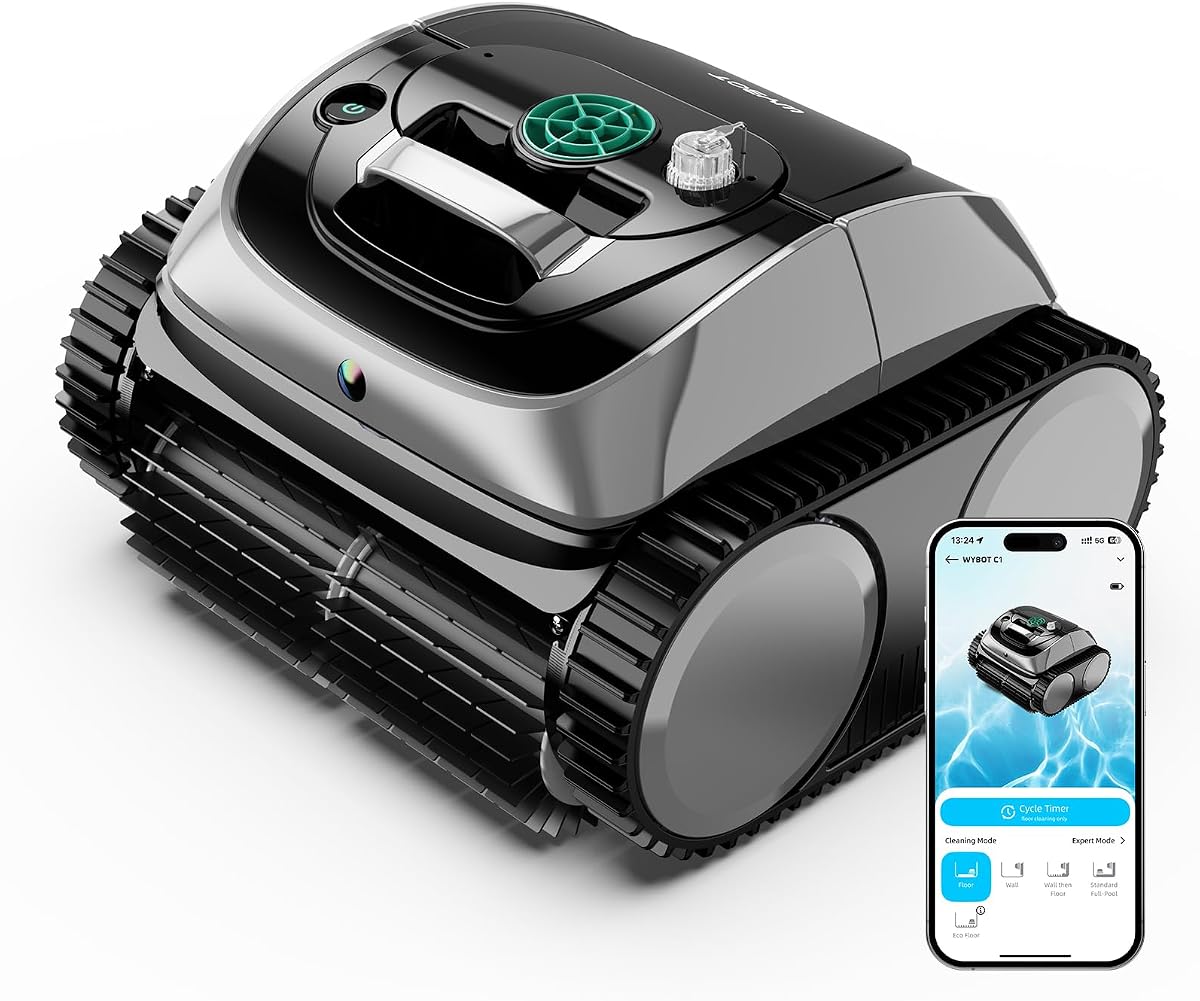
The WYBOT C1 is an inground robotic pool vacuum rated 4.0 out of 5. It emphasizes four-zone coverage, triple-motor power, and gyroscope-assisted navigation. The robot is designed to clean pool floors, walls, waterlines, and steps while handling slopes of up to 45 degrees.
We may earn a commission when you buy through this link, at no additional cost to you.
Its upgraded gyroscope follows optimized N-Path and S-Path patterns to reduce overlapping routes and missed areas. A high-capacity lithium battery provides up to 160 minutes of continuous operation after a stated four-hour charge. The listed cleaning capacity extends to pools up to 1,618 square feet and depths up to 9.86 feet.
App support allows owners to schedule cleaning, customize modes, and track progress, while over-the-air updates can add or refine cleaning programs. This makes the unit more flexible than a basic fixed-cycle cleaner. However, the 160-minute maximum runtime is shorter than several alternatives, and the stated rating does not place it among the strongest-reviewed choices in this list.
The WYBOT C1 is a sensible pick for an inground pool with pronounced slopes, steps, or walls that require climbing. Its systematic path planning and app controls serve owners who want a connected cleaner for regular maintenance. Pool dimensions and depth should be checked against the stated limits before purchase.
Gyroscope-based N-Path and S-Path cleaning patterns help the robot maintain organized routes across the floor and walls. The approach is especially relevant for pools where random movement could increase missed corners or unnecessary overlap.
Triple motors and climbing capability of up to 45 degrees help the C1 transition between the floor, walls, and steps. That broader mobility supports the product's four-zone cleaning claim.
We may earn a commission when you buy through this link, at no additional cost to you.
The AIPER Scuba V3 is rated 4.0 out of 5 and introduces camera-based AI to a cordless robotic pool cleaner. Its single front-facing camera can identify more than 20 debris types and navigate toward them, with the brand claiming cleaning up to ten times faster than traditional methods for pool-floor maintenance.
We may earn a commission when you buy through this link, at no additional cost to you.
The Navium cognitive mode analyzes pool size, weather, and cleaning history to create autonomous weekly cleaning plans. After setup, the robot can maintain the pool without a weekly manual schedule. An app provides real-time status notifications and tells users when the machine has returned to the waterline for retrieval.
Data privacy receives specific attention: the supplied information says visual information is processed on the device, with nothing stored or uploaded, and the product is TÜV certified for data privacy protection. Its weight of 8.2 kilograms is also intended to reduce lifting strain. A maximum runtime is not stated, which makes duration comparisons less straightforward.
The Scuba V3 is best for owners who want automated scheduling and targeted debris recognition rather than simply a fixed cleaning pattern. It is less compelling if wall and waterline coverage is the main priority because the supplied feature details focus heavily on pool-floor debris. Its no-installation wireless dock also simplifies routine charging and storage.
The front camera identifies more than 20 debris categories and directs the robot toward visible material. This targeted behavior can reduce unnecessary travel and focus attention where the pool visibly needs cleaning.
Navium Mode considers the pool, weather, and prior cleaning history when creating a recurring plan. Once configured, owners can rely on scheduled autonomous cleaning instead of starting each cycle manually.
We may earn a commission when you buy through this link, at no additional cost to you.
The AIPER Scuba S1 is rated 4.0 out of 5 and focuses on long runtime, comprehensive zone coverage, and app-supported scheduling. It offers an Eco mode of up to 270 minutes and up to 180 minutes in Auto, Floor, Wall, or Scheduled modes, giving owners a meaningful choice between long maintenance runs and focused cleaning.
We may earn a commission when you buy through this link, at no additional cost to you.
Eleven high-precision sensors and a dual-path algorithm support the WavePath cleaning pattern. Adaptive navigation analyzes the pool layout in real time with the aim of reducing missed sections and overlap. The robot is designed to clean the floor, walls, waterline, and shallow areas above 12 inches, while Caterpillar Treads support movement and climbing.
Its replaceable three-micron ultra-fine filter works alongside a 180-micron standard filter to capture dust, sand, leaves, and debris. Scheduled mode includes a weekly custom plan for hands-free operation. The main comparison limitation is that no suction output figure is supplied, so power is harder to evaluate numerically than on models with published GPH ratings.
This is a strong fit for owners who want long Eco cycles, flexible schedules, and coverage that extends beyond the main floor. It is particularly relevant for pools with shallow zones that a standard floor-focused robot might not address. Its two-year warranty and responsive support also provide practical ownership reassurance.
The 270-minute Eco setting is intended for frequent upkeep, while the shorter Auto, Floor, and Wall modes support targeted work. Weekly scheduling adds another layer of automation for consistent pool care.
Eleven sensors and dual-path navigation work with the tread system to cover floors, walls, waterlines, and shallow areas. This broad approach is designed for pools with multiple depths and surfaces.
We may earn a commission when you buy through this link, at no additional cost to you.
The CZYBYTE cordless robotic pool cleaner is rated 4.6 out of 5 and offers brushless-motor suction of up to 4,500 GPH. It is intended for both inground and above-ground pools, cleaning floors, walls, and waterlines through three modes designed to balance coverage and operating time.
We may earn a commission when you buy through this link, at no additional cost to you.
After charging, the robot begins with walls and the waterline before transitioning to a floor scrub. Its S-shaped navigation is intended to produce orderly route planning, while automatic parking at the surface makes retrieval easier when a cycle finishes or the battery becomes low. The supplied information does not publish a specific runtime, so buyers should not compare it numerically with models that do.
The four-liter top-loading basket uses 150-micron dense mesh to capture fine particles, leaves, and hair. This is a larger filter opening than the three-micron layers offered by some premium models, meaning very fine particles may require a different filter to be trapped. The broad pool compatibility and simple three-mode structure remain useful for general households.
App support is present, but the updated application requires new buyers to scan a QR code and install the latest version. Existing customers are instructed to uninstall the old application first. The charging port must also be covered before submersion. For owners who value straightforward automation, suction, and easy basket access, the CZYBYTE is a practical choice with those setup steps understood.
The robot is designed to address walls and the waterline before moving into a thorough floor scrub. This sequence gives it a structured cleaning approach without requiring extensive mode configuration.
A top-loading four-liter basket allows owners to remove collected debris without accessing a bottom-mounted compartment. The stated mesh density captures fine particles along with larger leaves and hair.
We may earn a commission when you buy through this link, at no additional cost to you.
The WYBOT C2 is rated 4.4 out of 5 and balances navigation, coverage, and filtration for inground pools. A built-in gyroscope and intelligent navigation system help the robot follow optimized paths, minimizing missed regions while it cleans the floor, walls, steps, and waterline.
We may earn a commission when you buy through this link, at no additional cost to you.
The stated maximum operating time is 180 minutes, with cleaning coverage of up to 2,152 square feet per cycle. Three brushless motors provide the power needed for wall climbing, and the unit is described as effective across different pool shapes and wall materials. This makes it a flexible choice for common inground layouts.
Its filtration system combines a 180-micron primary filter for larger debris with a 10-micron ultra-fine filter for finer material. Seven cleaning modes provide some control over the cleaning approach, and the robot parks at the pool edge after finishing or reaching a low battery. Bluetooth control simplifies operation, although the supplied information does not list Wi-Fi connectivity or an app.
The WYBOT C2 is well suited to owners who want more coverage and finer filtration than a basic model without moving to the premium end of the category. It also works for pools where wall and step debris needs attention. Verify that Bluetooth control fits your preferred setup, as remote functions are less expansive than those of app-based competitors.
The built-in gyroscope supports optimized paths and reduced overlap across the pool. This systematic movement is central to the C2's promise of comprehensive coverage for inground installations.
The primary filter handles leaves and coarse debris, while the ten-micron layer targets finer dirt and sand. Combining both levels supports clearer water without changing the robot's basic cleaning sequence.
We may earn a commission when you buy through this link, at no additional cost to you.
The Dual-Action cordless robotic pool vacuum is rated 4.4 out of 5 and combines 5,500 GPH suction with dual drive motors, a dedicated pump, and two active brushes. It is designed for both inground and compatible above-ground pools, offering focused cleaning for floors, walls, and waterlines.
We may earn a commission when you buy through this link, at no additional cost to you.
Three modes—Full Pool, Floor Only, and Wall Only—let owners direct the robot toward particular areas. Smart S-Path and N-Path navigation reduces overlap and missed spots, while high-grip tracks handle transitions and slopes of up to 30 degrees. The robot scrubs the floor, climbs walls, and travels along the waterline as part of routine maintenance.
The built-in 5,200mAh battery provides up to 120 minutes of operation for pools up to 1,830 square feet and recharges in about 2.5 hours. Automatic parking helps with retrieval, and the included hook provides an additional way to lift the robot near the edge. The four-liter basket uses 150-micron mesh and can be rinsed with a garden hose.
This model is a practical choice when basic wall and floor coverage matters more than premium vision, ultra-fine filtration, or long operating time. Its relatively short runtime may lead to more frequent charging than several competitors, and the 150-micron basket does not offer the same fine-particle capture as three-micron filtration. Its balanced feature set remains effective for routine maintenance.
Full Pool offers an all-surface cycle, while Floor Only and Wall Only concentrate the robot on specific tasks. This flexibility is useful when one part of the pool needs attention before the next complete cycle.
The top-loading four-liter basket separates from the unit for rinsing with a garden hose. Easy access makes it easier to clear collected leaves, sand, and dirt after each cleaning session.
We may earn a commission when you buy through this link, at no additional cost to you.
The right cordless robotic pool cleaner depends on pool geometry, debris type, cleaning frequency, and preferred level of automation. Comparing these factors before purchasing helps avoid paying for features that do not improve your particular routine.
Start by confirming whether the pool is inground, above-ground, or a combination of both. Some robots are explicitly limited to inground installations, while others can clean compatible above-ground pools. Consider the deepest zone, wall shape, steps, tanning ledges, shallow shelves, and whether any unusual obstacles could limit navigation. Models with wall climbing and shallow-area cleaning are particularly useful for pools with several depth transitions.
Suction figures provide a useful indication of how aggressively a robot can collect debris, although the listed GPH values are not directly comparable across every manufacturer. Brushes, pumps, motor arrangements, and sealing also affect performance. Dual-jet or triple-motor designs may suit owners with sand, pebbles, or algae concerns, while strong climbing power becomes important when the robot must move from the floor to the walls.
Filter mesh determines which particles the robot can retain. The listed products range from 150-micron and 180-micron baskets to replaceable three-micron or ten-micron ultra-fine layers. Fine filters may improve dust and sand collection but can require more careful maintenance. Basket volume also affects how often cleaning is needed, particularly during leaf-heavy periods. Check whether a filter is washable, reusable, replaceable, or optional.
Good navigation reduces missed corners, repeated travel, and unnecessary operating time. Sensor-based systems, gyroscope navigation, AI vision, and programmed S-Path or N-Path routes all approach coverage differently. Look for a model that cleans the pool floor, walls, waterline, and shallow areas if your pool contains multiple surfaces. A planned path is especially useful for freeform pools and layouts with obstacles.
Runtime should be sufficient to finish a cycle before the robot parks itself at the edge. Stated runtimes in this guide range from 120 to 300 minutes, although not every model publishes a maximum operating time. Consider battery capacity, pool size, the selected cleaning mode, and how often the battery will need to recharge. A model that needs several shorter cycles may still work well if its retrieval and charging process is convenient.
Cordless freedom means you should not have to enter the pool or fish out the robot with a pole. Automatic parking at the waterline or pool edge makes retrieval easier, while a hook or lightweight construction can help with lifting. App control, weekly schedules, autonomous plans, and over-the-air updates add convenience. Note the restrictions: some settings must be configured on shore, and real-time control may not be available underwater.
A robotic cleaner still requires attention to its filter basket, fine filters, charging contacts, and general condition. Washable or reusable components can simplify recurring care, while replaceable filters provide another maintenance option. Warranty length is useful for long-term confidence, and several products also list two-year coverage. Owners should verify the stated terms with the seller and retain documentation after purchase.
App support can provide scheduling, mode selection, progress tracking, cleaning history, and firmware updates. Bluetooth-only control is simpler and may suit owners who do not need remote access, while Wi-Fi or app connectivity offers more control. Confirm which functions remain available during active cleaning and whether modes or presets must be selected before submersion. Also consider how software updates fit your comfort level.
Begin by reading the robot's instructions, confirming pool compatibility, and inspecting the unit and filter for damage. Charge it fully, install the appropriate app if one is required, and select your desired mode and timer while the robot is on shore. Some models require all presets to be configured before submersion, and some charging ports need a protective cover or plug before the unit enters the water.
Place the robot in the pool with the direction and entry method specified by the manufacturer. Allow it to complete its programmed floor, wall, waterline, or shallow-area cycle. Keep the pool accessible for retrieval, and do not pull a submerged robot by its cable or force it against a wall. Use the included hook where provided, and wait for the unit to reach the surface or designated parking position before lifting it out.
After each cycle, remove and rinse the debris basket and filters according to the manual. Let the unit and charging components dry as directed, clear hair or debris from brushes and tracks, and inspect the charging port for moisture or blockage. Store the robot in its dock or another suitable dry location, then check the filter and basket before the next session. Periodic firmware updates can also keep supported app features current.
Most models in this guide are designed for inground pools, with some also supporting compatible above-ground installations. The robot must be able to navigate the pool's floors, walls, slopes, steps, and shallow areas. Check the stated dimensions, depth limits, pool type, and salt-water compatibility before ordering.
Charging time varies by model, and most products do not provide a universal figure. The WYBOT C1 lists a four-hour charge for up to 160 minutes of operation, while the Dual-Action robot lists about 2.5 hours for up to 120 minutes. Follow the instructions for the specific unit and allow a full initial charge before judging runtime.
Yes, all ten products list wall or waterline cleaning, although their methods differ. Some climb the wall directly, while others use a dedicated horizontal waterline pass that extends above the surface. Pool shape, wall material, and depth can affect performance, so owners with difficult geometry should review the product details carefully.
A robotic cleaner can reduce the need for routine manual vacuuming, brushing, and waterline touch-ups, but it does not replace all pool care. Skim leaves from the surface, empty the basket, rinse filters, check water chemistry, and inspect areas the robot may not reach. Manual cleaning remains useful for stubborn buildup and debris collected before the robot gets to it.
Only if the manufacturer explicitly confirms saltwater compatibility. The Beatbot Sora 10 lists saltwater-safe construction for sodium chloride levels below 5,000 parts per million. Other models do not provide that specification in the supplied information, so owners should verify the manual and manufacturer guidance before exposing a unit to salt water.
A primary filter usually has a larger mesh designed to catch leaves, hair, and coarse debris. An ultra-fine filter has a much smaller pore size intended to capture sand, dust, and other fine particles. The products here use combinations such as 180-micron primary filters with three- or ten-micron layers, while other baskets rely on 150-micron mesh.
Control options vary substantially. Some units offer app scheduling, cleaning history, and status notifications, but the AIPER Scuba S3 does not provide real-time app control while submerged. Other models use Bluetooth or shore-based app presets. Check whether settings must be selected before entering the water and what monitoring remains available during a cycle.
Allow the robot to finish and park at the waterline or edge whenever possible. Use the supplied hook for edge retrieval, and avoid entering the water or pulling forcefully on the unit. Because some robots park underwater rather than rising completely to the surface, owners should follow the manual's specific retrieval procedure.
The AIPER Scuba X1 offers the most advanced feature set with dual-jet suction, very fine filtration, dedicated waterline cleaning, and a wireless dock. The Beatbot Sora 10 is the most versatile general option, combining long runtime with broad pool compatibility, while the BRINBO C1 delivers extensive modes, washable filters, and app controls at a value-focused level.
For all other buyers, prioritize the features your pool actually demands: adequate runtime, filtration appropriate for leaves or fine sand, wall climbing for complex geometry, and a retrieval method you will use without frustration. Smart functions are useful, but dependable coverage, simple filter care, and pool-specific compatibility should remain the foundation of the decision.
Final availability, promotions, and prices can change after this guide was prepared. Review the current listing, manufacturer instructions, warranty terms, and pool specifications before purchasing so the selected cordless robotic pool cleaner remains a good fit for your installation.