SEAC Partner
4.0Editor score
Up to 99 recorded dives
100 meter water resistance
Backlit display
Stopwatch and countdown functions
Our dive watch for freediving guide compares 10 models across depth tracking, safety features, readability, battery life, navigation, and everyday versatility
A dive watch for freediving must do more than tell the time. It should provide dependable depth information, track each breath-hold session, remain readable underwater, and suit the demands of a surface interval between dives. The right model can also support training, navigation, and everyday timekeeping without becoming cumbersome on the wrist.
We compared ten dive watches and wrist computers using the information supplied for each model. The list covers dedicated freediving devices, general dive computers with freediving modes, compact options for snorkeling and spearfishing, and rugged multisport watches designed for divers who also track training and outdoor activities.
Each review explains the features that make the product relevant to freediving, along with practical limitations to consider before buying. The three leading picks range from a budget-focused dedicated model to more advanced choices for data logging, navigation, and training. Product details and availability can change, so confirm the current listing before purchasing.
4.0Editor score

4.8Editor score

4.6Editor score
The comparison below highlights each model’s core strengths, from dedicated freediving tools and water-resistant wrist computers to feature-rich multisport dive watches. It is designed to help divers identify the right balance of depth data, safety features, display quality, and underwater versatility.


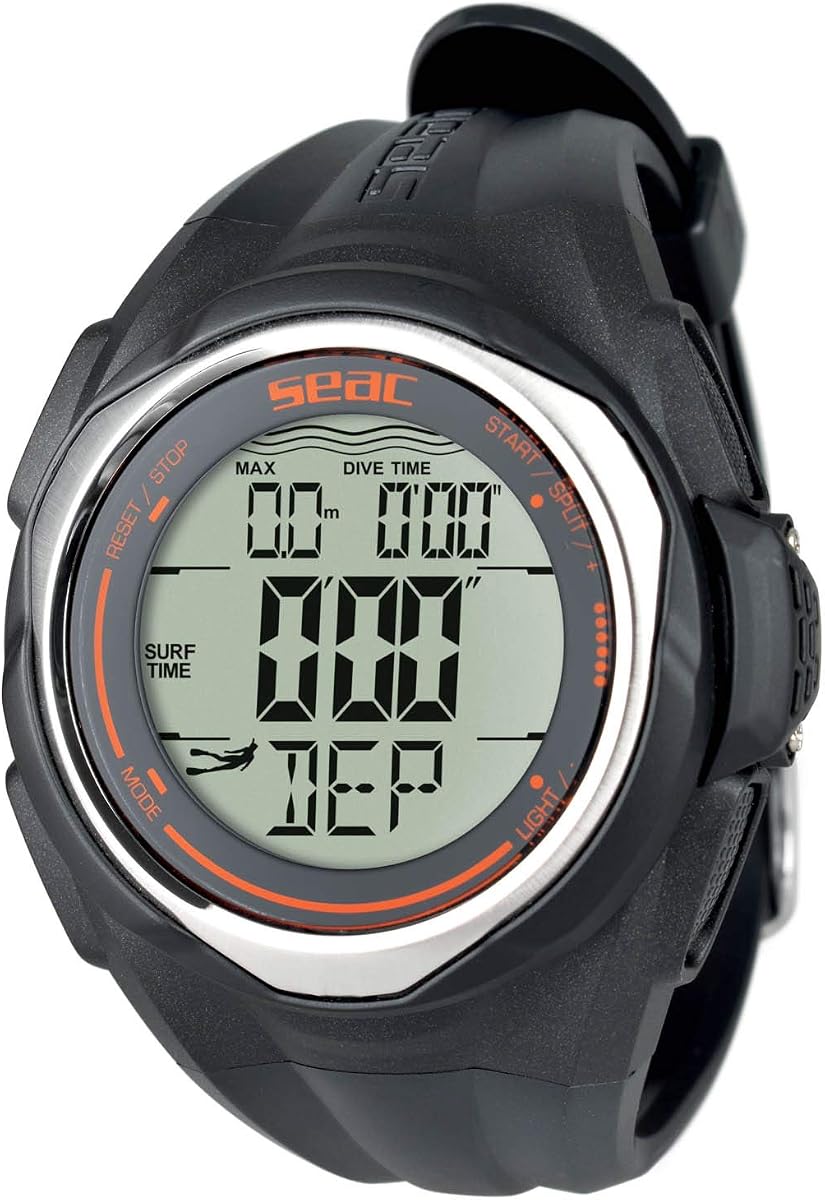
The SEAC Partner is a purpose-built wrist-mounted freediving computer for divers who want a simple instrument for recording breath-hold sessions. Its 4.0 rating reflects a practical product with a clear specialization: recording dives, timing sessions, and providing a backlit display without the complexity of a full scuba computer. It is especially relevant to freedivers who want a dedicated tool rather than a general-purpose sports watch.
We may earn a commission when you buy through this link, at no additional cost to you.
The strongest feature is the ability to record up to 99 dives, giving a diver a practical log for multiple sessions without requiring a separate notebook every time. Its stopwatch and countdown functions support both free timing and structured preparation, while the 100-meter water resistance suits submerged use. The backlit display helps when checking information in dim underwater conditions, and the standard CR2032 battery simplifies the maintenance routine.
The trade-off is that the Partner focuses on the core freediving experience rather than offering the wide feature set found in advanced dive computers or multisport watches. Its listed functions do not include sophisticated decompression algorithms, navigation, wireless tank data, or detailed training metrics. For a freediver seeking straightforward depth and session data, that specialization can be an advantage, but it may feel limited when comparing against more elaborate models.
This is the strongest choice for budget-conscious divers who want a dedicated freediving computer, a readable backlight, and onboard dive recording. It is less suitable for someone who expects the model to double as a detailed scuba computer, navigation instrument, or everyday training watch. For straightforward freediving data and convenient battery replacement, the SEAC Partner remains a focused and practical option.
Recording as many as 99 dives gives the Partner a useful middle ground between a completely improvised session and a sophisticated computer. Freedivers can review basic information after surfacing without treating every dive as an isolated event.
The integrated backlight is particularly valuable underwater, where glare, depth, and changing light can make a plain screen difficult to inspect. Combined with 100-meter water resistance, it supports the core demands of a submerged training or recreational dive.
We may earn a commission when you buy through this link, at no additional cost to you.
The SALVIMAR One Plus is a watch-style wrist computer aimed at freedivers, spearfishers, snorkelers, and people who also want useful functions outside the water. Its 4.2 rating places it among the stronger options in this list, while its combination of depth tracking, dive time, surface recovery information, and water temperature gives it more substance than a basic stopwatch.
We may earn a commission when you buy through this link, at no additional cost to you.
Accurate depth tracking up to 100 meters is the defining feature, giving the device relevance across recreational freediving, spearfishing, snorkeling, and underwater training. The EL backlight improves screen visibility in low-light and deeper conditions. Depth, timer, temperature, and surface interval data are all useful during a session, while the stopwatch, countdown, world time, alarms, and calendar extend the device beyond diving.
Its main limitation is that the broader feature set does not make it a specialist technical computer. There is no stated decompression algorithm, configurable gradient system, tank-pressure support, or group-dive functionality. Divers who want only the essentials may need to navigate more settings than they would on a basic freediving watch, although the stated lightweight, compact design helps offset that concern.
The One Plus is a good match for a snorkeler or recreational freediver who wants one wrist device for both water time and daily functions. It also makes sense for spearfishers who value temperature and surface interval data. Choose it when a versatile, backlit wrist computer is more appealing than a highly specialized decompression instrument or a large multisport adventure watch.
Depth, elapsed dive time, surface recovery information, and water temperature create a useful record of each excursion. That combination is valuable for tracking patterns during repeated freediving or spearfishing sessions without moving to a full scuba-computer interface.
World time, programmable alarms, a long-term calendar, stopwatch, and countdown functions give the One Plus broader daily utility. The result suits travelers and active users who prefer carrying one watch for travel, training, and underwater activities.
We may earn a commission when you buy through this link, at no additional cost to you.
The SUUNTO D5 is a general dive computer that can suit freedivers who also scuba dive or want a connected wrist device. Its 4.0 rating is solid, and the watch-style form, color display, 100-meter water resistance, and vibration alarms make it a versatile option for water sports. It does not present itself as a dedicated breath-hold computer.
We may earn a commission when you buy through this link, at no additional cost to you.
Wireless mobile connection is the standout feature for a diver who wants information on a phone after a session. The digital compass adds basic underwater orientation, while wireless tank pressure support broadens its usefulness for scuba setups. These functions make the D5 appealing when one computer needs to serve several underwater disciplines rather than only timed freediving.
The trade-off is specialization. The supplied information does not identify a dedicated freediving mode or describe a freediving-focused algorithm, so a diver centered on apnea training may find a purpose-built computer more direct. Wireless tank pressure also depends on using compatible transmitting equipment, which is irrelevant to someone who only freedives. The D5 therefore carries more complexity than a basic freediving watch.
Choose the D5 if you split your time between freediving, scuba diving, snorkeling, and connected device use. It is particularly suitable for divers who value a compact color screen, phone integration, and compass access. A strictly apnea-focused diver should prioritize a model with explicit freediving features, while a multi-sport user will find more value here.
Wireless mobile connection makes the D5 convenient for divers who want to review information away from the wrist. It also reduces the sense of being tied to a device that performs only one function.
A digital compass, vibration alarms, and optional wireless tank pressure support create a broader underwater toolkit. Those functions are most valuable to divers whose activities extend beyond breath-hold training.
We may earn a commission when you buy through this link, at no additional cost to you.
The Cressi Nepto is explicitly designed for freediving, and that focus is visible in its compact case, high-contrast display, logbook, and safety algorithm. Its 4.1 rating indicates a well-regarded specialist option for divers who want a wrist computer developed around breath-hold diving rather than a general scuba or multisport device.
We may earn a commission when you buy through this link, at no additional cost to you.
At only 48 millimeters in case diameter, the Nepto prioritizes a relatively unobtrusive wrist profile. Its 35-millimeter high-contrast display provides a clear information area without requiring a large watch body. More importantly, Cressi developed an algorithm intended to protect against Taravana risk and includes a function designed to avoid the risk of pulmonary edema, adding a safety-oriented layer beyond simple timing.
The mineral glass, heavy-duty case, steel buttons, rubber strap, and stainless steel buckle are designed for resistance to water pressure up to 120 meters. That construction is appropriate for dedicated underwater use. The limitation is that the supplied specifications emphasize freediving rather than a broad collection of everyday functions, compass navigation, wireless connectivity, or multisport training tools.
The Nepto is an excellent choice for a diver who values specialization, compact dimensions, and a readable display. It is especially relevant to freedivers who want a logbook and dedicated safety features in a purpose-built format. Those seeking one watch for scuba, navigation, fitness, and daily connectivity should consider a broader alternative, but apnea-focused users may find this model more direct.
The Taravana-protection algorithm and pulmonary-edema avoidance function distinguish the Nepto from a basic timer. These features reflect the priorities of a computer built specifically for breath-hold diving and repetitive surface intervals.
The 48-millimeter case is designed to sit comfortably on the wrist, while the 35-millimeter high-contrast display provides a focused view of essential data. Compactness can be valuable for divers who dislike bulkier watch-style computers.
We may earn a commission when you buy through this link, at no additional cost to you.
The Cressi Leonardo 2.0 is a scuba-focused watch computer that may appeal to freedivers who also use conventional breathing equipment. Its 4.2 rating is among the higher results in the list, and the defining strengths are a straightforward one-button interface, multiple dive modes, critical alerts, and connectivity with iOS and Android devices.
We may earn a commission when you buy through this link, at no additional cost to you.
Air, Nitrox, and Gauge modes make it adaptable to different scuba configurations. Visual and audible alarms help communicate important changes, while USB and infrared transfer provide additional ways to manage dive logs. Bluetooth compatibility with iOS and Android devices adds convenient post-dive data access. The single-button navigation is straightforward and reduces the need to manipulate multiple controls underwater.
As a freediving choice, however, it is not as specialized as the Nepto, Teric, or other models with explicit apnea functions. The supplied information does not identify a dedicated freediving mode. Its gas planning, multiple scuba modes, and data workflow may be unnecessary for someone who only wants to time breath-hold dives, although a diver moving between apnea and scuba may appreciate the broader range.
The Leonardo 2.0 is best for a recreational diver who wants an approachable computer and does scuba as well as freediving. It is less compelling as a dedicated apnea device. Buyers who value simple controls, clear alarms, and familiar Italian dive-computer design will find plenty to like, while specialists should examine one of the purpose-built freediving options.
A one-button interface is useful underwater because it reduces control complexity. The result is a watch that feels approachable for divers who want a traditional wrist computer without navigating through a crowded set of physical buttons.
Bluetooth connectivity works with iOS and Android devices, while USB and infrared transfer offer additional data-management routes. Divers can keep the device practical for both casual review and more organized log analysis.
We may earn a commission when you buy through this link, at no additional cost to you.
The Garmin Descent G1 combines dive-computer fundamentals with training, health, and navigation functions in a rugged watch-style case. Its 4.6 rating is one of the strongest in this roundup. It supports recreational and advanced scuba diving as well as free diving and spear fishing, making it a broad option for active divers who do not want separate devices for the water and the training pool.
We may earn a commission when you buy through this link, at no additional cost to you.
The durable design uses a sapphire lens, silicone bands, and an easy-to-read monochrome display. Battery life reaches up to 25 hours in dive mode, 21 days in smartwatch mode, and 26 hours in GPS mode. GPS, GLONASS, and Galileo support allow divers to mark surface entry and exit locations, which is especially helpful for boat-based sessions and repeat dive-site navigation.
Training and lifestyle features distinguish the G1 from conventional dive watches. It includes more than 30 sports apps, advanced training features such as VO2 Max, wrist-based heart rate, Pulse Ox, Body Battery energy monitoring, and sleep information. Up to 200 dives can be stored on the wrist, then uploaded, shared, and reviewed through the Garmin Dive app. The monochrome screen and broad feature set are less focused than those of a dedicated apnea computer.
The G1 is an excellent all-around choice for a diver who wants freediving, scuba, spearfishing, fitness, and recovery information in one device. It is less compelling for someone wanting the smallest possible freediving watch, but the combination of surface markers, app-based logs, rugged construction, and training features makes it a compelling premium choice.
Using GPS, GLONASS, and Galileo to mark surface entry and exit points gives divers a clearer record of where a session began and ended. That is particularly useful on open water where returning to the exact entry area can be challenging.
More than 30 sports apps, advanced training features, and wellness monitoring make the G1 useful between dives. Freedivers can connect breath-hold sessions with broader fitness, activity, sleep, and recovery information rather than treating each dive as an isolated event.
We may earn a commission when you buy through this link, at no additional cost to you.
The Garmin Descent Mk3i is the most feature-rich watch in this guide, combining a large AMOLED display, a 200-meter dive-rated case, freediving modes, navigation, group support, lighting, fitness functions, and health monitoring. Its 4.6 rating reflects strong user reception, and it is the most advanced option for a diver who wants a capable adventure computer rather than a basic freediving timer.
We may earn a commission when you buy through this link, at no additional cost to you.
The 1.4-inch AMOLED display is unusually large for a dive watch and should provide excellent visibility in changing conditions. A scratch-resistant sapphire lens and 51-millimeter titanium bezel add protection, while the 51-by-51-by-16.4-millimeter body gives the watch a substantial wrist presence. Multiple modes cover recreational scuba, technical diving, and freediving, allowing one device to support several styles of immersion.
The built-in LED flashlight offers variable brightness and strobe modes in red or white, making it useful both above and below the surface. SubWave technology can exchange preset messages with nearby divers, and the optional Descent T2 supports group monitoring. DiveView provides bathymetric contours and more than 4,000 listed dive sites. Multiband GPS, an underwater compass, 200 stored dives, a dive-readiness tool, and extensive health features add further utility.
Those capabilities also create the main trade-off: this is a large, sophisticated watch with more menus and settings than a dedicated apnea computer requires. It is best for technical freedivers, traveling divers, spearfishers, and scuba divers who value a rugged all-purpose instrument. The extra size may deter buyers seeking a discreet watch, but for advanced capability it is one of the strongest choices available.
The 1.4-inch AMOLED screen provides a large viewing area, while the integrated LED flashlight adds a practical layer of visibility. Variable intensity, strobe modes, and red or white light are useful around dusk, in shaded water, and during surface recovery.
SubWave diver messaging and optional Descent T2 group monitoring make the Mk3i particularly useful for organized sessions. DiveView maps, bathymetric contours, an underwater compass, and multiband GPS support planning and orientation on the surface.
We may earn a commission when you buy through this link, at no additional cost to you.
The Cressi Raffaello is a versatile dive computer that includes an apnea mode alongside conventional diving features. Its 4.4 rating is strong, and the built-in digital compass gives it a useful advantage for divers who want navigation without carrying a separate instrument. The replaceable battery is another practical feature for long-term ownership.
We may earn a commission when you buy through this link, at no additional cost to you.
Its four operating modes include apnea and gauge, allowing freedivers to use a dedicated breath-hold setting while retaining broader scuba functionality. The built-in compass supports underwater orientation, and the RGBM-based mixed-gas planning system is designed for detailed preparation with multiple gas mixes. Bluetooth and USB connectivity make stored dive information easier to transfer to a smartphone or computer.
The user-replaceable battery is expected to last four years, which helps reduce routine maintenance. The trade-off is that this is not a compact, freediving-only watch. Mixed-gas planning and multiple modes introduce more complexity than the SEAC Partner or Cressi Nepto require. It is most attractive to a diver who wants one device for apnea, gauge work, and other underwater activities.
Choose the Raffaello when freediving is one part of a broader dive-computer setup and underwater navigation matters. It is a strong fit for divers who want an integrated compass, flexible log transfer, and a long replacement interval. A dedicated freediver who wants the smallest possible design and simplest menu may prefer one of the more specialized models.
An explicit apnea mode makes the watch relevant to freedivers, while the built-in digital compass adds orientation during the dive. The combination can reduce the need to carry another navigational device.
The battery is user-replaceable and expected to last four years. That approach can simplify ownership compared with a sealed rechargeable computer, especially for divers who keep a device in a locker or use it seasonally.
We may earn a commission when you buy through this link, at no additional cost to you.
The Shearwater Research Teric has the highest customer rating in this guide at 4.8, and its combination of a dedicated freediving mode with advanced decompression functions makes it one of the strongest technical choices. It is designed for divers who want precise control over their dive computer settings and expect to use it for more than simple breath-hold timing.
We may earn a commission when you buy through this link, at no additional cost to you.
The Bühlmann ZHL-16c algorithm with configurable Gradient Factors is the major technical distinction. Those settings allow the diver to influence decompression behavior rather than relying on a fixed configuration. The Teric also supports Open-Circuit, Fixed PO2, Gauge, and Freediving modes, making it useful for divers whose activities include apnea, gauge work, and several forms of scuba.
Switchable audible and vibration alerts provide different ways to notice important events, whether the diver prefers sound, haptic feedback, or both. Optional wireless tank pressure transmitters and upgradeable firmware add further flexibility. The 316 stainless steel bezel and buttons contribute to a substantial, durable build, while the 22-millimeter strap and included extender make it adaptable to different wrist sizes.
The complexity is the main compromise. A diver who only wants a stopwatch and basic depth readings may find the configurable algorithm excessive. The Teric rewards users who understand decompression concepts and want a durable, extensible device. For a serious freediver or mixed-discipline diver, it offers an exceptional balance of specialized apnea support, proven decompression architecture, and build quality.
The Bühlmann ZHL-16c algorithm and adjustable Gradient Factors give knowledgeable divers direct influence over the device's decompression model. That flexibility is a major reason to consider the Teric when diving plans or personal risk-management settings matter.
Freediving, Gauge, Open-Circuit, and Fixed PO2 modes allow the Teric to serve several underwater disciplines. Optional wireless tank transmitters and upgradeable firmware extend that flexibility as the diver's activities evolve.
We may earn a commission when you buy through this link, at no additional cost to you.
The Shearwater Research Peregrine delivers a 4.7 rating and focuses on an uncluttered wrist-computer experience. Its most appealing characteristic is the two-button, state-aware menu structure, which provides a clear route through functions without requiring a crowded control layout. It is a streamlined alternative to the more configurable Teric.
We may earn a commission when you buy through this link, at no additional cost to you.
The interface is designed to remain understandable as the user moves through different menus, with two physical controls and 316 stainless steel buttons providing durable input. Battery life is approximately 30 hours per charge at medium brightness, and a USB wireless charging station is included. That combination offers a convenient charging routine for regular dive use.
The supplied information is intentionally concise and does not list the same depth of specialized features as the Teric or Garmin Descent models. As a result, buyers should examine the current product details to confirm that the available modes, navigation functions, and logging tools match their needs. The Peregrine is less about feature excess and more about a focused interface and solid construction.
The Peregrine is a strong choice for a diver who values a simple menu, physical buttons, and a high customer rating without wanting a large adventure watch. It may be particularly attractive to users moving up to a capable Shearwater computer without needing every advanced feature of the Teric. Confirm the current mode list and specifications before purchase, especially if freediving is your primary activity.
The two-button interface is built around a menu structure that adapts to the current screen. This approach can make the device less intimidating than a densely populated multi-function watch while still providing quick access to important settings.
An included USB wireless charging station makes recharging straightforward, while the approximately 30-hour medium-brightness runtime supports regular sessions. The setup is particularly convenient for divers who return the watch to a home or boat base after use.
We may earn a commission when you buy through this link, at no additional cost to you.
The right freediving watch balances depth accuracy, display readability, safety logic, fit, battery needs, and the amount of training or navigation data you want. Start with the type of diving you actually do, then consider how much complexity and durability your sessions require.
A dedicated freediving mode is the most direct signal that a watch was designed around breath-hold diving. Look for features that support the rhythm of a freediving session, such as depth tracking, dive time, surface intervals, and a logbook. Models built specifically for apnea may also include safety algorithms or functions intended to reduce risks associated with repetitive deep breath-hold dives. A general scuba computer can still be useful, but it may ask you to navigate more settings than a freediving specialist.
Prioritize an explicit apnea or freediving mode if breath-hold diving is your main activity.
Match the stated depth capability and water resistance to the environments where you dive. The models in this guide are rated from 100 to 200 meters, but the practical requirement depends on your typical maximum depth and whether you occasionally exceed recreational limits. Also distinguish water resistance from a formal dive-computer depth rating: both matter, yet they describe different aspects of underwater suitability.
Choose a rating with comfortable margin above the depth you expect to reach.
A display that is clear on land may still be difficult to read underwater. Favor high contrast, a suitable screen size, and an integrated backlight. The SEAC Partner and SALVIMAR One Plus use backlit displays, while the Cressi Nepto emphasizes a high-contrast screen and the Garmin Descent Mk3i uses a large 1.4-inch AMOLED panel. Larger displays can show more information, but they also increase wrist bulk.
Balance screen visibility against comfort, and never choose display size alone.
Safety features vary widely. The Cressi Nepto includes an algorithm developed to protect against Taravana risk and a function intended to avoid pulmonary-edema risk. The Shearwater Teric provides the Bühlmann ZHL-16c algorithm with configurable Gradient Factors, along with switchable audible and vibration alerts. For scuba-oriented models, alerts and gas planning may matter more than freediving-specific logic.
Understand what each safety system does before relying on it for planning.
Consider whether recording dives on the watch is enough or whether you need downloadable logs, phone compatibility, and detailed review. The SEAC Partner stores as many as 99 dives, while both Garmin Descent models store up to 200. The Cressi Leonardo 2.0 offers iOS and Android connectivity plus USB and infrared transfer, and the Raffaello supports Bluetooth and USB. More data can help reveal patterns, but it is useful only if the transfer process fits your routine.
Choose storage and transfer tools that you will actually use after each session.
Battery strategy should match how often you dive. The SEAC Partner uses a standard replaceable CR2032 battery, and the Cressi Raffaello has a user-replaceable battery with an expected four-year life. Rechargeable models offer convenient charging, with the Shearwater Peregrine including a wireless charging station and providing about 30 hours per charge at medium brightness. The Garmin G1 lists up to 25 hours in dive mode, 21 days in smartwatch mode, and 26 hours in GPS mode.
Compare battery life with realistic use and choose a maintenance routine you will follow.
Freediving from a boat, reef, or open-water entry often requires reliable orientation above the surface. A digital compass appears in the SUUNTO D5, Cressi Raffaello, and Garmin Descent Mk3i, while the G1 can mark surface entry and exit points with its multi-constellation GPS support. The Mk3i also offers DiveView maps, bathymetric contours, more than 4,000 listed dive sites, multiband GPS, and an underwater compass.
Add navigation only if it improves your actual dive-site workflow and routine.
Your dive watch should remain comfortable throughout a session and fit securely over a wetsuit or bare arm. Compact models such as the Cressi Nepto emphasize a small 48-millimeter case, while the 51-millimeter Garmin Descent Mk3i has a more substantial profile. Material choices also matter: the Nepto combines mineral glass, a heavy-duty case, steel buttons, a rubber strap, and a stainless steel buckle, while both Shearwater models use 316 stainless steel components.
Try the wrist fit if possible, especially with a wetsuit and under changing conditions.
Before the first dive, read the manual for the exact model and set the date, time, units, and relevant profile information. Confirm that the watch has adequate battery or power, test the backlight in a dark setting, and verify that the display remains readable. If the model supports multiple modes, select the designated freediving or apnea mode before entering the water rather than adjusting settings during the dive.
Establish a repeatable routine. Check the starting surface time, note any equipment issues, and review the configured depth and alert settings. During the dive, use the watch as a guide rather than staring at it continuously. After surfacing, allow the device to record the session, check that the data is complete, and begin the appropriate surface interval before starting the next dive. The SEAC Partner, Cressi Nepto, Cressi Raffaello, and Shearwater Teric all provide dedicated session or freediving-related tracking to support this workflow.
Rinse the watch with fresh water after use, especially after swimming in salt water or visiting a pool, and dry it before operating any buttons. Keep the display and buttons free of sand, mud, and debris, and avoid exposing the device to extreme heat or impacts beyond its intended use. Follow the manufacturer's instructions for battery replacement or charging, and use the supplied charging equipment where provided. Periodic log transfers also help ensure important session records remain available.
A dedicated freediving watch is usually better for a diver whose primary activity is breath-hold diving because its controls, display, and logging features may be organized around apnea sessions. A general dive computer can be more versatile for scuba, gauge, mixed-gas, and freediving use. The right choice depends on how many disciplines you expect the device to support.
Yes, provided the device includes a suitable freediving or apnea mode and is rated for the intended depth. Models such as the Cressi Raffaello, Shearwater Teric, and Garmin Descent watches support multiple modes that can include freediving. Confirm the mode and specifications before entering the water.
The rating should comfortably cover the depth you expect to reach with a reasonable margin. Models in this guide list capabilities ranging from 100 meters to 200 meters. A higher specification can add confidence for deeper environments, but it does not replace proper training, planning, and sound freediving practices.
A backlight is useful because underwater visibility can change quickly and checking a dark screen at the wrong moment may be distracting. The SEAC Partner and SALVIMAR One Plus explicitly include backlighting, while the Cressi Nepto offers a high-contrast display. Display size, contrast, and light should be evaluated together.
Phone connectivity is helpful if you want to review detailed logs, organize sessions, or connect diving with training and wellness data. It is optional for many divers who are satisfied with basic onboard records. The Cressi Leonardo 2.0, Raffaello, and both Garmin Descent models offer different levels of device or app integration.
Water resistance describes the watch's ability to resist water under specified conditions, while a dive-computer rating indicates its stated operating depth. The two specifications are related but should not be treated as interchangeable labels. For repeated submerged use, check the full depth rating and the manufacturer’s operating instructions.
The useful amount depends on how often you dive and whether you transfer records regularly. The SEAC Partner stores up to 99 dives, while the Garmin Descent G1 and Mk3i each store up to 200. A larger onboard log is helpful for divers who may not transfer every session immediately.
Look for a readable size, strong contrast, and a backlight or illumination suited to low-light conditions. The compact Cressi Nepto prioritizes a 35-millimeter high-contrast display, while the Garmin Descent Mk3i uses a much larger 1.4-inch AMOLED screen. The best choice is the display you can interpret quickly without the watch feeling overly bulky.
The SEAC Partner is the most focused budget-oriented choice, combining a dedicated freediving format, up to 99 recorded dives, a backlit display, and 100-meter water resistance. The Shearwater Research Teric stands out for its dedicated freediving mode, configurable Bühlmann algorithm, durable construction, and strong customer rating. At the premium end, the Garmin Descent Mk3i provides a large AMOLED display, advanced dive modes, group and navigation functions, and a built-in flashlight.
Prioritize the features your dives actually require. A recreational freediver may value compact size, simple timing, and a readable backlight, while a technical user may need configurable decompression logic. Boat divers should consider surface entry and exit markers, and active athletes may prefer integrated training, wellness, and sport functions. Mixed-discipline divers can look for both freediving and scuba modes rather than settling for a limited timer.
Before purchasing, verify the current product listing, supported modes, depth specification, battery requirements, connectivity details, and included accessories. These features can be revised across product generations, and the most suitable dive watch is ultimately the one that matches your depth, training, navigation, and comfort needs without unnecessary complexity.