
Titan ONE
4.8Editor score
App-based drill programming
Internal oscillation
Large ball capacity
Over-the-air feature updates
Our Ball Machine for Pickleball Practice guide compares automatic launchers, rebounders, nets, and training systems for drills at home or on court.
A ball machine for pickleball practice can transform a quiet court into a repeatable training station, giving players consistent feeds for serves, dinks, volleys, and resets. The right system depends on ball capacity, movement, control options, power source, and whether you want random trajectories or the freedom to hit your own shots.
We compared the ten products in this guide by examining their documented functions, training versatility, portability, included equipment, and practical value. The list covers full automatic launchers, compact electric feeders, entry-level kits, rebounders, recycling nets, and ball collection accessories for solo practice.
Each review identifies what the product does best, where its compromises appear, and who may benefit from choosing it. Ratings and product details reflect the supplied marketplace information, while availability and prices change over time, so readers should confirm the current listing before purchasing.
4.8Editor score

4.8Editor score

4.4Editor score
The comparison covers automatic feeders, multipurpose training kits, rebounders, and collection systems, with emphasis on feed control, portability, capacity, and court efficiency.


The Furlihong 3816PBH combines a 4.8 rating with a broad set of solo-training controls in a straightforward automatic feeder. Its remote can turn the machine on or off and adjust oscillation at the launch port and base, making it easier to begin or alter drills without repeatedly walking to the unit. That combination makes it a strong all-around choice for players who want control over placement as well as pace.
We may earn a commission when you buy through this link, at no additional cost to you.
The most important feature is its oscillating base, which moves the feed side to side for wider court coverage. A launch-port swing adds vertical variation, while adjustable speed ranges from soft volleys to faster rally conditions. The machine can operate from batteries or an AC adapter, so users are not tied to an outlet. It is also tripod-compatible for height adjustment, although the tripod itself is not included.
There are a few practical limitations. The machine does not include pickleballs, so new users must supply them separately, and tripod compatibility is less useful without the accessory. It also lacks the app-based drill library and expandable programming ecosystem offered by the Titan ONE. Even so, the 3816PBH covers the fundamentals unusually well for a player training alone.
This is a strong recommendation for recreational and competitive players who want repeatable feeds, random horizontal placement, and remote control without committing to a premium coaching platform. It is particularly useful at home, on a private court, or during a group session where each player needs to change drill settings frequently. For those priorities, it offers an effective balance of flexibility and simplicity.
Changing a feed from the baseline saves time compared with walking to the machine between sets. Players can alter operation and oscillation while preparing for the next repetition, which makes solo sessions more continuous.
The moving base helps a player practice reactions rather than anticipating a feed from one fixed spot. Vertical swing capability further supports drives, volleys, and changes in contact height.
We may earn a commission when you buy through this link, at no additional cost to you.
This multipurpose system combines an automatic launcher with a return net and earns a 4.0 rating. Its defining advantage is the integrated ball loop: instead of simply sending balls toward the player, the setup can help collect and return them, reducing the interruption caused by chasing loose shots. The same system also accommodates tennis, broadening its use for mixed household training.
We may earn a commission when you buy through this link, at no additional cost to you.
The documented 5200mAh battery offers an advertised six to eight hours of continuous use, while the lightweight construction and tool-free 15-minute assembly support training at home, in a yard, or at a party. Remote operation adjusts distance up to nine feet, height up to seven feet, and left-right oscillation. A seven-track hopper accommodates 28 pickleballs or 30 tennis balls, and a scoring app is included.
Its limited feed distance means it is less suited to reproducing deep baseline exchanges or advanced, high-speed drives. The package also requires more space than a standalone feeder because it includes a net and return structure. The 4.0 rating suggests that some buyers may have encountered issues not detailed in the supplied listing, so buyers should examine current customer feedback carefully.
Choose this system for beginners, families, coaches running compact drills, or anyone who values efficient collection over maximum feed speed and distance. It is especially attractive when practice space is limited and balls would otherwise need frequent manual retrieval. For advanced court coverage, a more powerful feeder would be the better choice.
The return net is the centerpiece of this setup. By directing balls back toward the machine, it can keep a solo practice rhythm moving and reduce repeated walks across the court.
Tennis-ball compatibility makes this more than a single-purpose pickleball accessory. Players can vary the type of feed or use the machine in a mixed-sport household without purchasing separate equipment.
We may earn a commission when you buy through this link, at no additional cost to you.
Titan ONE is the most technically advanced system in this guide, pairing a 4.8 rating with programmable drills, internal oscillation, and a broad control ecosystem. It is designed not only for solo players but also for coaches, clubs, and community sessions. The trolley handle and integrated all-in-one storage approach help distinguish it from basic feeders that require several separate accessories.
We may earn a commission when you buy through this link, at no additional cost to you.
The Titan Drill App lets users create dink, volley, and stroke drills on a phone. A drill library lets users scan a QR code to load content from YouTube or drills shared by coaches and friends. Commands can be sent through the app, an Apple Watch, an onboard panel, or a separately sold remote. Internal oscillation and a patented motor design create less predictable feeds intended to resemble match play.
Capacity is another major strength: the hopper is listed at 85 to 240 balls, depending on configuration, reducing reloads during extended sessions. The product also supports over-the-air updates, including new features such as Rapid Fire. The principal drawback is financial: it costs substantially more than every other product listed, and the physical remote is an optional extra.
Titan ONE is best for serious players, coaches, and clubs that want repeatable lesson plans and a library of programmed drills. The investment is easier to justify when the machine will serve many users or replace several manual training tasks. For occasional practice, a simpler remote-controlled feeder may deliver more value.
A phone-based drill system makes it easier to organize a session around specific skills instead of manually changing settings. Sharing options also allow coaches to distribute the same sequence to a group.
Internal oscillation helps vary feed location without relying on a large external moving structure. This can make drills feel more dynamic and help players practice movement and reaction.
We may earn a commission when you buy through this link, at no additional cost to you.
The Furlihong 680PBH Starter Kit is aimed at new players who want a complete practice setup rather than a single machine. It earns a 3.7 rating and includes a launch machine, recycling net, paddle, carrying bag, and three pickleballs. That range of included equipment makes it a convenient starting point for someone assembling a home practice area from scratch.
We may earn a commission when you buy through this link, at no additional cost to you.
The machine offers adjustable angles and launch intervals, with balls tossed between approximately 3 and 6.6 feet high. An oscillating function expands placement options, while the included net collects and returns balls to create a continuous loop. Additional ball chutes can be added to hold more pickleballs and reduce refill frequency.
Compatibility deserves attention before purchase. The listing states that the net is designed only for Furlihong 681PBH, 680BH, and 6801BH machines, so buyers should verify the exact model relationship. The 3.7 rating is also lower than most highly rated systems in the guide, suggesting that prospective buyers should investigate current feedback and identify which aspects of their needs the kit satisfies.
This kit is most appropriate for a beginner who values a complete setup and immediate access to several useful accessories. It may also suit a family that wants a simple indoor or backyard loop. Experienced players with specific performance or programmability requirements should compare more advanced launchers, while the core appeal here is convenience and inclusion.
Including a paddle, balls, bag, machine, and net removes much of the guesswork from building a first practice kit. A player can focus on learning the machine instead of shopping for every basic item separately.
The recycling net is designed to return collected balls to the machine, allowing longer repetitions. Optional chutes can further reduce pauses caused by an undersized hopper.
We may earn a commission when you buy through this link, at no additional cost to you.
PP SMART PRO stands out as a value-oriented automatic launcher with a 4.4 rating and an unusually broad control list. The smartphone interface can adjust speed from 20 to 120 kilometers per hour, serving frequency from 1.8 to 8 seconds, and elevation from 5 to 45 degrees. A remote is also listed in the product title, giving users a quicker option for changing a drill.
We may earn a commission when you buy through this link, at no additional cost to you.
The hopper holds more than 80 pickleballs, so the machine can support extended sessions without frequent refills. Its built-in DC25.6V 6Ah lithium battery is advertised to provide four to six hours of continuous use, and wheels assist when moving it between courts. Construction combines ABS and metal components, while a stated 18-kilogram weight indicates that it is substantial rather than ultralight.
No collection net is included, so users will need to retrieve balls unless they already own a separate system. At 18 kilograms, the machine may also be less convenient for one person to transport than lighter plastic feeders. The supplied information does not identify a dedicated net or mention an internal oscillation system comparable with the Titan ONE.
PP SMART PRO is a compelling choice for players who want app-based control, high speed settings, and a large hopper without purchasing a premium coaching platform. Its long battery runtime makes it useful for clubs, schools, and personal drills. Buyers who require effortless ball collection or compact storage should account for those needs before choosing.
Wide adjustment ranges let a player progress from slower fundamentals to faster reactions. The ability to alter pace and timing independently is valuable for isolating a particular skill.
An 80-plus-ball capacity and a four-to-six-hour battery window support sustained practice. That combination minimizes interruptions during coached lessons, club sessions, or personal development blocks.
We may earn a commission when you buy through this link, at no additional cost to you.
The YUEWO Pickleball Machine is a portable multipurpose feeder rated 3.6, with a hopper that accommodates 26 pickleballs, 26 red tennis balls, or 30 standard tennis balls. It offers four throwing-distance levels and three launch-angle positions, while a rotary base helps vary placement. Those controls cover several essential ways to change a feed without requiring an app.
We may earn a commission when you buy through this link, at no additional cost to you.
Power flexibility is another practical benefit. The unit can run on four Type D batteries or be plugged into a 110V or 220V supply, depending on the location. Its elevated design is intended to support high-volley practice, and the inclusion of different ball formats makes it suitable for mixed pickleball and tennis training.
The lower rating warrants attention when comparing this model with better-reviewed launchers. A 26-ball hopper also requires more frequent refilling than the 80-plus-ball capacity of the PP SMART PRO, and the use of Type D batteries may be less convenient for owners who already maintain rechargeable lithium systems. There is no app or shared drill library mentioned in the supplied information.
YUEWO is a practical selection for players who want a manually adjustable feeder that can alternate between pickleball and tennis. It may suit a multi-sport household or a player who values straightforward speed and angle controls. Those seeking software-driven programming, a much larger hopper, or stronger customer ratings should favor a higher-rated alternative.
Four power levels and three angles let users change the feed without navigating software. That directness can be useful for quick lessons and fast transitions between drill types.
The multi-track hopper accepts several ball types, including red and standard tennis balls. That flexibility supports both mixed-sport use and simple changes in shot feel.
We may earn a commission when you buy through this link, at no additional cost to you.
Franklin Sports ProShot is a compact automatic launcher with a 3.5 rating. It feeds a pickleball every eight to nine seconds, making it a straightforward option for a player who wants to rehearse forehands, backhands, dinks, and touch shots without a partner. The fixed timing and limited controls simplify setup, though they also place a ceiling on drill complexity.
We may earn a commission when you buy through this link, at no additional cost to you.
Its hopper holds 15 balls, enough for a short set but small compared with the 26-, 28-, and 80-plus-ball systems elsewhere in the list. The launcher can use four D batteries, which are not included, or an attached AC power adapter. A lightweight, sturdy design makes it easier to carry to a home, park, or court than a heavier motorized feeder.
The main limitation is the lack of documented oscillation, variable launch angles, app control, and remote operation. A smaller hopper also means more frequent refills, and the fixed interval may not provide enough variety for advanced reaction training. The 3.5 rating makes it particularly important to check recent customer comments about reliability and suitability.
ProShot is best for beginners, casual players, and anyone who wants a low-complexity way to automate basic repetitions. It is less appropriate for coaches who need repeatable shot locations, programs, or a high volume of uninterrupted feeds. Within that narrower role, its portability and straightforward operation remain appealing.
The automatic launch interval allows a player to step onto the court, settle into a ready position, and work through a consistent sequence of shots without a feeding partner.
The unit is easier to carry than larger powered systems and can operate away from a wall outlet. It remains a practical option for compact spaces and casual practice.
We may earn a commission when you buy through this link, at no additional cost to you.
The Westant Match Buddy is a rebounder rather than an automatic machine, and it carries a 3.3 rating. It uses a high-bounce pickleball and an adjustable string to return shots to the user, allowing more than 100 consecutive hits with practice. Two balls are included, so a new owner can begin without sourcing the specialized rebound ball separately.
We may earn a commission when you buy through this link, at no additional cost to you.
Adjusting the string length changes how much power the user must generate to return the ball. A longer string calls for stronger contact, while a shorter setting supports softer exchanges. The listed training applications include serves, dinks, resets, sweet-spot accuracy, footwork, overhead smashes, and hand-eye coordination, giving the simple device broader instructional value.
Unlike an automatic feeder, the Match Buddy cannot create a programmed feed or consistently target a fixed location. Players must generate the return themselves, and repeated use of a rebounder can develop a rhythm that differs from a live feed. The 3.3 rating is the lowest numerical score among the automatic and manual systems shown, so buyers should assess the current feedback closely.
This trainer is a good fit for a player who wants inexpensive, self-paced repetitions away from a full-size court. It is especially useful for working on contact points and movement because the player remains actively responsible for every shot. Players who need automated consistency or randomized placement should choose a powered launcher instead.
Changing string length lets the user progress from controlled taps to more forceful returns. That makes the rebounder adaptable to fundamentals, resets, and more demanding stroke work.
Because the player must produce each return, the device reinforces preparation, contact timing, and footwork. It is a hands-on alternative to watching a machine deliver the same feed repeatedly.
We may earn a commission when you buy through this link, at no additional cost to you.
This portable net and ball collector is built for integration with pickleball and baseball training equipment rather than functioning as a standalone launcher. Its angled base and weighted 360-degree collar are designed to guide incoming balls into the collection area, and the listing advertises 98 percent accuracy for tournament balls. A dual-layer structure combines HD polyester with memory-foam padding to reduce rebound by 70 percent compared with standard nets.
We may earn a commission when you buy through this link, at no additional cost to you.
Setup is designed to take about 90 seconds without tools, and the assembled dimensions are listed as 5.25 feet high by 3.38 feet wide by 6.6 feet long. Once folded, the net is described as slimmer than a guitar case. The frame and netting weigh about five kilograms, balancing portability with enough structure for intensive drills.
The product does not itself launch balls, so it must be paired with a compatible feeder or used for rebound and collection work. Its 3.6 rating should be weighed against that narrower role, and the highly specific accuracy and rebound-reduction figures come from the supplied product description rather than independent testing. Tennis, baseline rallies, baseball, and wiffle-ball use are all listed as applications.
The net is a useful addition for players who already own a machine but spend too much time collecting balls. It is also appropriate for multi-sport backyard training. Buyers should verify the base and collar dimensions against their launcher and inspect the folded profile to ensure it fits their storage and transport needs.
A collection net can redirect shots into a contained area rather than leaving them scattered. That reduces pauses and makes a machine-centered practice loop more efficient.
The tool-free design and collapsible frame support quick changes between indoor and outdoor sessions. Its relatively low listed weight also makes repositioning more manageable.
We may earn a commission when you buy through this link, at no additional cost to you.
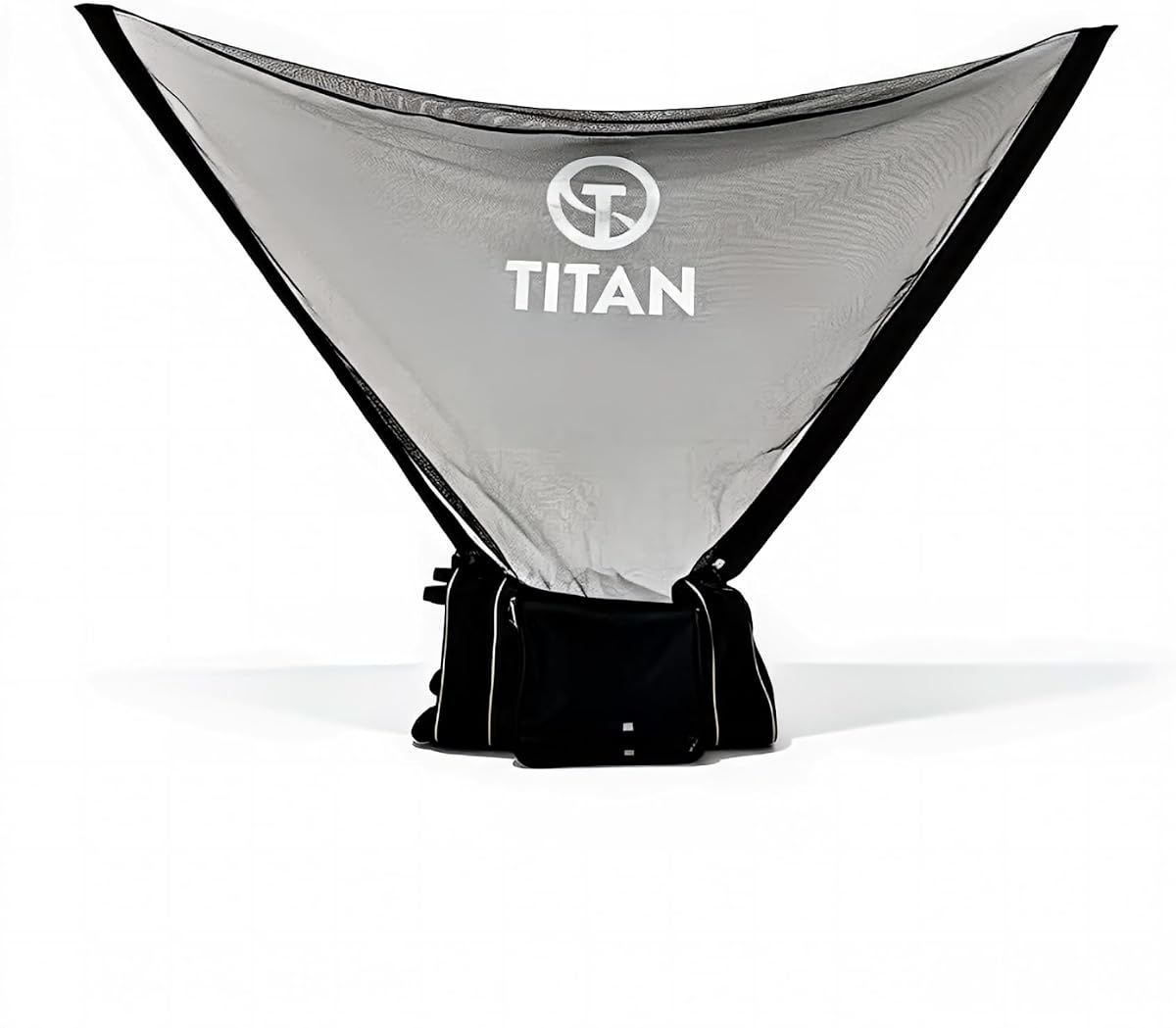
The TITTAN Reload is a specialized ball collector and rolling storage system rather than a launcher, and the supplied listing does not provide a numerical customer rating. Its central benefit is efficient collection: the net catches shots at waist height, directs them into an integrated bag, and eliminates much of the bending and chasing associated with machine training on hard courts.
We may earn a commission when you buy through this link, at no additional cost to you.
The storage bag holds 180 pickleballs. A retractable handle and wheels allow the collector to be rolled over and positioned for pouring balls back into a compatible machine. The product is specifically described as an easy-pour refill system for the Titan Machine, making it most relevant to owners of that machine. A folding frame and included travel bag simplify storage and transport.
The system is not a complete practice solution because it neither launches nor feeds balls. Its compatibility is also narrower than the broad multi-sport positioning of the portable recycling net in this guide. The absence of a numerical rating means buyers cannot use that measure to compare satisfaction and should instead rely on dimensional fit, material quality, and the strength of the machine pairing.
TITTAN Reload is an excellent companion for Titan owners who practice frequently and want to reduce collection time. It is especially valuable for clinics, coaches, and competitive players who need many uninterrupted repetitions. Anyone without a compatible machine will need a broader recycling solution rather than this Titan-focused system.
Catching balls at waist height reduces the need to crouch throughout a session. That can make long practice blocks more comfortable and preserve time for actual hitting.
The wheeled bag lets a user move collected balls to the machine and pour them back in. Its 180-ball capacity supports a high-volume practice cycle with fewer refills.
We may earn a commission when you buy through this link, at no additional cost to you.
Choose the training system that matches your court, skill level, and tolerance for setup. Feed control, capacity, collection, power, and portability matter more than the number of advertised features.
A fixed-position feeder is useful for repeatable technique work, but a moving system better develops reaction time and court coverage. Look for horizontal oscillation, vertical swing, adjustable elevation, or a combination of these functions. Random placement can make practice more match-like, while precise positioning is valuable when a coach is teaching a specific contact point or movement pattern.
A small hopper is manageable for short drills but interrupts longer sessions with frequent refills. Capacity ranges from 15 balls on the Franklin ProShot to more than 80 on the PP SMART PRO, while the Titan ONE supports a much larger range. Consider how many balls you collect, how quickly you can reload, and whether a return net is included before judging hopper size alone.
Manual switches, onboard controls, remotes, and smartphone apps offer different levels of convenience. A remote is ideal for quick changes during solo practice, while an app supports stored programs and coach-led workflows. Programmable systems are most useful when a player follows a structured plan rather than simply asking for a steady feed at a chosen speed.
Automatic feeding only saves time if balls remain manageable after they are hit. A recycling net catches and redirects shots, while a rolling collector stores a larger quantity and can be poured back into a compatible machine. Full-court or side-court collection systems require more space and setup, but they can dramatically reduce interruptions during frequent sessions.
AC-powered machines suit fixed locations, while battery models offer freedom from courtside outlets. Some accept both mains power and disposable batteries, and others use built-in lithium-ion packs. Advertised runtimes range from several hours to as much as eight hours. Battery type also affects the inconvenience of recharging, replacing cells, and transporting a heavier unit.
The lightest options are easiest for one person to carry between a garage, yard, park, or court. Larger units may include wheels or a trolley handle, but weight still matters. Tool-free assembly and foldable frames are particularly useful for people with limited storage or for coaches who move equipment regularly.
Not every launcher is intended for the same ball. Some support standard pickleballs exclusively, while others accept red tennis balls or standard tennis balls. A multipurpose hopper can be useful for mixed-sport households, but buyers should confirm the listed ball sizes and avoid assuming that conventional tennis balls behave like pickleballs in every drill.
Beginners often benefit from slow, consistent feeds for dinks, volleys, and basic contact. Advanced players may need faster speed ranges, random movement, longer distance, and stored drills. A manual rebounder offers active self-practice, while an automatic machine provides greater consistency. Match the tool to the skill you want to improve rather than choosing only by the largest feature list.
Begin with a clear drill and a safe court position. Place the machine on stable, level ground, keep the launch path away from people, and set a conservative speed before moving it. For oscillation or powered swing systems, confirm that the full movement envelope remains inside the intended practice area.
Load only the compatible ball type and keep the hopper and feed path clear. Begin with a short session to learn the remote, app, interval, speed, and angle settings. Advance one variable at a time, and allow enough recovery between repetitions so the drill remains technically sound rather than becoming a test of endurance alone.
After use, switch off the machine, unplug it when applicable, remove any remaining balls, and wipe the housing and feed mechanism according to the product instructions. Store batteries as directed, inspect the wheel, base, net, and moving parts, and address loose hardware before the next session. Automatic feeders and collection nets should be kept dry and protected from impact during transport.
A beginner usually benefits from a simple machine with a slow-speed setting, consistent delivery, and a manageable hopper. The Furlihong 3816PBH or Franklin ProShot are approachable choices, while the Furlihong Starter Kit adds a paddle, balls, net, and bag for a more complete setup. The best option depends on whether ease of use or bundled equipment matters more.
Oscillation is not essential for every drill, but it adds useful movement and reaction variety. A fixed feed helps isolate a stroke, while side-to-side or vertical movement better simulates unpredictable live-ball situations. Players focused on dinks and repeatable mechanics can begin with a simpler system and add movement as their skills develop.
Only some systems in this guide are explicitly compatible with tennis balls. The Pickleball Machine Ball Thrower and YUEWO machine list tennis-ball support, while the others are designed primarily for pickleball. Ball size, weight, and surface characteristics can affect performance, so compatibility should be confirmed rather than assumed.
A small hopper can work for short focused drills, but frequent refills interrupt longer sessions. Capacity requirements depend on shot frequency, whether balls are collected automatically, and how long the player intends to practice. A larger hopper or integrated collection system generally makes sustained training and coaching sessions more efficient.
A collector is valuable if your usual sessions involve frequent rallies and you dislike chasing balls. It requires additional floor space and setup, and some systems only work with particular launcher models. The TITTAN Reload is designed for Titan machines, while the Portable Pickleball Net is positioned as a broader multi-sport collection option.
Battery operation is the most flexible choice when no outlet is available. Dual-power machines are even more convenient because they can be used at home with mains power and taken outdoors on batteries. When comparing runtimes, also consider battery type, recharge time, replacement availability, and the weight of the installed pack.
Not necessarily. An app can make speed and interval changes convenient, but a beginner may benefit more from a simple remote or onboard switch. App-based systems become more valuable as drills become structured, programs are used regularly, or a coach shares repeatable routines with a group.
A rebounder can replace a machine for self-paced contact practice, but it does not deliver a consistent automated feed. The Westant Match Buddy lets the player generate and return shots, which develops preparation and timing but cannot provide programmed location, speed, or frequency. Automatic launchers are better for standardized drills and reaction training.
The Furlihong 3816PBH is the most balanced standalone choice, with remote controls, adjustable speed, two-axis movement, and flexible power options. Titan ONE leads the premium category through app-based drill programming, internal oscillation, shared content, and a substantial hopper, while PP SMART PRO delivers an unusually capable feature set at a budget-friendly level.
Prioritize the training problem you need to solve. Choose simple consistency for fundamentals, unpredictable movement for reaction work, programmable drills for structured improvement, and a collection system when court cleanup is consuming your sessions. Manual rebounders and multipurpose nets can add value, but they are complements to a full launcher rather than direct substitutes in every use case.
Before purchasing, verify ball compatibility, included accessories, dimensions, hopper capacity, power requirements, and any model-specific connections. Prices, ratings, and availability can change, and marketplace listings may evolve, so check the current product page and recent customer feedback at the time of purchase.