
BigBlue 21W SolarPowa 20
4.3Editor score
Lightweight book-sized folding design
Dual USB charging ports
IP68 panel weather protection
Our guide compares 10 foldable solar panels for backpacking, covering power output, portability, charging ports, weather resistance, efficiency, and setup
Foldable solar panels give backpackers a lightweight way to recharge phones, cameras, lights, power banks, and other essential electronics without relying on an outlet. The best models balance usable solar output, portable construction, dependable charging ports, and enough weather resistance for camping and hiking conditions.
We compared all ten panels using their stated wattage, conversion efficiency, folded size, weight, charging options, durability ratings, and included accessories. The list covers direct-charging designs for basic electronics as well as higher-output models intended for tablets, portable power stations, and selected laptops.
Each review identifies the panel that best fits a particular trip, from a lightweight option for ultralight hikers to a larger model for campers needing more charging flexibility. Product ratings and availability can change over time, and current prices should be checked on each listing before making a purchase.
4.3Editor score

4.4Editor score

4.4Editor score
The comparison below covers rated output, charging interfaces, portability, and environmental resistance, making it easier to identify the right panel for your route, device mix, and expected weather.

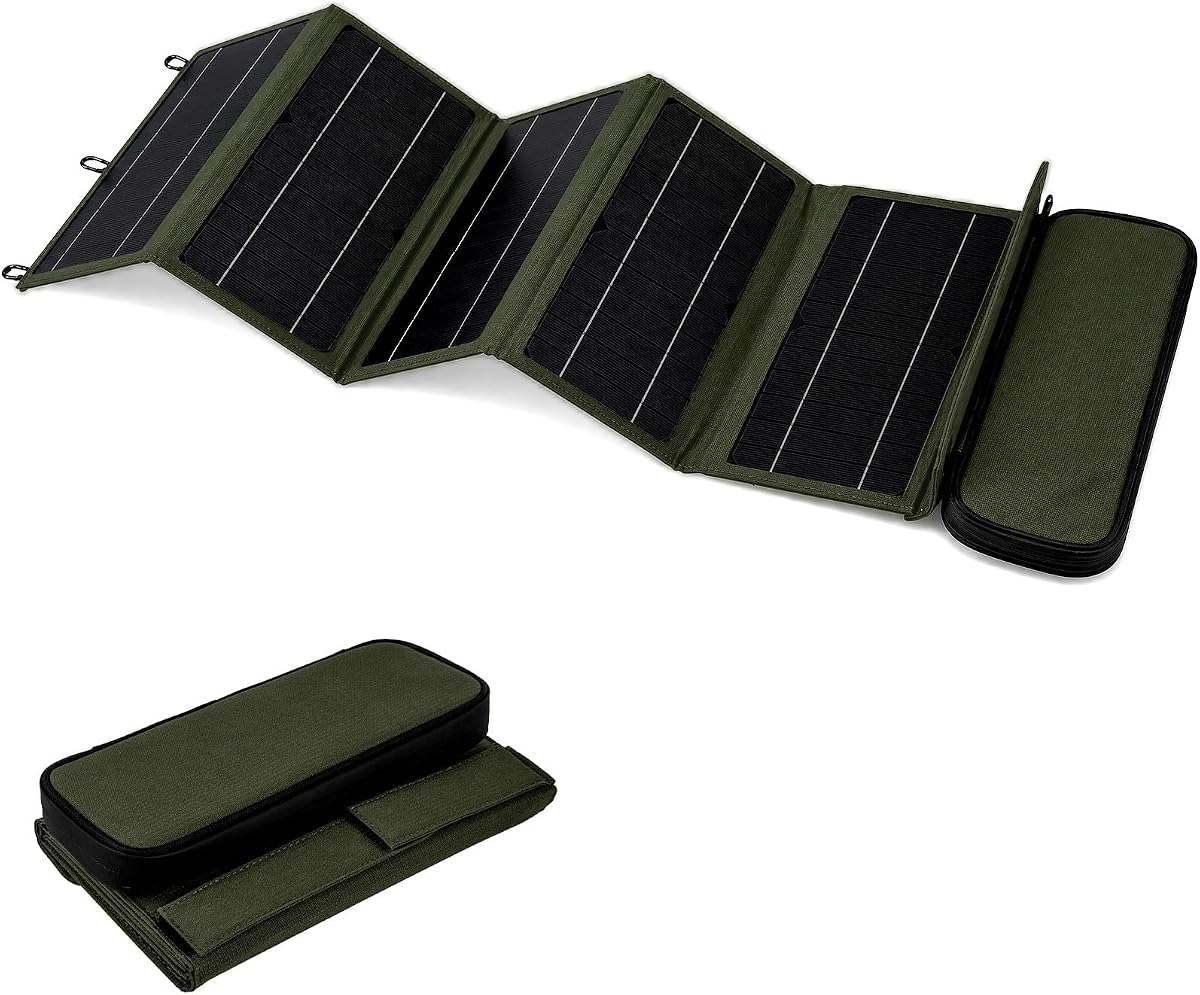


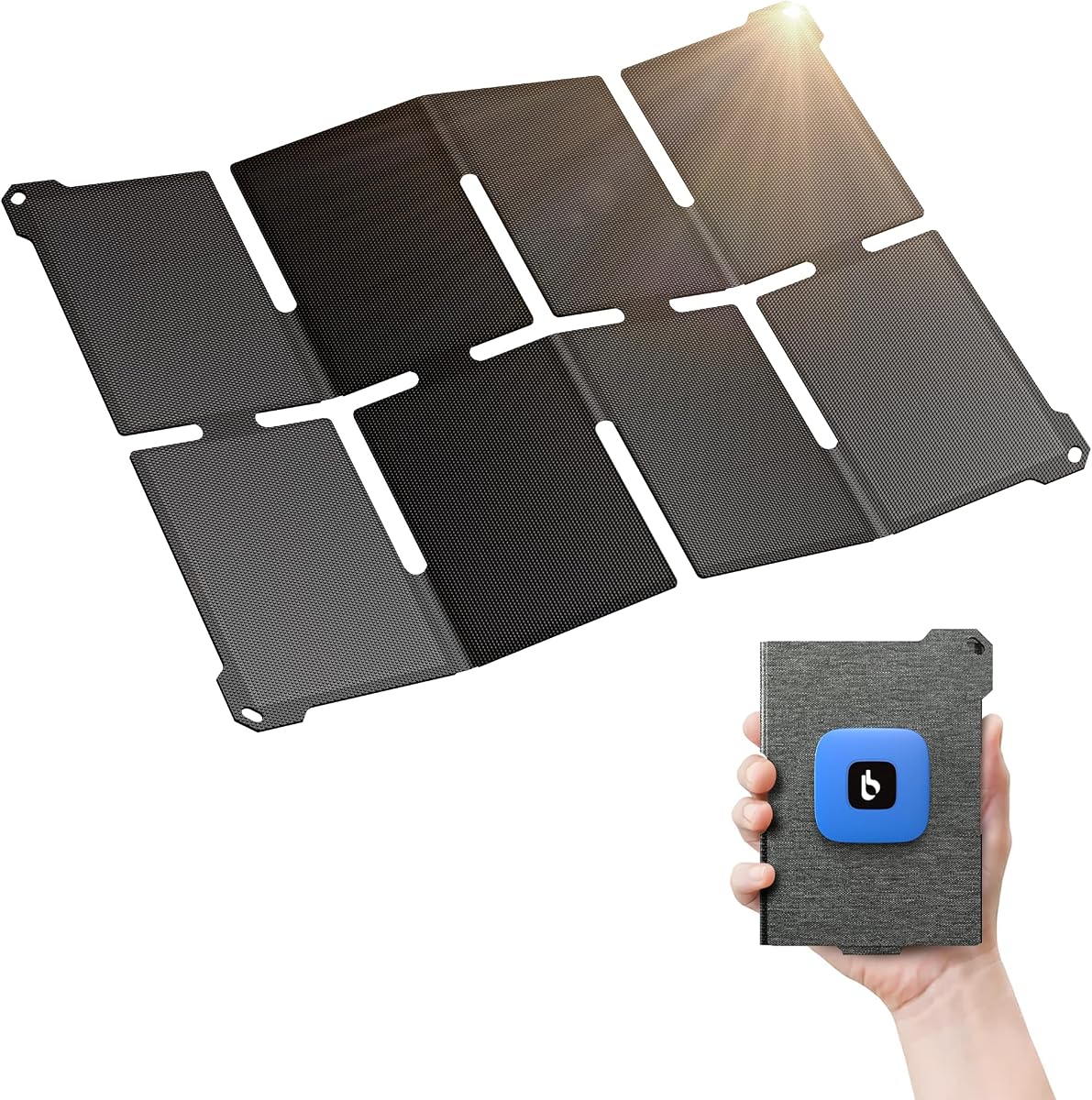


The FlexSolar 40W is a well-rounded direct-charging panel with a 4.4 rating and a broad collection of output options. It stands out because it combines 40 watts of rated solar output, 24% monocrystalline conversion efficiency, and a folded weight of only 1.76 pounds. That balance makes it suitable for backpackers who need more than a simple phone charger without carrying a large portable power station.
We may earn a commission when you buy through this link, at no additional cost to you.
Its charging flexibility is one of the most useful features. The panel includes a QC3.0 USB-A port and a PD2.0 USB-C port, each rated for up to 18 watts, plus a 19-volt DC output that can deliver up to 40 watts to a compatible small station. An integrated chip detects connected devices and distributes power intelligently, although the stated guidance recommends concentrating on one port when maximum efficiency is the priority. This makes the panel suitable for phones, tablets, power banks, cameras, and compatible small power stations.
The construction balances portability and outdoor durability. The panel folds to approximately 8 by 11.1 inches, includes two carabiners, and uses a monocrystalline construction with a 24% stated conversion rate. Its ETFE laminate is more resistant to abrasion than a basic PET surface, while the IP67 rating adds confidence in dusty or wet environments. There are still important limitations: the junction box is not fully waterproof, and heavy rain calls for storing the panel indoors.
This is the strongest general recommendation for backpackers who want one panel to handle several device classes. It is especially useful for a weekend trip involving a phone, camera, power bank, and small station, provided the panel can be unfolded in direct sunlight. People who demand the lightest possible setup may prefer the 21W BigBlue, while those seeking a larger USB-C-focused design may favor the 35W BigBlue. For broad compatibility and useful DC output at a manageable weight, however, the FlexSolar 40W occupies the most versatile position in this list.
The combination of USB-C, USB-A, and 19-volt DC output lets one panel serve phones, tablets, power banks, and compatible small stations. For the cleanest results, connect fewer devices when sunlight or panel surface area is limited.
At 1.76 pounds and approximately 8 by 11.1 inches folded, the panel is compact enough for many established backpacks. It offers more charging headroom than the smallest phone-oriented designs while remaining lighter than many higher-capacity camping panels.
We may earn a commission when you buy through this link, at no additional cost to you.
The SOLUPUP 30W is a value-oriented panel rated 4.4 stars and designed to serve common backpacker electronics. Its 30-watt output, 23%-plus monocrystalline efficiency, USB-A and USB-C ports, and included accessories make it a straightforward option for hikers who want to charge two devices during a break. It does not store electricity, so its value depends on using it in suitable sunlight.
We may earn a commission when you buy through this link, at no additional cost to you.
The dual outputs are specified at 5 volts and up to 3 amps, with a combined maximum of 15 watts. They can charge two compatible phones, a phone and a power bank, or other small USB-powered devices simultaneously. A built-in smart chip handles device recognition and includes protection against overcurrent, overvoltage, and short circuits. The automatic optimization function reconnects the system when sunlight returns after an interruption, which is useful when clouds move across a campsite.
For outdoor use, the panel includes an adjustable stand, two carabiners, and a USB-to-Type-C cable. It folds to a compact 10.63-inch size and weighs 2.4 pounds. The stated IPX5 rating covers dust and water resistance, though it is not as strong as the IP68 ratings offered by several BigBlue models in this comparison. Actual charging performance will vary with season, temperature, cloud cover, and panel angle, so positioning remains important.
The SOLUPUP is a good fit for weekend backpackers who want simultaneous charging without moving to a larger, heavier panel. It is less attractive for ultralight hikers because two pounds can noticeably affect pack weight, and it lacks the DC output of the FlexSolar 40W. Even so, it delivers a practical combination of capacity, dual charging, useful accessories, and straightforward setup at a likely lower cost than premium alternatives.
USB-A and USB-C outputs can charge two suitable devices at once, which is useful when a phone and camera battery need attention during the same sunny break. A power bank remains a sensible intermediary when total output is limited.
The folding design and adjustable stand allow the panel to be oriented toward the sun rather than laid flat. Included carabiners also make it easy to hang the folded unit from a pack or tree while it is not being used.
We may earn a commission when you buy through this link, at no additional cost to you.
This 30W five-panel charger has the highest listed rating in the group at 4.8 stars. Its defining feature is a broad, segmented folding design paired with a stated conversion efficiency above 25%. That configuration is appealing for backpackers who want a generous solar surface without moving into the weight class of a large 60W camping panel.
We may earn a commission when you buy through this link, at no additional cost to you.
The panel provides USB-C and USB-A outputs with a combined specification of 5 volts and 6 amps, limited to 5 volts and 3 amps per port. A USB-A-to-USB-C cable is included. The stated device compatibility includes smartphones, camping lights, cameras, GPS units, and other USB-powered electronics, which covers most common trail-navigation and capture equipment without requiring a separate cable for basic phone charging.
Its physical design focuses on outdoor setup. Nylon fabric and a wear-resistant surface protect the panel, while integrated hanging loops, secure folding straps, and adjustable kickstands provide several ways to orient it toward sunlight. The five sections unfold into a larger collector than a simple four-panel phone charger, which may help under favorable conditions. Actual output still depends on sunlight, and the listing appropriately notes that direct exposure remains essential.
This product is a strong choice for campers who prioritize a large collecting area, an advertised efficiency rate, and flexible positioning. It may be less compelling for strict ultralight buyers because no folded weight is provided, allowing a direct comparison to be difficult. It also lacks a stated IP rating, so careful storage during heavy rain is advisable. Subject to those uncertainties, its design and 4.8 rating make it one of the most compelling options here.
The five-panel structure provides more surface area than compact four-panel designs, which can be useful when a hiker has limited time to recharge. The advantage is most meaningful in direct sun and with the kickstands correctly aimed.
Hanging loops, straps, and kickstands make it possible to move the panel between ground-level and hanging positions. This flexibility helps users respond to changing sun angles without carrying separate mounting hardware.
We may earn a commission when you buy through this link, at no additional cost to you.
The BigBlue SolarPowa 20 is a compact 21-watt panel with a 4.3 rating, built for backpackers who want to keep carried weight under control. It folds to approximately the size of a book, weighs 1.32 pounds, and includes hooks for attachment to a backpack or tent. Its primary role is direct charging of common trail electronics rather than serving as a large power source.
We may earn a commission when you buy through this link, at no additional cost to you.
Two USB ports each support up to 5 volts and 3 amps, with a combined maximum of 5 volts and 4.2 amps. The panel is listed as suitable for iPhones, Android phones, tablets, power banks, and GPS devices when all sections receive sufficient sunlight. An intelligent charging chip provides overcurrent and short-circuit protection, and a USB-C-to-USB-C cable is included with two carabiners and a user manual.
Durability is a major strength. The panel uses monocrystalline cells with an advertised conversion efficiency of up to 24.7% and a light transmittance of up to 95%. Its PVDF surface is described as more durable than conventional PET and is said to offer twice the lifespan of conventional PET solar panels. The IP68 rating covers the panel, although the USB junction box is not waterproof and should be protected from moisture.
This is a compelling option for solo hikers whose daily load consists of a phone, small power bank, GPS unit, or camera. It is less suitable for tablets that need sustained high output or travelers seeking a direct laptop connection. The lack of internal storage is normal for this category but means the panel is useful only when sunlight is available. For anyone seeking the lightest credible all-day phone-charging solution among the higher-rated models, this BigBlue is hard to overlook.
The 1.32-pound weight and book-like folded form make this panel easier to justify on long backpacking routes. It can remain in the main pack or hang outside the pack using the included hooks when conditions are dry.
An IP68 panel rating provides strong resistance to dust and rain exposure. Because the junction box is not waterproof, keeping connections protected during downpours remains an important part of extending equipment life.
We may earn a commission when you buy through this link, at no additional cost to you.
The FlexSolar 25W combines a 4.4 rating with one of the lowest stated weights in the group. At 1.2 pounds and approximately 7.7 by 5.1 inches folded, it is designed for hikers who want USB charging capability without carrying a large panel. Its 25-watt rating and 23.2% photovoltaic efficiency place it between compact phone chargers and larger multi-device designs.
We may earn a commission when you buy through this link, at no additional cost to you.
Built-in USB-A and USB-C ports support simultaneous 5-volt, 3-amp charging. The listing describes MPPT technology for maximizing harvested energy even in partial shade, along with intelligent output management and Qi and PD compatibility. These features make the panel more appropriate for phones, earbuds, lights, cameras, and small power banks than for demanding laptop charging.
The panel emphasizes repeated-use durability. Its protective stack includes a scratch-resistant E-film surface, UV-stabilized EVA encapsulation, and an impact-absorbing polymer baseplate. The manufacturer states that this construction withstands more than 2,000 fold cycles, while hidden busbars are intended to reduce micro-crack failures. Components are rated IP67, and the stated operating range runs from minus 4 degrees Fahrenheit to 149 degrees Fahrenheit.
The trade-off is charging throughput. Although the solar panel is rated at 25 watts, the stated USB output is only 15 watts combined, and there is no 19-volt DC connection. That limitation is still reasonable for lightweight setups centered on a phone and a small battery. FlexSolar 25W is a good fit for travelers who rank pack weight and folding durability above laptop support or direct power-station charging.
A reinforced multilayer construction and a stated test of more than 2,000 fold cycles target the repeated compression backpackers give portable panels. The low-profile folded form also makes it easier to distribute weight across a pack.
MPPT harvesting and intelligent output management can improve energy capture when the panel experiences partial shade. Those features do not eliminate the usual limits of solar charging, but they make the unit more adaptable to changing outdoor conditions.
We may earn a commission when you buy through this link, at no additional cost to you.
The upgraded BigBlue 35W is a strong option for backpackers whose devices rely on modern USB-C fast charging. It has a 4.4 rating, a 35-watt solar rating, and a claimed 25.4% conversion efficiency. At 1.54 pounds and 8.29 by 4.84 inches folded, it is compact enough for a backpack while offering more output headroom than typical phone chargers.
We may earn a commission when you buy through this link, at no additional cost to you.
The interface configuration includes two Type-C ports and one USB-A port. One Type-C port supports up to 25 watts with PD and PPS, while the USB-A port supports QC up to 18 watts. The important compatibility restriction is that Type-C port 1 does not support Apple devices. The other ports are intended for Android and Apple phones, tablets, cameras, GPS units, and power banks.
Its dual parallel circuit design allows one section to continue producing power if another becomes shaded. This is a meaningful advantage during trail breaks when a backpack, tree, or passing cloud can interrupt part of the collector. The panel also has an IP68 rating for dust and weather resistance, although the USB junction box must remain dry. The product does not store electricity and requires direct sunlight.
This panel is a good match for modern Android-centric users, camera kit, and travel setups where USB-C PD matters. It is less fitting for travelers who need every port to support Apple hardware. Users should also keep connected devices in the shade because direct heat can trigger their thermal protection and reduce charging speed. Subject to those compatibility details, the 35W BigBlue is a fast-charging, shade-tolerant, and highly portable option.
The 25-watt PD and PPS Type-C connection is the main attraction for compatible laptops, tablets, and modern phones. PPS adjusts voltage and current, which can reduce heat and support steadier charging when the available solar output varies.
Parallel circuit strings help preserve output when one portion of the panel is shaded. The design cannot create energy without sunlight, but it can reduce the impact of a localized obstruction.
We may earn a commission when you buy through this link, at no additional cost to you.
The BigBlue 28W is a versatile three-port panel with a 4.3 rating. Its combination of 28 watts of solar output, 25.4% stated conversion efficiency, and a 1.5-pound folded weight gives it a balanced profile for backpackers who regularly carry more than one USB-powered device. It is a direct-charging panel rather than a stored-energy system.
We may earn a commission when you buy through this link, at no additional cost to you.
Two USB-C ports and one USB-A port each support up to 5 volts and 3 amps, with a combined maximum of 5 volts and 4.8 amps. The product is listed for smartphones, power banks, GPS units, flashlights, and other small electronics. A USB-C-to-USB-C cable, carabiners, and a manual are included. The manufacturer notes that an Apple device cable is not included, so buyers may need to bring their own compatible lead.
N-type cells and a shadow-free front surface are used to capture more sunlight and reduce front-side heat. The special polymer surface is described as resistant to rain, fog, and wear, while the overall panel carries an IP44 rating. That is below the IP65 and IP68 ratings of several alternatives, and the USB junction box is explicitly not waterproof. The panel folds to 11 by 6 by 1.4 inches.
The BigBlue 28W is well suited to travel, camping, and emergency kits where one panel should service several small electronics. It cannot charge laptops or large power stations, and the manufacturer advises against placing it behind a window or windscreen because glass and framing can reduce useful light. For campers seeking a simple three-port layout with strong cell efficiency and moderate weight, it remains a practical choice.
Dual USB-C and one USB-A connection simplify charging a phone, camera, GPS, and power bank during a sunny pause. Each port can operate at up to 5 volts and 3 amps, with a stated combined ceiling of 5 volts and 4.8 amps.
Removing metal lines from the front improves the uninterrupted light exposure of the N-type cells. Fewer exposed components may also help the panel run cooler, though outdoor placement and direct sunlight remain essential.
We may earn a commission when you buy through this link, at no additional cost to you.
The BigBlue Ultra-Light 25W is the smallest and lightest model in this comparison, with a stated weight of 0.84 pounds. Its folded dimensions are approximately 4.65 by 6.42 by 1.38 inches, and it carries a 4.3 rating. For ultralight hikers, those figures make it easier to justify carrying solar charging capability on a route where every ounce matters.
We may earn a commission when you buy through this link, at no additional cost to you.
The panel has USB-A output rated at 5 volts and 2.4 amps and USB-C output rated at 5 volts and 3 amps. It can charge two compatible devices at once, making it practical for a phone and small camping light or a phone paired with a compact power bank. The package includes a USB-C-to-USB-C cable, two carabiners, and an elastic strap. The panel does not contain an internal battery.
The construction uses ETFE coating, UV-resistant EVA, N-type solar cells, and a solid baseplate intended to resist hidden cracks. The absence of front-side metal lines is claimed to improve light capture and help the cells stay cooler, supporting a stated conversion efficiency of up to 25.4%. Its IP68 rating covers dust, splashes, spills, and light rain, although exposed electronics should still be protected during severe weather.
This is an excellent fit for hikers who need emergency or top-up charging rather than a powerful campsite generator. It can maintain a phone for navigation, preserve a camera battery, or replenish a small light during a sunny rest. The limited port output means it is not the right choice for a demanding tablet workflow or a direct power-station connection. For low overall weight and practical daily charging, however, this is a leading option.
At 0.84 pounds, the panel adds less carried mass than every other model listed here. Its compact folded profile fits easily into small side pockets or the upper section of a lightweight pack.
ETFE, UV-resistant EVA, and a reinforced baseplate create a durable package for regular handling. The IP68 rating adds useful protection, but keeping the connection area dry remains wise.
We may earn a commission when you buy through this link, at no additional cost to you.
The LUMOPAL 60W is the highest-output model here, with a 4.3 rating and a claimed 23.5% conversion rate. It is intended for backpackers and campers whose device mix includes tablets, cameras, laptops, or portable power stations. Unlike smaller phone panels, it offers USB-C PD, USB-A fast charging, and a 19-to-20-volt DC output.
We may earn a commission when you buy through this link, at no additional cost to you.
The USB-C port can provide up to 60 watts, while the two QC3.0 USB-A ports are described as supporting up to 22 watts collectively. The DC connection uses a 5.5-by-2.1-millimeter format. A smart charging chip identifies attached equipment and provides protection against overcurrent, overheating, and short circuits. These capabilities make the panel more versatile for high-draw USB-C devices than the basic phone-oriented alternatives.
The panel uses monocrystalline cells and an ETFE laminate that is described as more resistant to abrasion and corrosion than PET. Its IP65 rating, waterproof nylon fabric, and waterproof zipper improve weather resistance, but the junction ports themselves are not waterproof. The stated folded size is 6.7 by 9.5 inches, and the panel weighs 3.42 pounds. It is also stated to withstand up to 176 pounds of pressure when folded.
LUMOPAL is the right choice for a camper carrying a relatively heavy electronics load and willing to accept additional pack weight. It can support a portable station or compatible laptop in a way that the smaller panels cannot. It is less suitable for an ultralight solo trip where every item must earn its weight. For a vehicle-supported or base-camp outing, however, its output and port variety provide the most complete charging package in the list.
A 60-watt USB-C PD rating and dedicated DC output create more headroom for tablets, compatible laptops, cameras, and power stations. Actual device speeds still depend on sunlight, connection negotiation, and the requirements of the attached equipment.
ETFE lamination, an IP65 rating, waterproof fabric, and a sealed zipper are useful in wet camping environments. The exposed junction ports should still be covered or disconnected during heavy rain.
We may earn a commission when you buy through this link, at no additional cost to you.
The ELECOM NESTOUT 28W has a 4.5 rating and a distinctive fabric-based design intended to make the panel easy to organize and deploy. Its four-panel structure produces a stated 28 watts and uses SunPower MAXEON cells, which the manufacturer says can deliver up to a 24% efficiency increase compared with traditional solar cells. It is primarily aimed at phones, tablets, earbuds, and similar devices.
We may earn a commission when you buy through this link, at no additional cost to you.
Two USB-A ports provide the charging interfaces, and an integrated current checker uses an LED display to indicate the power being generated into those ports. That status feature can help a user determine whether the panel is receiving good light, although it does not convert the unit into a stored-power device. Two built-in adjustable stands allow the panel to be angled toward the sun.
Storage is the defining practical advantage. The water-resistant ripstop nylon body includes two mesh pouches for cables, carabiners, and small accessories, plus three exterior loops for hanging from a tree, tent, or cable. This organization can reduce the need for loose accessories in a pack. No numeric IP rating is given, so the weather-resistance claim should be treated as useful but less specific than the IP ratings attached to several BigBlue and FlexSolar models.
This panel is best for traditional backpackers who prefer a soft case with integrated organization and a four-panel layout. It is less attractive for travelers whose modern device ecosystem depends heavily on USB-C fast charging. It also may be bulkier than the smallest ultralight models. Nevertheless, its adjustable stands, current indicator, hanging points, and thoughtful storage make it a distinctive and user-friendly option for camping and general outdoor use.
Two mesh pouches keep small cables and carabiners organized within the folding case. This is a modest feature that can make a shared gear compartment tidier and reduce the chance of leaving small accessories behind.
Two adjustable stands help set the angle, while three exterior loops allow suspension from branches, tents, or lines. These options are useful when no flat patch of ground is available.
We may earn a commission when you buy through this link, at no additional cost to you.
The right backpacking solar panel depends on the devices you carry, the weight you can tolerate, the amount of direct sun available, and how often you need to recharge. Output ratings, port capabilities, folded size, and weather protection should be compared together rather than treated as interchangeable numbers.
Rated output indicates the panel's maximum solar generation under suitable conditions, but it is not the same as the charging speed delivered to every device. A 30-watt panel may deliver substantially less to a phone when partially shaded, placed at a poor angle, operating in cloud, or affected by high heat. Higher ratings generally provide more headroom for tablets, power banks, cameras, and portable stations, but they often require a larger collector and add weight.
Choose the lowest rating that comfortably covers your expected load. A 21W or 25W model is sensible for phones and small electronics, while a 30W to 35W panel offers more flexibility. Consider 60W only when you carry higher-power equipment and can accept the extra bulk.
USB-A remains useful for older batteries, lights, and many power banks, while USB-C is increasingly important for modern phones, tablets, GPS units, cameras, and laptops. Fast-charging protocols such as PD, PPS, and QC can improve results when both the panel and connected device support them. Always check the exact port limitations, because a model with multiple USB-C sockets may still restrict one of them to a particular device family.
Match every port to your actual equipment. Bring the correct cable if it is not included, particularly for older devices. DC output is useful for compatible small power stations but adds little for travelers whose entire load is charged over USB.
A backpacking panel competes with water, clothing, food, and safety gear for every gram. The lightest model in this guide is 0.84 pounds, while the highest-output LUMOPAL weighs 3.42 pounds. Folded dimensions matter as much as weight because a compact rectangle is easier to distribute across a pack than a broad, rigid object.
For ultralight trips, prioritize the lightest panel that can recharge your phone and essential navigation device. Car-based camping or base-camp travel allows a larger, higher-output model to make more sense. Measure your available pack space before choosing.
Conversion efficiency describes how effectively incident sunlight becomes electrical output under standardized testing, but real trail performance also depends on temperature, angle, cloud cover, shading, and panel cleanliness. A higher stated efficiency is helpful because it can produce more power from a limited collector area. It does not guarantee that a panel will charge quickly under poor conditions.
Treat efficiency as a supporting specification rather than the sole decision. A well-positioned 25.4% panel may outperform a nominally higher-wattage panel that is shaded or poorly angled. Favoring cell quality, adequate surface area, and sensible positioning gives a more balanced result.
IP ratings provide a more useful indication of environmental protection than a general claim of being waterproof. Panels in this guide range from IP44 to IP68, but most manufacturers note that the USB junction box or ports are not waterproof. That distinction matters because cables and connections are common failure points during drizzle, blowing dust, and wet campsites.
Choose a higher rating for exposed trips, but keep connections dry regardless. Disconnect and stow the panel during heavy rain, avoid submerging it, and dry it before packing. A protective bag can also prevent abrasion against keys, trekking poles, and hard gear.
Hanging loops, carabiners, integrated stands, straps, and kickstands influence how easily a panel can be deployed away from camp. A panel that stands correctly may collect substantially more energy than one laid flat or hung vertically at the wrong time of day. Backpack attachment options are convenient for charging while moving, although moving panels generally receive less direct light than stationary setups.
Look for stable supports and multiple hanging points if you expect to change positions. Also consider whether the included accessories are useful for your trip. Extra hardware adds convenience, but it can also create loose items that need to be tracked.
Backpacking panels are repeatedly folded, compressed, and exposed to abrasive surfaces. ETFE, PVDF, polymer laminates, and reinforced fabric can improve abrasion resistance and long-term durability, while hidden busbars and flexible cell layouts may reduce cracking around fold lines. Some products also publish fold-cycle testing, which offers more insight than a generic durability claim.
Inspect crease points after long trips, keep grit from accumulating in hinges, and do not compress a warm panel tightly in a closed pack. Proper storage helps preserve both the solar cells and the folding seams.
Nearly every panel here charges devices directly and has no internal battery. That keeps weight down, but output disappears when sunlight is unavailable. A foldable solar panel therefore complements a power bank rather than replacing one: use the panel to replenish the bank during good conditions, then use the bank after sunset. Products described as mini power stations still require sunlight to generate the energy they deliver.
If continuous nighttime power is essential, carry a separately charged power bank or a power station with its own battery. This distinction prevents disappointment when a hiker expects a panel to retain energy collected hours earlier.
Start by unfolding the panel in an open location that receives direct sunlight. Remove bags, clothing, branches, or other objects that could shade individual sections, and use the built-in stands or kickstands to face the cells toward the sun. Angle the panel as the sun moves when you have time, but avoid constantly repositioning it if that prevents devices from remaining connected. For the best results, keep the panel itself in sun while placing the phone or power bank in the shade to prevent overheating.
Connect the intended device with a compatible cable and avoid assuming every port offers the same charging speed. When multiple devices are connected, the available solar output must be shared, so charging may be slower. Monitor the charging indicator, and remember that clouds, trees, dust, high temperatures, and an unfavorable angle can all reduce output. Use a power bank as a buffer when you need reliable charging at a specific time.
After the trip, disconnect cables and wipe away dirt with a soft, dry cloth. Let the panel cool before folding it, and never place a hot panel under heavy compression. Keep the junction box and ports dry during storms, store the unit in a breathable location, and periodically inspect the laminate, seams, and cables for damage. Following these steps helps preserve output and extends the useful life of a panel that is exposed to constant movement and changing outdoor conditions.
Only some higher-output panels provide enough power for compatible laptops. The LUMOPAL 60W offers USB-C PD up to 60 watts and a 19-to-20-volt DC output, making it the most suitable option in this list for selected laptops and power stations. Even then, charging may be slow or intermittent because real solar output changes with sunlight, angle, and heat. A separately charged power bank or power station remains more dependable for critical laptop work.
The panels in this guide are direct-charging devices and do not store the energy they generate. They need sunlight connected to a device at the time power is needed. Pairing a panel with a power bank allows a hiker to collect solar energy during sunny periods and use the stored charge later after sunset.
Low output is commonly caused by shade, cloud cover, an incorrect sun angle, panel heat, dirty cells, or a device that is not compatible with the selected port. A phone or tablet left in direct sunlight may also slow or stop charging because its thermal protection activates. Move the panel into unobstructed sun, keep the device shaded, clean the surface, and verify the cable and charging protocol.
Many panels have strong dust and water-resistance ratings, but most manufacturers state that the USB junction box or ports are not waterproof. Light rain may be tolerated on the panel surface, while heavy rain, immersion, and wet connections should be avoided. Disconnect and stow the unit during storms and allow it to dry completely before packing.
No. Higher output is useful for tablets, power banks, portable stations, and selected laptops, but it usually means more surface area and weight. A 21W or 25W panel may be a better fit for a phone-centric ultralight kit, while a 60W model makes more sense for a heavier camping load. Choose based on your devices and realistic pack-space allowance.
It is better to keep the phone and other devices shaded while exposing the panel to direct sunlight. Phones and tablets can heat quickly in direct sun, causing their internal thermal controls to reduce or interrupt charging. Connecting the shaded device to a sunlit panel protects the device and can support steadier performance.
Reposition it when the sun angle changes enough to place part of the collector in shade. A stand or hanging loop can make adjustments easier, but frequent movement is not always necessary. During short breaks, a stable, well-oriented position is usually more practical than constantly chasing the sun.
Bring the correct charging cables, a compatible power bank, and any adapters your devices require. A small protective pouch can prevent abrasion and keep the panel dry, while the included carabiners or loops can aid attachment to a pack or tent. Keeping cables organized in a mesh pouch also helps prevent them from being lost during a long trip.
The FlexSolar 40W is the most versatile overall choice because it combines useful USB-C and USB-A charging, a 19-volt DC output, solid efficiency, and a manageable 1.76-pound weight. The SOLUPUP 30W provides a balanced value option with two ports and an adjustable stand, while the BigBlue 35W stands out for USB-C fast charging and partial-shade tolerance.
For a lighter kit, prioritize the BigBlue Ultra-Light 25W at 0.84 pounds or the BigBlue SolarPowa 20 for its compact form and IP68 protection. Choose the five-panel 30W model when a large collector and high stated efficiency matter, and consider the LUMOPAL 60W only when higher-power devices justify its extra weight. Device compatibility, connection placement, and realistic pack space should guide the final decision.
Ratings, product configurations, and prices can change, so check the current listing and included accessories before buying. Confirm that the panel's ports support your devices, read the latest weather limitations, and compare the current offer with the balance and charging needs of your trip.