
Klipsch Reference R-26FA
4.7Editor score
Integrated Dolby Atmos elevation
Dual copper-spun woofers
Flexible dual binding posts
Standing floor tower speakers are among the most versatile ways to build a powerful home audio system, whether the goal is cinematic surround sound, expansive stereo music, or a flexible mix of both. A strong tower should produce clear dialogue, controlled bass, convincing dynamics, and a wide soundstage while fitting naturally into the room.
This guide compares ten tower speaker options using their supplied specifications, ratings, driver configurations, cabinet construction, amplification needs, and intended applications. The list covers affordable powered-compatible passive models, premium home theater designs, hi-fi-oriented floorstanders, single speakers, and complete pairs so shoppers can compare more than just size.
Each entry explains the most important strengths, limitations, and ideal listener profile. The three leading selections are also featured in the top picks, while the full comparison table makes it easier to scan driver layouts and key features. As always, current prices and availability can change, so check the linked listings before purchasing.
4.7Editor score

4.6Editor score

4.6Editor score
As an Amazon Associate we earn from qualifying purchases.
This side-by-side overview compares every tower in the guide, highlighting driver layouts, bass approaches, amplification requirements, surround-sound capabilities, and practical placement features. It is designed to help narrow the field before considering the complete individual reviews.




The Polk Audio Monitor XT70 earns the top position because it combines a substantial three-way bass arrangement with broad home theater versatility. It carries a 4.6 rating, and its specification sheet includes a 1-inch tweeter, two 6.5-inch Dynamically Balanced woofers, and two 8-inch passive radiators. That combination makes it particularly compelling for listeners who want a large, full-range presentation rather than a modest pair of stereo towers.
We may earn a commission when you buy through this link, at no additional cost to you.
Its two passive radiators are the standout feature. Rather than relying on one visible bass driver to handle all low-frequency work, the XT70 has two dedicated 8-inch radiators that supplement the powered woofers. This architecture is well suited to movies, television, and music because it can create substantial low-end scale while preserving separate drivers for midrange and higher frequencies. Polk also specifies compatibility with Dolby Atmos and DTS:X receivers, along with high-resolution streaming services.
The main trade-off is that the listing contains one speaker rather than a stereo pair. Buyers should budget for a second unit when creating conventional left-and-right channels or a complete surround system. The XT70 also remains a passive design, meaning a suitable receiver or amplifier is required. Those considerations keep it from being a simple all-in-one option, but they also give knowledgeable buyers more control over system matching and future expansion.
This is an excellent choice for a dedicated home theater room, an ambitious music system, or a mixed-use setup where the speaker must handle both cinematic impact and extended hi-fi listening. Its relatively traditional visual design should fit comfortably into many interiors, and the supplied rubber feet support both carpet and hardwood placement. For shoppers seeking the most complete overall package in this guide, the Monitor XT70 offers the strongest balance of bass capability, format support, expansion potential, and practical home integration.
The XT70 is especially valuable as a front or surround tower in a larger theater system. Its dedicated radiators can contribute substantial low-frequency scale, while the dual balanced woofers provide the foundation for the midrange. The result is a design well matched to action films, streaming series, and large-room music playback when it is driven appropriately.
Polk describes the Monitor XT series as timbre matched, making it easier to build around the tower with compatible bookshelf, center, height, and subwoofer models. The available ecosystem supports both a traditional 5.1 layout and more ambitious surround configurations, giving buyers a clear path for expansion.
We may earn a commission when you buy through this link, at no additional cost to you.
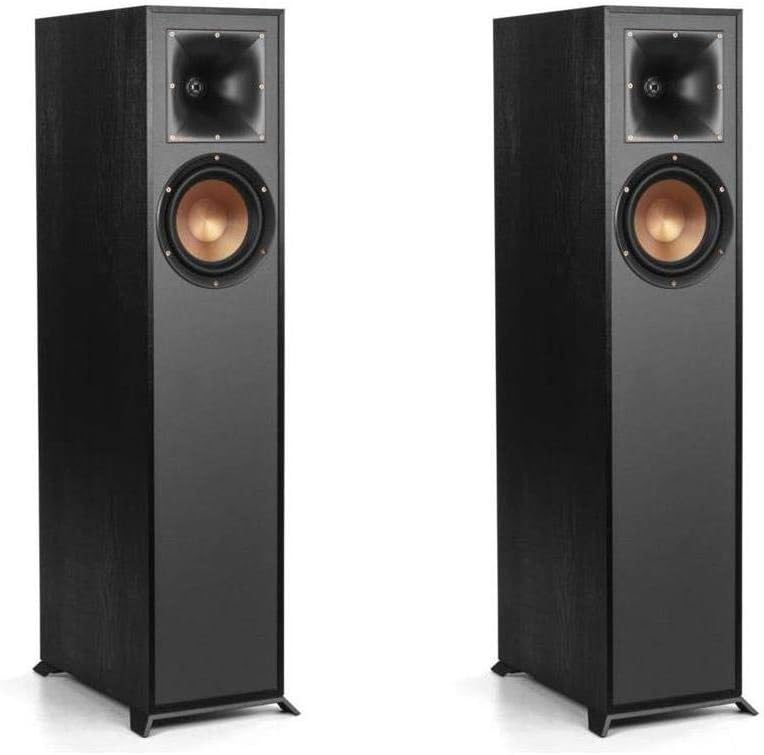
The Klipsch Reference R-26FA stands out as the strongest value-oriented selection in this roundup. It has a 4.7 rating, ships as a black pair, and combines an integrated elevation speaker with a conventional front-firing driver array. This is particularly useful for home theater buyers who want a more dimensional presentation without immediately adding separate height modules to the system.
We may earn a commission when you buy through this link, at no additional cost to you.
Its 1-inch aluminum diaphragm compression driver sits inside a 90-by-90-degree Tractrix horn, a design Klipsch uses to improve clarity, efficiency, and controlled directivity. Below it, dual 6.5-inch copper-spun IMG woofers handle bass and midrange duties, while the front-firing port supports low-frequency extension. The listed 100W continuous and 400W peak power handling provides a useful indication of the amplifier headroom to consider.
The principal compromise is that the built-in elevation speaker does not guarantee the same overhead effect as a dedicated height module in every room or processor configuration. Placement, ceiling reflections, and receiver processing all influence the result. The front port also means the rear wall cannot be completely flush, which should be considered in tightly arranged furniture layouts. Despite those room-dependent factors, the integrated height channel makes the R-26FA unusually complete for a two-speaker package.
The R-26FA is a strong recommendation for first-time home theater builders, music listeners who also watch movies, and anyone seeking a complete pair with surround-oriented design. It offers dedicated height hardware, a clear horn-loaded tweeter, robust woofers, and flexible connection options without requiring a tower pair to be assembled from separate units. That balance of capability and convenience makes it an especially persuasive budget-focused choice.
The integrated elevation speaker gives the R-26FA a practical advantage for Dolby Atmos and similar height-based formats. When connected to a compatible receiver and configured correctly, it can add overhead effects while keeping the primary front speakers in their normal positions.
The Tractrix horn controls dispersion around the compression driver, which can help maintain clarity and imaging. Dual binding posts also provide options for bi-wiring or bi-amping, giving experienced listeners additional ways to manage cable distribution and amplifier channels.
We may earn a commission when you buy through this link, at no additional cost to you.
The Polk Audio Reserve R700 is the premium selection because it combines high-resolution credentials, carefully engineered cabinet bracing, and an advanced bass-loading design. Its 4.6 rating reflects a well-regarded performance proposition, while the walnut finish and carefully shaped cabinet are designed to make it a visible part of a sophisticated living room or theater.
We may earn a commission when you buy through this link, at no additional cost to you.
At the top of the speaker, a 1-inch Pinnacle Ring Radiator tweeter is paired with dual 6.5-inch Turbine Cone woofers. The supplied specifications also identify a bass reflex cabinet with a down-firing port, dual 8-inch long-throw drivers, and Polk's patented Power Port 2.0 with X-Port Technology. Hi-Res Audio Certification, support for formats such as DSD, FLAC, WAV, ALAC, and MQA, and compatibility with Dolby Atmos and IMAX Enhanced make it particularly relevant to modern home entertainment systems.
Premium construction brings some practical caveats. The R700 is offered as one speaker, so a stereo or front-channel application generally requires a second unit. It is also a passive design, meaning amplifier quality and channel matching remain essential. Its specialized port and long-throw bass architecture are intended to deliver clean, powerful low frequencies, but placement in a small room should be handled carefully to avoid excessive low-end buildup. The adjustable feet and multiple included options make that process more manageable.
This model is ideal for serious home theater enthusiasts and hi-fi listeners who want a flagship-style floorstander with detailed specifications. It can serve as a front, side, or rear surround speaker, and adding the separately sold R900 height module creates a dedicated vertical layer. For buyers willing to build a matched premium system, the R700 is the most ambitious option in the guide and a fitting top recommendation.
The down-firing port and Power Port 2.0 construction distinguish the R700 from more conventional front- or rear-port designs. The supplied information highlights its ability to reduce port noise while producing room-filling, distortion-controlled bass for films and music.
Cross-braced cabinets help limit internal resonances, while acoustically inert magnetic grilles preserve a clean appearance. Rubber feet suit hard floors, and adjustable spike feet are included for carpet, allowing the owner to level and angle the tower according to the room.
We may earn a commission when you buy through this link, at no additional cost to you.
The Elimavi Black Tower Pair is a straightforward passive floorstander for shoppers who want two ready-matched speakers with a traditional two-way design. It carries a 4.4 rating and pairs dual 6.5-inch woofers with a 1-inch silk dome tweeter. The pair format is convenient for stereo music, front channels, or the front and rear positions of a home theater system.
We may earn a commission when you buy through this link, at no additional cost to you.
Its stated frequency response of 40Hz to 21kHz within plus or minus 3dB suggests an emphasis on full-range reproduction. The 120W RMS power rating is supported by a dense MDF cabinet intended to reduce resonance and coloration. A precision-engineered crossover divides the frequency spectrum, and the product information describes a wide, immersive soundstage suitable for room-filling listening. Compatibility with most AV receivers and amplifiers makes the towers flexible for many system configurations.
The trade-offs are mostly about sophistication rather than basic function. This model does not offer an integrated elevation speaker, and the listing does not identify advanced wireless connectivity or an active amplification section. It remains fully passive, so an appropriate receiver or amplifier is necessary. Buyers who want dedicated Atmos height effects should plan for separate height speakers, while those building a conventional 5.1 system will find the basic architecture easier to accommodate.
The Elimavi pair is a sensible option for first-time buyers building a home theater, as well as listeners who want conventional full-range towers without a complicated feature set. Its complete-pair packaging removes the need to source two units separately, and the black finish is broadly compatible with many rooms. It is best suited to users who prioritize familiar speaker design, clear specifications, and straightforward integration over specialized height effects.
The two-way layout assigns bass and midrange work to the dual woofers while the silk dome tweeter handles high frequencies. This familiar division allows the speakers to serve music and films without requiring a separate processor to activate built-in height channels.
Dense MDF is used throughout the cabinet to limit unwanted vibration. That construction supports a controlled presentation, while the specified crossover and broad frequency range make the pair suitable for both direct stereo listening and multi-channel home theater duty.
We may earn a commission when you buy through this link, at no additional cost to you.
The Klipsch Reference R-610F is built around efficiency, dynamics, and a familiar horn-loaded high-frequency design. It has a 4.7 rating and is sold as a black pair, making it an appealing choice for listeners who want immediate impact and broad amplifier compatibility. Its 94dB sensitivity is one of the most useful specifications for judging how easily a tower can be driven.
We may earn a commission when you buy through this link, at no additional cost to you.
Klipsch specifies an 85W continuous and 340W peak power rating, along with an 8-ohm impedance that works with most AV receivers. The 1-inch aluminum LTS tweeter uses a 90-by-90-degree Square Tractrix horn, designed to improve clarity and controlled high-frequency dispersion. The stated frequency response extends from 45Hz to 21kHz, providing a broad range for movies, music, and television.
As a conventional two-way design without a listed elevation speaker, the R-610F focuses on front-facing performance rather than integrated Dolby Atmos height effects. It will still serve within an Atmos system as a front, rear, or surround channel, but dedicated height modules would be needed for vertical placement. Its high efficiency and conventional impedance reduce amplifier-matching concerns, making it approachable for a broad range of systems.
This pair is well suited to buyers who value strong output, strong efficiency, and a dynamic presentation. It can work for a stereo setup, serve as the front pair in a theater, or fill rear channels when a center and subwoofer are added. The R-610F is less specialized than the R-26FA, but that simpler design can be an advantage for listeners who want established full-range behavior without height-processing considerations.
A 94dB sensitivity rating means the R-610F can produce substantial output without requiring exceptionally forceful amplification. Its standard 8-ohm load broadens receiver compatibility and makes it a straightforward option for a first serious home audio setup.
The Square Tractrix horn shapes dispersion around the 1-inch aluminum LTS tweeter. That controlled output is intended to improve clarity and dimensionality, particularly useful for dialogue, film effects, and stereo imaging.
We may earn a commission when you buy through this link, at no additional cost to you.
The Polk Audio Monitor XT60 is a flexible home theater tower that delivers a 4.6 rating and pairs a 6.5-inch Dynamically Balanced woofer with two matching passive radiators. That three-way low-frequency arrangement gives the model a larger apparent scale than a basic two-way tower while retaining a relatively straightforward front-facing design.
We may earn a commission when you buy through this link, at no additional cost to you.
The XT60 supports Hi-Res Audio, Dolby Atmos, Auro 3D, and DTS:X. This makes it relevant to modern receivers and a wide selection of streaming services, including Apple Music, Amazon Music, and Spotify. Its passive radiators are intended to extend low-frequency impact and help the speaker fill a room during movies, television, and music. The supplied information also notes that the towers can blend with related bookshelf, center, height, and subwoofer products.
As with the XT70, the principal purchasing consideration is that the listing is for one speaker. Creating stereo or front theater channels calls for a second tower, and the separate system components are additional purchases. The XT60 is also passive and therefore dependent on suitable amplification. Its relatively compact driver arrangement may also deliver less deep-bass scale than the XT70, but it can remain a more manageable option in rooms where very large floorstanders are impractical.
The XT60 is a strong middle ground for home theater listeners who want modern format compatibility and substantial passive-radiator bass without moving to the XT70's larger architecture. It also works well for music because the balanced woofer and tweeter are designed for smooth midrange and clear high frequencies. Buyers seeking a flexible, expandable Polk theater system will find this model especially easy to incorporate into a broader layout.
Compatibility with Dolby Atmos, Auro 3D, and DTS:X allows the XT60 to participate in several major surround-sound ecosystems. Actual height and immersive performance still depends on receiver processing, the chosen configuration, and the addition of appropriate height or surround channels.
The Monitor XT range is described as timbre matched, and the available bookshelf, center, height, and subwoofer options make it straightforward to assemble a coherent system. Rubber feet provide stability on both carpet and hardwood floors.
We may earn a commission when you buy through this link, at no additional cost to you.
The Polk Signature Elite ES60 in stunning black combines a 4.7 rating with one of the most robust conventional driver arrays in the guide. It uses a 1-inch Terylene tweeter and three 6.5-inch woofers under a Dynamically Balanced Acoustic Array 2.5-way cascading crossover, providing a large platform for cinematic playback and full-range music.
We may earn a commission when you buy through this link, at no additional cost to you.
Polk's Power Port Technology is the distinguishing feature. According to the supplied specifications, it delivers bass up to 3dB louder than conventional ported designs while reducing distortion, helping keep vocals and dialogue focused. The speaker is compatible with 4- and 8-ohm amplifiers, so it can accommodate a broad range of receivers. It also supports current surround formats, including Dolby Atmos and DTS:X, when used within a properly configured system.
The ES60 does not list an integrated elevation speaker, so dedicated Atmos height effects would require separate modules. It is also sold as a single unit, leaving the buyer to acquire a second tower for conventional stereo or front-channel use. Those points deserve attention because the visual presence and feature set of a premium tower should be matched by a deliberate system plan. The dual gold-plated five-way binding posts support secure, flexible cable connections, including the possibility of bi-wiring.
The black ES60 is well suited to a serious home theater or hi-fi system where substantial midrange and bass capability is desired without the Reserve R700's specialized port architecture. It is a particularly good match for listeners who prioritize dialogue clarity, music, and a polished modern appearance. The related white version offers the same core acoustic design, but this listing is the option for a dark, dramatic room aesthetic.
Three 6.5-inch woofers provide a large surface area for low- and mid-frequency reproduction. The cascading crossover organizes their operation, helping the ES60 create powerful, room-filling sound for action films, gaming, and music.
Dual gold-plated five-way binding posts provide a dependable termination point and support multiple connection methods. They are particularly useful for listeners who want clean cable management or plan to explore bi-wiring within a carefully matched system.
We may earn a commission when you buy through this link, at no additional cost to you.
The Elimavi Brown Tower Pair offers the same two-way architecture as the black version in a warmer finish for listeners who want floorstanding speakers that blend with wood furniture, warm interiors, or neutral decor. It has a 4.4 rating and includes two passive towers, each with dual 6.5-inch woofers and a 1-inch silk dome tweeter.
We may earn a commission when you buy through this link, at no additional cost to you.
The stated 120W RMS handling and 40Hz-to-21kHz frequency response make the pair suitable for conventional home theater and hi-fi use. Its MDF cabinet is designed to minimize resonance and coloration, while the crossover divides the frequency spectrum in a conventional two-way arrangement. According to the product information, it is compatible with most AV receivers and amplifiers, so it can be integrated into either a stereo setup or a larger surround configuration.
This model shares the practical limitations of conventional passive towers. There is no integrated elevation speaker, so buyers interested in overhead sound effects need separate height channels. Because the listing contains a pair, the speakers can immediately serve as the main left and right units, although a center channel, surround speakers, and subwoofer would still be needed for a complete theater. Matching a brown tower to darker electronics can also require more deliberate room planning than a black model.
The brown pair is a practical choice for shoppers who prioritize a complete two-speaker package, familiar full-range design, and understated domestic appearance. It is suited to music, television, and movies, particularly in rooms where wood finishes are already prominent. It does not attempt specialized height effects, but it delivers a clear specification set and straightforward path to building a larger system.
The silk dome tweeter and paired woofers provide a direct division of high- and low-frequency duties. This arrangement is easy to integrate, familiar to hi-fi shoppers, and suitable for conventional music and movie listening without dedicated height processing.
The brown finish distinguishes this pair from the black Elimavi model without changing the underlying acoustic specification. It can work especially well in living rooms with wood media furniture, neutral walls, and a less theater-focused visual style.
We may earn a commission when you buy through this link, at no additional cost to you.
The Polk Signature Elite ES60 in elegant white delivers the same 4.7-rated acoustic platform as the black ES60 in a finish designed for bright, contemporary, or minimalist interiors. Its 1-inch Terylene tweeter and three 6.5-inch woofers are controlled by a Dynamically Balanced Acoustic Array 2.5-way cascading crossover, creating a capable full-range tower for movies, games, and music.
We may earn a commission when you buy through this link, at no additional cost to you.
Power Port Technology is included to provide stronger, cleaner bass than conventional ported designs while minimizing distortion. The high-sensitivity speaker is compatible with both 4- and 8-ohm amplifiers and can be used with Dolby Atmos and DTS:X receivers, as well as major high-resolution streaming services. That flexibility makes the white ES60 appealing for a mixed system rather than one limited to a single content type.
Buyers should plan for a second tower because this is a single-speaker listing. It also lacks an integrated elevation driver, meaning an immersive height channel would need separate equipment. The four-and eight-ohm compatibility broadens receiver options, but proper matching still matters when combining it with a center, surrounds, and subwoofer. The white finish may also stand out more prominently in a dark room, although that can be an intentional design choice.
This ES60 is best for buyers who want flagship-like scale and modern styling without the Reserve R700's advanced port specification. It is especially attractive in a bright media room where black equipment would feel visually heavy. The combination of three woofers, a dedicated tweeter, and a flexible 2.5-way crossover gives it strong all-around credentials for both critical music listening and dynamic home theater playback.
The elegant white finish gives the ES60 a more decorative presence than a conventional black tower. It can function as part of the room design rather than disappearing into a dark entertainment cabinet, making it attractive for contemporary living spaces.
The specified Power Port design is intended to increase low-frequency impact while maintaining cleaner output. Combined with three woofers and the cascading crossover, it supports a large, confident presentation when the speaker is correctly placed and amplified.
We may earn a commission when you buy through this link, at no additional cost to you.
The Polk Signature Elite ES50 is the more compact-class option in this guide, using two 5.25-inch woofers rather than the three larger woofers found in the ES60. It carries a 4.6 rating and retains the same 1-inch Terylene tweeter, Dynamically Balanced Acoustic Array 2.5-way cascading crossover, and Power Port Technology. Those shared features preserve the core identity of the Signature Elite line.
We may earn a commission when you buy through this link, at no additional cost to you.
The smaller driver format may make the ES50 easier to accommodate in rooms where a full-size floorstander feels visually or physically imposing. Its high sensitivity and 4- and 8-ohm compatibility allow it to work with a broad range of receivers and amplifiers. Dolby Atmos and DTS:X compatibility expands its role in a modern theater, and the supplied information notes support for high-resolution streaming services such as Apple Music, Amazon Music HD, and Spotify.
The central trade-off is bass scale. Two 5.25-inch woofers will not offer the same low-frequency output or visual impact as three 6.5-inch drivers, and a subwoofer may be important for home theater use. The product is also sold as a single speaker, so a second unit is required for stereo or matching front channels. Those are acceptable compromises for buyers who value a slimmer visual footprint and strong full-range performance over maximum low-end authority.
The ES50 works well for apartment listening, compact media rooms, or a two-channel music system where large tower speakers would dominate the space. It can also serve as part of a multi-speaker theater because its 2.5-way architecture and shared Polk design language support coherent system building. For shoppers seeking the Signature Elite character at a more compact scale, this is a practical final selection.
The ES50 reduces the woofer count and diameter while retaining the 2.5-way cascading crossover and dedicated tweeter. This allows it to deliver a broad, room-filling presentation in a less imposing enclosure.
With 4- and 8-ohm compatibility and support for major surround formats, the ES50 can serve in front, rear, or side positions. A subwoofer can supply deeper low-frequency effects when the system requires more foundational bass than the tower alone provides.
We may earn a commission when you buy through this link, at no additional cost to you.
Choosing floorstanding speakers means balancing room size, amplifier capability, driver design, sound priorities, and system expansion. The most important first step is to identify how the towers will be used and which technical features can improve that particular setup.
Choose an amplifier and tower combination that fits together rather than focusing on peak wattage alone. Continuous or RMS handling indicates sustained capability, while sensitivity helps estimate how hard the speaker asks the amplifier to work. For bi-wiring or bi-amping models, confirm that your receiver provides the necessary channels or external amplification.
Prioritize the driver and port approach that matches your room and media. If you need the deepest home theater impact, favor the passive-radiator, multi-woofer, or advanced port designs. If physical size and moderate low-frequency output matter more, a conventional two-way tower may be the better fit.
Decide whether the first priority is a natural stereo pair, a complete theater front stage, or a modular system that will expand later. Buying matched front and rear towers from the same model family usually simplifies tonal continuity. Planning the entire channel layout before ordering helps prevent mismatched drivers, uneven output, or an unnecessary upgrade later.
For a main listening seat, auditioning is valuable because horn character, crossover behavior, and room placement are subjective. When comparison is not possible, look for models with clearly stated frequency response, sensitivity, and directivity characteristics. Favor a design whose sound signature and physical dimensions suit your listening habits.
Choose a finish and cabinet scale that you will want to live with every day. Leave enough room for airflow, rear connections, and the port's required clearance. If the speakers will be visible, treat their design as part of the room rather than an afterthought.
Read the package contents carefully before ordering. When assembling a multi-speaker theater, matching model families generally provides more consistent tonal balance. Also remember that center, surround, height, and subwoofer products may be sold separately.
Prioritize immersive support if height effects, object-based audio, or high-resolution streaming are central to your setup. For conventional stereo listening, a capable full-range tower, reliable amplifier, and favorable room placement can matter more than extra format badges.
Begin with the manual and the amplifier instructions. Confirm impedance, recommended power, terminal configuration, and any manufacturer-specific setup requirements before connecting the speakers. Turn the amplifier off while wiring, match positive and negative terminals on both channels, and make sure each speaker receives the correct left or right input. For bi-wiring or bi-amping, follow the supplied diagrams exactly rather than improvising connections.
Position the towers symmetrically near the front of the listening area, then angle them toward the primary seats if the design allows. Leave clearance around bass ports, particularly on front-ported models. The Reserve R700 includes separate rubber and spike feet for different floor types, while other models supply rubber feet for carpet and hard surfaces. Run experiments with small changes in toe-in, distance from the wall, and distance between the towers.
Start with modest volume, set the receiver to a neutral or appropriate starting point, and allow the speakers to operate consistently before judging final placement. Keep the cabinets dry, dust them gently with a soft cloth, and avoid liquid cleaners or abrasive materials. Do not push the amplifiers into clipping, and consult the manufacturer before changing crossover, bass-management, or bi-amping settings.
Floorstanding speakers are not automatically better, but they can reduce cabinet space needs and often provide greater bass capacity because they can use larger drivers and deeper cabinets. Bookshelf speakers can still deliver excellent results when paired with a subwoofer and placed properly. The best choice depends on room size, budget, amplifier capability, and whether a freestanding tower suits your decor.
Most stereo systems use a left and right tower to create a balanced, spacious image. Some products in this guide include two speakers, while the Polk listings generally contain one unit. A single tower can be used in a multichannel layout, but buying a matched second speaker is necessary for conventional stereo playback and matching front channels.
They require an external receiver or amplifier because the featured models are passive. Match the amplifier to the speaker's stated impedance, sensitivity, and power handling, and verify that the receiver supports one or two channels at the required load. High-sensitivity models may work well with a range of receivers, while less efficient or premium towers may benefit from more capable amplification.
Yes, tower speakers are commonly used as front or surround channels in a home theater. Many of the Polk models can be matched with compatible center, bookshelf, height, and subwoofer products. For low-frequency effects, adding a subwoofer is usually more effective than expecting the towers to reproduce the deepest bass on their own.
A conventional 3-way design assigns separate drivers to low, mid, and high frequencies, while a 2.5-way design often allows some of the bass-capable woofers to contribute to lower midrange output. The ES50, ES60, and XT70 use multi-driver arrangements that may be described as 2.5-way systems. These designs can offer strong dynamics while keeping the cabinet simpler than a fully separate three-way tower.
No. The Klipsch R-26FA's integrated elevation speakers require a compatible processor or receiver, appropriate wiring, and correct channel assignment to create the intended overhead effect. Other tower models may support Dolby Atmos or DTS:X but still require separate height speakers to reproduce vertical channels.
There is no single correct distance because the cabinet, port placement, and room dimensions matter. Front-ported models need more rear clearance, while down-firing or carefully ported designs may allow different positioning. Start with a symmetrical arrangement and gradually adjust the distance, toe-in, and amplifier settings while listening from the main seat.
The Reserve R700 includes acoustically inert magnetic grilles designed to reduce diffraction while maintaining a clean appearance. Other listed models may or may not include removable grilles, so check the package information. Leaving grilles off can protect the drivers from accidental contact, while grilles on can provide a more uniform visual appearance across a large cabinet.
The Polk Audio Monitor XT70 stands out as the most complete overall recommendation, with dual balanced woofers, two 8-inch passive radiators, broad format support, and a strong path toward a larger home theater. The Klipsch Reference R-26FA is the best value pick for buyers who want a ready-made pair with integrated height effects, while the Polk Reserve R700 represents the premium destination for high-resolution audio and refined bass engineering.
For a more traditional full-range pair, the Elimavi models offer a clear and accessible specification set, and the Klipsch R-610F provides high efficiency with a dynamic horn-loaded tweeter. Among the remaining Polk choices, the XT60 is a versatile theater option, the ES60 emphasizes larger woofer arrays, the white ES60 fits brighter rooms, and the ES50 offers a more compact alternative. Prioritize the required channel quantity, amplifier match, room dimensions, and finish before making a final decision.
Current prices, discounts, seller details, and availability can change, so review the linked product pages before ordering. Confirm the package contents, speaker quantity, dimensions, impedance requirements, and included accessories, and make sure the system plan includes a suitable receiver, center channel, surround speakers, and subwoofer where needed. A carefully matched setup and correct placement will matter more than any single specification.