
JSAUX RCA to 3.5mm Cable
4.7Editor score
Dual-shielded oxygen copper
Double-braided nylon exterior
Six-foot flexible cable
Color-coded RCA channels
A 3.5mm to RCA cable bridges modern phones, tablets, and laptops with older amplifiers, receivers, speakers, and car stereos that use separate left and right channels. The best cable should provide a secure fit, preserve a clean stereo signal, withstand regular handling, and suit the distance between your source and destination.
We compared all ten options by examining connector design, cable length, conductor and shielding construction, jack compatibility, directional requirements, and practical durability claims. The list covers budget everyday cables, extended runs, right-angle solutions, and premium constructions intended for more demanding audio systems.
Each pick stands out for a different reason, from versatile six-foot connectivity to advanced four-core signal handling and compact high-end designs. Ratings reflect the supplied customer feedback, while specifications and product details are based on manufacturer information. Prices and availability may change, so check the current listing before purchasing.
4.7Editor score

4.7Editor score
4.5Editor score
As an Amazon Associate we earn from qualifying purchases.
The comparison below highlights each cable's length, connector configuration, shielding, and intended use. These differences determine whether a model is best for a compact desktop setup, a longer room or vehicle run, or a premium signal chain.




The UGREEN 3.5mm to RCA Cable combines a 6.6-foot length with gold-plated connectors, copper conductors, and a flexible PVC jacket. Its 4.7 rating reflects broad customer approval, while the compact 3.5mm plug and separate red and white RCA ends make it a practical all-purpose stereo adapter.
We may earn a commission when you buy through this link, at no additional cost to you.
The cable's main strength is its balanced approach. Gold-plated contacts and copper conductors support conductivity and durability, while the construction is designed to minimize sound loss, radio-frequency interference, and electromagnetic interference. Slim connector housings may also seat more easily when a phone or tablet remains in a protective case, and color coding reduces confusion when matching left and right channels.
UGREEN states that the cable has been tested to withstand more than 10,000 bends, and its flexible, tangle-free design is useful for repeated daily routing. The main limitation is that this particular six-foot version has no fixed length options, even though the broader product is described in four lengths. It also lacks the dedicated filtering components seen in some premium alternatives.
This is the strongest general recommendation for someone who wants dependable construction without choosing a highly specialized cable. It is suitable for phones, tablets, laptops, MP3 players, amplifiers, receivers, speakers, and other RCA-equipped equipment. Choose it when straightforward stereo connectivity, a manageable cable length, and durable everyday materials matter most.
Gold-plated connectors, copper wiring, and interference-conscious construction make this cable a dependable choice for common home and office audio connections. The goal is consistent stereo transmission rather than adding equipment to the signal chain.
The red and white RCA markings make it easy to identify the right and left channels. Its slim 3.5mm housing is also designed for a more secure fit when a mobile device is used with a case.
We may earn a commission when you buy through this link, at no additional cost to you.
The JSAUX RCA to 3.5mm Cable offers a 6.6-foot braided cable, dual shielding, gold-plated connectors, and an oxygen-copper core. With a 4.7 rating, it stands out as an economical option that does not require buyers to sacrifice the basic features associated with a dependable auxiliary-to-RCA connection.
We may earn a commission when you buy through this link, at no additional cost to you.
Shielding is a central part of the design, helping reduce exposure to outside interference while supporting stable stereo transmission. The RCA ends have easy-to-grip housings, and red and white markings make channel assignment straightforward. A double-braided nylon exterior adds useful resistance to everyday bending, pulling, and tangling.
The principal tradeoff is that it does not include a ferrite bead or a built-in circuit board at the splitter. That means it is less specialized for installations with unusually high electromagnetic noise or strict directional requirements. Its six-foot length is also not ideal when a source sits much farther from the amplifier, although the cable is otherwise easy to route.
This cable is best for budget-conscious shoppers connecting a phone, tablet, MP3 player, or laptop to a stereo receiver, speaker, amplifier, television, or car audio system. It offers one of the strongest balances of shielding, flexibility, and durability in the list, making it an especially attractive everyday choice.
Dual shielding and an oxygen-copper core form a practical foundation for clean stereo playback. These details can be useful where a cable runs near computers, power equipment, or other potential sources of electrical noise.
The double-braided nylon exterior resists tangling and repeated bending. A stated lifespan of more than 10,000 bends supports its suitability for mobile setups where the cable is moved frequently.
We may earn a commission when you buy through this link, at no additional cost to you.
The FosPower 3.5mm to RCA Cable is a 10-foot stereo adapter with a 3.5mm male plug and two male RCA connectors. Its 4.7 rating and emphasis on shielding, flexible construction, and a beveled step-down design make it especially practical for setups where the source and stereo equipment are not close together.
We may earn a commission when you buy through this link, at no additional cost to you.
Its copper-braided and aluminum-foil shielding provide two layers of protection against electromagnetic and radio-frequency interference. A polyethylene foam dielectric is intended to minimize signal loss, while 24K gold-plated contacts resist corrosion and tarnish. These features make the cable appropriate for a home receiver, amplifier, or similar RCA-equipped system where a longer route is needed.
The defining physical feature is the beveled step-down plug. According to the product information, it can remain fully seated even when the source device has a case installed. The tradeoff is that a 10-foot cable is less convenient to carry than a three- or four-foot option, and the step-down housing is less minimalist than a slim straight connector.
Choose this cable when cable routing matters more than portability. It is a strong fit for a phone or laptop feeding a stereo system across a desk, entertainment center, or workshop. Buyers who need an even longer run should also examine the 15-foot option later in this guide, while compact installations are better served by a shorter premium cable.
The beveled step-down design is intended to fit when a phone or tablet is enclosed in a case. This reduces the chance that the connector will sit too shallow for a stable audio connection.
Copper braid and aluminum foil work together to reduce EMI and RFI. The polyethylene foam dielectric adds another layer of signal control for longer home or studio-style runs.
We may earn a commission when you buy through this link, at no additional cost to you.
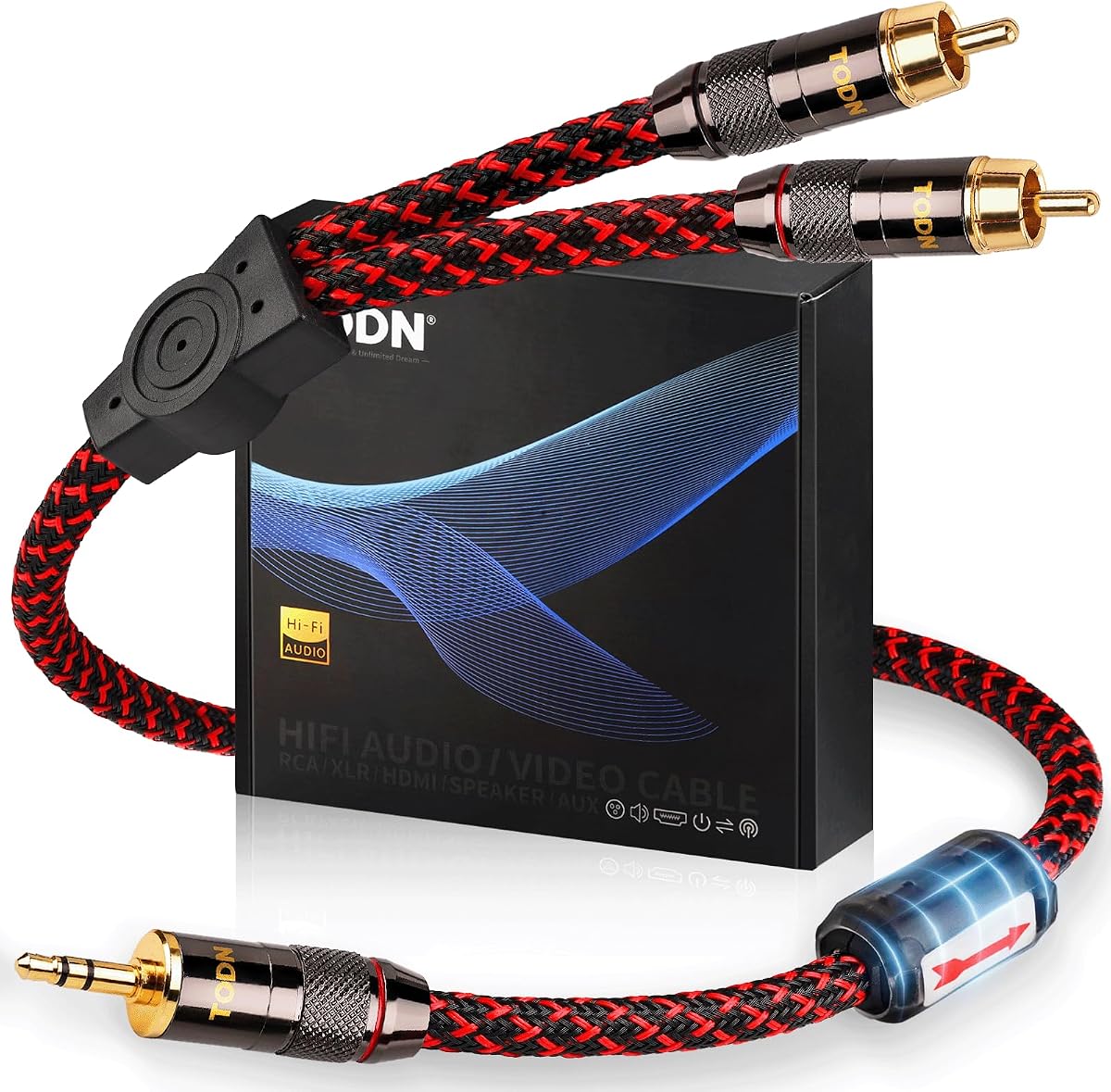
The TODN 3ft RCA to 3.5mm Cable is the most technically specialized option in the guide, featuring 99.99% oxygen-free copper, a four-core conductor arrangement, an integrated circuit board, and a ferrite bead. Its 4.5 rating indicates solid customer approval, and the three-foot length is well suited to a nearby source and stereo system.
We may earn a commission when you buy through this link, at no additional cost to you.
The four-core construction increases total conductor surface area, which the manufacturer says improves high-frequency performance compared with a two-core design. Tinned-copper braided shielding reduces electromagnetic and radio-frequency interference as well as crosstalk between the left and right channels. A ferrite bead positioned near the 3.5mm output end provides an additional filtering function, while the built-in PCB provides a more precise split of the stereo output.
Unlike simpler passive adapters, this cable has a defined signal direction. An arrow on the ferrite bead identifies the recommended orientation, and the product information warns that reversing it may cause a signal-level mismatch or equipment damage. That requirement adds complexity, and the short lead may not reach equipment positioned farther away.
This is a compelling option for a compact audiophile setup, a near-field desktop system, or a car installation where short routing and careful signal conditioning are priorities. It is less suitable for a room-spanning connection or for anyone who prefers a completely unrestricted cable. Carefully observing the indicated direction is essential.
The built-in PCB separates the 3.5mm stereo output into left and right RCA connections. This design and the 7mm cable diameters are intended to minimize crosstalk between the two channels.
The ferrite bead should remain near the 3.5mm source, with the arrow indicating the intended signal flow. Correct orientation helps the filtering and separation features work as intended.
We may earn a commission when you buy through this link, at no additional cost to you.
The Amazon Basics 3.5mm Stereo Aux to 2 RCA Audio Cable Adapter is a four-foot cable with one 3.5mm male connector and two male RCA ends. It has a 4.7 rating and focuses on a familiar, uncomplicated design for connecting phones, tablets, and MP3 players to speakers, stereo receivers, and other RCA-enabled equipment.
We may earn a commission when you buy through this link, at no additional cost to you.
Dual shielding is intended to reduce interference, while polished metal connector housings and a corrosion-resistant gold-plated 3.5mm plug support dependable contact. The cable includes separate right and left connections and fits standard 3.5mm auxiliary outputs, including the headphone-style jacks commonly found on portable media devices.
Its four-foot length is excellent for a desk, bedside setup, or compact stereo arrangement, but it is too short for many entertainment centers where the source may be across the room. It also does not advertise the braided exterior, stepped plug profile, or enhanced filtering found in more specialized products.
This adapter is a sensible choice for anyone seeking a familiar, uncomplicated stereo connection without unnecessary features. It is particularly useful when both devices are close together and the main priorities are a standard 3.5mm interface, a straightforward RCA split, and dependable shielding.
A four-foot lead provides enough room to move a phone or small player around a desk while keeping the connection tidy. It is less useful when the source and receiver are separated by furniture or positioned in different rooms.
The standard male 3.5mm connector works with the headphone or auxiliary outputs commonly found on phones, tablets, and portable media players. Two RCA plugs then carry the separate stereo channels.
We may earn a commission when you buy through this link, at no additional cost to you.
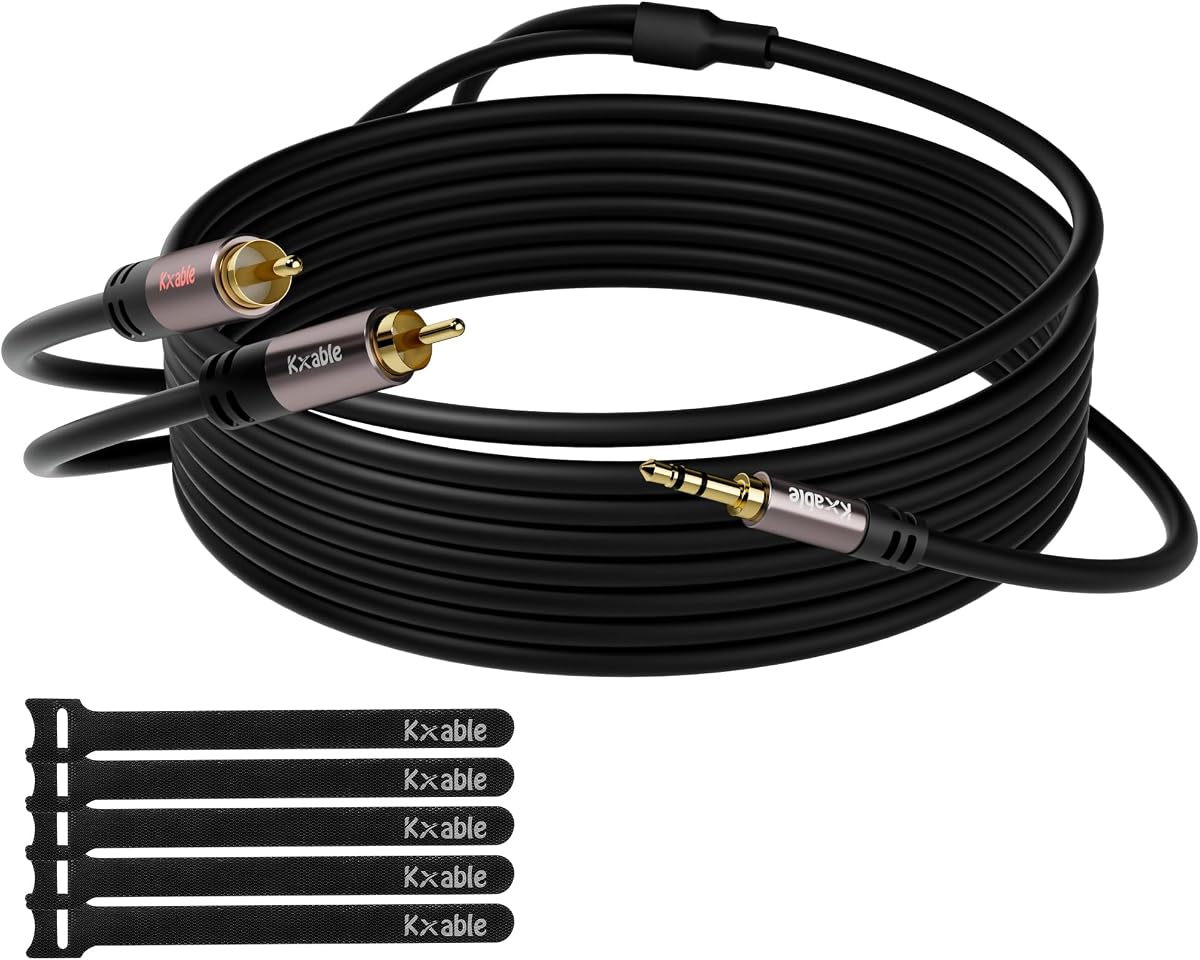
The 3.5mm to RCA Cable 15FT is the longest option included in this comparison, with a 15-foot length designed to bridge distant source equipment and an amplifier or receiver. Its 4.7 rating reflects favorable customer feedback, while dual shielding, an oxygen-free copper core, and gold-plated plugs target dependable stereo transmission.
We may earn a commission when you buy through this link, at no additional cost to you.
A step-down ladder connector design is used to create a manageable profile where the 3.5mm plug enters the source. The cable is also described as flexible and constructed with a high-elastic PVC material. It includes five cable ties, which is useful for organizing a long run along a wall, entertainment center, or vehicle interior.
The obvious disadvantage is that 15 feet can be more cable than needed. Excess length may create awkward loops, create unnecessary exposed cable, or make the adapter less convenient to carry. The product also lacks a ferrite bead and a circuit-board splitter, so it is a conventional shielded adapter rather than a fully signal-conditioned design.
This cable is a strong fit for a home theater, classroom, shop, office, or vehicle where source and receiver are separated by a significant distance. It supports phones, tablets, laptops, MP3 and CD players, cars, amplifiers, and RCA-equipped receivers. For a shorter or more compact installation, consider the four-foot or six-foot alternatives.
Fifteen feet is long enough to cross a room, connect components in different furniture areas, or reach a vehicle-mounted stereo. The included ties help keep the route controlled after installation.
The double-shielded design and oxygen-free copper core focus on reducing interference and maintaining signal quality over a longer run. Gold-plated plugs add resistance to oxidation and tarnish.
We may earn a commission when you buy through this link, at no additional cost to you.
The CableCreation 3.5mm to RCA Cable uses a 10-foot lead and a right-angle 3.5mm connector, making it particularly useful where the source jack is close to a wall, cabinet, road case, or other restricted surface. Its 4.7 rating reflects a strong reception among buyers who value both flexibility and tidy installation.
We may earn a commission when you buy through this link, at no additional cost to you.
The angled connector reduces how far the cable projects from the device and can relieve strain at the connection. A soft cotton-braided exterior is designed to remain flexible and tidy, while the ultra-slim gold-plated 3.5mm plug is designed to fit common mobile-device and tablet jacks.
The cable supports bi-directional use, with one end acting as the input and the other as the output. It cannot send audio in both directions at once, so users should confirm which side must be input for their equipment. As with any right-angle connector, the plug can also reduce access to buttons or controls placed directly beside the jack.
Choose this option for a constrained entertainment center, a mounted tablet, a road case, or a car where a straight connector would create unnecessary strain. It is less essential when the device has ample open space around its jack. Its ten-foot length also makes it a practical middle ground between compact desktop leads and very long room-spanning cables.
The 90-degree connector sits closer to the source device than a straight plug. This can protect the connection and free room around furniture, wall-mounted screens, or portable cases.
The cable can carry stereo audio from either a 3.5mm source to RCA equipment or from RCA equipment to a 3.5mm input, depending on the equipment. Only one direction can operate at a time.
We may earn a commission when you buy through this link, at no additional cost to you.
The Audiophile HiFi RCA to 3.5mm Audio Cable is a compact 3.28-foot option with 4N oxygen-free copper conductors, multi-layer shielding, ferrite cores, and 24K gold-plated contacts. Its 4.5 rating makes it a credible premium choice for nearby stereo equipment where build quality and signal isolation are more important than long reach.
We may earn a commission when you buy through this link, at no additional cost to you.
Its internal shielding combines a high-density tinned-copper braid with double-layer PVC shielding, while the ferrite cores provide additional filtering. The connector plating is listed as five microns, and the manufacturer states that the contacts remain reliable after more than 1,000 insertions. A heavy-duty nylon-braided exterior is intended to resist pulling, fraying, and repeated bending.
The main constraint is its short length, which naturally suits desktop or near-field equipment but not a separated entertainment center. The product description also discusses subwoofer use, yet the physical design remains a standard 3.5mm-to-dual-RCA stereo adapter rather than a dedicated mono subwoofer cable. Buyers should consider the wording carefully when choosing it for a particular signal path.
This cable is best for a compact high-end stereo setup, a near-field speaker system, or a home audio arrangement with closely placed components. Its layered shielding and robust connector construction give it a premium profile without relying on an integrated directional ferrite bead. Confirm that the 3.28-foot reach meets your installation needs before choosing it.
Tinned-copper braid, double-layer PVC shielding, and ferrite cores provide several layers of interference control. This construction is aimed at preserving clean stereo details in compact audio installations.
The stated five-micron gold plating is intended to resist oxidation, while the heavy-duty nylon braid protects the cable from pulling and bending. The result suits frequently used desktop connections.
We may earn a commission when you buy through this link, at no additional cost to you.
The SKW Audiophile 3.5mm to Dual RCA Y Cable combines a compact 3.2-foot length with 22AWG copper conductors, dual-layer shielding, and 24K gold-plated connectors. Its 4.6 rating makes it one of the strongest compact options, with a heavy-duty seven-millimeter profile that feels geared toward regular use.
We may earn a commission when you buy through this link, at no additional cost to you.
The product information emphasizes an ultra-high-purity copper core, extra shielding to prevent wire fatigue, and corrosion-resistant contacts. Its nylon-braided exterior is designed to resist fraying, while the substantial cable diameter provides a more robust appearance than many lightweight household adapters.
The drawback is its short reach, which limits placement flexibility. It is also positioned as an audiophile-grade product and therefore costs more than many functionally similar budget cables. Because the cable is only 3.2 feet long, it is best suited to components positioned close together rather than across a large room or entertainment unit.
This model suits a compact stereo, desktop listening system, DJ equipment, or home receiver where the user wants a substantial cable in a short form factor. It also works with subwoofers, MP3 and CD players, laptops, tablets, amplifiers, and receivers with red and white RCA inputs. Its main appeal is the combination of gauge, shielding, and braided durability.
The stated 22AWG copper core provides a robust signal path for a short cable. A seven-millimeter profile and nylon braid make the lead feel more substantial than a standard lightweight adapter.
Dual-layer shielding is intended to limit EMI and RFI, while gold-plated connectors resist corrosion. These features make the cable appropriate for frequently connected equipment.
We may earn a commission when you buy through this link, at no additional cost to you.
The Premium AUX to 2RCA Audio Cable is a one-meter, 3.2-foot adapter built around high-purity copper, double-layer shielding, and a stated 75-ohm constant impedance. Its 4.7 rating and 15,000-plus bend test claim make it one of the most resilient compact options in the list.
We may earn a commission when you buy through this link, at no additional cost to you.
Constant impedance is the distinguishing specification, as it is intended to support consistent signal transmission rather than allowing electrical characteristics to vary unpredictably. The cable also uses gold-plated connectors, reinforced copper shells, and a cotton-braided exterior intended to resist wear and preserve a neat appearance.
As with the other compact premium choices, cable length is the biggest practical limitation. The product is best placed between nearby components rather than devices in different parts of a room. Its mention of turntables may also require care: a turntable needs compatible line-level output, and not every turntable has a 3.5mm output suitable for this adapter.
This cable is a good fit for a compact amplifier, speaker, smartphone, or another source positioned near a stereo receiver. It combines refined electrical specifications with a braided, durable exterior and broad compatibility with standard 3.5mm audio outputs. For buyers seeking premium materials in a short, tidy package, it is a strong contender.
The specified 75-ohm constant impedance supports stable signal transmission. Combined with high-purity copper and double-layer shielding, it targets clear and consistent stereo output.
A stated bend-test result of more than 15,000 cycles indicates an emphasis on repeated flexing. The cotton-braided cover adds both mechanical protection and a clean appearance.
We may earn a commission when you buy through this link, at no additional cost to you.
The right cable depends on source and destination hardware, connection direction, available space, and the distance between components. Evaluate signal construction and physical design together rather than treating gold plating or shielding as substitutes for correct compatibility.
Choose by connector and function first. The 3.5mm end should fit the source cleanly, while the RCA ends should match the available red and white sockets on the amplifier, receiver, speaker, television, or car stereo.
Measure the route before choosing. A slightly longer cable provides placement flexibility, but an excessively long lead is harder to manage and may look untidy when no additional length is required.
Match the connector geometry to the available space. Straight plugs offer simple access, while right-angle and stepped designs are more suitable for crowded or recessed installations.
Prioritize easy channel identification and a clean left-right split. An integrated board may benefit a higher-end installation, but it is not automatically necessary for every home stereo.
For most systems, a properly shielded cable with sound connectors is enough. Consider multi-layer shielding, ferrite filtering, or advanced conductor layouts when the cable runs near power equipment or feeds a more demanding setup.
Confirm which device supplies the signal and which device receives it. Follow any arrow or flow marking, especially on filtered or direction-aware models, to maintain proper signal levels.
Treat plating as one part of overall build quality rather than the only measure. A secure connector, flexible jacket, and adequate shielding are more useful than a plated contact alone.
Prioritize compatibility, length, and construction for the intended setup. Expensive features are worthwhile only when they solve a real routing, interference, or durability concern in your system.
Begin by identifying the source and destination. Turn both devices off, locate the source's 3.5mm headphone or auxiliary output, and connect the cable's 3.5mm plug fully. On a direction-aware cable, check the arrow before inserting anything. Once the source is connected, attach the red RCA plug to the right input and the white plug to the left input on the amplifier, receiver, speaker, television, or car stereo.
Power on the equipment, begin with a low volume, and raise the level gradually. If the sound is distorted, check that every connector is fully seated and that the source is not exceeding the receiving equipment's permitted input level. Do not connect the 3.5mm source to an RCA output, or connect the RCA ends to another pair of outputs. If a modern phone lacks a 3.5mm jack, use a compatible digital-to-analog adapter before attaching this cable.
To preserve the cable, avoid sharply bending the plug where it enters the housing, especially on the stepped and angled models. Do not yank either end to disconnect it; grip the connector shell instead. Coil the cable loosely for storage, secure long runs with the supplied ties or suitable clips, and keep both ends dry and free of dust. Periodically inspect the jacket and connectors for damage before reconnecting the cable.
It connects a device with a 3.5mm headphone or auxiliary output to equipment with separate left and right RCA audio inputs. Common examples include a phone feeding a stereo receiver, a laptop connecting to powered speakers, and a portable player connecting to a car stereo. It carries analog stereo audio rather than video or digital data.
Yes, if the phone has a functioning 3.5mm headphone output and the amplifier has left and right RCA inputs. Newer phones without a headphone jack usually need a compatible USB-C or Lightning digital-to-analog adapter. The 3.5mm-to-RCA cable then connects from that adapter to the amplifier.
Not automatically. A longer cable is useful only when it solves a routing problem, and its construction should support the distance involved. For nearby desktop equipment, four to six feet is usually manageable, while ten or fifteen feet can accommodate room, vehicle, or workshop installations. Avoid excess length when a shorter lead can make the connection tidier.
Gold plating is intended to resist oxidation and tarnish, helping connectors remain clean through repeated insertion and removal. It is one aspect of connection reliability, but it does not replace good shielding, sound conductor materials, or a secure fit. A properly engineered cable with lesser plating can still work very well in ordinary conditions.
A right-angle connector is useful when the device sits against a wall, inside a tight cabinet, in a road case, or near another obstruction. It keeps the cable from projecting straight outward and can reduce strain at the jack. In an open area, a straight plug may be easier to access and easier to plug and unplug.
Some cables include ferrite beads, circuit-board splitters, or other components that should face the source end for correct operation. Reversing a direction-aware cable may produce a signal-level mismatch, and the product information for the TODN model specifically warns against it. Check the cable marking and follow the manufacturer's installation instructions.
A standard dual-RCA 3.5mm adapter is primarily designed for stereo left and right audio. Some product descriptions mention subwoofer use, but a true subwoofer connection may require a dedicated mono cable and compatible preamp output. Confirm that the source provides a suitable line-level signal and that the destination has the correct input.
First, confirm that the cable is fully seated and that the red and white plugs match the correct channels. Ensure the source is an output and the destination is an input, and use a proper digital-to-analog adapter when required. If interference remains, try a shielded cable and route it away from power cables, transformers, and other electrical sources.
The UGREEN 3.5mm to RCA Cable is the most versatile overall recommendation because it combines a useful six-foot length, durable materials, clear channel markings, and broad compatibility. JSAUX provides a similar balanced package for budget-conscious shoppers, while the compact TODN model leads the premium group with four-core conductors, integrated splitting, and a ferrite bead.
Prioritize correct connector and signal compatibility before considering refinements. Choose the appropriate length for the actual route, use a right-angle model for restricted spaces, and select a stronger shield or more advanced conductor when noise, equipment quality, or a long run justifies it. For basic desktop audio, one of the shorter conventional cables will usually provide the most practical experience.
Customer ratings and product availability can change over time, and current prices may vary between sellers. Review the latest listing, product dimensions, connector direction, and compatibility details before buying, particularly if your source device uses USB-C or Lightning rather than a native 3.5mm jack.