
Icom M25EVO Blue Marine VHF Radio
4.9Editor score
IPX7 floating waterproof design
USB-C fast charging
11-hour lithium-ion battery
Our Marine Handheld Radios guide compares ten floating VHF models for waterproofing, range, battery life, channel coverage, emergency features, and ease of use
Marine handheld radios provide a practical communication link between a vessel, the shoreline, and other boaters. A capable unit should resist water, float after an overboard drop, monitor priority channels, and deliver clear transmissions. Battery life, controls, display visibility, and emergency features also influence which model suits a particular boater.
This guide compares ten handheld marine VHF radios using the supplied specifications, including waterproof rating, transmit power, channel coverage, watch functions, charging options, display design, and safety features. It covers high-output models for offshore use, compact options for smaller craft, and feature-rich radios with GPS or Bluetooth while keeping the list accessible to different budgets.
Each review identifies the strongest reason to consider a radio and also explains meaningful limitations. The top picks highlight a premium compact model, a well-rounded conventional unit, and a capable lower-cost option, while the remaining reviews show how the alternatives differ. Product availability and market conditions can change, so confirm current specifications before purchasing.
4.9Editor score

4.6Editor score

4.6Editor score
The table below places all ten radios side by side, with particular attention to their maximum transmit power, water resistance, channel monitoring, charging method, and distinguishing safety or navigation features.




The Cobra BlueBound 350 White is a six-watt floating VHF marine radio built for boaters who want useful range without an oversized handset. Its 4.5 rating reflects a solid feature set, and the most immediately noticeable design element is the high-visibility orange floating core, which helps a dropped radio remain easy to retrieve.
We may earn a commission when you buy through this link, at no additional cost to you.
Power can be switched among 1, 3, and 6 watts, allowing the operator to balance communication distance against battery consumption. Tri-Watch keeps channels 9 and 16 available alongside a selected channel, a valuable combination in active harbors or busy approaches. The radio also provides access to 12 weather channels and the NOAA emergency broadcast channel, while the selectable day-night display is designed to remain readable in changing conditions.
The main trade-off is that this is a focused marine radio rather than a connected navigation device. It does not offer the GPS, Bluetooth messaging, compass, or man-overboard functions found in the Uniden MHS338BT. Using the six-watt setting regularly will also consume more energy than selecting one of the lower power levels, so thoughtful adjustment remains important during a long outing.
It is a strong choice for recreational boating, fishing, and coastal trips where floating construction, emergency channel access, and flexible range matter most. The white enclosure also stands apart from the black version, which may be easier for some buyers to spot. Overall, the BlueBound 350 is a balanced, dependable recommendation for anyone seeking six-watt output and uncomplicated marine operation.
The 1, 3, and 6-watt settings let operators conserve power when nearby stations are sufficient and increase output when distance or open water makes reception more difficult. That flexibility makes the radio useful across different stages of a trip.
The orange floating core separates this model from many conventional black handhelds. Combined with the floating construction, it gives the operator a better chance of spotting and recovering the radio in rough or discolored water.
We may earn a commission when you buy through this link, at no additional cost to you.
The Cobra BlueBound 350 Black offers the same core performance as the white version in a more traditional dark enclosure. It is a 4.5-rated six-watt marine handheld designed for boaters who prioritize easy retrieval, adjustable range, and continuous access to important watch and emergency channels.
We may earn a commission when you buy through this link, at no additional cost to you.
Its floating orange core is one of the most practical safety details in the design. Even if the radio is dropped from a wet deck, the high-visibility section should make it easier to locate. The user can select 1, 3, or 6 watts, use Tri-Watch to monitor channels 9, 16, and another selected channel, and access 12 weather channels plus the NOAA emergency broadcast channel.
Compared with more advanced models, the Black BlueBound 350 does not include integrated GPS, Bluetooth, a compass display, or automatic man-overboard positioning. Users who require those functions may find the Uniden MHS338BT more suitable. Those who simply need a robust, high-output VHF radio are less likely to miss them, and the straightforward feature set makes the BlueBound 350 easier to introduce to new operators.
This model makes sense for boaters who prefer a conventional appearance and want dependable performance for fishing, cruising, or coastal travel. It is also a logical alternative for anyone who likes the BlueBound 350 platform but does not want the white housing. For straightforward six-watt marine communication, it is a capable and easy-to-justify recommendation.
The radio offers enough maximum output for boats traveling farther from shore while retaining lower settings for routine communication. This makes it a versatile choice for inland lakes, larger coastal waters, and mixed-use family boating.
Tri-Watch and NOAA access cover the functions most handheld owners prioritize. The absence of connected features does not reduce access to these core marine communication and safety tools.
We may earn a commission when you buy through this link, at no additional cost to you.
The Standard Horizon HX210 is a compact six-watt floating marine radio that combines useful emergency equipment with a generous battery and broad channel access. Its 4.6 rating places it among the strongest performers in this group, while the included antenna, rapid charging cradle, cables, and documentation create a well-rounded package.
We may earn a commission when you buy through this link, at no additional cost to you.
The high-resolution dot-matrix display provides more detailed information than a simple segmented screen, and the programmable function keys can make frequently used settings easier to reach. A water-activated emergency strobe is a notable safety advantage, while selectable 6, 2.5, and 1-watt output supports a sensible balance between range and endurance. The radio also includes USA, international, and Canadian channels, weather reception, and an FM broadcast band.
Its 1850mAh lithium-ion battery and three-hour desktop rapid charger are appealing for users who spend substantial time away from shore power. On the other hand, the interface is described as an easy menu system rather than a modern connected experience, and there is no integrated GPS or Bluetooth. Boaters wanting digital position sharing and advanced man-overboard functions may need to look farther up the feature hierarchy.
The HX210 suits boaters and anglers who want a proven-looking, portable radio with a bright display, emergency strobe, strong battery, and multiple charging options. It is especially attractive for anyone who values a broad selection of marine and FM channels without needing a smartphone or GPS. That combination makes it an excellent general-purpose marine handheld.
The high-capacity lithium-ion battery and selectable output levels make the HX210 a practical radio for extended outings. Lower transmit settings can extend operating time when the radio is being used primarily for close-range conversations.
A water-activated emergency strobe helps draw attention to the radio and its wearer after an overboard incident. The feature adds meaningful safety value in low-light or difficult recovery conditions.
We may earn a commission when you buy through this link, at no additional cost to you.
The Uniden Atlantis 275 combines six-watt power with a notably large 25-by-40-millimeter display, earning a 4.6 rating and standing out in this comparison. It is a floating IPX8/JIS8 radio that can withstand immersion and clear water from its speaker after submersion, making it especially reassuring for demanding marine conditions.
We may earn a commission when you buy through this link, at no additional cost to you.
The screen changes between a paper-white daytime backlight and red nighttime backlight, supporting visibility in different environments. User-selectable 1, 2.5, and 6-watt transmission provides useful control over range and power use. The built-in emergency strobe and flashlight add practical safety equipment, while reception covers USA, Canadian, and international marine channels, including four-digit and Canadian B channels, along with NOAA weather channels and alerts.
It lacks integrated GPS and Bluetooth connectivity, so it does not duplicate the navigation and text-sharing capabilities of the MHS338BT. The supplied information also does not identify the battery capacity in the same way it does for some competitors. Even so, the included lithium-ion battery pack, AC and DC charging cables, and charging cradle make the ownership package convenient.
The Atlantis 275 is a compelling recommendation for budget-conscious boaters who do not want to give up high transmit power, a large display, or strong waterproof protection. It suits fishing, coastal cruising, and general recreational use. For buyers prioritizing a conventional marine handheld with large controls and extensive channel coverage, it is a particularly well-balanced choice.
The IPX8/JIS8 rating and floating design create confidence around rain, spray, docks, and rough water. The ability to clear its speaker after immersion is another useful detail for a device expected to face frequent wet conditions.
The unusually large LCD gives important channel, power, and status information a generous area. Dual-color backlighting also makes the radio more practical for bright daytime conditions and low-light operation at night.
We may earn a commission when you buy through this link, at no additional cost to you.
The Uniden MHS75 is a rugged floating marine radio with a 4.4 rating and up to five watts of transmit power. Its defining strength is a full JIS8 waterproof rating and the ability to remain submersible for up to 30 minutes at five feet, which gives it a reassuring level of physical protection.
We may earn a commission when you buy through this link, at no additional cost to you.
Three power levels allow operators to move between one, 2.5, and five watts depending on communication distance and battery priorities. The radio covers USA, international, and Canadian marine channels, while Triple Watch monitors channels 16 and 9 every two seconds alongside the currently selected channel. NOAA weather channels and an enabled emergency alert function provide additional safety information.
Its maximum power is one watt below that of the leading six-watt alternatives, which may matter for demanding offshore exchanges. It also lacks the integrated strobe, flashlight, GPS, and Bluetooth functions available on higher-feature models. Those limitations are acceptable for a buyer whose priority is ruggedness, simple marine communication, and dependable monitoring rather than connected navigation.
The MHS75 is a solid recommendation for fishing boats, cruisers, and smaller recreational vessels that need a floating, submersible handheld. Its selectable transmission, automatic weather warnings, and Triple Watch functions cover the essentials without requiring complex setup. It remains a credible alternative when durability and ease of operation outweigh maximum output.
Triple Watch allows the selected channel to remain active while channels 16 and 9 are checked in the background. That is useful for receiving hailing and emergency traffic without abandoning the conversation or fishing channel already in use.
The one-watt setting is appropriate for nearby communication and can reduce energy consumption. Operators can step up to 2.5 or five watts when greater distance makes a stronger signal more useful.
We may earn a commission when you buy through this link, at no additional cost to you.
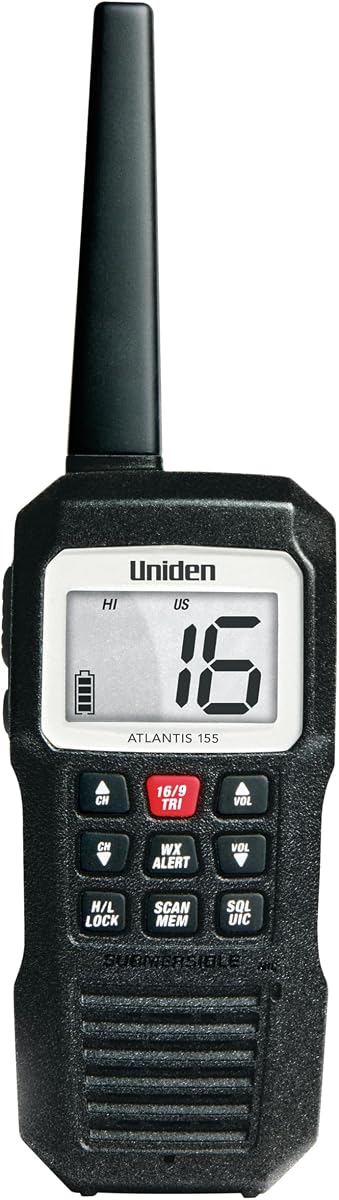
The Uniden Atlantis 155 is a compact floating marine radio designed for users who need core VHF safety functions in a smaller and less complex package. It carries a 4.1 rating and uses selectable one- or three-watt output, placing it below six-watt models in potential range but well within reach for routine communication around lakes, harbors, and coastal areas.
We may earn a commission when you buy through this link, at no additional cost to you.
Despite its compact profile, the radio includes the same generously sized 25-by-40-millimeter dual-color screen used in the larger Atlantis 275. The daytime backlight is paper white, the nighttime backlight is red, and the IPX8/JIS8 construction allows the unit to float and withstand immersion while clearing water from its speaker. It receives USA, Canadian, and international marine channels, including four-digit and Canadian B channels, plus NOAA weather channels and alerts.
Three-watt maximum transmission is the clearest limitation for boats traveling far from shore or communicating across large stretches of open water. The radio also does not list the larger model's emergency strobe and flashlight. Its four AAA NiMH rechargeable batteries and included DC charging cable offer flexible cell handling, although the pack is less integrated than a single lithium-ion battery.
The Atlantis 155 is best suited to day boating, fishing close to shore, and general users who prioritize compactness, a readable display, and rugged waterproof protection. It can also serve as a supplementary radio aboard larger vessels. For boaters who need greater range, the Cobra BlueBound 150 or a six-watt model would be a more logical step up.
The radio keeps its overall footprint manageable while retaining a relatively large display. That balance helps preserve quick readability for users who may be handling lines, controls, or other equipment at the same time.
Four AAA NiMH cells give users a straightforward battery arrangement and the option to keep spare cells ready. The included DC cable supports charging away from a wall outlet.
We may earn a commission when you buy through this link, at no additional cost to you.
The Icom M25EVO Blue is a premium compact marine radio that earned a 4.9 rating, the highest in this comparison. Its 7.8-ounce body, floating IPX7 design, and flashing recovery light distinguish it as a highly portable model for boating, kayaking, and other marine activities.
We may earn a commission when you buy through this link, at no additional cost to you.
The most attractive practical feature is the stated 11-hour lithium-ion battery life, which is well suited to long days away from a dock. USB-C charging adds convenience because the radio can draw power from a broad selection of compatible sources rather than relying on a proprietary wall charger. Its slim, ergonomic shape also makes it easy to carry in a pocket or keep accessible on deck.
The supplied specifications do not identify a maximum transmit wattage, nor do they list the channel coverage, watch modes, weather functions, or emergency controls found in the descriptions of several competitors. Buyers who require documented six-watt performance or a detailed set of marine functions should verify those specifications. The flashing feature is intended to make the radio easier to locate after it enters the water.
This radio is a strong recommendation for active boaters and kayakers who place a premium on weight, charging convenience, and long battery life. It also suits anyone who wants a marine handheld that is less bulky than traditional models. For the stated priorities, the M25EVO Blue is a polished premium selection, with exact channel and transmit specifications worth confirming before use offshore.
At 7.8 ounces, the M25EVO Blue is among the lightest radios featured. The slim body is easier to keep on a life jacket, tuck into a pocket, or store in a dry bag without taking up much room.
USB-C reduces cable friction and makes it easier to top up the radio from compatible power banks, vehicle adapters, or wall chargers. The stated long battery life adds further flexibility for extended outings.
We may earn a commission when you buy through this link, at no additional cost to you.
The Retevis RM21 is a five-watt floating marine radio with a 4.4 rating and an emphasis on reducing unwanted sound. Its one-button noise cancellation is designed to lessen engine noise, wind, and waves, which are familiar challenges for boaters trying to communicate clearly in a working environment.
We may earn a commission when you buy through this link, at no additional cost to you.
The radio offers high, medium, and low output settings corresponding to five, three, and one watts. A battery-saver mode complements those power choices, while the 1800mAh lithium-ion battery is listed as providing 10 hours of operation and 60 hours of standby. The supplied charging dock creates a convenient home base, and dual-band watch with instant access to channel 16 adds marine-specific utility.
Its IP67 rating supports protection from rain, spray, and immersion, but it is not the same specification as the IPX8 ratings claimed by several other floating radios. Buyers who need the strongest stated submersible protection should compare the details carefully. The colorful backlit LCD may appeal to some users, although a subtler display can be easier on the eyes at night. The product listing also does not detail the same broad international channel inventory as several competitors.
The RM21 is a good match for fishing, offshore work, boating, and users who prioritize voice clarity in noisy conditions. Five watts provides meaningful range, and the lithium-ion battery is well suited to all-day use. It is a compelling alternative for anyone who wants noise reduction and customizable display lighting in a floating marine handheld.
Engine vibration, wind, and wave noise can make VHF conversations difficult. The RM21's dedicated noise-cancellation control offers a direct way to improve perceived voice clarity without changing several complicated menu settings.
The battery-saver mode and three output levels help manage energy use across long days. Users can select stronger transmission when needed and conserve power during periods of close-range monitoring.
We may earn a commission when you buy through this link, at no additional cost to you.
The Cobra BlueBound 150 is a three-watt floating marine radio with a 4.2 rating and a flexible approach to power. It can operate at 0.5, one, or three watts, allowing users to use minimal output for nearby conversations and increase power when the operating area becomes more demanding.
We may earn a commission when you buy through this link, at no additional cost to you.
Its high-visibility orange floating core supports recovery after an overboard drop, while the IPX7 waterproof construction is designed to handle wet environments and potential immersion. A large, clear LCD is intended to provide an intuitive at-a-glance view in different lighting and weather conditions. NOAA access includes 12 weather channels and the National Oceanic and Atmospheric Administration emergency broadcast channel.
Dual-Watch gives the operator access to channels 9 and 16 but does not offer the third selectable channel found in the BlueBound 350's Tri-Watch system. Maximum output is also three watts, which can limit communication distance compared with five- and six-watt alternatives. The radio's flexibility comes partly from its ability to use either rechargeable or alkaline AAA cells, with a USB-C port for compatible rechargeable batteries.
The BlueBound 150 is a sensible recommendation for close-to-medium-range boating, fishing, and general users who appreciate battery flexibility and straightforward channel monitoring. It is less suitable for demanding offshore communication than the six-watt models in this guide. Within its intended range, however, it offers a clear display, weather access, and practical floating protection.
The 0.5-watt setting can support close-range use with lower energy consumption, while one and three watts provide additional reach. This makes the radio adaptable to local lakes, sheltered waterways, and broader coastal outings.
Compatibility with rechargeable and alkaline AAA cells helps users avoid dependence on one specific battery format. The USB-C charging port provides a modern way to recharge compatible cells while the radio is on board.
We may earn a commission when you buy through this link, at no additional cost to you.
The Uniden MHS338BT is a feature-rich six-watt floating marine radio that stands apart through integrated GPS, Bluetooth, a compass display, and automatic man-overboard functions. Its 4.2 rating reflects a capable package, though the extensive feature set is more demanding than that of a straightforward waterproof VHF handset.
We may earn a commission when you buy through this link, at no additional cost to you.
The radio can save a current position or manually entered positions in a directory, return to stored locations, and auto-plot a received DSC distress call. Bluetooth enables connection to Uniden's smartphone app for iOS and Android, including setup of the radio and text messaging with compatible VHF radios. The display can show course and direction or a north-south-east-west position view, while dual and triple watch modes monitor Coast Guard, hailing, weather, and regular marine channels.
Physical safety features are unusually thorough. The unit is IPX8 submersible, floats, and has a water-activated emergency strobe and flashlight. It also offers selectable one-, 2.5-, and six-watt transmission, NOAA weather alerts, FM radio, automatic backlight switching, noise cancellation, a backlight-level adjustment, and a drop-in charging cradle with a lithium-ion battery.
This is the best fit for boaters who value position awareness and digital connectivity rather than a simple channel radio. It may require more initial setup, and buyers who never use GPS or connected messaging will not receive full value from every capability. Even so, for a modern connected vessel or a safety-conscious owner, the MHS338BT is a capable and distinctive six-watt choice.
The integrated GPS can save favorite positions, support return-to-location use, and display direction or a cardinal position view. It can also automatically plot a received DSC distress call, adding context to emergency traffic.
Bluetooth links the radio to the Uniden smartphone app for configuration and text communication with compatible devices. The feature extends the radio beyond conventional voice communication, though users should prepare to manage a more advanced menu structure.
We may earn a commission when you buy through this link, at no additional cost to you.
Selecting a marine handheld involves balancing water resistance, transmission range, power efficiency, emergency functions, and the type of boating you do. The following factors help narrow the field before comparing individual models.
A marine radio should be designed for rain, spray, and the possibility of being dropped into the water. IPX7 indicates protection against temporary immersion, while IPX8 represents a more demanding submersible specification, and JIS8 ratings are also relevant when comparing some models. Floating construction is especially valuable because a radio that sinks may be difficult or impossible to recover. The Uniden Atlantis 275 and Atlantis 155 claim IPX8/JIS8 protection and floating bodies, while the Icom M25EVO, Cobra BlueBound models, Standard Horizon HX210, Retevis RM21, and Uniden MHS338BT offer various levels of stated water resistance.
Higher transmit power can improve the ability to reach other stations over greater distances, but it also places more demand on the battery. Three-watt radios are generally suited to closer-range activities, while five watts provides more flexibility and six watts offers the highest listed output in this group. The Cobra BlueBound 350, Standard Horizon HX210, Uniden Atlantis 275, and Uniden MHS338BT reach six watts. Actual range depends on antenna height, vessel position, weather, obstructions, and whether the receiving station answers, so rated power should be treated as one factor rather than a guaranteed distance.
Battery capacity, transmit power, screen use, and standby behavior all affect how long a radio remains useful. The Icom M25EVO advertises 11-hour battery life, while the Retevis RM21 lists 10 hours of operation and 60 hours of standby. Some radios use integrated lithium-ion packs and charging cradles, while the Uniden Atlantis 155 uses four AAA NiMH cells and the Cobra BlueBound 150 supports rechargeable or alkaline AAA cells. USB-C, as offered on the Icom and BlueBound 150, can make charging from shared power banks and other common sources more convenient.
A useful marine radio should provide access to relevant local, USA, international, and Canadian channels where applicable, along with NOAA weather information. Watch modes are valuable because they allow priority channels to remain monitored while another channel is selected. The Uniden MHS75 and Icom M25EVO emphasize Triple Watch, the Uniden MHS338BT offers dual and triple modes, the Cobra BlueBound 350 uses Tri-Watch, and the BlueBound 150 uses Dual-Watch. Compare these functions with the waterways and traffic patterns in the areas where the radio will be used.
A marine radio must remain readable when the operator needs information quickly, sometimes in sunlight, darkness, rain, or spray. The Uniden Atlantis models use dual-color screens with white daytime and red nighttime backlighting. The Cobra BlueBound 350 and Standard Horizon HX210 offer selectable day-night displays, while the MHS338BT automatically switches between white and amber illumination. The Retevis RM21 adds a seven-color backlit screen, offering personalization, while the large dot-matrix display on the HX210 and large LCD on the Atlantis models emphasize information-rich visibility.
A radio can provide much more value when it includes tools that improve visibility and response after an emergency. Water-activated strobes appear on the Standard Horizon HX210, Uniden Atlantis 275, Uniden MHS338BT, and the high-visibility floating core on the Cobra BlueBound models aids recovery. The Atlantis 275 and MHS338BT also provide flashlights, while the MHS338BT adds automatic man-overboard positioning. NOAA alerts, emergency broadcast channel access, DSC capability, and water-activated lights should be considered alongside personal flotation and other required safety equipment.
A handheld radio is most useful when it is easy to carry and operate. The Icom M25EVO weighs 7.8 ounces and emphasizes a slim, ergonomic body, while the Cobra BlueBound 350 and Uniden Atlantis models are designed as compact marine units. Large screens, programmable keys, simple menus, and clearly separated controls can matter more than advanced specifications for a new user. Consider where the radio will be carried, whether it will be operated with wet or cold hands, and whether a larger display is worth the additional bulk.
Connected features can improve position awareness, setup convenience, and communication with compatible devices, but they add complexity and are not essential for every operator. The Uniden MHS338BT includes integrated GPS, Bluetooth smartphone app support, text messaging, DSC functions, a compass display, favorite positions, and automatic man-overboard behavior. Most other radios in this guide focus on conventional voice communication, weather access, and channel monitoring. Advanced users should verify compatibility, charging needs, and the learning curve before deciding that connected functionality is worth the added complexity.
Before the first outing, read the supplied manual, identify the power, charging, channel, scan, and emergency controls, and learn how the dual or triple watch function behaves. Program frequently used channels and confirm the radio charges correctly. Where possible, carry the radio in a protective floating or waterproof pouch while keeping it easy to reach, and attach a secure lanyard that cannot become tangled in lines or running equipment.
On the water, begin with one-watt output for nearby communication and increase the power only when distance or reception requires it. Monitor channel 16, the applicable hailing and distress channels, and weather information according to local guidance. Keep the radio away from direct spray when practical, avoid charging a wet unit unless its instructions permit it, and do not rely on a handheld radio as a substitute for required navigation equipment, a personal flotation device, a signaling device, or a properly equipped vessel.
After use, remove excess water, inspect the charging contacts and body, and store the radio in a dry, temperature-appropriate location. Replace damaged batteries or cables, and use only compatible charging equipment. Periodic channel checks, alarm tests, control checks, and battery inspections help reveal problems before they matter. If the radio has been submerged, follow the manufacturer's drying and inspection instructions even when it appears to work normally.
A marine handheld VHF radio is designed for marine frequencies, channel formats, emergency procedures, and wet environments. It generally offers access to priority distress and hailing channels, NOAA weather information, and floating or submersible construction. A general two-way radio may work for ordinary voice communication but is not a substitute for a marine VHF model on the water.
No. Higher transmit power can improve practical range, but it also uses more battery energy and may be unnecessary for short distances or protected waterways. Three watts is often adequate for routine local communication, while five or six watts can be more useful for offshore and open-water operations. The best setting also depends on battery capacity, antenna position, weather, and the distance to the other station.
Floating is a major safety advantage because it improves the chance of retrieving a radio after an overboard drop. It does not prevent damage from impact or eliminate the need for careful handling. Look for both floating construction and an appropriate waterproof or submersible rating, and consider a high-visibility case, lanyard, or locator light for additional recovery visibility.
Dual-Watch generally monitors two priority channels while the selected channel remains active, while Triple-Watch adds a third monitored channel. These modes let a radio watch important hailing, distress, and user-selected channels simultaneously. Exact channel assignments and timing vary by model, so users should review the manual before relying on a watch function during an emergency.
GPS is not required for ordinary VHF voice communication, but it can help with position storage, direction display, DSC distress context, and man-overboard functions. It is most valuable to boaters who want integrated position awareness or digital features. Operators who mainly need conventional voice communication can focus on waterproofing, power, battery life, and channel monitoring instead.
Rinse away salt and dirt with fresh water, dry the unit and contacts, and inspect the housing and controls for damage. Charge it only as directed, use compatible batteries and cables, and avoid exposing it to extreme heat or charging while wet unless the manufacturer explicitly permits it. Periodic alert, channel, and battery checks help ensure the radio remains ready for use.
A marine VHF radio can communicate on the designated distress and hailing channels, including channel 16 in the United States. For an actual emergency, transmit the required identification and distress information, state your position and nature of the emergency, and follow official guidance. The radio should supplement, not replace, other required emergency communications and safety procedures.
A six-watt radio can be suitable when the user accepts its size, battery demand, and controls. Smaller craft and kayaks may benefit from a compact model that is easy to carry and secure, such as the Icom M25EVO, while operators traveling farther offshore may favor the added potential range of a higher-output model. Local conditions and carrying comfort should guide the decision.
The Icom M25EVO Blue leads the premium group with its 7.8-ounce body, USB-C charging, long stated battery life, and floating IPX7 design. The Standard Horizon HX210 stands out as an editor's choice for its balanced feature set, emergency strobe, large dot-matrix display, and flexible output, while the Uniden Atlantis 275 delivers the strongest budget-oriented combination of six watts, IPX8 protection, a large dual-color screen, and emergency lighting.
Prioritize floating construction, an appropriate water-resistance rating, dependable priority-channel monitoring, and enough battery life for the duration of your outings. Then add transmit power, display visibility, charging method, GPS, or noise cancellation according to how and where you boat. A simpler radio can be the wiser choice for routine local use, while offshore travelers may value six-watt output, GPS, and stronger recovery features.
Ratings, configurations, and availability can change over time, so confirm the current specifications and included accessories with the manufacturer or retailer before buying. Comparing the final model with your vessel, typical travel distance, and emergency plan will help ensure that the marine handheld you select is ready to serve as a useful part of your onboard safety equipment.