
Rongta Bluetooth Shipping Label Printer
4.0Editor score
Automatic label detection
Flexible 203 DPI output
Broad device compatibility
Best Dhl Label Printer guide comparing 10 thermal shipping models for print quality, wireless connectivity, platform compatibility, ease of use, and value for
A DHL label printer should make shipping faster, clearer, and less frustrating, especially for merchants handling frequent parcels. The right thermal printer needs dependable output, straightforward pairing, broad label compatibility, and enough flexibility for the devices and shipping platforms you already use. These qualities matter more than decorative features or an intimidating specification sheet.
This guide compares ten thermal shipping label printers across print resolution, speed, connection methods, supported label widths, platform compatibility, setup considerations, and intended workspace. It includes USB-only models, Bluetooth printers for mobile workflows, Wi-Fi options, higher-resolution devices, and a specialized DYMO system. Ratings and product details reflect the supplied listings, without claiming hands-on testing.
The recommendations show what each printer is best positioned to handle, from compact Bluetooth units to commercial Rollo models. JADENS offers a versatile all-around choice, Rollo USB is a strong desktop option, and the Rollo Wireless model is ideal for users who want cable-free network printing. Product availability, feature bundles, and prices can change, so confirm current details before purchasing.
4.0Editor score
4.4Editor score

4.1Editor score
The table below compares all ten printers by rating, connection method, print resolution, supported label width, and key platform support to help identify the model that best fits your shipping setup.



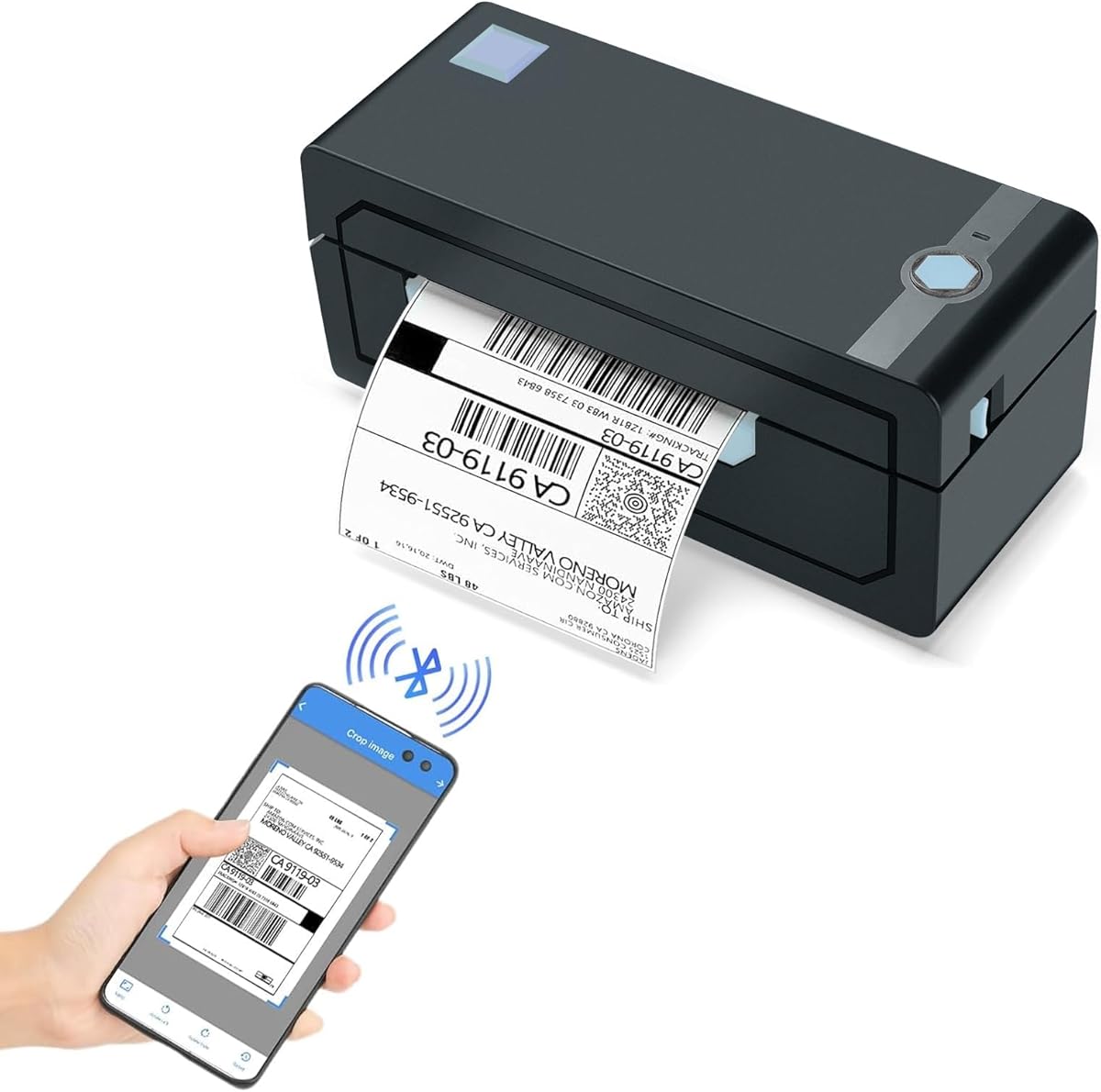
The JADENS Bluetooth Thermal Shipping Label Printer is our leading choice because it balances connectivity, label versatility, and shipping-platform support without specializing in only one workflow. Its 4.4 rating reflects a generally positive customer reception, while the supplied specifications identify a 203 DPI print head and support for both Bluetooth and USB connections. That combination makes it suitable for a home-based merchant, a small fulfillment operation, or a worker who alternates between a phone and a desktop computer.
We may earn a commission when you buy through this link, at no additional cost to you.
The printer works with fanfold and roll labels measuring 1.57 to 4.1 inches wide, covering common 4×6 shipping labels as well as smaller product, warehouse, and marketplace labels. Bluetooth is available on Windows 8 or later and Mac systems, while Android and iOS users must download the Jadens Printer app. USB connectivity offers an alternative for Windows 7 and newer systems and Mac OS 10.9 or later. This mix of wired and wireless options is valuable because mobile pairing can be less predictable than a direct USB connection.
Shipping-platform compatibility is one of the JADENS printer's strongest attributes. The listing names Endicia, Dazzle, ShipStation, ShippingEasy, Shippo, ShipWorks, Ordoro, eBay, Amazon, Shopify, and other common services and marketplaces. Since DHL labels are normally generated by a shipping platform and downloaded as a document before printing, support for the surrounding workflow matters as much as physical printer support. The printer uses direct thermal technology, so it requires no ink or toner.
There are practical compromises. The mobile app is necessary for phone and tablet Bluetooth printing, and changing label formats may require holding the feed button to calibrate the media. Those steps are not unusual for compact thermal printers, but users who want a completely plug-and-play experience may prefer the Rollo USB model. Even with those considerations, the JADENS combines a useful label-width range, broad platform support, and multiple connection paths, making it the strongest overall recommendation for a flexible DHL shipping setup.
Bluetooth supports cable-free printing from compatible computers and mobile devices, while USB provides a stable alternative for desktop setup. This makes the printer useful whether labels originate from a phone, a MacBook, or a Windows workstation.
Compatibility with major carriers, marketplaces, and fulfillment services reduces the chance of a fragmented workflow. Users can prepare shipping documents in their preferred platform and then print them through the supported application or driver.
We may earn a commission when you buy through this link, at no additional cost to you.
The NULLTONEX Thermal Shipping Label Printer 4×6 Bluetooth Label Maker is a feature-focused option for small businesses that want more design flexibility than a basic driver-only printer. It carries a 4.4 rating and uses 203 DPI direct thermal printing, which is appropriate for standard address, barcode, and shipping text. Its claimed speed of 150 mm/s translates to as many as 72 four-by-six-inch labels per minute under the conditions stated in the listing.
We may earn a commission when you buy through this link, at no additional cost to you.
The FlashLabel Pro app is one of the product's defining features. The supplied information highlights more than 1,800 customizable templates, more than 300 fonts, multiple editing tools, and offline capability for locally stored templates and designs. That assortment is especially helpful for merchants who repeatedly create packaging labels, product stickers, mailing labels, or barcoded inventory tags rather than printing shipping documents only.
Connectivity includes Bluetooth and USB, allowing phone, laptop, and desktop workflows. The listing states that Bluetooth requires the FlashLabel Pro app, while USB offers a direct and potentially more stable office connection. Compatibility is broad, covering Amazon, Shopify, Etsy, USPS, UPS, FedEx, and DHL. Standard four-by-six labels are supported, as are other widths from 1.57 to 4.3 inches. Output is limited to black and white, but that is normal for direct thermal shipping printers.
The package is unusually complete for the category: it includes the printer, power cord, USB cable, and 25 sheets of four-by-six thermal labels. The reinforced matte finish and compact design also suit a permanent desk position. The main limitation is that color artwork is unavailable, and mobile users must work through the app. For buyers who prioritize editing resources, offline templates, and a ready-to-use accessory bundle, the NULLTONEX is a compelling small-business option.
The large template, font, and icon library reduces the work involved in creating recurring labels. Offline storage is particularly useful when a busy packing session cannot depend on cloud downloads or continuous connectivity.
Starter labels and both USB and Bluetooth paths allow a new user to begin with standard shipping documents quickly. The included cables and compact footprint also make relocation straightforward.
We may earn a commission when you buy through this link, at no additional cost to you.
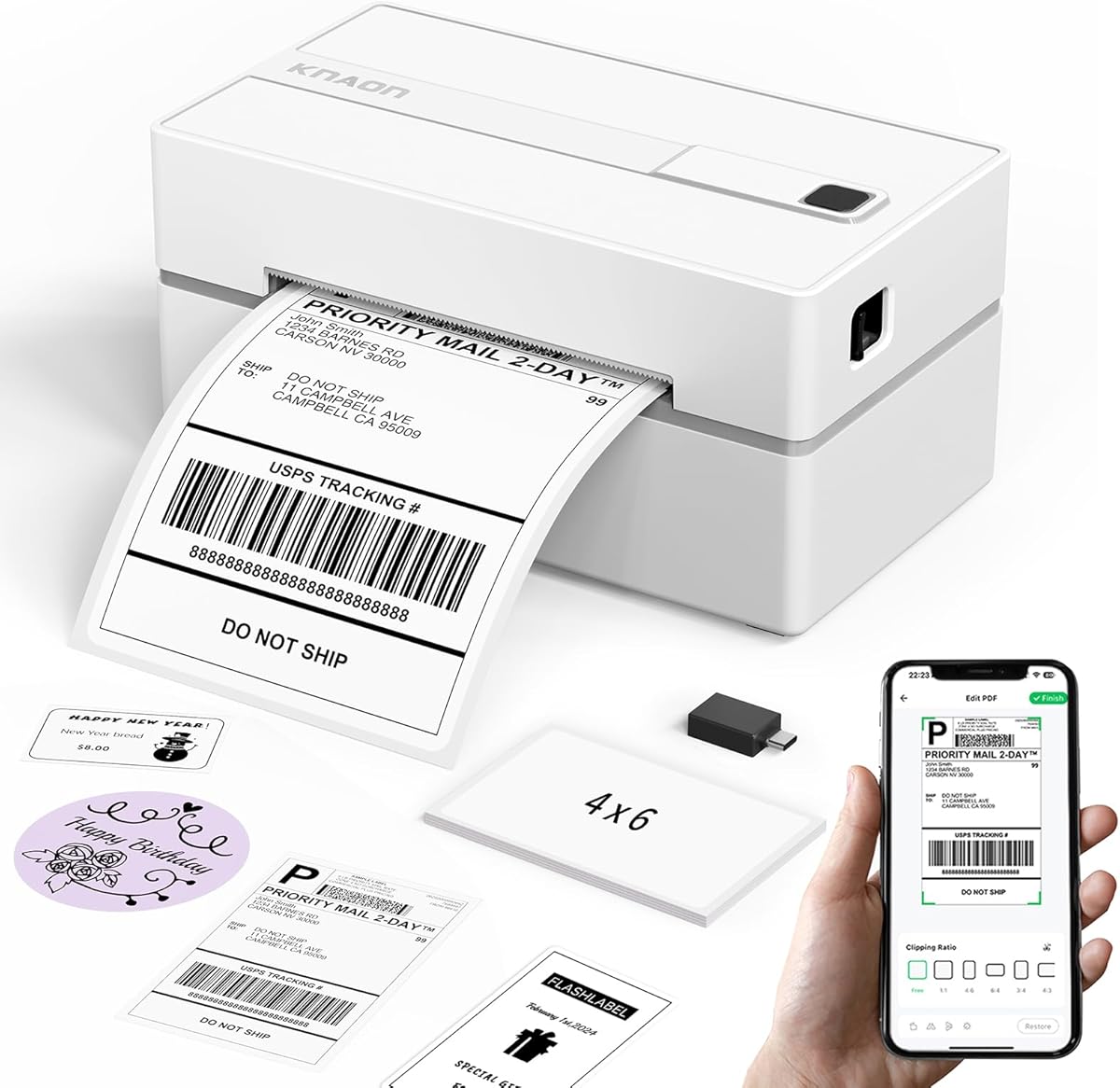
The KNAON Bluetooth Thermal Shipping Label Printer is an attractive option for users who create labels directly from a phone or work across several operating systems. Its 4.4 rating is supported by a versatile design that includes Bluetooth, USB, and a stated print speed of up to 180 mm/s. At 7.17 by 3.9 by 3.43 inches, it also fits comfortably into a compact home office or mobile packing setup.
We may earn a commission when you buy through this link, at no additional cost to you.
Bluetooth printing is handled through the FlashLabel Pro app on iOS and Android. Windows and macOS users can also connect through the app, while Windows 7 and newer systems can use Bluetooth after installing the latest advanced driver. USB provides a broad alternative that covers macOS, Windows 7 and later, ChromeOS, and Linux. ChromeOS users need the FlashLabel extension. This range of support is helpful for people who change devices or need a consistent printing route across several systems.
The app is also the creative center, offering more than 3,000 templates, 5,000 icons, and 100 fonts. It supports shipping labels, barcodes, thank-you labels, name tags, price tags, and other small thermal formats. For marketplace shipping, the listing instructs users to save a logistics label as a PDF and import that file into FlashLabel Pro. The printer works with major services including Amazon, eBay, Shopify, USPS, UPS, Etsy, PayPal, Poshmark, and DHL.
Label widths from 1.5 to 4.2 inches cover standard shipping formats and smaller specialty labels. A speed of 180 mm/s is the highest stated figure in this group, although real workflow results depend on label handling, file preparation, and connection stability. Bluetooth's reliance on the app is the primary inconvenience. For a user who values mobile design tools and broad device support, however, the KNAON provides a flexible and approachable package.
Thousands of templates, icons, and fonts make the companion app useful beyond simple shipping documents. It provides a practical way to build customized labels from a phone without a full desktop design workflow.
Windows, macOS, Linux, ChromeOS, iOS, and Android support make the printer less dependent on a single ecosystem. USB and Bluetooth routes offer flexibility, although each platform has slightly different setup requirements.
We may earn a commission when you buy through this link, at no additional cost to you.
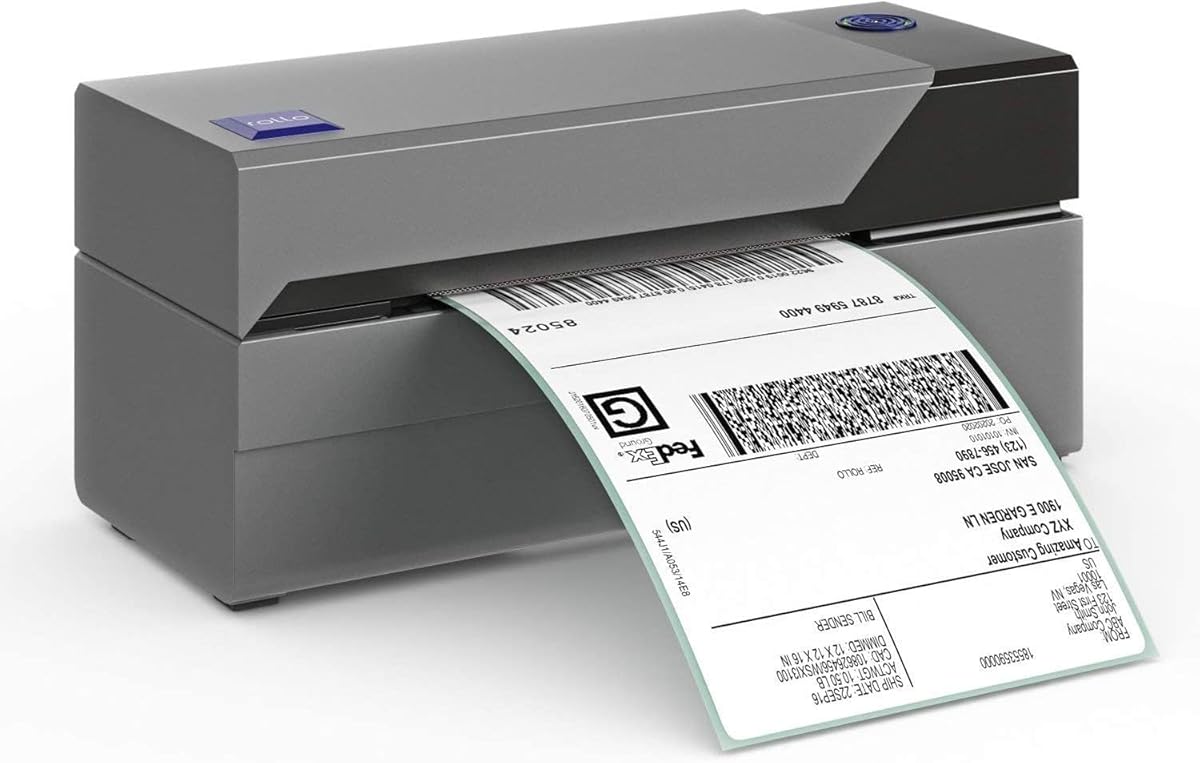
The Rollo USB Shipping Label Printer stands out as the most dependable conventional desktop choice in this guide, carrying the highest customer rating at 4.6. It uses a 203 DPI thermal print head and a stated speed of 150 mm/s, described as one four-by-six label per second. That is a useful level of throughput for small fulfillment desks, mail rooms, and business operators who print from a fixed workstation.
We may earn a commission when you buy through this link, at no additional cost to you.
Its defining simplicity is USB connectivity. The printer supports Windows XP and newer and Mac 10.9 and newer, with drivers that are downloaded for the relevant system. Rollo Ship, the included shipping application, provides a streamlined path for connecting ecommerce platforms and preparing shipments. Even if a business already owns a shipping service, this focused application can make parcel creation and label output more convenient.
The label range extends from 1.57 to 4.1 inches wide, and the printer can handle shipping labels, warehouse labels, barcode labels, stickers, QR codes, thank-you stickers, and business labels. The Rollo app provides creative controls, making the device more versatile than a single-purpose shipping printer. It also works with FedEx, UPS, USPS, ShipStation, ShippingEasy, Shippo, ShipWorks, Amazon, Shopify, Etsy, and eBay, giving users considerable flexibility.
The trade-off is obvious: there is no native wireless connection. A USB-only design avoids Bluetooth pairing problems and often provides a stable desktop workflow, but it also anchors the printer to one computer or requires a hub. The commercial-grade positioning and strong rating make this a sensible first choice for users who value reliability over mobility. It is also a logical DHL label printer when labels are downloaded and printed continuously from a fixed computer.
A direct wired connection reduces wireless setup variables and fits naturally into a dedicated packing station. Windows and Mac support makes it suitable for established offices using mixed computer environments.
The broad supported width and app-based editor allow the same hardware to produce warehouse tags, QR codes, product identifiers, and customer stickers. This extends its useful life beyond parcel processing.
We may earn a commission when you buy through this link, at no additional cost to you.
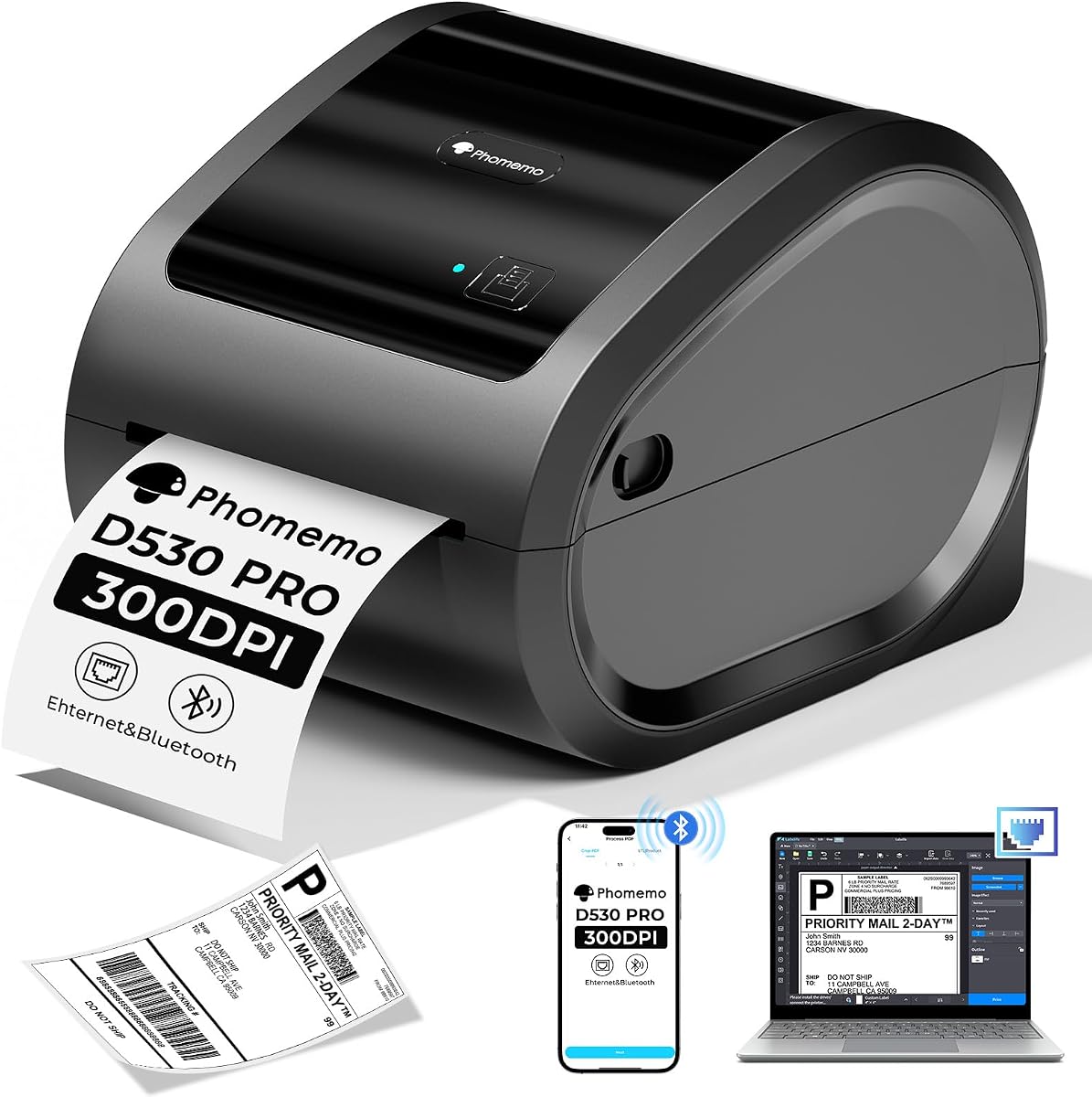
The Phomemo 300DPI Ethernet Thermal Label Printer 4×6 with Built-in Paper Bin is the choice for buyers who prioritize fine text, compact barcodes, and a professional production setup. Its 4.1 rating reflects a solid but less universally enthusiastic reception than the top desktop models. The major technical advantage is 300 DPI resolution, substantially finer than the 203 DPI standard used by most printers in this comparison.
We may earn a commission when you buy through this link, at no additional cost to you.
The D530Pro provides several connection methods. It supports high-speed Bluetooth within approximately 10 meters, Ethernet, and USB, with compatibility for Android, iOS, Windows, macOS, Linux, and ChromeOS. This unusual mix makes it appropriate for a permanent office that needs network access, a mobile packing station, or a computer with a reliable USB connection. Buyers should still verify the exact setup route for their particular device and network.
Its built-in paper slot and label holder can store up to 500 four-by-six-inch label rolls, reducing desk clutter and the need for a separate holder. The stated speed remains 150 mm/s, or an average of 72 four-by-six labels per minute. A return-to-paper function helps recover label material, and the supported printing width of 1 to 4.6 inches accommodates shipping labels, rectangles, circles, and unusual shapes.
Platform compatibility includes USPS, UPS, FedEx, DHL, Amazon, eBay, Shopify, Etsy, PayPal, and Poshmark. The printer can also create bakery, packaging, promotional, freight, warehouse, and product labels, making it relevant beyond home shipping. The main drawback is complexity: multiple networking options and broad media support require a little more deliberate setup than a USB-only unit. For users who can use that versatility, the 300 DPI output and integrated storage provide a clear technical advantage.
The 300 DPI print head produces finer characters and more detailed barcodes than standard 203 DPI models. It is useful when labels include small text, dense product information, or compact code graphics.
The integrated holder stores up to 500 labels while keeping the printer compact. A dedicated production station can therefore stay orderly without a separate large roll stand.
We may earn a commission when you buy through this link, at no additional cost to you.
The MUNBYN Bluetooth Thermal Label Printer is designed for users who want professional output without turning their workspace into a noisy production area. Its 4.2 rating supports a solid overall impression, and the most distinctive specification is a stated operating level of 60 dB, described as quieter than ordinary typing. That makes it relevant to home offices, libraries, shared workspaces, and customer-facing counters where constant mechanical noise would be disruptive.
We may earn a commission when you buy through this link, at no additional cost to you.
The printer supports direct thermal labels from 1.57 to 4.25 inches wide, covering standard shipping labels along with return slips, inventory tags, organization stickers, and branding materials. The stated 0.1 mm font legibility is designed to produce clear monochrome output. Bluetooth is the principal wireless connection, and an indicator illuminates during data transfer before switching off when the connection is stable.
A four-inch DAC chip provides dynamic algorithm technology and automatic calibration intended to reduce label misalignment. The listing also gives an exceptionally low jam-rate figure below 0.01 percent and states that the thermal printer can handle up to 970,000 labels, six times more than ordinary devices. These figures describe manufacturer claims rather than independently verified test results, but they point to an engineering focus on longevity and dependable operation.
The supplied information is less detailed about particular ecommerce-platform integrations and the included software, so buyers should confirm those elements before purchase. It also mentions Bluetooth but provides no detailed USB or Ethernet alternative in the listing. Even so, the combination of quiet operation, calibration, and a broad label range is compelling. MUNBYN is best suited to a user who values tidy, consistent printing in a shared environment more than a large catalog of connection methods.
A stated 60 dB operating level makes the printer suitable for spaces where ongoing conversation or concentration matters. The design is especially relevant to home offices and shared workspaces.
The DAC chip is intended to identify label positioning automatically and reduce alignment errors. That can be helpful when switching between media widths or handling frequent label changes.
We may earn a commission when you buy through this link, at no additional cost to you.
The Rollo Wireless Shipping Label Printer is the premium recommendation for buyers who want a printer accessible from several devices without relying on Bluetooth. Its 4.1 rating is supported by a well-established set of connectivity features, including native Wi-Fi and AirPrint. iPhone, iPad, and Mac users can print through AirPrint, while Android, Windows, Chromebook, and Linux users can connect over Wi-Fi without needing Bluetooth or a traditional driver.
We may earn a commission when you buy through this link, at no additional cost to you.
The main advantage is flexibility. A shared office can place the printer where several workstations can reach it, while a phone-based packing station can avoid a cable. USB is also available as a fallback when wireless access is inconvenient or unreliable. This makes the model particularly attractive for teams, shared packing rooms, and anyone who wants one printer to serve more than a single computer.
Printing performance follows the familiar Rollo specification of 203 DPI and up to 150 mm/s, described as one four-by-six label per second. Labels from 1.57 to 4.1 inches wide are supported, and the app can create shipping labels, barcodes, product labels, QR codes, thank-you stickers, and business stickers. The included Rollo Ship Manager application provides a streamlined shipping workflow and can connect to ecommerce platforms.
Compatibility includes FedEx, UPS, USPS, ShipStation, ShippingEasy, Shippo, ShipWorks, Amazon, Shopify, Etsy, and eBay. The print head has a stated life of approximately 650,000 shipping labels, or 327,360 feet, which the listing describes as four times longer than alternatives. Network configuration is the main setup consideration, and some AirPrint functions can differ by device. For a multi-user operation, however, native Wi-Fi is a premium feature worth prioritizing.
Wi-Fi and AirPrint let phones, tablets, Chromebooks, and desktop systems reach the same printer. Shared packing stations can avoid moving a device or connecting a cable each time a label is needed.
The stated 650,000-label print-head life supports use in sustained shipping environments. Routine cleaning and correct media loading remain important for preserving that longevity.
We may earn a commission when you buy through this link, at no additional cost to you.
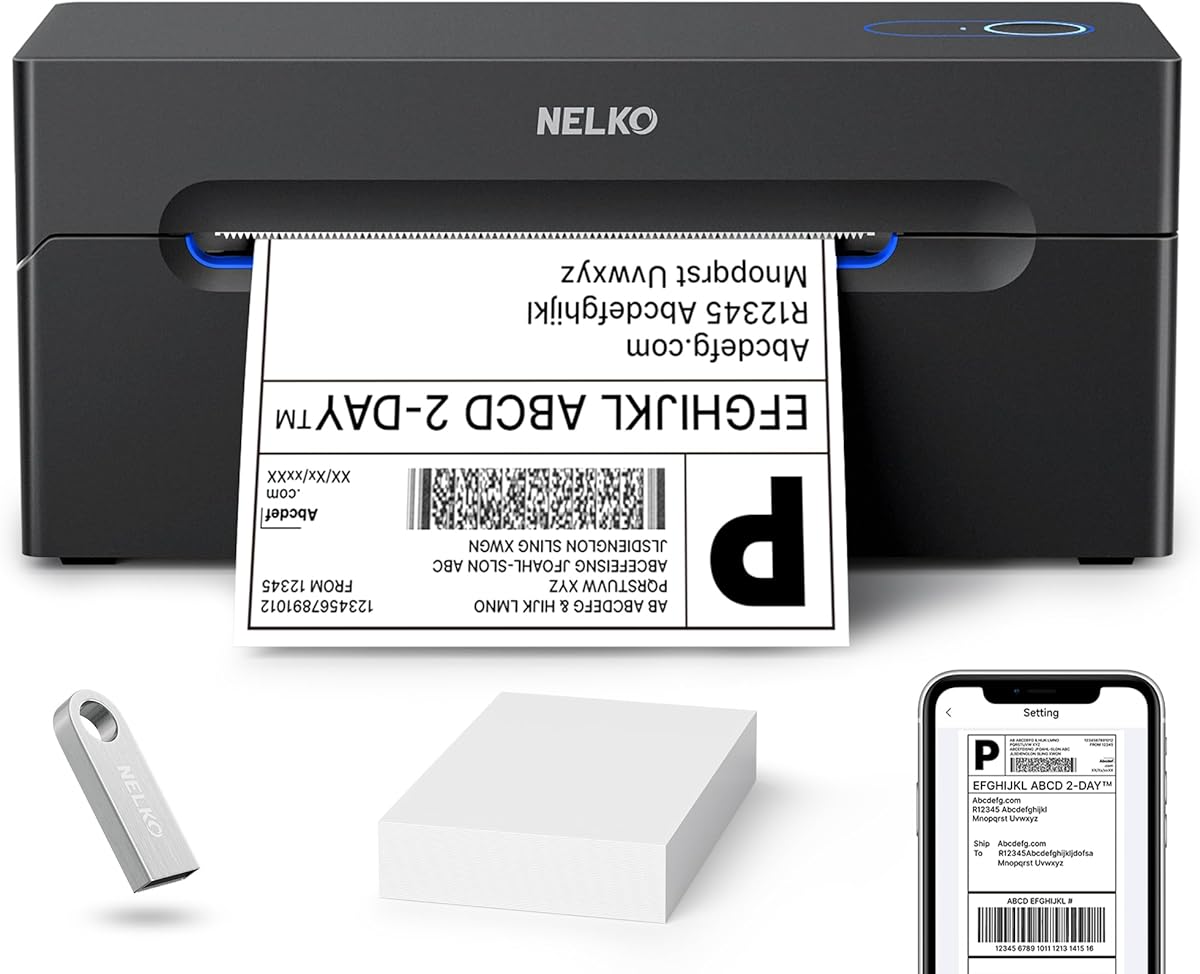
The Nelko Bluetooth Thermal Shipping Label Printer is a well-rounded option for small businesses that want both mobile flexibility and a reliable wired path. Its 4.3 rating is among the stronger results in this group, while the 203 DPI resolution and 150 mm/s speed provide familiar, practical thermal performance. The listing equates that speed to as many as 72 four-by-six labels per minute.
We may earn a commission when you buy through this link, at no additional cost to you.
Bluetooth works through the Nelko app on iOS and Android. Windows 7 and later computers can print through Bluetooth, and Mac systems with M1 or M2 processors can connect by installing the app. USB supports Windows 7 and later, Mac OS, and ChromeOS, although the listing specifically states that Mac Bluetooth is not supported. Buyers using a Mac should therefore plan on the wired route or the app-mediated workflow offered by other products in this guide.
Both fanfold and roll labels are accepted, with widths from 1.54 to 4.1 inches. Common formats include four-by-six shipping labels and smaller three-by-two, three-by-one, and two-by-one labels. Platform support extends to Amazon, eBay, Shopify, USPS, UPS, Etsy, PayPal, and Poshmark. For shipping documents, the recommended process is to save the logistics label as a PDF in the shipping platform and then upload it to the Nelko editing app.
The printer is smaller than traditional desktop models and needs relatively little workspace. A U-disk includes printer drivers, instructional videos, and troubleshooting material, which is a helpful addition for first-time setup. The tradeoff is that users must navigate a slightly fragmented device matrix, especially on Mac. For a Windows-centered or mobile-first merchant who handles varied label sizes, the Nelko remains an efficient and flexible choice.
Support for both roll and fanfold media lets the printer move beyond a single shipping format. Smaller product, address, and barcode labels can share the same compact device.
Drivers and instructional material on the included U-disk help new users establish connections and troubleshoot common issues. This is especially helpful when switching between mobile and desktop workflows.
We may earn a commission when you buy through this link, at no additional cost to you.
The Rongta Bluetooth Shipping Label Printer is our budget recommendation for a new seller or occasional shipper who wants modern mobile printing without a large investment in equipment. Its 4.0 rating is the lowest among the ten products, but the underlying specifications cover the essential needs: 203 DPI output, a stated 150 mm/s speed, and automatic label detection.
We may earn a commission when you buy through this link, at no additional cost to you.
Automatic identification is a meaningful convenience. The printer is described as detecting, grabbing, and feeding labels without manual adjustment, which reduces setup time when changing between media. It supports direct thermal labels from 0.98 to 4.37 inches wide, including four-by-six shipping labels, two-by-two circular labels, two-by-one barcodes, and one-by-one QR-code labels. That is one of the broadest size ranges in the group.
The RONGTA app provides Bluetooth printing from iOS and Android phones and tablets. Windows and Mac drivers are available from the brand's official website, with stated support for Windows 7 and newer, Mac OS 10.11 and newer, and ChromeOS. The physical design measures 10.2 by 7.4 by 5.3 inches, so it is larger than several other compact models but still suitable for a desk, drawer, or travel setup.
The listing gives less detail about a direct USB workflow, and the 4.0 rating suggests some room for improvement in overall user satisfaction. Nevertheless, its automatic feeding, broad media compatibility, and solid core specifications cover the basics well. It is best suited to price-conscious buyers who primarily print from a phone and want support for many small label formats. As with any budget printer, buyers should verify the latest driver and app requirements before committing.
Automatic detection and feeding remove much of the manual adjustment normally required when switching label formats. This makes the printer approachable for occasional shippers and changing media use.
The printer supports everything from tiny QR-code labels to standard shipping labels. Its modest footprint and portable shape suit small workspaces, storage drawers, and travel.
We may earn a commission when you buy through this link, at no additional cost to you.
The DYMO LabelWriter 550 is the most specialized model in this guide. Rather than competing primarily with 4×6 shipping printers, it focuses on precise quantities of DYMO-branded labels and automatic media recognition. Its 3.6 rating is the lowest in the comparison, so it should be considered carefully. It is most relevant to offices and home users organizing files, products, mail, or inventory with supported DYMO media.
We may earn a commission when you buy through this link, at no additional cost to you.
The principal feature is waste reduction. Instead of printing a full sheet and discarding unused labels, the printer outputs the exact number required. Direct thermal technology removes the need for ink or toner, and automatic recognition helps the printer adjust to compatible label formats. The product is also associated with BPA-free labels made from FSC-certified material and comes in plastic-free packaging.
A critical limitation is brand-locked media. The listing states that the printer works only with authentic DYMO LabelWriter labels, which may constrain users who already own compatible generic thermal stock. The supplied information also does not describe broad carrier or marketplace integration, four-by-six parcel-label support, wireless connectivity, or a dedicated shipping application. That makes it less suitable for someone searching specifically for a high-volume DHL parcel printer.
There are still reasons to choose it. Precise quantities, automatic recognition, and a simple direct-thermal process are valuable for repetitive organization tasks. The trade-off is that label supply is limited to one brand, and the lower rating reflects a less universally appealing proposition than the flexible shipping printers above. Consider the LabelWriter 550 for label organization or small office labeling, while choosing a dedicated shipping model for parcel workflows.
Printing only the number of labels needed helps avoid unused sheets and reduces material waste. This is particularly useful for archive, filing, and product-organization projects.
Automatic recognition reduces the setup required when changing compatible DYMO media. The result is a simpler workflow for users who do not want to manage detailed printer settings.
We may earn a commission when you buy through this link, at no additional cost to you.
The right DHL label printer depends on where you prepare labels, which devices you use, how many parcels you handle, and which shipping services you rely on. The following factors help separate basic label printers from flexible, shipping-focused systems.
USB is the most direct and stable option for a fixed computer. It avoids wireless pairing and works particularly well when labels are downloaded, edited, and printed continuously from a dedicated packing station. Bluetooth is more convenient for phones, tablets, and occasional mobile packing, although most models require a companion app and may have operating-system limitations. Wi-Fi is the strongest choice for a shared office because multiple devices can reach one printer without a cable. The Rollo Wireless model stands apart with AirPrint and broad Wi-Fi support.
Most thermal printers use 203 DPI, which is suitable for standard addresses, barcodes, and shipping text. The Phomemo D530Pro raises the stated resolution to 300 DPI, offering finer detail for dense labels, small fonts, and compact graphics. Higher resolution is useful when readability is critical, but it should be considered alongside compatibility and workflow rather than treated as the only measure of printer quality. Barcode scanning and platform-generated labels may still be perfectly clear on a well-performing 203 DPI model.
A standard four-by-six shipping label is the primary requirement for parcel workflows, but many printers also handle narrower products, barcodes, and return labels. The JADENS, Rollo, Nelko, and NULLTONEX models cover roughly 1.54 to 4.3 inches, while the MUNBYN extends to 4.25 inches. The Rongta supports an especially broad 0.98-to-4.37-inch range, and the Phomemo supports up to 4.6 inches. Always confirm the exact width range and whether the required media type is roll or fanfold.
A printer can produce sharp labels and still be inconvenient if it cannot accept the format generated by your shipping workflow. The JADENS lists a particularly broad group of marketplaces and fulfillment tools, while the NULLTONEX, KNAON, Nelko, and Phomemo explicitly name DHL along with major carriers and ecommerce platforms. Some workflows require saving the logistics label as a PDF and importing it into the printer app. Confirm the required import method and whether your preferred platform is explicitly supported.
Most models in this guide use a stated speed of 150 mm/s, which is described as up to 72 four-by-six labels per minute. The KNAON lists up to 180 mm/s, offering a slight stated advantage for rapid batches. Speed matters most for high-volume fulfillment, but it should not be considered independently of label handling, connection stability, and preparation time. An occasional shipper may gain more from simple automatic loading than from a marginal speed increase.
Every model in the list uses direct thermal output, so color printing is not available. Most focus on black-and-white shipping, barcode, address, and product labels. The NULLTONEX and KNAON provide especially large template, font, and icon libraries, while the Rollo models also support custom labels such as QR codes and thank-you stickers. Businesses needing branding should verify whether they require full color, which would call for a different printer category entirely.
A compact printer can make a home packing station more comfortable, but speed and quiet operation are not identical. The MUNBYN is the clearest option for noise-sensitive environments, with a stated 60 dB operating level. The KNAON is particularly small at 7.17 by 3.9 by 3.43 inches, while the Phomemo uses its built-in holder to organize up to 500 labels. Consider the full setup, including media storage and the route to power, rather than measuring the printer alone.
Thermal printers are rarely as simple as selecting a device and pressing print. Mobile workflows generally require an app, desktop systems may need a driver or extension, and logistics labels are often imported as PDFs. Windows, Mac, Linux, and ChromeOS support varies considerably, especially for Bluetooth. The Nelko and KNAON include U-disk setup resources, while other brands provide driver downloads through their websites. Check current operating-system requirements before choosing the most appealing model.
Begin by installing the appropriate app or driver for your device and pairing the printer through its supported method. For Bluetooth models, open the named companion app, complete the connection, and confirm that the printer appears as available. USB-only models should be connected directly or through a reliable hub. If the printer ships with test media, print a sample before loading your usual roll or fanfold labels so you can confirm alignment, size recognition, and text clarity.
Prepare the shipping document in your ecommerce or shipping platform, save the logistics label as a PDF when instructed, and import it into the printer app. Avoid rescaling the document unless necessary because resizing can blur small text or affect barcode dimensions. Check that the loaded media width falls within the supported range and that the printer or app is set to the matching label size. If output is shifted or cut off, use the printer's feed or calibration control according to its manual.
For care, keep the print head and label path free from adhesive residue and paper dust. Open the printer carefully, inspect the rollers, and remove loose debris with a soft, dry material rather than scraping the thermal head. Store thermal labels in a cool, dry location away from direct heat and sunlight. Periodically print a test label to check darkness, alignment, and barcode readability, and keep the device's firmware, app, and drivers updated through the manufacturer's official channels.
Yes, a compatible thermal printer can print DHL labels after they are generated through a supported shipping platform. The practical method is to save the logistics label as a PDF and import or open it in the printer software. Compatibility varies by printer, so confirm that the model supports your shipping workflow and the required four-by-six media. Always check addresses, barcodes, and service information on a test label before processing a large batch.
No. The thermal printers in this guide use direct thermal technology, so they do not require ink or toner. They print on heat-sensitive labels, which reduces maintenance and consumable costs. Thermal output is monochrome, however, so these printers are unsuitable for tasks requiring full-color logos or packaging graphics. Thermal labels should also be stored properly because heat, moisture, and direct sunlight can affect their quality.
Bluetooth is convenient but not necessary. A USB-connected printer can provide a more stable connection at a fixed packing station, while Wi-Fi is useful when several devices need access to one printer. Bluetooth models are valuable for mobile workflows, although most require a companion app and have device-specific pairing requirements. Choose the connection method that matches how you actually prepare and print labels rather than selecting wireless solely for novelty.
Most DHL parcel shipments use four-by-six-inch labels, so that size should be your first purchase. A printer that supports a range of widths can also handle smaller product, return, barcode, and address labels. Confirm the printer's supported width, media type, and roll or fanfold format before ordering. Buying the wrong stock can cause calibration problems, partial output, or wasted labels even when the printer itself is working correctly.
A properly functioning 203 DPI thermal printer is suitable for standard shipping labels, addresses, and barcodes. Readability depends on correct media, clean print heads, suitable contrast, and a barcode that has not been improperly resized. The Phomemo D530Pro offers 300 DPI for unusually small text or dense graphics, but resolution alone cannot correct damaged thermal stock or poor maintenance. Always test-scan a label before shipping a large batch.
Blank output can result from incompatible or poorly stored thermal media, a dirty print head, an incorrect label-size setting, or a connection problem. Misalignment may indicate that the media width does not match the configured template or that automatic calibration has not completed. Reload the roll, clean the print path with an appropriate dry method, and check the app's label dimensions. Consult the model-specific instructions if the problem continues.
Most models in this guide support more than standard parcel labels. Compatible widths and design apps allow users to print product labels, return slips, barcodes, QR codes, name tags, thank-you stickers, and organizational materials. The key is to select the correct media and use the matching size preset. If both label types have very different widths, changing rolls may take extra time, but a broad-width printer can still handle both efficiently.
Choose USB for one fixed computer, Bluetooth for mobile or occasional wireless use, and Wi-Fi for a shared workspace. The JADENS offers both Bluetooth and USB, while the Rollo USB model focuses on dependable desktop operation. The Rollo Wireless model uses AirPrint and Wi-Fi to reach a broader collection of devices. Consider your actual packing location, network reliability, and operating-system compatibility before making the final choice.
The JADENS Bluetooth Thermal Shipping Label Printer is the best overall option because it combines 203 DPI output, Bluetooth and USB connections, a useful label-width range, and broad shipping-platform support. The Rongta Bluetooth Shipping Label Printer stands out as the best budget choice for buyers who prioritize automatic media handling and a wide range of label sizes. At the premium end, the Rollo Wireless Shipping Label Printer offers native Wi-Fi, AirPrint, and shared-device flexibility.
Your operating environment should guide the final decision. Use a wired Rollo USB printer for a stable dedicated computer, a Bluetooth model for mobile packaging, or a Wi-Fi printer for a shared packing station. Higher resolution is valuable for unusually dense labels, while a broad app-based template library benefits merchants who produce more than standard shipping documents. Always verify platform integration, operating-system support, and media compatibility before purchasing.
Prices, bundles, ratings, and software requirements can change, so review the current listing before ordering. Check whether the package includes labels, cables, media holders, or accessories that your setup still needs. Most importantly, use the printer's pairing or driver instructions, test the required label format, and print a sample DHL document before processing a full shipping batch.