
Focusrite Scarlett Solo 4th Gen
4.6Editor score
High-resolution 120 dB range
Enhanced Air recording mode
USB-C computer connection
Recording software bundle included
Compare the best Audio Interfaces with Built in Dsp for recording, streaming, and music production, with guidance on sound quality, I/O, effects, and workflow.
Audio interfaces with built-in DSP put recording tools, effects, and signal control directly into the hardware. This can simplify vocal production, podcasting, streaming, and instrument recording while reducing dependence on the computer. The right model balances conversion quality, preamps, connectivity, monitoring, and the kind of processing your workflow actually needs.
We compared all ten models by examining their documented preamps, analog and digital connections, onboard effects, monitoring options, supported software, and control features. The list covers portable creator tools, bus-powered studio units, expandable professional interfaces, and premium Thunderbolt models. It also highlights whether DSP is focused on mixing, instruments, monitoring, or a broad recording ecosystem.
Each pick represents a different route into hardware-based signal processing. Some prioritize polished vocal chains and virtual instruments, while others provide extensive routing, multiple monitor mixes, or large plug-in libraries. Ratings and technical details reflect the supplied product information, and current prices can change, so compare the latest offers and full feature lists before purchasing.
4.6Editor score

4.8Editor score

4.0Editor score
This side-by-side comparison highlights each interface's processor approach, input configuration, monitoring features, and workflow emphasis, helping you identify the most suitable model for recording, streaming, or professional studio use.





The Focusrite Scarlett Solo 4th Gen is a compact USB-C interface for songwriters who want a straightforward path from microphone or guitar to a finished recording. Its supplied rating is 4.6, and its strongest qualities are a 120 dB dynamic range, converters shared with higher-tier Focusrite designs, and a compact format suited to home studios and mobile recording.
We may earn a commission when you buy through this link, at no additional cost to you.
The interface is designed around a solo musician rather than an expanded production room. Its microphone and guitar-oriented workflow makes it especially useful for capturing ideas, vocal parts, and direct instrument performances. The improved Air mode is the main sound-shaping feature, adding presence and harmonic drive to vocals and guitars while preserving a simple connection to the included recording software.
Its limitations are equally clear. It does not offer the extensive onboard mixer, multibus routing, virtual instruments, or voice-processing suite found in more specialized DSP interfaces. Users seeking loopback capture, complex podcast routing, or multiple independent headphone mixes will need a more specialized model. For a one-person studio, however, those omissions may matter less than simple setup and dependable recording.
This is a strong recommendation for a beginner or songwriter who wants a recognizable studio workflow without configuring a dense signal chain. It also makes sense for mobile creators who only need one or two inputs. The Solo 4th Gen is best viewed as a compact recording foundation with a helpful character mode, rather than a complete all-in-one production console.
The Solo concentrates on the most common solo-creator tasks: connecting a microphone or guitar, monitoring, and recording into a DAW. That narrow focus makes it approachable while retaining the 120 dB dynamic range and quality converters that give the interface more serious studio credentials.
Rather than offering a deep collection of processors, the interface provides one clearly defined tonal tool. Air mode lifts vocals and guitars with presence and harmonic richness, giving recordings a more polished starting point when extra coloration is welcome.
We may earn a commission when you buy through this link, at no additional cost to you.
The Elgato Wave XLR MK.2 is a USB audio interface and DSP mixer aimed at streamers, podcasters, and solo presenters who want onboard voice processing. It carries a 4.3 rating and combines a high-gain XLR input, low-latency headphone monitoring, touch controls, and a focused collection of vocal tools.
We may earn a commission when you buy through this link, at no additional cost to you.
Its 80 dB gain range is one of the most notable specifications, allowing support for a broad selection of XLR microphones. The onboard voice enhancer, compressor, equalizer, and other effects provide a convenient processing chain without requiring every operation to happen in host software. Wave Link integration extends control over routing, monitoring, and effects.
The main limitation is scale. With one XLR microphone input, it is not intended to manage a large session or multi-instrument recording. Its 24-bit, 48 kHz monitoring is well suited to real-time communication and streaming, but studios that require higher-resolution recording or extensive I/O should look elsewhere. The compact design also centers on speech and broadcast-style use.
Choose this interface if your priority is an attractive, understandable streamer setup with physical controls and integrated vocal processing. It is particularly compelling for a creator who wants the interface and mixer to operate as one device. For band recording or advanced multichannel production, its focused feature set will feel too narrow.
The integrated voice chain addresses the most common streaming problem: making speech clear and consistent without a deep software session. Compression, equalization, and enhancement can be managed through Wave Link and are especially useful for broadcast-style monitoring.
Touch control with customizable LED feedback makes important states visible at a glance. This is useful during live sessions because the creator can confirm levels, mute status, and routing without continually opening a software window.
We may earn a commission when you buy through this link, at no additional cost to you.
The Universal Audio Apollo Twin X QUAD Gen 2 is a premium Thunderbolt 3 interface for engineers and advanced producers who want hardware-based UAD processing integrated into a professional recording workflow. Its supplied rating is 4.0, and its defining features include Unison preamp emulations, more than 200 UAD DSP and Native plug-ins, and Apollo Monitor Correction powered by Sonarworks.
We may earn a commission when you buy through this link, at no additional cost to you.
The combination of quad-channel architecture, low-latency monitoring, and a large plug-in catalog creates a flexible environment for tracking. Artists can record through modeled Neve, API, Avalon, Manley, Fender, and other preamp characteristics, while the included plug-ins cover compression, distortion, mixing, and mastering tasks. Auto-Gain helps establish consistent levels across multiple inputs.
This is not a simple all-in-one box. Its professional ecosystem assumes access to a suitably equipped computer and a serious production workflow. The scale of the UAD library can also make setup more involved than choosing a handful of onboard effects. Buyers must decide whether access to that ecosystem justifies a premium interface and associated computer requirements.
The Apollo Twin X QUAD Gen 2 is best for a serious project studio, commercial production room, or advanced home setup where plug-in choice and low-latency monitoring matter. Its value lies in combining premium conversion, preamp modeling, monitoring tools, and a large DSP library in one professional platform rather than offering a simple creator device.
More than 200 UAD DSP and Native plug-ins cover a broad range of recording and mixing tasks. This gives the interface flexibility for mixing sessions as well as tracking, with the option to move beyond the interface's immediate recording workflow.
Apollo Monitor Correction and Auto-Gain address two recurring production problems: inaccurate room translation and inconsistent recording levels. Together, they make the hardware more useful to engineers working across different spaces and input configurations.
We may earn a commission when you buy through this link, at no additional cost to you.
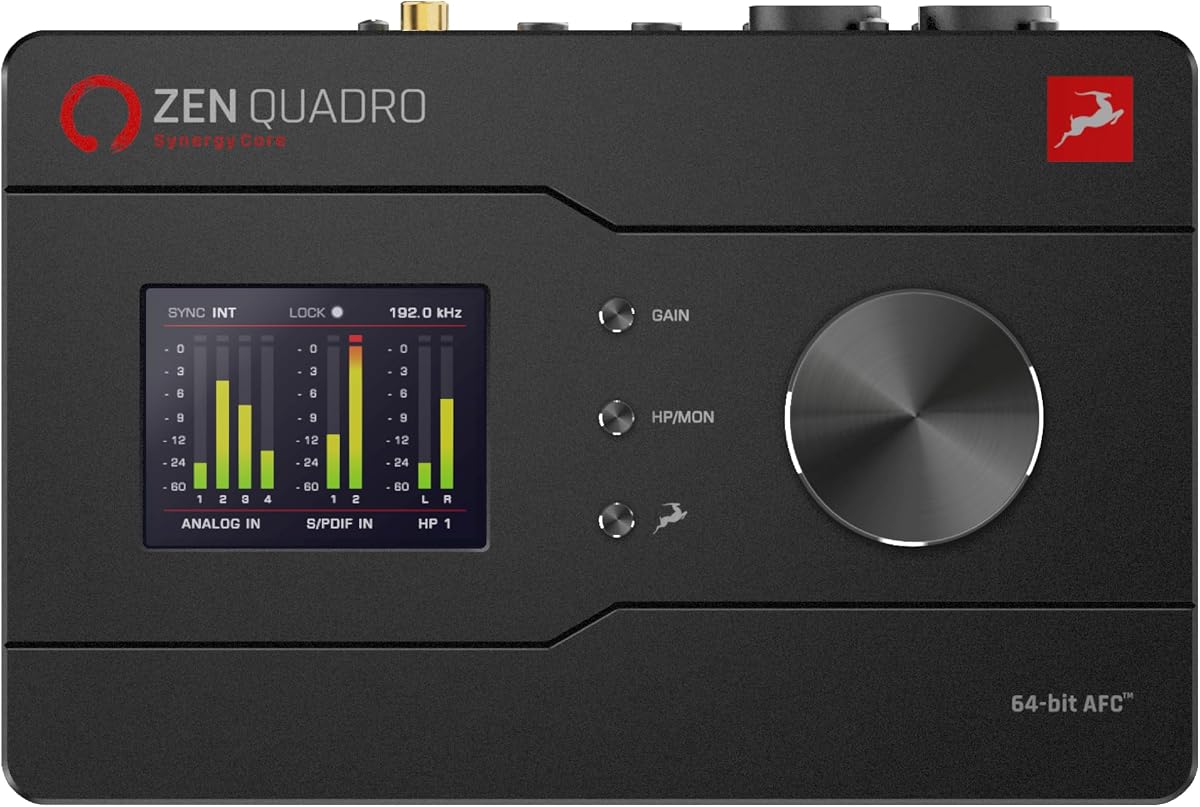
The Antelope Audio Zen Quadro is a portable studio interface with dedicated real-time DSP and a surprisingly broad recording architecture. Its 4.7 rating reflects a strong balance of features, including four discrete preamps, two Hi-Z inputs, 37 included Synergy Core effects, dual USB-C connectivity, and expansion through digital audio connections.
We may earn a commission when you buy through this link, at no additional cost to you.
Dedicated DSP and FPGA hardware allow the included compressors, EQs, preamps, amplifiers, and cabinet simulations to run with near-zero latency and without loading the host CPU. The conversion system supports up to 130 dB of dynamic range, while 64-bit AFC clocking is designed for precise synchronization. The result is a portable interface capable of handling vocals, instruments, and small sessions.
Its complexity is the main trade-off. The 14-input, 10-output design, ADAT expansion, S/PDIF, loopback, independent headphone outputs, and standalone presets offer substantial control but may exceed the needs of a simple singer-songwriter. The extensive effects library also rewards experimentation and organized preset management rather than a minimal signal chain.
The Zen Quadro is a compelling recommendation for a mobile studio, small production room, or creator who wants a large hardware effects catalog without relying on host processing. It stands out particularly for people who record electric instruments, work across computers and mobile devices, or want to expand the interface as their setup develops.
Running real-time effects on dedicated DSP and FPGA hardware reduces dependence on the computer's processing capacity. That is valuable during recording, where predictable performance and low monitoring latency can directly affect the quality and ease of a take.
The bus-powered enclosure and dual USB-C ports support a flexible mobile workflow. At the same time, ADAT, S/PDIF, and dedicated monitor and headphone outputs allow the compact unit to grow into a wider studio or stage system.
We may earn a commission when you buy through this link, at no additional cost to you.
The Universal Audio Apollo Twin X DUO Gen 2 delivers a focused version of the Apollo professional ecosystem. It has a 4.5 rating, Thunderbolt 3 connectivity, Unison preamp modeling, access to more than 200 UAD DSP and Native plug-ins, and Apollo Monitor Correction for headphone or room-based mixing.
We may earn a commission when you buy through this link, at no additional cost to you.
The two-channel format is ideal for projects centered on one singer, a single instrument, or a stereo tracking chain. Real-time Unison preamps reproduce characteristics associated with several famous preamp designs, allowing the performer to record through a modeled sound rather than only a neutral input. Bass management also supports more complete monitor setups with a subwoofer.
Compared with the Quad version, the DUO provides less room for simultaneous multichannel tracking. It also requires a more professional computer and software setup than a bus-powered creator interface. As a result, the deciding question is whether the user values UAD access and Apollo tools enough to prioritize that ecosystem over broader channel count.
This model is a strong recommendation for producers who primarily work with one or two sources but want premium monitoring, modeled preamps, and a deep plug-in library. It is especially suitable for a serious home studio that will grow through software and plug-ins rather than an expanding hardware input inventory.
Unison places the selected preamp emulation directly in the recording path. This makes it possible to shape the source during the performance, giving the artist immediate feedback on a modeled analog texture rather than waiting for a plug-in during mixing.
Sonarworks-powered monitor correction helps users hear a more consistent representation through headphones or studio monitors. Bass management adds another layer of control for setups that include a subwoofer.
We may earn a commission when you buy through this link, at no additional cost to you.
The Solid State Logic 2 MKII Plus is a well-balanced 2×4 USB-C interface for producers, podcasters, and live musicians who want high-resolution conversion and useful studio-oriented tools. Its 4.7 rating is supported by two XLR preamps, 32-bit and 192 kHz conversion, Legacy 4K Analog Enhancement, zero-latency monitoring, loopback, and MIDI I/O.
We may earn a commission when you buy through this link, at no additional cost to you.
SSL's Legacy 4K feature gives recordings an optional analog-style enhancement, offering a different approach to onboard color than a conventional compressor or EQ chain. The conversion capability supports high-resolution projects, while two discrete headphone outputs give performers and collaborators separate monitoring paths. The supplied SSL Production Pack adds software to the hardware package.
The main constraint is scale. Two XLR inputs and two line or Hi-Z inputs are enough for focused sessions but not larger ensemble tracking. It also does not present the expansive built-in effect libraries seen on dedicated DSP platforms, so users seeking many hardware processors will need to look elsewhere.
The SSL 2 MKII Plus is a smart recommendation for a small project studio where conversion quality, flexible input types, MIDI, and restrained analog coloration matter more than a large onboard mixer. It is equally suitable for podcast production, compact music recording, and mobile creative work on Mac or Windows.
The 32-bit, 192 kHz converters and two XLR preamps make this a solid foundation for detailed recording. It suits producers who want clean capture with the option to add a specific SSL-inspired character later.
MIDI I/O, stereo loopback, high-pass filters, and multiple line outputs expand the interface beyond basic microphone capture. These additions support instrument control, podcast workflows, and more versatile routing.
We may earn a commission when you buy through this link, at no additional cost to you.
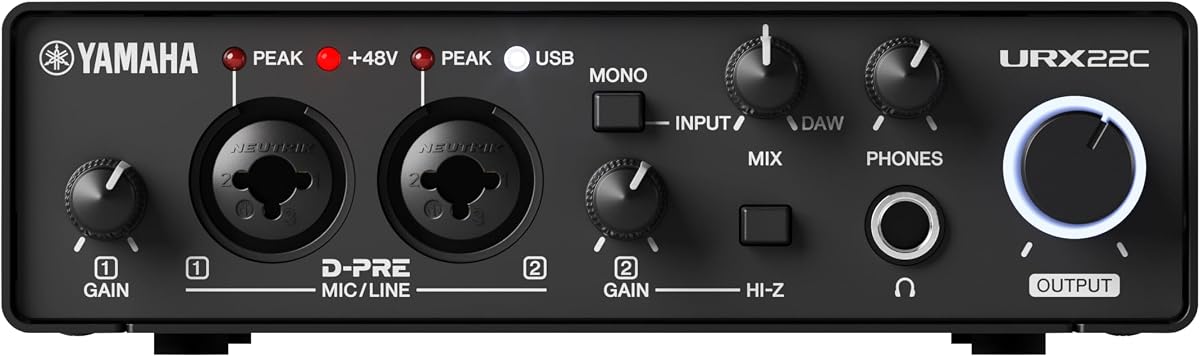
The Yamaha URX22C is a compact two-input interface aimed at musicians who want high-resolution recording and low-latency monitoring with hardware-based effects. Its 4.5 rating reflects a capable combination of 32-bit, 192 kHz USB support, Class-A D-PRE preamps, MIDI I/O, a rugged metal housing, and latency-free DSP monitoring.
We may earn a commission when you buy through this link, at no additional cost to you.
Its DSP section includes REV-X reverb, a Channel Strip, and Guitar Amp Classics. These processors let performers hear a more developed signal while tracking, reducing the need to duplicate every effect in the DAW. VST 3 and AU plug-in versions are included, and compatibility spans Windows, macOS, and iOS through Cubase AI, Steinberg Plus, and dspMixFx.
With two XLR or TRS combo inputs, the interface is best for a single vocalist, guitar, or stereo pair rather than a multi-person session. The full-metal housing adds durability, but the software and effect routing still require some setup. A creator who wants a fully hardware-configured mixer may find the controls less direct than on a dedicated mixer-style device.
The URX22C is a strong fit for a mobile guitarist, singer, or small duo that values portability, high-resolution audio, and monitor effects. Its appeal lies in the combination of sturdy construction and a capable effect chain in a relatively compact package.
Latency-free DSP monitoring allows singers and guitarists to perform through reverb, channel-strip processing, or amplifier simulations. This can make a home recording feel more immediate and reduce duplicated plug-in work.
The compact metal body, bus-powered design, MIDI support, and cross-platform applications suit musicians who move between rehearsal spaces and production setups. It is particularly useful for creators who work on both computers and mobile devices.
We may earn a commission when you buy through this link, at no additional cost to you.
The MOTU UltraLite-mk5 is an expansive USB interface for producers who need many connections, flexible monitor routing, and a hardware mixer. It has a 4.3 rating and combines two combo inputs, six additional analog inputs, ten analog outputs, headphone, S/PDIF, and eight-channel optical connectivity for as many as 40 simultaneous channels.
We may earn a commission when you buy through this link, at no additional cost to you.
DSP-driven monitor mixing is its defining advantage. Live inputs and computer channels can be assigned to any analog output pair, allowing up to six separate mix buses. Onboard reverb, four-channel parametric equalization, and dynamics processing can be applied to inputs and buses, while CueMix 5 provides control from Mac, Windows, or iOS devices.
The breadth comes with a learning curve. Its numerous connections, software-controlled mixer, and dense routing options are more involved than a two-channel creator interface. The physical footprint may also be less convenient for a minimal desk, and users with simple tracking needs may never need the optical and digital connections.
The UltraLite-mk5 is an excellent recommendation for a production room with several players, a streamer using multiple mix destinations, or an engineer who wants hardware control over monitoring. It is less suitable for someone who wants a simple, immediate box for a single microphone and instrument.
Six independent mix buses are valuable for rehearsal, podcast interviews, live performance, and collaboration. Each performer can receive a different blend of instruments, computer playback, and effects while the main outputs remain under separate control.
Optical and S/PDIF connections add channels beyond the analog front end. That makes the interface relevant to small ensembles and evolving studios, while the comprehensive metering helps users monitor a large routing matrix accurately.
We may earn a commission when you buy through this link, at no additional cost to you.
The Yamaha URX22 is a touchscreen-focused four-input interface designed for creators who want direct hardware control over a modern production workflow. It supports 32-bit, 192 kHz audio, includes a 4.3-inch touchscreen and five knobs, and uses a built-in DSP processor for latency-free monitoring. No published rating was supplied for this model.
We may earn a commission when you buy through this link, at no additional cost to you.
Dual MAIN and SUB USB ports are a notable feature because they can support a computer plus a phone or tablet, two computers, or a more segmented control arrangement. The 78 dB preamp range and 48-volt phantom power cover many common recording conditions, while the touchscreen provides a visual center for configuring the interface.
The available product information describes the core features but provides less detail about the exact bundled effects than some competing systems. With only two main outputs, it is not designed for complex multichannel speaker management. Users who need highly specific monitoring buses should verify the complete routing documentation before committing.
The URX22 is best suited to a compact studio or content-creation setup that values visual control, high-resolution conversion, and flexible USB connectivity. It is a sensible option for users who want the interface to feel more like an integrated production instrument than a basic box with a few physical knobs.
The 4.3-inch touchscreen and five dedicated knobs make configuration easier to understand at a glance. This visual approach is useful for creators who want to adjust settings without navigating a small menu through a computer application.
Separate MAIN and SUB USB connections provide options for combining computers, mobile devices, and dedicated control hardware. That flexibility can support both a traditional DAW setup and a creator-oriented production arrangement.
We may earn a commission when you buy through this link, at no additional cost to you.
The Antelope Zenith 2 is a richly equipped USB-C interface for streaming, podcasting, gaming, and music recording. It holds the highest supplied rating in the group at 4.8 and combines 123 dB conversion, 32-bit and 192 kHz operation, two discrete console-grade preamps, 75 dB of gain, and an extensive collection of onboard creator tools.
We may earn a commission when you buy through this link, at no additional cost to you.
Its Smart Vocal Chain provides compression, equalization, de-essing, and an Air-style presence control, while the virtual guitar section includes a noise gate, compression, distortion, and amplifier and cabinet simulations. A complete virtual pedalboard makes the interface useful for guitarists who want hardware-style tone without assembling a computer rig.
The feature set can feel dense, and optimal results depend on choosing the right tools for the source and stream. Software control is optional because the device offers direct access, but optional control software adds another layer to learn. It is also more specialized for creators and musicians than for a conventional large-scale studio interface.
The Zenith 2 is a top recommendation for a creator who wants vocals, guitar, loopback capture, and independent monitoring in one portable box. Its class-compliant USB-C design works across PC, Mac, iOS, and Android, making it especially attractive for users who need one reliable device across several platforms.
The Smart Vocal Chain addresses compression, EQ, de-essing, and brightness in a focused workflow. It is valuable for podcasters and streamers who want consistent speech without manually recreating the same chain in every software session.
Hi-Z inputs feed a full signal chain with gate, compression, distortion, amp, and cabinet simulations. Guitarists can audition complete tones through the hardware and record a processed signal without recreating the entire pedalboard.
Fully independent headphone mixes let a host, guest, or collaborator hear different combinations of microphone and system audio. Loopback capture supports streams, interviews, gaming, and podcast production, while onboard DSP reduces reliance on host processing.
We may earn a commission when you buy through this link, at no additional cost to you.
The right interface depends on your sources, monitoring needs, host computer, and the kind of processing you want to run outside your DAW. Consider connectivity and conversion alongside DSP because excellent effects cannot compensate for an input layout that does not fit your sessions.
Begin with the number and type of sources you expect to record. A singer recording alone needs one XLR input, while a guitar-and-vocal session requires at least two. Stereo recording, live drums, and small ensembles benefit from additional line, instrument, and digital inputs. Models such as the MOTU UltraLite-mk5 and Antelope Zen Quadro support substantially larger configurations than compact two-channel units.
Check connector types as well as counts. XLR/TRS combo inputs are versatile, dedicated Hi-Z inputs make guitar connection easier, and optical or S/PDIF connections allow future expansion. Choose enough usable inputs for realistic growth without paying for complexity you will never use.
Converter and preamp quality determines the baseline quality of every recording. Dynamic range, noise performance, gain, and phantom-power support are useful indicators, but they do not tell the entire story. The SSL 2 MKII Plus, Yamaha URX22C, and Antelope Zenith 2 specify high-resolution operation, while several others emphasize low-latency performance and integrated gain control.
For demanding microphones, confirm available gain and preamp character. The Wave XLR MK.2 offers 80 dB, the Yamaha URX22 lists a 78 dB range, and the Zen Quadro provides up to 75 dB across four discrete preamps. Match the gain range to the microphone and also consider whether modeled preamp sounds are desirable.
Built-in DSP can refer to several different things. The Zen Quadro and Zenith 2 emphasize real-time Synergy Core effects, the Wave XLR focuses on voice processing and mixing, the Yamaha URX22C offers monitoring effects, and the Apollo models integrate a large UAD plug-in ecosystem. These approaches are not interchangeable, so identify which tasks you want to perform without a host plug-in.
For live monitoring, consider a compressor, EQ, reverb, amp simulation, or vocal chain. For production, a large library and native plug-in access may matter more. Make sure the device can save or recall the settings your workflow requires, and check whether its processor supports the input and output paths you intend to monitor.
Low-latency monitoring helps performers hear themselves naturally and makes timing easier during recording. Some interfaces provide direct monitoring, while others route processing through the host and require specific buffer settings. The Yamaha URX22C and Antelope products explicitly highlight latency-free hardware monitoring, and the Wave XLR MK.2 emphasizes ultra-low-latency operation.
Decide whether you need basic zero-latency monitoring or software-based direct monitoring with effects. The latter provides greater flexibility but can create a round-trip delay that affects performance. Test the available monitoring paths with your microphones and instruments before committing to a model.
The number and type of outputs determine how well an interface can support speakers, headphones, live feeds, and separate performer mixes. Balanced line outputs are useful for professional monitors, while multiple headphone outputs support interviews, collaboration, and rehearsal. The MOTU UltraLite-mk5 creates six monitor buses, and both Antelope models offer two independent headphone outputs.
Look for independent level control, mute functions, and visual metering. These details become important in live or collaborative settings where several people need different levels. A single headphone output may be adequate for a solo producer, but it can become a bottleneck for podcast hosts and band members.
The interface must work smoothly with your operating system, DAW, and mobile hardware. Class-compliant USB devices can offer a straightforward setup across systems, while Thunderbolt models require compatible hardware and a more specialized environment. The Zenith 2 supports PC, Mac, iOS, and Android, while the URX22C supports Windows, macOS, and iOS.
Also verify driver support, sample-rate options, MIDI needs, and application compatibility. The SSL interface includes MIDI I/O, and the Yamaha URX22C and MOTU UltraLite-mk5 offer broader application or device support. Review current documentation because software requirements and operating-system support can evolve.
Bundled software can shorten the path from unboxing to a usable project. The Focusrite package includes major recording applications and a Hitmaker Expansion, the SSL model includes an SSL Production Pack, the MOTU package includes Performer Lite, and the Zenith 2 includes Bitwig Studio Essentials plus a large effects selection.
Evaluate the included tools against the software you already own. A useful DAW, instrument collection, virtual pedalboard, or mastering package can add considerable value, but redundant software is less important than reliable hardware control. Check whether optional control software is required for a feature and whether compatible plug-in formats are included.
A portable interface must fit the available desk or bag and remain convenient to reconnect. The Scarlett Solo, Wave XLR, Yamaha URX22C, and Antelope Zenith 2 suit relatively focused or mobile setups. Larger systems such as the MOTU UltraLite-mk5 offer more connectivity but require more space and deliberate configuration.
Plan for realistic expansion rather than unlimited ambition. Digital connections can add channels later, while front-panel controls and screen size influence daily usability. A simple device that is easy to operate may produce better sessions than a sophisticated interface whose routing remains confusing.
Begin by connecting the interface to the computer before adding microphones, instruments, and speakers. Install the required software, select the correct sample rate and buffer size, and confirm that the DAW sees all expected inputs and outputs. Set input gain conservatively, enable phantom power only for microphones that require it, and avoid connecting outputs to a live system until levels have been checked.
Build the signal chain from the source toward the recording. Decide which hardware DSP elements are needed, such as a vocal compressor, guitar amp simulation, reverb, or monitor correction. Use bypass and comparison to evaluate each processor, save separate presets for vocals, speech, instruments, and streaming rather than relying on one universal setting.
Protect the equipment by keeping the housing dry, avoiding force on combo connectors, and routing sound through proper gain staging. Do not insert or remove phantom power while microphones are exposed, and power down in an orderly manner. Periodic software updates, preset backups, and a check of connections can preserve both performance and setup time.
Built-in DSP means the interface processes audio with its own internal processors rather than relying entirely on the computer. These effects can include equalization, compression, reverb, instrument simulation, monitor mixing, or automatic level management. The exact capabilities vary widely, so check whether effects are available directly on the hardware, require host software, or depend on an included plug-in library.
No. Most interfaces with built-in DSP still need a DAW for multitrack recording, editing, arranging, and final mixing. Hardware DSP can provide monitoring effects, faster control, lower-latency performance, or a way to record a processed signal. It complements rather than automatically replaces editing and production software.
Neither approach is inherently better. Hardware DSP can be more reliable during live tracking, easier to recall, and less dependent on host CPU performance. Computer plug-ins usually provide a larger selection, deeper editing, and more flexible automation. The best choice depends on the effects required, the creator's comfort with hardware controls, and the production environment.
Yes, and many are specifically designed for streaming and podcasting. Useful features include loopback capture, voice chains, built-in effects, talkback-style monitoring, multiple headphone outputs, and illuminated level controls. Verify that the interface supports your operating system and that any required application is available for the computer you plan to use.
Choose a rate supported by your DAW, project requirements, and the interface's full specification. The 192 kHz support advertised by several models is useful for high-resolution work, but a lower rate may be more practical for storage and performance. Match the host and project settings consistently, and avoid unnecessary conversion unless a specific deliverable requires it.
Not necessarily. USB-C interfaces can provide excellent results for solo recording, podcasting, streaming, and many small sessions. Thunderbolt is especially relevant when a production room needs very high channel counts, extensive low-latency monitoring, or a demanding plug-in workload. Consider your computer, software, session size, and expansion plans before choosing a connection standard.
The appropriate amount depends on the microphone, source level, and recording technique. Dynamic microphones often need less gain, while demanding condensers may benefit from substantial clean preamp gain. Compare published gain ranges, but also consider the preamp's noise performance and whether a dynamic instrument or passive source is being recorded.
Choose bundled instruments if you want immediate access to sounds for songwriting, scoring, or virtual performance. Choose a focused effects system if your main need is consistent vocal, guitar, or monitoring processing. Avoid buying a large library simply because it appears on the specification list; select an interface whose onboard tools match how you actually record and mix.
The Antelope Zenith 2 stands out for creators who want a broad collection of vocal, guitar, loopback, and monitoring tools in a portable class-compliant design. The Focusrite Scarlett Solo 4th Gen offers a simpler path into focused recording, while the Universal Audio Apollo Twin X QUAD Gen 2 delivers the most expansive premium UAD and Unison ecosystem in this group.
Prioritize input and output fit before processor quantity. Confirm the sources you need, speaker and headphone arrangements, operating system, and expansion plans. Then choose the DSP style that matches your work: a voice-focused chain for presenters, Synergy processing for portable music production, monitor buses for collaboration, or a large plug-in library for serious studio work.
Finally, check the current product listing, software requirements, warranty information, and latest offers before making a purchase. Interface features and bundles can evolve, while promotions change regularly. A careful comparison against your actual workflow will help you select a hardware processor that remains useful long after the initial setup.