
HICTOP Ender 3 Heated Bed
4.5Editor score
24V 220W power
Aluminum heating platform
Broad Ender compatibility
Discover the best heated bed for 3D printer options, comparing sizes, voltages, wattages, materials, compatibility, temperature features, and installation
A heated bed creates the stable surface required for strong first-layer adhesion, reduced warping, and more consistent print results. Choosing the right replacement involves matching bed dimensions, electrical requirements, mounting geometry, cable connections, and printer control compatibility rather than focusing on wattage alone.
This guide compares ten heated beds and silicone heating plates spanning compact, medium, and large-format machines. We evaluated the supplied specifications for size, voltage, power, material, sensor or fuse provisions, mounting details, and stated printer compatibility, while highlighting differences between complete beds and add-on heating mats.
Each review identifies the configuration that stands out for a particular need, from straightforward Ender-compatible replacements to specialty Voron and large-format assemblies. Ratings and product details reflect the supplied listing information, while availability and pricing can change, so confirm every mechanical and electrical specification before purchasing.
4.5Editor score

4.5Editor score

5.0Editor score
The table below places all ten options side by side, focusing on bed dimensions, electrical specifications, construction, and the printer or installation type each product appears designed to support.


The Official Creality Ender 3 V2 Heated Bed is the most straightforward replacement option for owners of the printers named in its listing. It carries a 4.5 rating and stands out for its official branding, 235 x 235 x 3 mm aluminum platform, 24V 220W rating, and assembled cable. Those details make it especially appealing when the goal is to restore a familiar Ender configuration without changing the machine's basic electrical layout.
We may earn a commission when you buy through this link, at no additional cost to you.
Compatibility is a major strength because the listing identifies the Ender 3, Ender 3 Pro, Ender 3 V2, Ender 3 Neo, and Ender 3 V2 Neo as supported models. An attached cable can also reduce one common source of installation difficulty: finding a correctly terminated lead. The bed uses a common 24V supply and a 220W heating load, although users should still verify the original bed's electrical rating and connector arrangement before ordering.
The main limitation is specificity. This is a complete replacement bed for a particular Creality family rather than a universal heating surface for arbitrary printers. It does not include a separate thermostat, sensor, thermal fuse, or printed surface in the stated package, so those functions must remain part of the printer's existing control system. Buyers replacing a damaged assembly should also inspect the mounting pattern and strain relief rather than assuming every visually similar Ender variant is identical.
This is the strongest all-around recommendation for a compatible Ender owner because it combines an official replacement designation with a preinstalled cable and conventional specifications. It is particularly suitable when the existing bed has a failed heater, damaged cable, or damaged aluminum platform and the owner wants the closest listed alternative to the original assembly.
The explicit compatibility list and standard 235 mm square format make this a practical choice for common Ender configurations. Confirm the model designation, mounting points, connector, and power requirements before installation.
The assembled cable removes much of the uncertainty associated with sourcing and attaching a separate lead. It does not, however, guarantee connector compatibility with every third-party installation, so compare the existing socket and cable routing.
We may earn a commission when you buy through this link, at no additional cost to you.
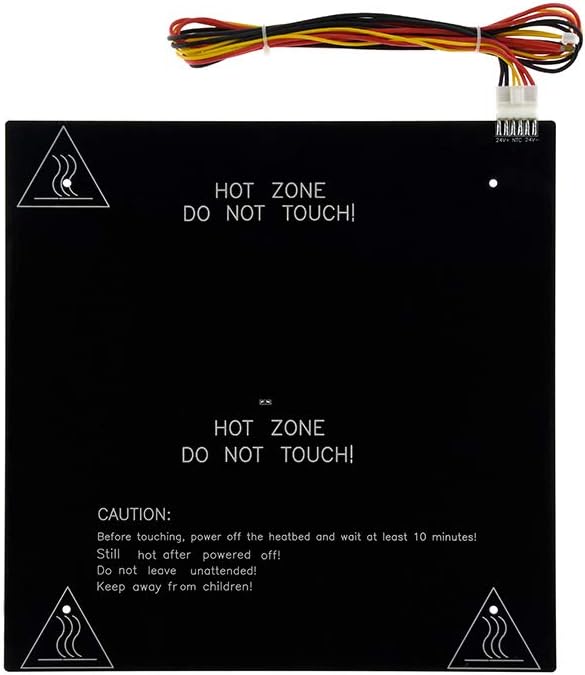
The HICTOP Ender 3 Heated Bed is a cost-conscious replacement that offers the same core format found on many popular Creality-style printers: a 235 x 235 x 3 mm aluminum platform powered by 24V at 220W. Its supplied information includes a 4.5 rating and states that the bed can reach a maximum temperature of 110°C. That combination makes it a practical candidate for routine repairs and upgrades where straightforward compatibility matters more than specialized construction.
We may earn a commission when you buy through this link, at no additional cost to you.
The cable-included design is useful because it provides the basic connection hardware needed for a typical replacement. At the same time, buyers should confirm that the cable's connector and pin arrangement match the printer's controller or harness. The listing also names the Ender 3, Ender 3 Neo, Ender 3 Pro, Ender 3 V2, Ender 3 V2 Neo, and Voxelab Aquila X2, providing a broad compatibility list for owners who know the mechanical layout of their specific machine.
A 110°C maximum is suitable for many common filament workflows, including many PLA and PETG jobs, though users printing at higher temperatures should verify both the actual bed temperature and the material's requirements. The listing does not mention an integrated sensor, thermal fuse, or surface sheet, so this product should be evaluated as a heated bed assembly rather than a complete bed-control system. Its electrical load also means that the printer's supply and control circuitry must be suitable for a 24V 220W heater.
For an Ender-family owner seeking a no-frills replacement, this bed delivers the essential dimensions, power rating, cable, and aluminum platform at a clear budget-oriented position. It is the best value pick when the existing printer already uses this common bed format and the owner can verify the connector and mounting arrangement before ordering.
The stated 110°C maximum offers enough range for numerous common desktop printing materials. Check the actual operating range of your filament and avoid treating the listing maximum as a guarantee for every filament or installation.
The supported list covers several familiar Ender variants and the Voxelab Aquila X2. Shared dimensions do not necessarily mean identical mounts or wiring, so identify your exact printer version before ordering.
We may earn a commission when you buy through this link, at no additional cost to you.
The Tosuny 200W 24V Silicone Heated Bed is a flexible heating-pad alternative to a rigid aluminum replacement bed. Its supplied rating is 5.0, and the product information emphasizes quick heating, uniform heat transfer, a 235 x 235 mm footprint, and a 3M rubber backing. Those qualities make it interesting for builders who prefer a thin pad that can conform to an existing heated-bed assembly.
We may earn a commission when you buy through this link, at no additional cost to you.
Unlike a complete metal bed, this silicone pad most likely serves as a heating element intended for attachment to or integration with another surface. The listing describes an adhesive backing and describes the pad as having high temperature resistance, low power use, and efficient heat conversion. Its 24V 200W rating sits below the common 220W figure used by several complete beds in this comparison, making it a meaningful option for systems built around that electrical load.
The central caution is temperature control. The product description states that silicone heating material is limited to approximately 200°C and warns against exceeding the heating plate's limit because overheating can damage it. That warning is essential because the actual operating temperature of a bonded pad can depend on adhesion, surface coverage, insulation, sensor placement, and heat loss. Users should use the printer's normal bed-temperature calibration process and avoid leaving the heater unattended.
This is the specialty top pick for a maker comfortable integrating a flexible silicone heater rather than simply bolting in a complete replacement bed. It is most appropriate when the existing structure, adhesive surface, sensor, insulation, and electrical controller are designed for a pad installation. For anyone needing an all-in-one replacement platform, the official Ender and HICTOP options are simpler.
A silicone pad can fit over a flat surface without the bulk of a complete heated-bed frame. Its effectiveness still depends on correct bonding and the quality of the surface placed above it.
The stated silicone limit and overheating warning make careful calibration essential. Use a functioning bed sensor, appropriate temperature limits, and the material guidance for your chosen filament.
We may earn a commission when you buy through this link, at no additional cost to you.
The CR-10 Aluminum Heated Bed is a purpose-specific replacement for the Creality CR-10. Its 310 x 310 x 3 mm aluminum platform, 24V 220W rating, and stated 240 mm center-hole spacing give it a clearly defined mechanical and electrical profile. The included power wire kit adds convenience, while its 3.8 rating makes this a replacement best judged by fit and specification rather than broad customer appeal.
We may earn a commission when you buy through this link, at no additional cost to you.
Detailed mounting information is one of the product's most useful features. The listing specifies a 240 mm distance between the center holes and an approximate 4.2 mm diameter, allowing an owner to compare the replacement with the original bed before disassembly. The 3 mm aluminum thickness also mirrors the dimensional class used by the included 310 mm platform, reducing uncertainty when compared with an original CR-10 assembly.
The back of the aluminum bed carries protective film that must be removed before use. That instruction is critical because leaving it in place can interfere with heat transfer to the supporting structure and may create an uneven thermal relationship between the heater and upper surface. The lower rating also warrants attention to recent customer feedback, although the supplied listing does not identify a particular defect or explain the distribution of ratings.
This bed is a strong recommendation for someone who owns a CR-10 and confirms the stated hole pattern and dimensions. It is less useful as a generic upgrade because its footprint, mounting geometry, and power lead are tailored to a narrower set of requirements. Verify connector orientation and cable reach before ordering, then remove the protective film during installation.
The stated 240 mm hole spacing and approximately 4.2 mm hole diameter make verification straightforward. Measure the old assembly and compare every relevant dimension before installation.
Remove the protective film from the back as instructed. Proper preparation helps the heater transfer heat to the intended support rather than trapping a protective layer against it.
We may earn a commission when you buy through this link, at no additional cost to you.
The YWBL-WH 500 x 500 mm Heated Bed targets large-format printers rather than compact desktops. It uses an aluminum alloy structure, a 24V 350W heating design, integrated heating and substrate construction, and countersunk mounting holes. Its 2.8 rating is the lowest among the products with numeric feedback, so an informed buyer should treat it as a specification-driven option and examine current customer feedback carefully.
We may earn a commission when you buy through this link, at no additional cost to you.
The integrated heating plate and aluminum alloy substrate are intended to improve heat conduction and maintain consistent output across the 500 mm surface. The product information also emphasizes resistance to deformation and wear during prolonged high-temperature operation. Its larger area and 350W rating make it more appropriate for machines with a substantial build volume than for a standard Ender-style frame.
Countersunk holes offer a practical advantage because the screw heads do not protrude above the printing plane. That preserves usable area near mounting points and reduces the chance of the nozzle striking a raised fastener. The tradeoff is that a large bed changes electrical and mechanical demands substantially. The printer's power supply, control board, bed support, leveling system, and thermal protection must all be appropriate for a 24V 350W assembly.
The low rating does not automatically disqualify the bed, especially when its large format, integrated construction, and flat mounting design match a particular machine. It is best for builders with a compatible large-frame printer who can provide the required power and mounting support. Those who value simple replacement over a major bed upgrade should compare the available alternatives more carefully.
A 500 mm heated surface can suit large-format projects that would otherwise need multiple smaller prints. The benefit depends on an appropriately rigid bed support and even thermal distribution.
A 350W heater at 24V places substantial demand on the printer's power path. Verify supply capacity, wiring, control electronics, and thermal protection before connecting a replacement of this class.
We may earn a commission when you buy through this link, at no additional cost to you.
The FYSETC Silicone Heating Plate is a specialized 300 x 300 mm AC-heated mat intended primarily for Voron 2.4 and R2-Trident builds. It has a supplied rating of 5.0 and distinguishes itself with a 3950 100K thermistor, a bimetal thermal fuse, an XH2.54 two-pin connector, and a claim that it covers more than 95% of the hot-bed plate without holes.
We may earn a commission when you buy through this link, at no additional cost to you.
Unlike the low-voltage DC beds common in desktop printers, this model operates on AC 110V at 750W. It therefore requires a suitable solid-state relay and sound high-voltage wiring practices. The included thermistor offers a way to monitor temperature, while the thermal fuse is designed to disconnect the circuit during a current overload at approximately 120°C. These protective components are valuable additions, but they do not remove the need for correct installation.
The no-hole design is intended to preserve the integrity of the silicone mat and maximize coverage. The manufacturer explicitly warns against trimming or drilling it because doing so can damage performance. Temperature management also requires attention: the product is described as resistant to approximately 120°C, but the recommended use is to remain below 100°C to extend service life.
This is a compelling option for a Voron builder replacing a damaged heat mat, especially one who values the bundled sensor and fuse. It is not a general-purpose Ender replacement, and the AC configuration makes it unsuitable without the appropriate relay and electrical infrastructure. For experienced enclosure and wiring builders, those requirements are manageable; for beginners, a low-voltage complete bed is a simpler starting point.
The included thermistor and bimetal fuse add monitoring and overload protection to the installation. They still need correct placement, wiring, and testing before the heater is used.
A 110V 750W heater needs a compatible solid-state relay and careful electrical work. If your printer is not designed around AC bed heating, use this product only after a qualified assessment of the system.
We may earn a commission when you buy through this link, at no additional cost to you.
The Aluminum MK2 MK3 12V Heated Bed is built for smaller Anet platforms and other systems using a similar 220 x 220 mm configuration. It has a 4.5 rating, a 12V 120W power rating, a 1.2-ohm resistance, and an included hot-bed wire cable. That lower electrical demand distinguishes it from the 24V assemblies in this roundup and makes voltage matching the decisive buying consideration.
We may earn a commission when you buy through this link, at no additional cost to you.
An aluminum substrate and resistance wire form the heating platform, while the included cable helps complete the electrical connection. The listing identifies the Anet A8, A6, and A2 as compatible and also references other printer brands, but its wording is broad enough that buyers should compare mounting points, bed dimensions, connector type, and controller behavior rather than rely only on a printed compatibility phrase.
A 120W rating may be adequate for many common filament types and smaller print areas, but it offers less heating power than 200W, 220W, and 280W alternatives. It should not be connected to a 24V supply, and changing voltage without confirming the heater resistance can create a serious safety hazard. The supplied information also does not identify a sensor, thermal fuse, or included mounting hardware, so the product should be considered a bed plate and wire rather than a full thermal-control kit.
This is a sensible choice for an Anet owner restoring a 12V printer with a 220 mm bed. The clear power rating, simple construction, and included cable make installation approachable, but exact mechanical and electrical compatibility must be confirmed first. It is not the right option for a 24V Ender-style system or for a build that requires high-power heating.
The 12V 220W configuration suits compatible Anet platforms and makes clear that this is not a drop-in option for 24V beds. Match the machine's native supply and controller arrangement.
A 220 x 220 mm surface works well with compact printers and small projects. Confirm that your available print area, mounts, and sheet system are designed around these dimensions.
We may earn a commission when you buy through this link, at no additional cost to you.
The 400 x 400 mm Aluminum Heated Bed Kit is a large-format replacement with a 24V 280W heating specification. Its listing highlights an aluminum alloy construction, countersunk mounting holes, an integrated heating plate and substrate, and a design intended to support flatter printing surfaces. No numeric customer rating is supplied, so this recommendation rests on the stated technical characteristics rather than a feedback score.
We may earn a commission when you buy through this link, at no additional cost to you.
The countersunk-hole design keeps fasteners below the upper printing plane, which can preserve space near the bed edges and reduce nozzle-collision risk. The integrated heater and aluminum substrate are intended to improve power consistency and reduce problems associated with warped prints and curled corners. These are meaningful design goals, but actual results depend on the support frame, insulation, leveling system, and slicer or firmware temperature control.
This bed is listed as compatible with the Ender 3 Pro and CR-10, but the dimensions and mounting configuration are what matter most. A 400 x 400 mm surface will not physically fit into a smaller standard bed frame, and a CR-10 normally uses a larger platform than this. Check the printer's actual build volume, mounting pattern, bed height, power supply, and control board before treating the compatibility claim as sufficient.
The kit is best suited to builders with a large-format frame that can accept its 400 mm footprint and 280W load. The lack of a numeric rating makes checking present customer feedback especially important before purchase. If the mechanical and electrical specifications align, its countersunk mounts and integrated construction offer a practical combination of flatness and stability.
Countersunk mounting holes keep raised screw heads away from the usable surface. They also need correct recess depth and leveling, so confirm that the holes align with your frame and supports.
A 400 mm bed needs a frame with sufficient travel, clearance, and support. Measure the machine rather than relying on a broad printer-family compatibility statement.
We may earn a commission when you buy through this link, at no additional cost to you.
The 500mm High-Power Heated Bed is one of the largest products in the comparison, with a 500 x 500 mm platform and an aluminum alloy substrate. Its listing also combines a 24V 350W bed description with information about a 24V 3800W silicone heating pad. Because those power figures describe very different loads, careful clarification is essential before ordering or connecting it to a printer.
We may earn a commission when you buy through this link, at no additional cost to you.
The product information emphasizes rapid heating, stable power output, support for high-temperature materials, and improved first-layer quality. It also describes an integrated heating plate and aluminum alloy substrate, which are intended to spread heat consistently across the broad surface. Countersunk holes again support a flat upper plane and reduce the chance of raised screws interfering with the nozzle or a printed object.
The principal drawback is the need to resolve the inconsistent power specification. A 350W bed and a 3800W silicone heater cannot be assumed to be electrically interchangeable, and a 3800W load at 24V would demand a power architecture very different from an ordinary desktop printer. The listing's claim that the pad reaches 100°C in 90 seconds should therefore be treated as a seller claim until the included components and wiring are confirmed directly.
This bed is potentially interesting for a purpose-built large-format machine, but it is not a safe drop-in recommendation based on the available description. Before purchase, confirm the exact heater wattage, voltage, connector, sensor arrangement, power supply capacity, wiring, and mounting geometry. The absence of a numeric customer rating makes independent verification even more important.
The 500 mm platform may improve productivity for oversized projects, but it also demands substantial structural and electrical support. Confirm every interface before considering installation.
The listing names both 350W and 3800W, so it does not establish which heater is included. Obtain a definitive wiring diagram and electrical specification before connecting the assembly.
We may earn a commission when you buy through this link, at no additional cost to you.
The 300/350mm Silicone Heated Bed Heating Pad is designed for Voron 2.4 and Trident-style builds. It offers dimensional options, a perforated installation pattern, AC operation at 220V, and stated heating options of 750W or 1000W. No numeric customer rating is supplied, so its appeal lies in the specialized dimensions and installation approach rather than an established feedback score.
We may earn a commission when you buy through this link, at no additional cost to you.
The perforations are intended to make installation easier while balancing mounting and heat dissipation needs. The listing also says that the stable power design helps minimize temperature fluctuations during heating, which can support flat first layers and reduce warping. The 300 and 350 mm options offer flexibility for different bed configurations, provided the user selects the version that actually matches the installed platform.
Operating on AC 220V means this is not comparable to a standard 24V desktop bed. It requires appropriate high-voltage wiring, switching equipment, enclosure planning, and safety controls. In addition, the supplied wording mentions 220V 750W or 1000W without making the exact selectable configuration unmistakable. A prospective buyer should verify the label on the specific pad and confirm the printer's controller and relay arrangement before installation.
This product is best for an experienced builder replacing a Voron-compatible heating element and able to manage AC-powered bed heating. Its perforations and size options offer practical advantages, but the missing rating and need for electrical verification should take precedence over marketing claims. For a low-voltage desktop printer, the complete Ender beds are substantially easier to match safely.
The 300 and 350 mm dimensions offer choices for compatible platforms, but the correct size must align with the upper bed, frame, and mounting pattern. Measure before selecting an option.
A 220V heater is a high-voltage installation. Use appropriate switching hardware, insulated connections, protective enclosure design, and a correctly rated power supply.
We may earn a commission when you buy through this link, at no additional cost to you.
The best replacement is the one that matches your printer's physical dimensions, mounting layout, control system, electrical supply, and intended materials. Use the specifications below as a structured checklist rather than assuming that the highest wattage produces the best prints.
Begin with the exact printer model and revision. Similar-looking printers can differ in bed length, width, mounting holes, connector position, controller behavior, and maximum supported temperature. Compatibility labels are useful screening tools, but they do not replace direct comparison with the bed being replaced. Measure the upper surface, distance between mounting holes, hole diameters, underside thickness, and available clearance around the frame. For Ender and Creality-family choices, also compare the cable route and whether the original thermistor is integrated into the bed or mounted separately.
A heated bed must fit the printer's leveling system and frame without reducing usable travel. Compact options in this guide include 220 x 220 mm and 235 x 235 mm plates, while larger products reach 400 x 400 mm or 500 x 500 mm. A larger bed can support larger projects, but it increases structural demands and may not suit a printer designed around a smaller print volume. Check the usable area after accounting for brackets, clips, leveling screws, and the location of any protruding hardware.
Electrical compatibility is a safety requirement, not merely a performance preference. Many desktop beds use 24V, the Anet option uses 12V, and the Voron-focused silicone products use AC power at 220V or 110V. These systems cannot be interchanged without appropriate redesign of the power supply, wiring, switching hardware, and controller. Wattage also affects heat-up speed and steady-state energy use, but a larger rating does not automatically create a better bed. Confirm resistance when it is specified and avoid applying supply voltage that does not match the heater design.
Complete aluminum beds offer a rigid platform and a defined heating surface, while silicone pads can be thin, flexible, and useful for covering a larger portion of a support plate. Integrated heating and substrate construction is intended to improve thermal consistency, but it is not a substitute for a level frame and good insulation. Consider whether the product is a complete assembly, a bare heater, or a mat intended to sit beneath a separate surface. The distinction determines which additional parts and installation steps may be required.
The bed must reach the temperatures required by your filament and printer calibration without exceeding component limits. The HICTOP bed states a 110°C maximum, while the FYSETC silicone plate describes approximately 120°C resistance but recommends operation below 100°C. Flexible silicone can have different thermal behavior from aluminum, and bond lines, surface layers, insulation, and sensor placement all affect real bed temperature. Check the temperature rating of every layer in the assembly and make sure the controller includes an appropriate maximum setting.
A reliable bed relies on accurate temperature sensing and sensible over-temperature behavior. Some listings explicitly include a thermistor and thermal fuse, particularly the FYSETC plate, while other complete beds may rely on the printer's existing sensor. Confirm whether the replacement includes a sensor, whether the original sensor can be reused, and whether a thermal fuse is present. Do not operate a high-power heater without appropriate sensing, and do not assume a generic replacement carries the same protection as the original assembly.
Countersunk holes can keep the upper bed plane smooth by recessing screw heads, which is useful near the edge of the print area. Other beds may use through-holes or different center spacing. Compare hole count, center-to-center dimensions, screw diameter, head style, and mounting depth. Check that the nozzle can reach all intended areas without striking a bracket or fastener, and that the bed can be leveled without introducing excessive tilt into a large unsupported surface.
A bed replacement can expose weak points in the wider machine. Confirm that the power supply has adequate headroom, the control board operates the heater correctly, wiring is rated for the load, and the frame remains rigid during heat cycling. Remove protective films exactly as instructed, position any sensor correctly, and avoid drilling or trimming silicone mats unless the manufacturer explicitly permits it. Large and AC-powered systems deserve extra attention to insulation, switching equipment, enclosure safety, and thermal-fuse placement.
Before installing a replacement bed, disconnect the printer's power and allow the old assembly, nozzle, and surrounding components to cool completely. Remove the existing bed according to the machine's assembly procedure, photograph the cable routing and sensor connections, and compare the replacement against the original dimensions and mounting holes. Remove any stated protective film and confirm that the new heater, sensor, and frame are positioned in the same arrangement as the original components.
Reconnect the heater and sensor using the proper connectors, check that cables are routed away from sharp edges and moving axes, and secure the bed against its supports. Ensure the nozzle can move across the entire usable surface without touching fasteners or brackets. Restore power gradually, verify that the printer detects the bed and reports a plausible room-temperature reading, then test a moderate target temperature while observing the controller, wiring, and heated area for abnormal behavior.
For ongoing care, keep the surface free of grease, adhesive residue, and accumulated plastic unless the surface material's guidelines say otherwise. Clean spills after they cool, avoid sudden temperature changes when the bed is hot, and periodically check leveling, mounting fasteners, cable connections, and sensor behavior. Do not cut or drill a silicone heater, do not bypass thermal protection, and replace damaged wiring promptly. Recalibrate bed leveling and temperature settings after installing a different bed material or assembly.
No. A replacement must match the printer's bed dimensions, mounting layout, electrical voltage, wattage or resistance, connector arrangement, and sensor configuration. Even two printers in the same family can have revision differences. Measure the existing bed and compare its cable and controls before ordering, and never connect a bed to a supply with an incompatible voltage.
Not automatically. Higher wattage may support faster heating or a larger heated area, but print quality depends on an even surface, accurate sensing, stable temperature control, sound insulation, and proper mechanical support. A bed with an unsuitable controller, weak frame, or inaccurate sensor can perform worse than a simpler bed that is correctly matched to the machine.
Several of the included options are 235 x 235 mm and are listed for common Ender 3 variants. That dimension alone does not guarantee fit because the mounting holes, underside components, and revision can differ. Compare the replacement with the original assembly, check the height of the bed carriage, and verify the connector before installation.
A silicone mat can be suitable when the printer's design or a custom build calls for a flexible heating element, but it usually needs a rigid upper surface, correct adhesive bonding, insulation, sensor placement, and suitable control hardware. Never drill or trim a mat unless its manufacturer says it is safe. Follow the pad's temperature guidance and use appropriate thermal protection.
Thermal protection is important, but the arrangement depends on the printer and replacement assembly. Some beds integrate a sensor, some include a fuse, and others depend on the printer's existing sensor and controller protections. Confirm what is included rather than assuming protection is present, and never operate a high-wattage heater without a functioning temperature sensor and appropriate thermal cutoff.
No. AC-powered beds require compatible switching equipment, wiring, grounding where applicable, and an enclosure designed for high voltage. The FYSETC plate is specified for AC 110V and requires a suitable solid-state relay, while the other Voron-oriented pad is described for 220V. Never power either type from an ordinary 24V or 12V printer supply.
A protective film can insulate the aluminum from the heater or supporting assembly, reducing heat transfer and creating an uneven temperature profile. It may also leave residue on the bonding or mounting surface. Remove every film specified by the manufacturer before installation, but keep any film intended to protect the user-facing print surface until that stage.
Start with a clean, level surface and a functioning bed sensor. Let the bed stabilize at a target temperature, then use a suitable temperature-measurement method across several areas to identify unusual hot or cold zones. Remember that the sensor measures one location, while the nozzle experiences the full surface. Persistent unevenness may indicate poor insulation, a bowed plate, a damaged heater, or an incorrectly positioned sensor.
The Official Creality Ender 3 V2 Heated Bed is the most convincing all-around replacement for the listed Ender models because it combines official positioning, a preinstalled cable, a standard aluminum platform, and conventional 24V 220W specifications. The HICTOP bed offers another solid Ender-oriented option with a stated 110°C maximum, while the Tosuny silicone pad stands out for builders seeking a flexible 200W heating element rather than a complete rigid bed.
For larger or specialized systems, the important priorities change. CR-10 owners should focus on exact hole geometry, the YWBL-WH option requires a capable large-format frame and power system, and the 400 mm and 500 mm assemblies should be judged by measured fit and unambiguous electrical specifications. Voron builders should distinguish low-voltage complete beds from AC silicone mats and verify relay, wiring, sensor, fuse, and temperature requirements before installation.
Regardless of the model, the most important priorities are exact mechanical fit, correct electrical compatibility, reliable temperature sensing, sound thermal protection, and a rigid leveling structure. Customer ratings can help identify recurring concerns, but they should supplement rather than replace technical verification. Check current listings, seller details, recent customer feedback, availability, and pricing immediately before making a purchase.