
KTC 24.5-inch 240Hz Fast IPS Gaming Monitor
240Hz refresh rate
Fast IPS panel
1ms MPRT response
HDR 10 support
Wide 114% sRGB gamut
A high-refresh gaming monitor can make movement feel more immediate, competitive games more responsive, and ordinary desktop use more fluid. The term 540Hz may appear in search results, but only one model in this guide actually claims that rate; the others provide useful alternatives based on speed, resolution, color, curvature, and value.
We compared the supplied specifications for ten displays, focusing on refresh rate, response time, resolution, adaptive synchronization, connectivity, color coverage, stand adjustment, and practical gaming features. The list includes a true 540Hz model alongside fast 240Hz, 310Hz, 180Hz, 165Hz, and 144Hz options across different screen sizes and formats.
Each selection reveals what it prioritizes: ultra-high refresh speed, competitive responsiveness, an ultrawide workspace, a premium OLED image, or a more accessible way to reach high refresh rates. Product listings and pricing can change, so confirm current specifications, compatibility, and availability on the linked listing before purchasing.

4.2Editor score

4.1Editor score
As an Amazon Associate we earn from qualifying purchases.
This side-by-side comparison highlights the largest differences among the ten monitors, including their stated refresh rates, response times, resolutions, panel formats, and gaming-focused capabilities. Only the CRUA claims 540Hz, while the remaining models provide competitive alternatives across conventional, curved, ultrawide, and OLED designs.




The CRUA 27-inch model is the only product in this guide that explicitly claims a 540Hz refresh rate, making it the most direct match for the search term. It pairs that headline speed with a 1ms MPRT response time and AMD FreeSync. Its 4.2 rating indicates generally favorable customer sentiment, although specifications alone cannot establish how consistently it reaches its maximum mode in every game.
We may earn a commission when you buy through this link, at no additional cost to you.
Its core appeal is a combination of unusually high refresh capability and practical physical adjustment. The 27-inch IPS panel uses Full HD resolution, supports 120% sRGB coverage, and is rated at up to 400cd/m² brightness with 1000:1 static contrast. Connectivity includes HDMI 2.1, DisplayPort 1.4, and a 3.5mm audio output, giving users options for modern PCs, laptops, and other compatible devices.
Ergonomics are another strength. The stand permits 120mm of height adjustment, tilt from negative five to positive 15 degrees, swivel across a similar range, and a 90-degree pivot into portrait orientation. It also supports 75mm by 75mm wall mounting. The trade-off is that the screen remains Full HD, so it emphasizes competitive frame rate and responsiveness rather than maximum pixel density.
This is the logical recommendation for a buyer who specifically wants the highest stated refresh rate available in this comparison. To gain the full benefit, a capable graphics card and game settings matter considerably. Players who need greater resolution, deeper blacks, or a wider workspace should examine the QHD and OLED alternatives instead.
The CRUA deserves the top position because it answers the central request directly while adding a broad set of connections, flexible adjustment, and FreeSync. It is best treated as a high-speed competitive display rather than a general-purpose creative monitor. For players prioritizing the highest possible refresh figure over pixel density, it offers the clearest match.
A 540Hz refresh rate can make very fast movement appear more fluid when the connected hardware and supported game can generate enough frames. The practical gain becomes clearer in competitive shooters, racing games, and fast arcade-style titles, where repeated visual transitions have less time to make motion look stepped.
Height, tilt, swivel, and pivot controls make it easier to position the screen around a desk, align it with a second display, or switch to portrait mode for documents. The 120mm height range and 90-degree rotation are especially useful for users who alternate between gaming and productivity tasks.
We may earn a commission when you buy through this link, at no additional cost to you.
The KTC H25T7-A represents a more attainable route into high-refresh gaming, with a stated 240Hz refresh rate and 1ms MPRT response time. Its 24.5-inch Fast IPS panel is smaller than many alternatives in the guide and uses Full HD resolution. The supplied data does not include a customer rating, so there is no numerical rating to assess alongside its specification sheet.
We may earn a commission when you buy through this link, at no additional cost to you.
Adaptive Sync is included to reduce tearing, while the claimed response time targets motion clarity during fast scenes. Color specifications include 114% sRGB coverage, 1000:1 contrast, and HDR 10 support. That combination makes the monitor more versatile than a basic high-refresh display, particularly for games and video content where richer color and contrast are useful.
The connection selection broadens its potential audience. HDMI 2.0 and DisplayPort 1.4 are listed for desktop PCs, gaming laptops, Nintendo Switch, Xbox, and PlayStation systems, although exact supported refresh rates can vary by device and resolution. Low-blue-light and flicker-free features are also claimed, while the tilt range and 100mm by 100mm VESA compatibility support basic positioning.
The principal limitation is its Full HD resolution. Although competitive players may prefer every pixel devoted to speed and minimal scaling, those who regularly edit images, work with dense documents, or want a more expansive desktop will find 2560 by 1440 models more accommodating. The 24.5-inch size also demands less desk space than the larger ultrawide options.
For a buyer searching specifically for 540Hz, this monitor is a step down in stated maximum refresh, but it remains a strong alternative for competitive gaming at 240Hz. It is best suited to value-conscious players who want fast motion, adaptive synchronization, and broad device support without moving to a premium OLED or high-resolution model.
A 240Hz panel can provide a visibly smoother presentation than conventional high-refresh displays when the PC and game support the higher mode. This makes the KTC suitable for players seeking a meaningful speed upgrade without pursuing the absolute headline rate available from the CRUA.
At 24.5 inches, the display is well suited to smaller desks and competitive gaming stations. Its HDMI and DisplayPort connections also make it a practical shared screen for a gaming PC, laptop, or compatible console, subject to the resolution and refresh-rate limits of each source.
We may earn a commission when you buy through this link, at no additional cost to you.
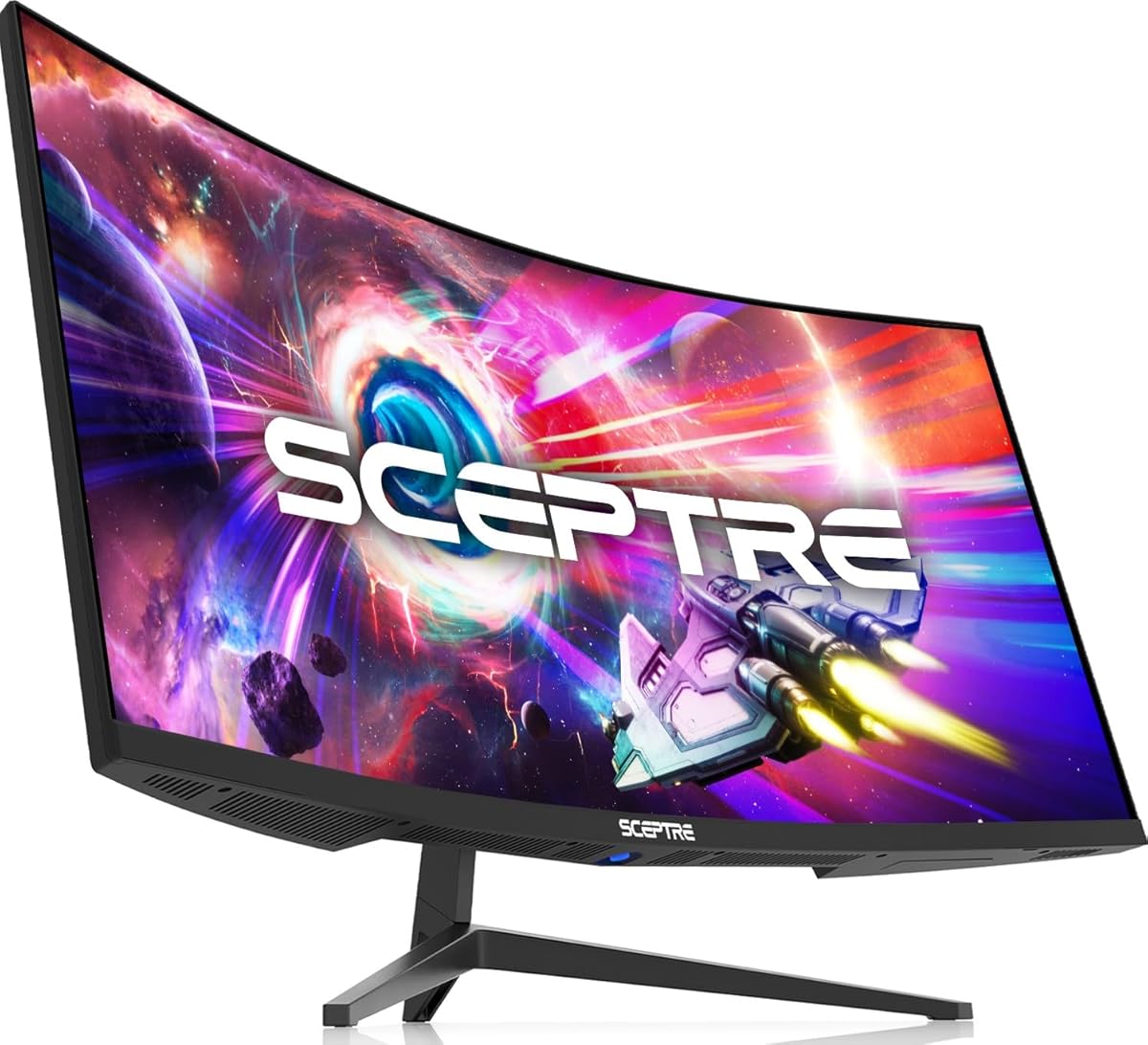
The Sceptre C345B-QU240T Series blends a high stated refresh rate with a wide, curved QHD display. It reaches up to 240Hz, uses a 1500R curve, and carries a 1ms response-time specification. Its 4.4 rating makes it one of the better-reviewed products here, though that rating should not be interpreted as a controlled performance test.
We may earn a commission when you buy through this link, at no additional cost to you.
The 3440 by 1440 resolution is the key distinction from most conventional high-refresh gaming monitors. At 34 inches, the 21:9-style canvas provides substantially more horizontal room than a 16:9 display, benefiting racing games, flight simulators, strategy titles, and multitasking. Its 100% sRGB coverage adds color breadth for a gaming monitor, while blue-light shift and flicker reduction aim to improve viewing comfort.
Connectivity is unusually generous for the category. Two HDMI ports and two DisplayPort connectors allow multiple sources to remain attached, reducing cable changes when alternating between a gaming PC and another device. Built-in speakers and an audio output jack also provide convenient audio options, although external headphones or speakers may still offer better sound for competitive communication and immersive play.
The main compromises are practical rather than technical. A 34-inch curved display needs a large desk and a relatively close viewing position, and buyers sensitive to curved geometry may prefer a flat screen. Some source devices may not drive the maximum refresh rate at the full QHD resolution, so hardware compatibility remains important.
This Sceptre is a strong all-round recommendation for someone who wants competitive speed without giving up resolution. It does not match the CRUA's 540Hz claim, but it delivers a more expansive image and 240Hz motion target. It is especially attractive for gamers who regularly benefit from extra side-to-side space.
The pairing of QHD and 240Hz balances detailed imagery with fast motion. It is well suited to modern GPUs and games that can sustain a high frame rate at 3440 by 1440, while the wide format remains useful for interface-heavy strategy games and simulation titles.
A 1500R curve wraps the edges of the panel toward the viewer, creating a more encompassing image. Although it cannot replicate the contrast of a QD-OLED panel, it offers a strong combination of size, curvature, color coverage, and speed for buyers who want immersion in a general-purpose gaming display.
We may earn a commission when you buy through this link, at no additional cost to you.
The LG UltraGear 32GS60QC-B is a 32-inch curved gaming monitor that combines QHD resolution with a stated 180Hz refresh rate and 1ms GtG response time. It has a 4.4 rating, placing it among the stronger customer-rated options in this list, and adds several competitive features that extend beyond basic motion specifications.
We may earn a commission when you buy through this link, at no additional cost to you.
The 1000R curve is notably tighter than the 1500R and R1500 curves used by the larger ultrawide monitors here. That can create a more pronounced surrounding effect without requiring the same physical width as a 34-inch display. Its 99% sRGB coverage and HDR10 support provide respectable color performance, while AMD FreeSync seeks to deliver fluid, virtually tear-free motion.
Gamer-specific tools include selectable Gamer, FPS, and RTS modes, a crosshair, an FPS counter, and Black Stabilizer for dark scenes. Dynamic Action Sync is also listed as a feature for reducing input lag. These functions can make the monitor more approachable for players who want useful competition aids without configuring a complex external overlay.
Its stand is less flexible than those of several rivals, with tilt adjustment as the principal ergonomic feature. The refresh rate is also below the 240Hz to 310Hz range offered by multiple 16:9 alternatives, and lower than the true 540Hz claim of the CRUA. A capable PC is still needed to make good use of 180Hz in demanding games.
LG's offering is a balanced choice for competitive players who value QHD clarity, a pronounced curve, and integrated gaming tools. It is less appropriate when maximum refresh rate is the single priority, but its overall feature set makes it a convincing alternative for mixed gaming and everyday use.
The built-in FPS counter, crosshair, and multiple game modes can reduce the need to switch between the game and external software. Black Stabilizer may also make enemies and environmental details easier to identify in shadowed scenes, although personal display preferences still vary.
The 1000R curvature creates an enveloping effect at a 32-inch size, which may feel less exaggerated than a wider 34-inch ultrawide. It remains a curved panel, so users sensitive to geometric distortion should consider their desk depth and preferred viewing distance.
We may earn a commission when you buy through this link, at no additional cost to you.
The Sceptre E225W-FW144 Series is the most compact entry in the guide, combining a 22-inch Full HD panel with a maximum 144Hz refresh rate. Its 4.4 rating is favorable, but the supplied specifications do not list a specific GtG or MPRT response time, so it offers less information about motion performance than the higher-speed alternatives.
We may earn a commission when you buy through this link, at no additional cost to you.
The 1920 by 1080 panel remains familiar for games, video calls, and general desktop use, and 144Hz is still a common competitive-gaming target. HDMI and DisplayPort give users flexibility when connecting a PC or laptop, while the built-in speakers keep everyday audio close at hand without requiring a separate desktop setup.
Its minimalist exterior and nearly bezel-free design are particularly relevant to dual-monitor arrangements. A small 22-inch display can sit beside a larger productivity screen without overwhelming the available desk area. Blue-light shift is another included feature intended to reduce potentially uncomfortable blue-light output during extended viewing.
The trade-offs are inherent to the compact format. Twenty-two inches provides less room for menus, editing timelines, and strategy maps than a 27-inch or ultrawide display. Full HD also becomes more noticeable at close viewing distances, and 144Hz trails the 165Hz, 180Hz, 240Hz, 310Hz, and 540Hz figures available elsewhere in the comparison.
This monitor is best for a small desk, a portable gaming setup, or a secondary display where high refresh is desirable without maximum size. It is not the strongest choice for 540Hz-focused shoppers, but it provides a tidy and approachable option for users who prioritize footprint and simplicity over maximum speed.
A 144Hz refresh rate remains highly responsive for many online shooters and competitive games. On a 22-inch display, the operating system and individual game interface can remain legible while the monitor occupies a modest amount of desk space.
The slim bezel design supports clean side-by-side arrangements. One screen can handle focused gameplay while the other displays chat, system controls, a guide, or productivity applications, reducing the need to repeatedly change windows.
We may earn a commission when you buy through this link, at no additional cost to you.
The Sceptre C345B-QUT168 is a 34-inch R1500 curved ultrawide monitor built around WQHD resolution. It offers refresh rates up to 180Hz or 165Hz, depending on the operating mode, and a 1ms MPRT response specification. Its 4.2 rating suggests generally positive feedback, with the screen size and resolution serving as its main attractions.
We may earn a commission when you buy through this link, at no additional cost to you.
At 3440 by 1440, the display contains about five million pixels and gives users a wider desktop than a standard 16:9 monitor. The 21:9 format is particularly useful in simulation games, racing titles, strategy games, and creative timelines. A 99% sRGB color gamut and built-in speakers round out a package designed for both entertainment and productivity.
Two DisplayPort connections support robust desktop and console connectivity, while the 1ms MPRT figure targets minimal ghosting in fast-moving scenes. The luminous back cover is primarily an aesthetic feature, adding a visible LED accent to an otherwise traditional black gaming monitor. Users looking for a practical high-refresh ultrawide may find the design less dramatic than more aggressively styled competitors.
Its maximum refresh rate is lower than the Sceptre 34-inch model's 240Hz alternative and well below the CRUA's claimed 540Hz. The 180Hz and 165Hz figures also mean that PC and game compatibility should be verified carefully. The sizeable curved chassis and R1500 curve may require more desk depth than a conventional display.
For a buyer who places resolution and screen area ahead of obtaining the highest possible refresh figure, this monitor is a compelling option. It balances fast motion with a detailed, spacious 3440 by 1440 canvas and should work particularly well for mixed gaming, browsing, and productivity.
The 21:9 format can show more of a game world at once, reducing the frequency of manual camera changes in some titles. It also provides room for multiple windows or toolbars when the monitor is used as a central productivity display.
The listed dual refresh-rate modes offer flexibility, but buyers should confirm which mode activates with their chosen graphics card and connection. The higher setting is most useful for competitive PC gaming, while other sources or power states may operate at the lower figure.
We may earn a commission when you buy through this link, at no additional cost to you.
Samsung's Odyssey G55C combines a 32-inch QHD panel with a 1000R curve, a 165Hz refresh rate, and a 1ms MPRT response specification. It carries a 4.4 rating, making it one of the strongest-reviewed entries in the list. The result is a display aimed at smooth, immersive play rather than the absolute maximum refresh rate represented by the CRUA.
We may earn a commission when you buy through this link, at no additional cost to you.
QHD resolution provides 1.7 times the pixel density of Full HD, according to the supplied listing. This creates a sharper image than 1920 by 1080 screens and makes the 32-inch format more appropriate for general desktop work, detailed interfaces, and media. HDR10 support adds a wider range of perceived highlights and shadows, while the curved panel extends the image toward the edges.
AMD Radeon FreeSync synchronizes the display and compatible graphics card to reduce image tearing. Eye Saver Mode is included to limit blue light, and the listing also states that the monitor reduces screen flicker. These features are useful for long sessions, though comfort still depends on the user's environment, brightness, and viewing habits.
The 165Hz maximum is modest compared with several 240Hz and faster options in this comparison. Buyers seeking the greatest competitive edge may prefer a higher-refresh conventional display, while those wanting 4K-level sharpness in a smaller footprint may find the G55C more balanced. The supplied information does not detail stand adjustment, so physical positioning should be verified before purchase.
Samsung's G55C is a strong fit for gamers who want a combination of sharp QHD imagery, a pronounced curve, and synchronized high-refresh motion. It is especially useful in racing, adventure, and single-player games where visual quality matters alongside responsiveness. For strict competitive shopping, though, its 165Hz ceiling is worth comparing carefully against faster alternatives.
The 2560 by 1440 panel offers more usable detail than Full HD, particularly for small interface text, weapon labels, and dense game menus. It also creates a more professional desktop for browsing, communication, and light content work.
The tight 1000R curve brings the display edges closer, increasing the sense of enclosure. Eye Saver Mode and flicker reduction add comfort-oriented features, although the effect varies by user and should be balanced with sensible brightness and break habits.
We may earn a commission when you buy through this link, at no additional cost to you.
The ASUS TUF Gaming VG259QMRL5A is one of the fastest conventional gaming monitors in this comparison, with an overclocked 310Hz refresh rate. Its 24.5-inch Fast IPS panel uses Full HD resolution and reaches a claimed minimum 0.3ms GTG response. The 4.4 rating and broad synchronization support make it an especially relevant option for competitive players.
We may earn a commission when you buy through this link, at no additional cost to you.
Both FreeSync Premium and G-SYNC compatibility are listed, offering flexibility with different graphics hardware. ASUS Extreme Low Motion Blur Sync, or ELMB SYNC, is designed to combine motion blur reduction with variable refresh rate. The result is a feature set focused on clean movement, fast response, and tear reduction rather than high-resolution productivity.
Color specifications are 99% sRGB with DisplayHDR 400 certification, and the supplied details also mention TUF Gaming A.I technology for AI-assisted gaming features. DisplayWidget Center provides mouse-based access to on-screen display settings, which can be more convenient than navigating a monitor's physical controls. A height-adjustable stand supports better positioning during long sessions.
As with other 310Hz and 540Hz-class displays, the large potential benefit depends on a powerful PC and a game capable of producing enough frames. Full HD makes reaching high frame rates more attainable than on a 4K screen, but the resolution provides less desktop detail. The overclocked 310Hz figure should also be understood as a performance mode rather than the default behavior of every connected device.
This ASUS is an excellent alternative for shoppers who want extreme refresh speed but do not specifically require a 540Hz panel. Its response-time claim, synchronization support, compact 24.5-inch footprint, and ergonomic stand make it especially compelling for fast competitive games and esports-style setups.
The 310Hz overclocked mode offers substantially more theoretical headroom than a standard 240Hz display. The visual benefit depends on frame rates, but competitive titles that run well at Full HD can make better use of this capability than demanding 4K applications.
Supporting both G-SYNC compatibility and FreeSync Premium broadens the potential graphics-card ecosystem. The ELMB SYNC feature is intended to preserve sharpness during fast movement while variable refresh rate remains active.
We may earn a commission when you buy through this link, at no additional cost to you.
The Acer Nitro XV272U W2bmiiprx is a 27-inch QHD IPS monitor that reaches 240Hz over DisplayPort and 144Hz over HDMI. Its response time is listed at 1ms GtG, with an up-to-0.5ms GtG claim. The 4.2 rating reflects positive customer sentiment, while the specification combination makes this one of the strongest all-round competitive options.
We may earn a commission when you buy through this link, at no additional cost to you.
Unlike a Full HD high-refresh display, the 2560 by 1440 panel provides more spatial detail and 1.7 times the pixel density of 1080p. AMD FreeSync Premium helps synchronize compatible systems, and the use of DisplayPort for the maximum refresh rate is worth noting. The lower HDMI ceiling may be relevant to users connecting a console or other limited source.
Physical adjustment is one of the monitor's strongest practical features. The ergonomic stand includes 4.7 inches of height adjustment, 360-degree swivel, plus or minus 90-degree pivot, and tilt from negative five to positive 15 degrees. It is also compatible with 100mm by 100mm VESA mounting. Connectivity includes one DisplayPort 1.4, two HDMI 2.0 ports, and an audio output.
Two included two-watt speakers provide basic sound for system audio, while DisplayPort and HDMI cables are also listed in the package. These convenience features can reduce setup friction, although serious players may still prefer a gaming headset for communication. The IPS panel and QHD resolution are well suited to both games and routine office tasks.
Acer's Nitro is a balanced recommendation for a buyer who wants a competitive 240Hz rate without sacrificing QHD sharpness. It falls short of the CRUA's claimed 540Hz, but its combination of resolution, response, adjustment, and connectivity would appeal to many players. It is a particularly strong option for users who switch between gaming and desktop work.
The 2560 by 1440 panel delivers a meaningful step up in detail over the Full HD high-refresh options. A GPU capable of driving the game at this resolution and frame rate will provide the most complete experience.
Height, swivel, pivot, and tilt controls make it easier to adapt the monitor to different desks, seating positions, and side-by-side arrangements. The broad 360-degree swivel is especially useful when sharing a screen or frequently changing orientation.
We may earn a commission when you buy through this link, at no additional cost to you.
The Acer Predator X32 X is the image-quality standout in this guide, combining a 31.5-inch curved 4K QD-OLED panel with a 240Hz refresh rate and a claimed 0.03ms GtG response time. Its 4.1 rating is the lowest among the customer-rated products here, but specifications reveal a monitor designed for buyers who want premium visual quality as well as competitive speed.
We may earn a commission when you buy through this link, at no additional cost to you.
The 3840 by 2160 resolution provides substantially more detail than QHD or Full HD, while the QD-OLED panel creates very high contrast and rich color. The listing states 99% DCI-P3 coverage and VESA DisplayHDR True Black 400 certification with a minimum black level of 0.0005 nits. A 10-bit representation further supports smooth tonal gradation, making the display relevant to games, video, and creative work.
Its 1700R curve creates an enveloping field of view, while the 240Hz refresh rate and exceptionally low response-time claim target fast competitive action. Image retention refresh is included to help prevent images from sticking. Together, these attributes make the monitor a potential all-in-one display for high-end gaming and visual productivity.
The demands are considerable. A 4K panel operating at 240Hz requires a suitably powerful graphics card, and high-resolution gaming can place a greater load on the system than Full HD. OLED displays also warrant sensible screen habits and periodic care, as is generally appropriate for this technology. The listed price also places it in a different buying tier from the rest.
For enthusiasts who can afford the premium specification, the Predator X32 X offers the most complete combination of resolution, contrast, color, curvature, refresh rate, and response time in the guide. It is the picture-quality winner, even though the CRUA is the direct 540Hz match and several other displays offer stronger value for budget-conscious competitive play.
OLED panels can switch individual pixels off, allowing extremely deep blacks and very high perceived contrast. Quantum-dot enhancement supports a wide DCI-P3 color gamut, while 10-bit color is useful for subtle gradients in modern games and HDR content.
The combination provides exceptional detail and rapid motion, but it places the greatest processing demand on the graphics system. Players should check current game benchmarks and ensure their GPU can sustain the desired resolution and refresh rate with acceptable settings.
The monitor's image retention refresh is intended to help keep static content from lingering. Users should also use sensible brightness levels, avoid prolonged static images, and follow the manufacturer's care guidance to maintain long-term panel quality.
We may earn a commission when you buy through this link, at no additional cost to you.
A good high-refresh gaming monitor must balance raw speed with resolution, response, synchronization, image quality, and practical ergonomics. The most important starting point is hardware: your graphics card, game, and chosen connection must be capable of driving the monitor at the resolution and refresh rate you actually want.
Choose the highest stable rate your hardware can sustain, not merely the largest number on the box. Check the maximum refresh supported over DisplayPort and HDMI separately, because the ceilings can differ substantially.
Treat response time as an important factor, but do not expect one labeled number to predict every game's visual quality. Panel implementation, synchronization, frame pacing, and system latency all affect the experience.
Prioritize resolution if you also edit, stream, or multitask. Prioritize refresh rate and response if the display is dedicated primarily to competitive play.
Choose IPS for a balanced competitive and everyday display. Consider QD-OLED when contrast, deep blacks, and high-resolution visual impact matter as much as refresh rate.
Check the manufacturer's compatibility list for your exact graphics card. If tearing is a concern, adaptive sync should be configured properly before judging the monitor's raw speed.
Measure the available desk before buying an ultrawide. A larger screen is not automatically more immersive if it forces you to sit too close or leaves no room for a keyboard and mouse.
Prioritize a height-adjustable stand and the input required by your PC. Treat built-in speakers as convenient system audio rather than a replacement for quality gaming headsets.
Start by connecting the PC through the intended high-bandwidth input, preferably DisplayPort for the highest stated PC refresh rate when the monitor supports it. Install the graphics card's current driver, open the operating system's display settings, and select the desired resolution. Then choose the matching refresh rate from the monitor's on-screen menu. If a higher mode is listed but does not appear, confirm that the cable, port, GPU, and game all support that specific combination.
After enabling the correct mode, configure adaptive synchronization in both the graphics software and monitor menu. Use the monitor's gaming presets as a starting point rather than a final solution, and adjust brightness, contrast, color temperature, and overdrive according to the room. Competitive players should create profiles for fast titles and test latency settings with familiar games, while photographers or editors may prefer a separate calibrated profile.
For long-term care, keep the panel away from direct sunlight, use a clean microfiber cloth, and avoid pushing dust into bezel gaps. Adjust the stand rather than pulling on the display, and route cables to reduce accidental tension. OLED owners should follow the manufacturer's brightness and image-retention guidance, while all users can reduce static-image duration, take regular breaks, and maintain comfortable viewing distance.
A 540Hz monitor can provide smoother motion when the PC and game generate enough frames, making it most relevant to competitive players with capable hardware. A 240Hz display is often more attainable and remains very responsive for most gaming scenarios. The practical difference can be small in games that do not reach high frame rates, so consider resolution, image quality, and your typical titles as well as the headline refresh figure.
It depends on the graphics card, game, settings, and connection. A modern high-end GPU may sustain substantial frame rates in competitive titles at Full HD, but demanding games may fall well below 540 frames per second. The monitor will generally display the highest rate the source supports. Use DisplayPort when required and verify the active mode in the operating system and monitor settings.
No. Response time describes how quickly panel pixels change color, while input latency includes the full path from input processing to the displayed image. A 1ms MPRT or GtG figure does not mean the entire system responds in 1ms. Refresh rate, frame pacing, adaptive sync, and processing features also influence total responsiveness.
Full HD places the lightest demand on a GPU and makes very high refresh rates easier to reach. QHD provides a sharper picture and more desktop space without the extreme rendering demand of 4K. A 4K QD-OLED offers the finest image and contrast, but the fastest sustained frame rates require a particularly capable system. Choose the balance that matches your GPU, display priorities, and most frequently played games.
A curve does not inherently increase refresh rate or reduce input lag. It can make the edges of a large display feel more visually encompassing, which some players enjoy in racing, flight, and action games. Others find stronger curves distracting, especially when viewing from an off-center position. Screen size, desk depth, and personal comfort are more meaningful than curve alone.
They are not required for the monitor to operate, but adaptive synchronization can reduce tearing and make fast motion appear more stable when the graphics card and game are compatible correctly. FreeSync is the most common option in this guide, while the ASUS TUF also lists G-SYNC compatibility. Check current graphics-card and monitor compatibility information before configuring the feature.
A modern QD-OLED can provide excellent text clarity, color, contrast, and motion, but the display technology and high-end specifications can be costly. Image-retention refresh is included on the Acer Predator model, yet users should still avoid leaving static content onscreen for long periods. It is best for buyers who value picture quality and have hardware capable of driving 4K gaming.
The CRUA 27-inch IPS is the clearest choice for buyers who want a genuine 540Hz option, adding a 1ms MPRT response, FreeSync, modern connections, and extensive stand adjustment. The KTC 24.5-inch Fast IPS offers a more attainable 240Hz alternative for competitive play, while the Acer Predator 31.5-inch QD-OLED stands apart with 4K resolution, exceptional contrast, and premium visual quality.
Prioritize your actual hardware and gaming habits before focusing on the largest number. Competitive players should consider response time, synchronization, ergonomic adjustment, and whether their GPU can sustain the target frame rate. QHD and ultrawide models are stronger choices for mixed use, while OLED buyers gain the most from high-end graphics hardware and careful screen habits.
Specifications, product availability, and pricing can change over time, so review the current listing before making a final decision. Confirm the resolution and refresh rate supported by each port, read updated customer feedback, and compare the current specification sheet with the needs of your PC, desk, and preferred games.